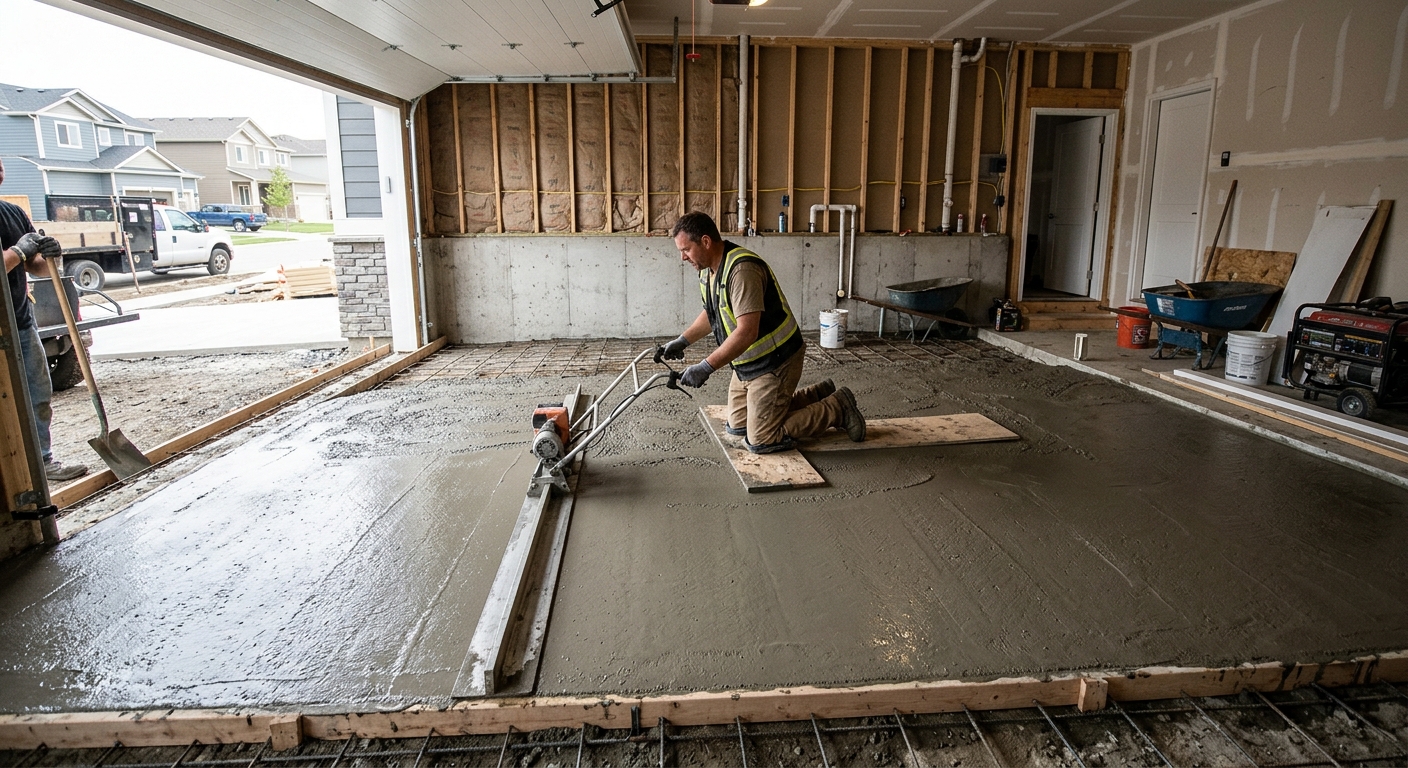
Concrete work options and costs in Mannheim
Mannheim, Ontario is a small community with a tight-knit housing market—Statistics Canada recorded 1,002 residents in the 2021 Census (Statistics Canada, 2021 Census). In practice, that means many concrete projects support existing homes and renovations rather than constant new builds. Concrete flatwork like driveways, patios, and walkways are commonly tied to older neighbourhood pockets where homeowners upgrade curb appeal and improve drainage after freeze–thaw seasons. You’ll also see demand around the more developed residential areas that connect to main roads, where access for a concrete truck and finish crews matters as much as the concrete itself.
In the Toronto economic region, your concrete cost is shaped by frost depth and repeated freeze–thaw cycles. Most structural footings must extend below the design frost depth to reduce frost heave and differential movement, and exterior slabs typically use air-entrained mixes with control joints to manage cracking. The region also concentrates exterior pours in warmer months to protect curing; when temperatures trend toward 10 °C or below, crews need extra protection and time. That timing pressure affects availability and can raise labour costs on short-notice schedules.
Below is a practical comparison of common options in Mannheim. Use it as a budgeting baseline, then we can dial in thickness, base prep, reinforcement, and finish based on your soil conditions and your site access.
| Application |
Typical Size |
Key Spec |
Finish Option |
Price Range |
| Concrete driveway (standard broom finish) |
400–480 sq. ft. |
4" slab, compacted granular base, air-entrained mix |
Broom finish |
$7,200–$10,800 |
| Exposed aggregate driveway |
400–480 sq. ft. |
4" slab, air-entrained mix, wash/expose process |
Exposed aggregate |
$9,000–$13,700 |
| Stamped concrete driveway or patio |
300–500 sq. ft. |
4" slab, base prep + reinforcement as required |
Stamped pattern + colour hardener/sealer |
$10,000–$20,000 |
| Plain concrete patio or walkway |
200–350 sq. ft. |
4" slab, proper base and drainage |
Plain broom or smooth trowel |
$3,300–$7,300 |
| Garage floor (interior slab) |
400–520 sq. ft. |
4" slab, vapour barrier as applicable, trowel finish |
Smooth interior finish |
$6,800–$12,500 |
| Foundation footings (structural, below frost) |
Per lin. ft. (typ. 20–60 lin. ft. total) |
Below frost depth, excavation + forming, reinforcement |
Structural concrete |
$180–$300 |
Prices are estimates only and vary by project scope, site access and material selection.
What affects the price of concrete work in Mannheim
In Mannheim and across the Toronto economic region, it’s common to see quotes for the same “concrete size” land 30–50% apart. The reason usually isn’t the concrete alone—it’s how each contractor designs for frost protection, controls cracking, and handles difficult site conditions. Even when your driveway or patio is the same square footage, one crew may include deeper base prep, proper air-entrainment and curing protections, while another may treat those items as optional. On exterior jobs, that difference is amplified by freeze–thaw cycles and colder shoulder-season weather.
Toronto-area specs are driven by frost depth and movement. Structural footings generally must extend to at least 1.2 m (about 4 ft) below grade to reduce frost heave and differential settlement. Exterior slabs and flatwork should use air-entrained concrete (and appropriate thickness) to survive repeated freezing and thawing. If temperatures drop toward 10 °C or below, cold-weather curing precautions—insulating blankets, protection, and sometimes extended set/curing windows—add cost. De-icing salts accelerate surface deterioration if the surface isn’t sealed and properly finished.
In Mannheim, cost can rise if your soil is saturated or poorly drained and needs thicker granular base plus a regraded slope; it can also rise with limited access (tight gates, overhead lines, or long wheelbarrow distances from the truck). Costs can fall when sites are clean and level, with straightforward drainage and short truck distance. If you’re comparing options, you’ll often see a standard driveway start in the $18–$28 per sq. ft. band for typical slabs, while stamped work moves into the higher $24–$40 decorative band because of formwork, stamps, and finishing labour.
| Price Factor |
Why It Matters |
Cost Impact |
| Frost line depth — determines footing depth and form height |
Footings must extend below design frost to prevent heave and settlement |
Higher excavation + concrete volume can add noticeable cost |
| Site preparation — excavation, grading, compacted granular base |
Base controls drainage and prevents pumping/voids under slabs |
Poor drainage or unstable soil increases material and labour |
| Reinforcement — rebar or wire mesh requirement |
Helps control cracking and improves load performance |
Reinforcement can add material and setup time |
| Mix design — air-entrainment and compressive strength spec |
Air-entrainment improves durability under freeze–thaw cycles |
Correct mix costs more but reduces failure risk |
| Finish type — broom vs. stamped vs. exposed aggregate |
Decorative finishes require more labour and specialized steps |
Stamped/exposed typically moves you into higher price bands |
| Pour size and concrete truck access to site |
More mobilization time or extra handling increases labour |
Long placements, difficult access, or multiple pours raise cost |
| Cold-weather curing precautions — heating and blankets |
Protects strength gain when temperatures fall |
Blankets/heaters + schedule changes increase overall price |
| Control joint pattern and sealing cost |
Joints manage cracking; sealing reduces chloride/salt damage |
Skipping these often leads to early deterioration and rework |
Permits & regulations in Ontario
In Ontario, structural concrete work typically requires a building permit. That includes items like footings, foundation walls, and grade beams, especially when the work changes the structural system or affects load paths. In many cases, municipalities also expect engineered drawings to support sizing of reinforcement and footing elevations. Concrete flatwork—such as driveways, patios, and walkways—often does not require a permit, unless your project affects lot grading, stormwater handling, or municipal requirements around impervious coverage and drainage. Before you start, it’s smart to confirm with the local authority having jurisdiction.
For Mannheim homeowners, the practical checklist is: (1) verify the contractor’s Ontario credentials and scope, (2) confirm the contractor carries liability insurance, and (3) ensure they have WSIB/WCB coverage for their workers. Then request proof documents before work begins.
Step-by-step verification you can do: start by checking the contractor’s status using the applicable online registry tools (search the business name and “Ontario contractor” to confirm licencing where required). Next, ask for a current certificate of insurance—it should list your address or show they cover general liability for the work. Finally, ask for their WSIB/WCB clearance letter or equivalent proof of coverage, dated and matching the time period of your project. If a contractor can’t provide documentation quickly, that’s a warning sign.
Getting concrete right in Mannheim's freeze-thaw climate
Concrete failures in Mannheim are usually tied to freeze–thaw exposure plus poor drainage or inadequate detailing. The big villain is often spalling—surface flaking caused by water entering the slab, then expanding as it freezes. In the Toronto economic region’s humid winters and wet shoulder seasons, that cycle repeats often enough to damage concrete if the mix, base, and joints aren’t built for exterior service. Even if your slab looks fine at first, the cracks and weak points can open up after the first harsh winters and de-icing use.
To spec the job correctly, focus on five areas. First is base preparation: a compacted granular sub-base at the right depth for local soil and frost movement, with a well-drained slope. Second is mix design: air-entrained concrete (typically 5–7% air content for exterior flatwork) and a minimum 32 MPa compressive strength so the material achieves durable strength. Third is control joints: spacing planned to limit random cracking. Fourth is curing: maintain proper conditions for at least 7 days; cold-weather pours require protection so the slab doesn’t freeze early or dry out. Fifth is sealing: use a penetrating sealer applied after the slab cures (often around 28 days) to repel de-icing salts and reduce water intrusion.
As a dollar example, a standard broom-finished driveway might land in the $18–$28 per sq. ft. range, while exposed aggregate or better decorative work can move higher. Spending extra on correct air-entrainment, base depth, and joints is usually better value than paying for a decorative finish on a slab that’s under-built for frost and drainage.
| Spec |
Why It Matters in Mannheim |
What to Ask For |
Impact if Skipped |
| Compacted granular base (depth?) |
Controls drainage and reduces movement under freezing conditions |
Confirm granular depth, compaction method, and slope to drainage |
Settling, pumping, and early cracking |
| Air-entrained concrete mix (target air %?) |
Improves freeze–thaw durability by allowing controlled expansion |
Ask for air content target (commonly 5–7% for exterior flatwork) |
Spalling and surface deterioration |
| Compressive strength (MPa rating) |
Ensures adequate strength gain and long-term performance |
Request minimum 32 MPa specification |
Reduced durability and load-bearing capacity |
| Control joints (spacing per ACI guidelines) |
Creates planned weak points that limit random cracking |
Ask for joint layout and spacing plan for your slab size |
Random wide cracks and water pathways |
| Minimum 7-day curing period |
Strength development is temperature- and moisture-dependent |
Confirm curing plan; protect if conditions are cold or windy |
Weak surface, scaling, and reduced long-term life |
| Penetrating sealer (when applied after cure) |
Reduces water and chloride penetration from de-icing salts |
Ask for sealer application after cure (commonly around 28 days) |
Accelerated spalling and discoloration |
How to choose a concrete work contractor in Mannheim
Choosing the right contractor matters in Mannheim because freeze–thaw performance is all about the details: base prep, air-entrainment, curing, joints, and sealing. Start by verifying Ontario compliance. Ask each contractor for: (1) proof of liability insurance (certificate of insurance showing current coverage), and (2) WSIB/WCB coverage for their workers, ideally with a clearance letter dated for your project period. If they can’t produce these documents quickly, that’s a red flag—legitimate crews are used to homeowners requesting proof.
Next, get 2–3 itemised written quotes rather than one lump sum. You want a breakdown that distinguishes labour, excavation/site prep, granular base, reinforcement, concrete supply/mix type, finish materials (including sealer if included), and any equipment charges. Confirm what’s excluded: permit pulling (if applicable), disposal/haul-away, holiday delays, and any restoration of landscaping or removing old concrete.
Warranty should be clear. Ask how long they provide workmanship coverage, and whether any product/manufacturer warranties apply to the mix, admixtures, or sealing system. Also ask if warranties are transferable to you if the home is sold.
For payment, a sensible schedule keeps risk down. I recommend you never pay more than 10–15% upfront. Hold back funds until key milestones are complete (forms/inspection readiness, curing window completion, and final clean-up). Finally, put timeline details in writing: a start date target, concrete pour date, curing/protection expectations, and an estimated completion date.
- Request a written scope that lists slab thickness, base depth, and reinforcement plan.
- Confirm air-entrained concrete is included for exterior work.
- Ask about control joint spacing and sealing timing.
- Verify insurance coverage before you sign anything (certificate of insurance).
- Verify WSIB/WCB coverage with a clearance letter.
- Get itemised pricing for excavation, disposal, and granular supply.
- Check whether permit fees (when required) are included or billed separately.
- Confirm how they protect curing in cool weather (blankets/heating if needed).
- Ask how they handle trucking access—where concrete will be staged and how far it will be carried.
- Require a written timeline, including protection and cure days.
- Ensure warranty terms are in writing and cover workmanship.
- Keep payment milestones tied to inspections and completion—not just “progress.”
Concrete contractor red flags in Mannheim include: vague scopes that don’t mention air-entrainment or curing, “all-in” pricing with no breakdown, refusing to provide insurance/WSIB clearance, cutting the cure period to meet schedule, and promising sealing immediately without respecting cure time (often needed around 28 days).
Frequently asked questions — concrete work in Mannheim
What is the difference between concrete and cement?
In Mannheim and across Ontario, people often use “cement” and “concrete” interchangeably, but they’re not the same. Cement is one ingredient—typically Portland cement—that acts as the binder. Concrete is the full material system made from cement, sand, gravel (or stone), water, and often admixtures like air-entrainers for freeze–thaw durability. For exterior flatwork in the Toronto region, contractors usually specify air-entrained concrete so the surface can handle repeated freezing and thawing without spalling. That means the concrete mix design matters as much as the slab thickness. When you compare quotes, don’t just compare the unit price; confirm the air-entrainment target and compressive strength spec are included, especially for driveways and patios.
How much does concrete work cost in Mannheim?
For Mannheim homeowners, typical budgeting depends on whether you’re doing plain flatwork, decorative concrete, or structural footing work. For concrete driveway and slab work, the common Toronto-region pricing bands for this tier are about $18–$28 for standard driveway/slab-style pours, while patio and walkway projects often sit around $16–$26. Decorative finishes like stamped concrete and exposed aggregate generally run higher, often aligned with the $24–$40 decorative band. Foundation footings (structural, below frost) are frequently priced per linear foot, with a typical band of $180–$300. Costs swing based on base excavation, reinforcement, truck access, and how much cold-weather curing protection is required if you’re pouring later in the season.
How deep must footings be for Mannheim's frost line?
In Ontario, footing depth is dictated by the design frost depth and the need to prevent frost heave and differential movement. In the Toronto economic region, local building practice and requirements commonly mean most structural footings extend at least about 1.2 m (roughly 4 ft) below grade. Exact depth can vary based on soil conditions, engineering requirements, and how the building system transfers loads, so your permit drawings (or engineer’s design) should govern. Practically, that means more excavation and formwork than people expect, which shows up in footing pricing even when your foundation footprint is small. If a contractor proposes a shallow footing to “save money,” it’s not the place to cut corners—freeze–thaw movement is unforgiving, particularly with Ontario winters and wet springs.
Why does concrete crack in Mannheim and how is it prevented?
Concrete cracks in Mannheim mainly because it’s exposed to moisture and temperature changes, and it shrinks as it cures. In the Toronto area’s freeze–thaw cycles, water that gets into the slab can freeze and expand, stressing the concrete further and widening existing micro-cracks. The best prevention is a combination of proper base preparation, correct mix design, and a deliberate joint plan. Exterior flatwork should use air-entrained concrete and be built on well-compacted granular base with drainage. Control joints should be spaced so cracks occur at planned locations rather than randomly. Sealing after the slab cures also helps reduce chloride and water intrusion from de-icing salts. If you’re comparing quotes, make sure they include joint layout and sealing timing—skipping either is a common cause of early cracking and surface damage.
Stamped vs broom-finish concrete — cost difference?
Stamped concrete and broom-finish concrete differ mainly in labour and materials. A broom-finished driveway or patio is the simpler system: you pour, finish to broom texture for traction, and manage joints and curing. Stamped concrete adds formwork-grade finishing steps such as stamp application, colouring/hardener steps (depending on the design), and usually more careful finishing to get consistent pattern depth. That’s why stamped work typically lands in the higher decorative pricing band—often around $24–$40 for this tier—while standard driveway/slab work is commonly budgeted near $18–$28. Whether the upgrade is worth it depends on your site conditions: if your base prep or drainage isn’t right, neither finish will last as long.
When is the best time to pour concrete in Mannheim?
The best time to pour concrete in Mannheim is in the warmer part of the season when temperatures stay supportive of curing—so typically late spring through summer, before nights regularly drop and cold-weather curing becomes necessary. In the Toronto region, crews also schedule exterior pours in warmer months because concrete curing and surface durability are harder to protect as temperatures approach about 10 °C or below. If you pour when it’s too cold, contractors may need insulating blankets, heating, and additional protection time to ensure strength gain and reduce surface scaling risk. Homeowners can help by planning so the pour happens when access and site prep are ready, not rushed on short notice. If you must pour later in the season, insist on a written cold-weather curing plan as part of the quote.