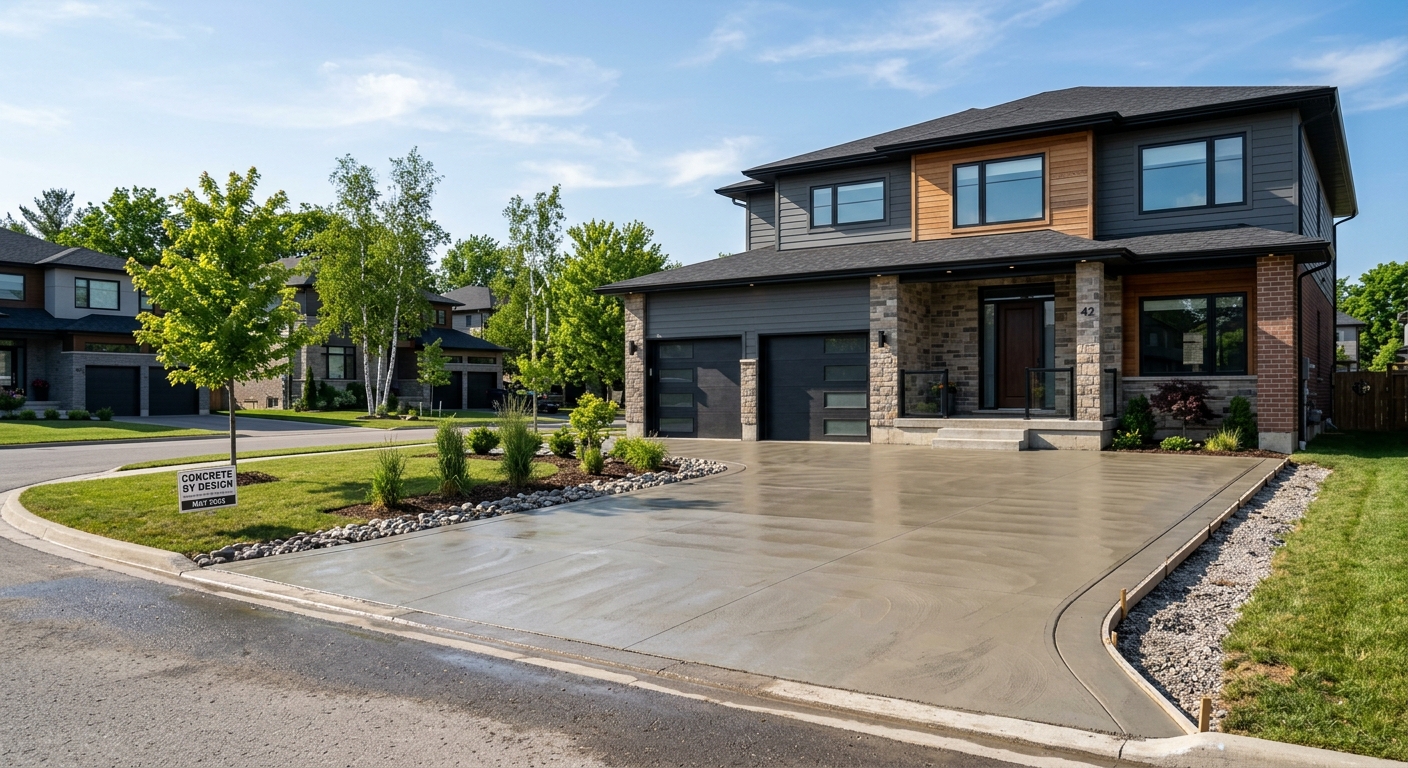
Concrete work options and costs in Cedar Hill
Cedar Hill, Ontario is a small community in the Toronto economic region, and most concrete flatwork demand comes from homeowners in established neighbourhoods where driveways, patios, and walkways are being replaced or upgraded. With a population of 2,633 (Statistics Canada, 2021 Census), the local contractor pool is tight compared with big-city cores, so scheduling and material availability can affect lead times and final pricing. Housing in the GTA is also heavily oriented toward family households and older properties, which is why you’ll often see re-pours tied to grading corrections, drainage fixes, or cracked slab repairs rather than new builds alone.
Toronto-area concrete pricing is strongly driven by frost depth and freeze–thaw cycles. Even if a driveway looks “shallow,” the prep work and drainage details have to hold up over repeated wetting and winter freeze. Ontario Building Code expectations for structural footings typically push below grade (most commonly at least 1.2 m) to reduce frost heave risk, which is a direct cost driver for foundation and footing work. For exterior slabs, GTA contractors also lean on air-entrained mixes, adequate thickness, and control joints to manage cracking.
In Cedar Hill, demand tends to be especially consistent around the residential pockets near local collector roads where access is manageable for trucks and forms. If you’re comparing options—standard broom concrete versus decorative finishes—the differences in labour intensity, cementitious content, and finishing time show up clearly in the ranges below.
| Application |
Typical Size |
Key Spec |
Finish Option |
Price Range |
| Concrete driveway (standard broom finish) |
12 ft x 20 ft (240 sq ft) |
Air-entrained mix, compacted granular base, control joints |
Broom finish |
$4,320 – $6,720 |
| Exposed aggregate driveway |
12 ft x 20 ft (240 sq ft) |
Air-entrained mix, retarder/expose process, proper curing |
Exposed aggregate |
$5,760 – $8,880 |
| Stamped concrete driveway or patio |
10 ft x 16 ft (160 sq ft) |
Air-entrained mix, thicker slab, release agent + stamping |
Stamps and texture skins |
$3,840 – $6,400 |
| Plain concrete patio or walkway |
8 ft x 12 ft (96 sq ft) |
Drainage-grade prep, air-entrained exterior mix |
Float + light broom |
$1,536 – $2,496 |
| Garage floor (interior slab) |
20 ft x 20 ft (400 sq ft) |
Vapour barrier, mesh/rebar as required, consistent thickness |
Smooth trowel or light broom |
$7,200 – $11,200 |
| Foundation footings (structural, below frost) |
Varies (typ. per linear foot) |
Below-frost depth, excavation, formwork, reinforcement |
Structural concrete |
$180 – $300 |
Prices are estimates only and vary by project scope, site access and material selection.
What affects the price of concrete work in Cedar Hill
In the Toronto economic region, it’s common to see quotes for the “same” concrete job vary by 30–50%. The reason usually isn’t the concrete itself—it’s what gets specified and what gets excluded: base prep quality, reinforcement decisions, drainage corrections, access constraints for trucks, and how well the contractor can control curing during cold snaps. In Cedar Hill and nearby GTA neighbourhoods, labour availability can also fluctuate quickly during peak pour season, which adds pressure to schedules and truck coordination.
Frost depth and freeze–thaw cycles dictate the spec from the ground up. Footings must extend below Ontario’s design frost depth (commonly at least 1.2 m) to limit frost heave and differential settlement. Exterior slabs also need air-entrained concrete mixes to survive repeated freezing and thawing. When temperatures trend toward 10 °C or below, contractors often need cold-weather curing precautions—insulating blankets or temporary heat—which can add cost but helps prevent surface scaling and weakness. Finally, de-icing salts accelerate spalling and pop-outs on poorly protected surfaces, so sealing and using the right finish matters.
Two Cedar Hill examples where pricing moves quickly: (1) If your driveway ties into an older foundation or has existing settlement, contractors may need extra excavation and regrading before they pour—this pushes you toward the higher end of the $18 – $28 per sq ft style range for slab work. (2) If you want a stamped patio, the labour-heavy stamping and sealing add up, often closer to the $24 – $40 per sq ft band for decorative work, especially where sub-base thickness and jointing must be increased for durability.
| Price Factor |
Why It Matters |
Cost Impact |
| Frost line depth — determines footing depth and form height |
Deeper excavation increases labour, formwork, and concrete volume |
Higher footing cost; can add meaningful dollars on structural jobs |
| Site preparation — excavation, grading, compacted granular base |
Proper base prevents pumping, voids, and early cracking |
Can swing 20%+ depending on soil condition and haul distance |
| Reinforcement — rebar or wire mesh requirement |
Controls cracking and improves load performance |
Adds material + labour, especially for slabs over poor subgrade |
| Mix design — air-entrainment and compressive strength spec |
Air void system is critical for freeze–thaw survival outdoors |
Typically increases material cost but reduces failure risk |
| Finish type — broom vs. stamped vs. exposed aggregate |
More finishing steps require skilled crews and longer cure management |
Decorative finishes usually cost more than plain broom finishes |
| Pour size and concrete truck access to site |
Short access routes may require smaller truck strategies or additional labour |
Reduced access can add labour/time and coordination charges |
| Cold-weather curing precautions — heating and blankets |
Prevents early freezing and surface damage in cooler fall/spring |
Can add to the job cost during borderline temperature windows |
| Control joint pattern and sealing cost |
Joints reduce random cracking; sealing helps resist de-icing salt damage |
Usually a modest line item but avoids costly rework |
Permits & regulations in Ontario
In Ontario, structural concrete work—such as foundation walls, grade beams, and footings—normally requires a building permit, and many projects also use engineered drawings that get reviewed for compliance by the municipality. Concrete flatwork like patios, walkways, and driveways usually does not require a permit on its own; however, you may still need approval if the work affects lot grading, changes how water drains on or off the property, or impacts impervious surface coverage limits and drainage requirements. If the project touches municipal right-of-way, curb returns, or drainage connections, always confirm first.
For Cedar Hill homeowners, a safe approach is to confirm in writing: (1) whether your planned scope triggers a permit, and (2) what documentation is required before excavation. Before work begins, verify the contractor carries liability insurance and has WSIB/WCB coverage (as applicable) so you’re not exposed to jobsite injuries or subcontractor issues. Ask for references from similar concrete projects in the Toronto area—especially exterior flatwork where freeze–thaw exposure is managed with air-entrainment, proper base prep, and jointing.
To verify credentials step-by-step: start with the Ontario licensing registry for the relevant contractor category (where available), then request a current certificate of insurance and confirm the coverage limits match the job value. For WSIB/WCB, ask for a clearance letter or proof of account status directly from the contractor, and verify the document is current. Finally, ask who will be pouring and whether any subtrades are covered under the same insurance and clearance documentation.
Getting concrete right in Cedar Hill's freeze-thaw climate
Concrete fails in Cedar Hill’s freeze–thaw conditions when water gets into the slab system and the freeze cycle expands it, causing spalling, scaling, and cracking. The fix isn’t one magic product—it’s a set of specs that work together: correct base preparation, an air-entrained exterior mix, control joints, reliable curing, and sealing when the slab is mature. In the Toronto market, contractors are used to managing temperature drops during shoulder seasons; that’s exactly when short curing or insufficient protection can turn into surface weakness months later.
Start with base prep: excavate to the right depth and compact a granular sub-base so the slab has firm support and good drainage. For exterior flatwork, use an air-entrained mix with 5–7% air content and plan a minimum 32 MPa compressive strength spec. Next, control joints: place them so contraction cracking happens in predictable lines rather than through the middle of slabs. Curing matters—aim for at least 7 days under proper conditions, and in colder weather keep the slab protected so it doesn’t freeze before it gains strength. Finally, sealing: apply a penetrating sealer after the slab has fully cured (commonly 28 days) to repel de-icing salts and reduce moisture movement.
As a practical example, you might pay about $4,000 more for an exposed aggregate driveway versus a plain broom driveway on a similar-sized area, but that difference can be justified when the contractor also improves base drainage, joint detailing, and uses correct exterior air-entrainment. If those fundamentals aren’t upgraded, the decorative finish won’t prevent the common Toronto-area failure modes.
| Spec |
Why It Matters in Cedar Hill |
What to Ask For |
Impact if Skipped |
| Compacted granular base (depth?) |
Supports the slab and reduces water infiltration that freezes |
Confirm granular base depth and compaction method; drainage grade |
Settlement, pumping, early cracking |
| Air-entrained concrete mix (target air %?) |
Freeze–thaw survival depends on protected internal void structure |
Ask for 5–7% air content for exterior flatwork |
Spalling and scaling after winter cycles |
| Compressive strength (MPa rating) |
Strength gain affects durability under loads and freeze expansion |
Confirm minimum 32 MPa compressive strength |
Surface wear, reduced long-term performance |
| Control joints (spacing per ACI guidelines) |
Limits random cracking to predictable locations |
Ask for joint spacing plan for your slab dimensions |
Cracks appear anywhere, including through finishes |
| Minimum 7-day curing period |
Allows strength development before freeze exposure |
Confirm protection plan if temps drop; curing approach |
Weak surface, increased cracking risk |
| Penetrating sealer (when applied after cure) |
Reduces water and salt penetration during winter |
Ask for penetrating sealer after curing (commonly 28 days) |
Faster spalling from de-icing salts and moisture |
How to choose a concrete work contractor in Cedar Hill
Choosing the right concrete contractor in Cedar Hill comes down to verifying credentials, demanding an itemised scope, and aligning the schedule with proper curing. Start with Ontario licensing: confirm the contractor’s licence category (where applicable) and ensure the company is set up for the type of work you’re hiring for. Then verify liability insurance—ask for a current certificate of insurance showing appropriate coverage limits—and request WSIB/WCB clearance information for the workers assigned to your project. If they can’t provide documents promptly, that’s a major warning sign.
Next, get 2–3 written quotes that break costs into labour and materials. You want to see what’s included for excavation, hauling/disposal, granular base depth and compaction, rebar or mesh, the concrete mix (including air-entrainment), finishing, and sealing (if applicable). Ask whether the quote includes permit pull (for structural work) and what happens if the site conditions differ from what was observed at the initial visit.
Review warranty terms carefully: workmanship warranty length and whether it covers surface scaling or cracking tied to freeze–thaw. Clarify product/manufacturer warranty coverage and whether it’s transferable. Payment schedule matters—never pay more than 10–15% upfront. Use a holdback until the job is complete and final grade/cleanup standards are met. Finally, require a start date and completion estimate in writing, and ask how the crew will protect the slab during early cold nights.
- Confirm their Ontario licence category for the work scope.
- Request a certificate of insurance before signing.
- Ask for WSIB/WCB clearance or proof of coverage status.
- Use itemised quotes (labour, materials, disposal, finishing, sealing).
- Insist on air-entrained exterior mix for driveways/patios/walkways.
- Ask for planned control joint locations and spacing.
- Verify base prep depth and compaction method.
- Confirm concrete thickness where it matters (especially edges and entrances).
- Ask how they handle cold-weather curing (blankets/heating if needed).
- Request curing and sealing timelines (sealer after curing, commonly 28 days).
- Set a payment schedule with 10–15% max deposit and a holdback.
- Get a written start date and completion target, including weather contingencies.
Red flags in Cedar Hill include: quotes that omit granular base depth or compaction details; no mention of air-entrainment for exterior slabs; refusal to provide proof of insurance/WSIB/WCB; “we’ll pour whenever” scheduling with no cold-weather curing plan; and payment demands that exceed 10–15% upfront.
Frequently asked questions — concrete work in Cedar Hill
What is a concrete overlay and is it suited to Cedar Hill?
A concrete overlay is a thin bonded layer poured or applied over an existing concrete surface to restore appearance and fix minor surface deterioration without full removal. In Cedar Hill and across the Toronto region, overlays can be suitable when the existing slab is structurally sound—meaning it’s not actively moving, has no significant settlement, and cracks aren’t heaving or widening year-to-year from freeze–thaw. The key question is whether the old slab has moisture issues or failed drainage underneath; if water is migrating, an overlay may trap it and speed up failure at the bond line. Pricing varies, but homeowners often compare overlays to new broom-finished concrete in the $18 – $28 range per sq ft: overlays can look cheaper initially, yet full prep and surface profiling can reduce the gap. Always ask for a site assessment and moisture/bond preparation plan.
How do I seal concrete to protect it in Cedar Hill?
Sealing helps protect exterior concrete in Cedar Hill by reducing water and salt penetration—important because winter de-icing compounds can drive moisture into the slab, then freeze–thaw expands it. Use a penetrating sealer (not just a surface film) that’s compatible with air-entrained exterior concrete. Timing matters: wait until the concrete has properly cured—commonly about 28 days—then ensure the surface is clean and dry before application. In the Toronto area, humidity and wet fall/spring weather can slow drying, so ask the contractor about surface moisture checks and expected weather windows. A well-timed sealer is usually a small line item compared with driveway replacement, and it works best when the underlying base prep and joint control are correct; sealing can’t fix poor drainage or missing air-entrainment.
What is the difference between concrete and cement?
Concrete is the final construction material made from cement plus aggregates (sand and gravel), water, and often air-entraining admixtures for exterior freeze–thaw durability. Cement is just one ingredient—the “binder”—that reacts with water to form the paste that holds the sand and gravel together. When you hear contractors talk about “air-entrained concrete,” they’re discussing the full concrete mix, not cement alone. For Cedar Hill homeowners, the performance point is what the contractor specifies for the entire mix: air content (typically 5–7% for exterior flatwork), curing approach, and the target strength (commonly a minimum 32 MPa spec). That’s what determines long-term resistance to scaling and spalling in Ontario’s winter cycles.
How much does concrete work cost in Cedar Hill?
Concrete costs in Cedar Hill are aligned with the Toronto economic region and depend heavily on site conditions, thickness, and finish type. For a driveway or exterior flatwork, typical contractor pricing bands often land in the $18 – $28 per sq ft style range for standard concrete, while decorative finishes like stamped concrete commonly track higher—about $24 – $40 per sq ft depending on complexity and base prep. Patios and walkways typically fall around $16 – $26 per sq ft. Foundation/footings are priced differently: structural footings are commonly estimated per linear foot in the $180 – $300 range, reflecting excavation and reinforcement below frost depth. If your project needs drainage correction or extra excavation, the job can move toward the higher end even for “plain” concrete.
How deep must footings be for Cedar Hill's frost line?
For Cedar Hill (Toronto economic region), structural footings typically need to extend at least 1.2 m below grade to reduce frost heave risk, aligning with Ontario Building Code expectations for most residential foundations. Exact depth can vary based on soil conditions, local design frost depth used by the engineered drawings, and how the foundation system is built (e.g., frost-protected designs are less common for typical slab-on-grade replacements). The practical takeaway is that a proper footing includes more than “digging to 1.2 m”: it requires correct excavation, inspection readiness, and reinforcement placement before concrete is poured. If you’re doing foundation work, the permit/engineering review process is part of keeping the depth correct. Always ask your contractor how they’re confirming footing depth on your specific site conditions.
Why does concrete crack in Cedar Hill and how is it prevented?
Concrete cracks in Cedar Hill mostly because of restrained shrinkage, load, and—most critically for Ontario—freeze–thaw cycles involving moisture movement. When water infiltrates and freezes, it can push against the slab and contribute to spalling and cracking. Prevention starts with the right system: compacted granular base with drainage grade, air-entrained exterior concrete (commonly 5–7% air content), and a minimum 32 MPa strength target. Control joints are also essential: they guide cracking into planned lines so you don’t get random cracks that undermine edges and allow more water entry. Finally, curing and sealing matter—poor curing in cold weather can create a weaker surface, and skipping penetrating sealer after cure (commonly 28 days) can leave the slab more exposed to de-icing salts. Ask your contractor for the control joint plan before the pour.