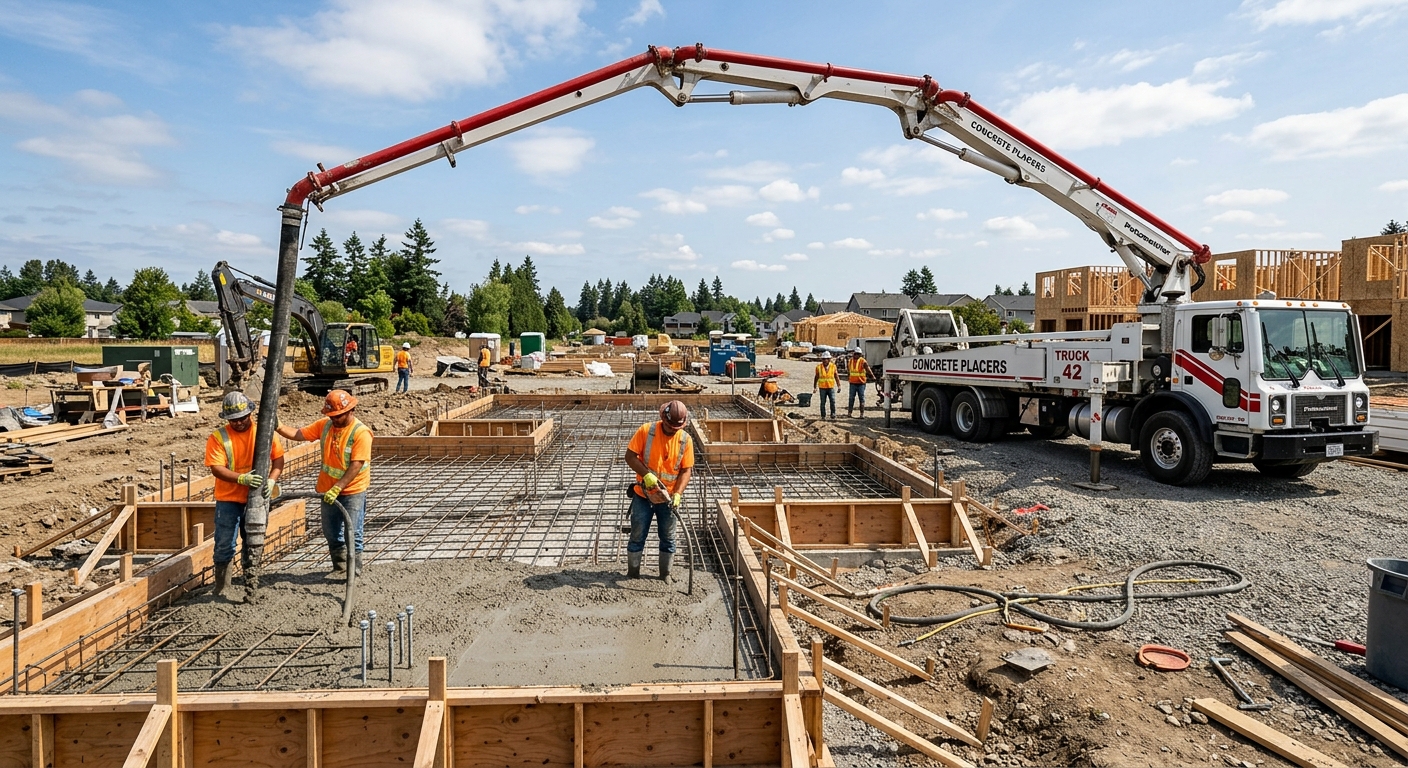
Concrete work options and costs in Chalk River
Concrete work in Chalk River is a little different than in milder parts of Ontario because freeze–thaw cycles make exterior concrete sweat, heave, and crack if the base and mix aren’t specified correctly. That matters here because Chalk River is a small community (1,025 people per the Statistics Canada, 2021 Census), and the concrete trade tends to be concentrated around a limited number of crews serving nearby residential pockets. Most homeowners are looking at concrete flatwork such as driveways, patios, and walkways—common add-ons in established neighbourhoods like the Staffordville area, where older lots often need re-grading, drainage fixes, or replacement of cracked sections.
In the Toronto economic region, contractors price concrete based on frost depth requirements and how quickly they can pour and cure during the short stretch of consistently warm weather. Ontario Building Code practice generally has structural footings extending below frost depth (often around 1.2 m, or about 4 ft, depending on design conditions), and exterior slabs still need air-entrained concrete plus proper control joints to manage cracking. Because freeze–thaw can be hard on surfaces—especially with de-icing salt—labour and materials for good base prep and finishing can shift your quote by more than you might expect, even when two projects look “the same” on paper.
Below are realistic price bands for common options, so you can compare like-for-like before you call for an estimate.
| Application |
Typical Size |
Key Spec |
Finish Option |
Price Range |
| Concrete driveway (standard broom finish) |
400–500 sq. ft. |
Air-entrained exterior concrete + control joints |
Broom finish |
$7,200 – $12,500 |
| Exposed aggregate driveway |
400–500 sq. ft. |
Proper grading, compacted granular base, air-entrainment |
Exposed aggregate (tumble/bucket) |
$9,500 – $15,800 |
| Stamped concrete driveway or patio |
300–450 sq. ft. |
Air-entrained mix + adequate thickness |
Stamp + release + colouring |
$8,900 – $17,200 |
| Plain concrete patio or walkway |
200–350 sq. ft. |
Drainage slope + air-entrained mix |
Float/screed with broom or light trowel |
$3,300 – $9,100 |
| Garage floor (interior slab) |
400–600 sq. ft. |
Vapour barrier/insulation as needed, proper thickness |
Steel trowel (typically broom later if desired) |
$6,200 – $13,800 |
| Foundation footings (structural, below frost) |
Per linear ft. (varies by foundation) |
Engineered design + reinforcement + below-frost excavation |
Structural concrete with specified formwork |
$180 – $300 |
Prices are estimates only and vary by project scope, site access and material selection.
What affects the price of concrete work in Chalk River
In Chalk River, it’s normal to see concrete quotes differ by 30–50% for the “same” project because the scope details (base prep, reinforcement, drainage corrections, and finishing complexity) are often handled differently from one contractor to the next. In the broader Toronto economic region, labour availability and scheduling around warmer pour windows also plays a role. When crews can’t access a site quickly—or when weather forces delayed curing—pricing usually moves to cover added protection and longer job durations.
The biggest driver is frost and freeze–thaw. Footings and structural elements must extend below design frost depth to prevent frost heave and differential movement. For exterior flatwork, Toronto-area specifications commonly use air-entrained concrete so the mix can survive repeated freeze–thaw. Cold snaps around or below roughly 10 °C also affect curing; contractors may need insulating blankets or heated enclosures to protect the pour, which adds cost. De-icing salt further increases risk for spalling on unsealed or poorly finished surfaces, so sealing becomes part of a durable exterior system.
Concrete costs in Chalk River can swing up or down based on local conditions. For example, if your driveway sub-base needs additional excavation and re-compaction, the job can land closer to the higher end of the $18,000 – $28,000 style driveway band; if the existing base is sound and drainage is already correct, you may stay nearer $16,000 – $26,000 for a simpler patio/walkway scope. Another common cost jump: replacing cracked slabs that have settled due to poor drainage often involves removing more concrete than homeowners expect, plus additional granular base.
| Price Factor |
Why It Matters |
Cost Impact |
| Frost line depth — determines footing depth and form height |
Deeper excavation increases labour, shoring, and concrete volume. |
Higher excavation/formwork can add hundreds to thousands depending on foundation size. |
| Site preparation — excavation, grading, compacted granular base |
Bad base prep leads to settlement and rapid cracking. |
Can shift exterior flatwork costs by 10–25%. |
| Reinforcement — rebar or wire mesh requirement |
Controls cracking and provides structural capacity (especially on driveways). |
Usually a moderate materials increase but can add labour and placement time. |
| Mix design — air-entrainment and compressive strength spec |
Air-entrainment is critical for freeze–thaw durability. |
More robust mix can raise per-yard material cost, but reduces premature failures. |
| Finish type — broom vs. stamped vs. exposed aggregate |
Complex finishes require more labour, curing awareness, and colour/materials. |
Stamped/exposed commonly adds cost relative to standard broom finishes. |
| Pour size and concrete truck access to site |
Access affects truck placement, pumping needs, and labour staging. |
Limited access can add pumping/extra labour and can increase minimum loads. |
| Cold-weather curing precautions — heating and blankets |
Concrete must gain strength; freezing can destroy the surface and durability. |
Added materials and labour when pours occur late in the season. |
| Control joint pattern and sealing cost |
Joints reduce random cracking; sealing helps repel moisture and de-icing salts. |
Often small compared to repairs if skipped; can increase upfront cost but protect the surface. |
Permits & regulations in Ontario
In Ontario, structural concrete work needs more oversight than typical backyard flatwork. Footings, foundation walls, and grade beams are usually part of a building permit and often rely on engineered drawings that the municipality and/or building department review. In contrast, concrete flatwork like patios, walkways, and driveways typically does not require a permit on its own unless it affects lot grading, drainage, or triggers municipal rules around impervious surface coverage or impacts to the municipal right-of-way.
For Chalk River homeowners, the practical approach is to confirm before you break ground: ask whether your driveway replacement or new sidewalk affects drainage plans, swales, or any municipal frontage conditions. Even when a permit isn’t required for the slab itself, your contractor should still follow Ontario Building Code expectations for base prep and structural thickness.
Next, verify contractor credentials in a way that protects you if something goes wrong. Start with the contractor’s Ontario licence details (look for the appropriate business listings/registry information, if applicable to their scope). Request a Certificate of Insurance showing general liability with active coverage. For labour-related coverage, ask for proof of WSIB coverage (or the applicable exemption documentation, if they legitimately qualify). Finally, ask for recent references on similar-scale projects (driveways/patios in mixed soil conditions are a good match to Chalk River’s freeze–thaw reality). If they can’t produce paperwork quickly, that’s a sign to keep looking.
When you compare quotes, insist the scope clearly states whether permit pulling (if required), inspections, and disposal are included.
Getting concrete right in Chalk River's freeze-thaw climate
Chalk River’s freeze–thaw climate stresses concrete the same way it does across the Toronto region: water gets into the slab or base, expands when it freezes, and forces the concrete to deal with movement. The most common failures are spalling, surface scaling, and random cracking from moisture and inadequate air-entrainment, plus settlement from an improperly compacted granular base. The fix is to spec the whole system—base, mix, joints, curing, and sealing—rather than focusing only on “what the finish looks like.”
Start with base preparation: compacted granular sub-base placed to the right depth for local soil and designed frost conditions, with proper drainage so the base doesn’t stay saturated. Next, use an exterior air-entrained mix (typical target air content around 5–7% for exterior flatwork) and a minimum compressive strength commonly specified around 32 MPa for durability. Then build control joints to limit cracking to predictable lines. Finally, curing is non-negotiable: plan for at least 7 days of curing under appropriate conditions. In cooler weather, crews should use cold-weather curing precautions (protective blankets and/or heating) rather than simply “hoping it sets.”
For long-term protection, apply a penetrating sealer after the concrete has properly cured—often around 28 days post-pour—so moisture and de-icing salts have less ability to attack the surface. If your quote is only cheaper because it skips sealing or thins the base, you’re likely buying future repairs.
Example: a stamped patio may be around the decorative band (think $24–$40 per sq. ft. finish work), but if the contractor also includes correct air-entrainment, steel reinforcement as needed, and sealing, the higher price can be justified. A lower “plain concrete” price alone won’t protect you if the base or mix is cut back.
| Spec |
Why It Matters in Chalk River |
What to Ask For |
Impact if Skipped |
| Compacted granular base (depth?) |
Prevents settlement and reduces water retention under freeze–thaw. |
Base type + depth, compaction testing approach, drainage slope details |
Premature cracking, edge failures, uneven surfaces |
| Air-entrained concrete mix (target air %?) |
Helps concrete resist freeze–thaw damage and spalling. |
Air content target (typically 5–7% for exterior flatwork) on the mix design sheet |
Surface scaling/spalling increases in winter |
| Compressive strength (MPa rating) |
Controls strength gain for durability and load performance. |
Minimum 32 MPa (or higher if specified for your project) |
Weaker surface and faster wear under traffic |
| Control joints (spacing per ACI guidelines) |
Limits random cracking by directing where cracks form. |
Joint spacing plan, saw-cut timing, and sealed/unfinished joint treatment |
Random cracking across the field, moisture infiltration |
| Minimum 7-day curing period |
Ensures adequate strength before cold weather returns. |
Curing method and protection plan if temps drop |
Reduced strength, surface damage, increased cracking risk |
| Penetrating sealer (when applied after cure) |
Repels moisture and helps slow de-icing salt damage. |
Sealer type + application timing (commonly after full cure, around 28 days) |
Faster surface degradation and more spalling potential |
How to choose a concrete work contractor in Chalk River
Choosing the right concrete contractor in Chalk River comes down to proof and process. First, verify Ontario licensing for the contractor’s trade scope (where applicable), then confirm insurance. Ask for a current Certificate of Insurance that shows general liability and the correct insured parties. For work involving labour, request proof of WSIB coverage (or exemption documentation if they’re legitimately exempt). You should be able to see the paperwork before the contract is signed, not after work starts.
Second, get 2–3 itemised written quotes. You want labour and materials broken down, including excavation, formwork, granular base, reinforcement, concrete supply, finishing, and any sealing. Avoid quotes that only state a lump sum “for concrete” without telling you what thickness, reinforcement, base depth, and finishing system you’re getting. Also check whether permits (if required), disposal, and traffic/safety control are included or excluded—those details can swing real costs.
Third, read warranty terms carefully. A workmanship warranty should be in writing with a clear length and what’s covered (often surface issues versus structural concerns). Confirm whether any product/manufacturer warranty is included and whether it transfers to you if you sell the property.
Fourth, payment schedule matters. Never pay more than about 10–15% upfront. Hold back a portion until the surface is complete, joints are finished, and cleanup/disposal is done. Finally, insist on a written start date and completion estimate. In freeze–thaw season, timing and curing protection are part of the job—not an afterthought.
- Ask for mix details: air-entrainment and compressive strength (target 32 MPa minimum is common).
- Confirm base scope: excavation depth, granular base type, and compaction approach.
- Request reinforcement plan: where rebar or mesh is used and why.
- Get a joint plan: spacing, saw-cut timing, and how joints will be sealed if specified.
- Ask how they handle pours if temperatures drop (blankets/heating).
- Verify truck access logistics and whether pumping is included if needed.
- Make sure disposal/haul-away is listed line-by-line.
- Check whether sealing is included (for exterior flatwork, penetrating sealer after cure).
- Review thickness and elevation details so drainage slopes are correct.
- Confirm warranty length for workmanship and what failures are excluded.
- Insist on proof of general liability insurance before work starts.
- Request WSIB proof for the crew and subcontractors involved.
Concrete red flags in Chalk River: (1) “one mix fits all” talk that doesn’t mention air-entrainment, (2) skipping granular base depth/compaction details, (3) no joint plan (or joints cut too late), (4) quoting decorative work without referencing curing protection, and (5) asking for a large upfront payment or avoiding paperwork like insurance/WSIB.
Frequently asked questions — concrete work in Chalk River
Can concrete be poured in cold weather in Chalk River?
Yes, concrete can be poured in Chalk River during cooler periods, but the contractor has to control curing conditions. In Ontario’s freeze–thaw climate, the risk isn’t just “setting too slowly”—it’s that freezing temperatures can damage the concrete before it reaches adequate strength. Reputable contractors plan protection (insulating blankets and/or heating) and track temperatures throughout the pour and curing window. Ask how they’ll protect the slab for at least the first days of curing and what they do when overnight temperatures drop toward or below about 10 °C. If someone offers a discount because they’ll pour “whenever,” that’s a major red flag. For context, exterior projects like patios and walkways typically land in the $16 – $26 per sq. ft. band—any savings from skipping protection usually shows up later as scaling or spalling.
How do I maintain concrete in Chalk River's freeze-thaw climate?
Maintenance in Chalk River is mainly about keeping water and de-icing salt from attacking the surface and joints. Start with good drainage: keep downspouts directing water away from the slab and avoid ponding along edges. Use proper de-icing practices—gentle application is better than letting salt sit in one spot. Sealing helps: a penetrating sealer applied after full cure (commonly around 28 days post-pour) reduces moisture absorption, which lowers spalling risk during winter cycles. Inspect seasonally for hairline cracks, lifted edges, or joint failures; addressing small issues early is far cheaper than full replacement. If your concrete is broom-finished or decorative, avoid harsh chemical cleaners that can strip surface treatments. For exterior projects that typically sit around $24 – $40 per sq. ft. for stamped work, regular maintenance protects your decorative finish and colour from early wear.
What causes concrete to spall in Chalk River winters?
Spalling in Chalk River is usually caused by moisture getting into the concrete and freezing, then repeating the cycle through the winter. If the mix doesn’t include enough air-entrainment, the freeze–thaw pressure builds faster and the surface flakes or scales. Poor base drainage can also keep the slab sitting in water, which accelerates deterioration. Another contributor is insufficient curing protection—if concrete isn’t allowed to gain strength properly, the surface is weaker and more vulnerable to salt and abrasion. Finally, joints that aren’t planned or maintained let water find its way into the slab edges and cracks. In Ontario, exterior flatwork durability hinges on specifying air-entrained concrete and using a proper joint and sealing plan. If a contractor can’t explain their air-entrainment target and cure plan, treat that as a concern—because repairs after spalling can easily exceed the premium you would have paid for a well-specified exterior pour.
What is rebar and when is it required in Ontario?
Rebar is reinforcing steel embedded in concrete to help it handle tension forces that plain concrete alone can’t resist well. In Ontario, whether rebar is required depends on the structural design (and the loads and conditions), not just the look of the slab. For example, structural elements like foundation walls and certain reinforced footings require engineered reinforcement, and those permits and inspections typically fall under the building permit process. For exterior flatwork such as driveways, reinforcement (rebar or wire mesh) is often used to control cracking and improve performance under vehicle loads, especially when the base thickness or subgrade conditions warrant it. Some projects may be reinforced to suit thickness, soil, and traffic patterns. Ask your contractor for the reinforcement plan and thickness spec in writing. If you’re comparing quotes for a driveway, reinforcement and base prep are commonly where “cheap” bids cut corners—despite driveways generally falling around $18 – $28 per sq. ft. in this tier.
How long does a concrete project take in Chalk River?
Project duration depends on size, site access, and weather. For typical residential flatwork in Chalk River, the actual concrete placement might be just one day, but the full timeline includes prep and curing protection. Base excavation and forming can take 1–3 days, especially when drainage corrections or base rebuilds are needed. Pour day includes finishing and joint work, then curing protection follows. Even after the slab is “set,” it may require about 7 days of proper curing before you treat it as fully capable of regular use, and many contractors plan around 28 days before sealing or expecting full service conditions. Winter conditions can extend timelines because curing protection is mandatory in freeze–thaw cycles. When you’re scheduling, request an exact start date and completion estimate in writing, not just “weather permitting.” For homeowners comparing costs in the Toronto region, a faster schedule that skips curing protection can look attractive initially but often leads to early maintenance needs.
What is a concrete overlay and is it suited to Chalk River?
A concrete overlay is a topping layer placed over existing concrete after the surface is prepped (often grinding, patching, and sometimes bonding prep). It can be a cost-effective way to improve appearance and add a new riding surface without fully removing the existing slab. In Chalk River’s freeze–thaw climate, overlays can work well when the existing concrete is sound—meaning it isn’t severely cracked, heaved, or failing in a way that indicates deeper base problems. If water is already pumping from joints or the slab has settled, an overlay may only postpone the inevitable. The key is thorough assessment: check for differential settlement, active cracking, and drainage issues before deciding. A good contractor will discuss whether a full replacement would better protect against future spalling. If you’re budgeting, overlays can be cheaper than full decorative replacement, but stamped and decorative costs can still move into higher bands (often around $24 – $40 per sq. ft. for decorative finishes). Ask for documentation of prep method and expected performance in winter conditions.