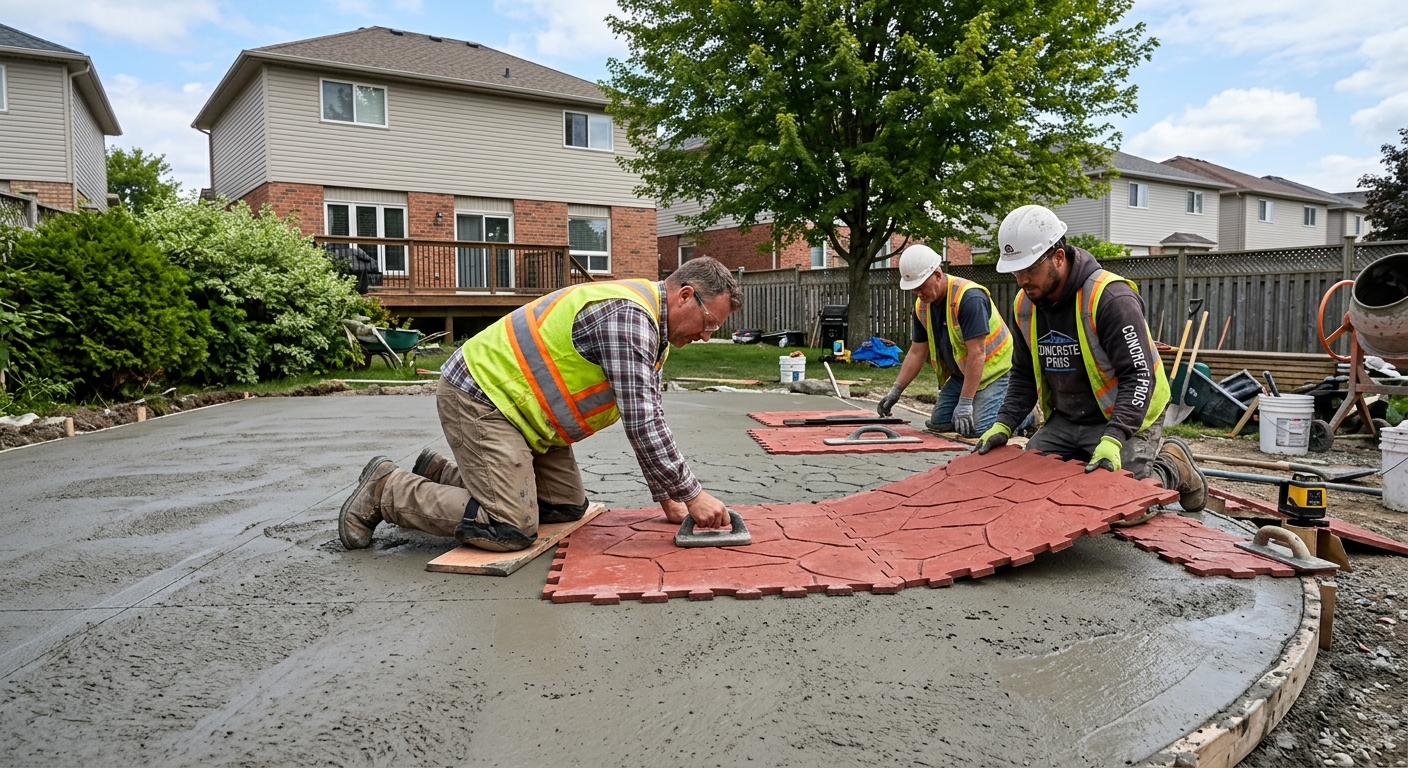
Concrete work options and costs in Leamington
Leamington is a strong market for concrete flatwork—driveways, patios and walkways—because the housing base is dominated by single-detached homes (64.6% of dwellings) (Statistics Canada, 2021 Census). With 7,305 homeowner households (69.3% of households own) (Statistics Canada, 2021 Census), many homeowners are maintaining older properties or upgrading entry features, especially in established neighbourhoods where lots are a mix of mature landscaping and tight access. In places like South Leamington and the older parts of downtown, it’s common to see repeat work that includes slab repairs, regrading, and new drainage runs before the concrete goes in.
In the Windsor–Sarnia region, concrete pricing is shaped by our cold, lake-influenced climate. Freeze–thaw cycles and moisture movement off Lake Erie and nearby waterways increase the risk of scaling and cracking, so contractors build in more protection: air-entrained mixes, properly compacted granular bases, and careful control-joint layouts (plus sealing). Another reason quotes can move fast here is that the effective pour season can be shorter; spring and fall work often needs blankets, heaters or admixture planning, and that adds labour and scheduling cost. Ready-mix supply and truck access also affects availability in peak weeks, particularly on streets with limited curb space.
Because of these factors, you’ll usually see installed pricing land in the bands below for typical residential work in Leamington—then rise or fall based on excavation depth, reinforcement, and finish complexity. Use the table to compare realistic scopes before you ask for firm, itemised bids.
| Application |
Typical Size |
Key Spec |
Finish Option |
Price Range |
| Concrete driveway (standard broom finish) |
400–600 sq. ft. |
Air-entrained mix; compacted granular base; control joints |
Broomed surface |
$5,500–$11,500 |
| Exposed aggregate driveway |
400–600 sq. ft. |
Air-entrained mix; proper base; retarder/curing control |
Exposed aggregate (washed or retarded) |
$9,000–$15,000 |
| Stamped concrete driveway or patio |
250–500 sq. ft. |
Air-entrained mix; release agent; joints planned for pattern |
Stamped pattern (concrete colour + texture) |
$7,500–$22,000 |
| Plain concrete patio or walkway |
200–400 sq. ft. |
Air-entrained mix; compacted base; edging and drainage |
Float + broom/spray texturing |
$3,500–$9,000 |
| Garage floor (interior slab) |
400–600 sq. ft. |
Vapour/insulation considerations; reinforcement if needed |
Standard trowel finish (with control joints) |
$6,000–$13,500 |
| Foundation footings (structural, below frost) |
Varies by house plan |
Below frost depth; engineered rebar cage; drainage detailing |
Structural concrete formwork |
$12,000–$35,000 |
Prices are estimates only and vary by project scope, site access and material selection.
What affects the price of concrete work in Leamington
In Windsor–Sarnia and across Ontario, it’s common to see the same “driveway-sized” job land 30–50% apart once you compare the real specs. One contractor may quote a surface-only replacement, while another includes deeper excavation, proper granular base thickness, reinforcement, drainage improvements, and correct cold-weather curing planning. Even the finish affects cost: a plain patio can be relatively straightforward, while stamped or exposed aggregate needs more labour time, specialty materials and tighter curing discipline—especially in Leamington’s freeze–thaw season.
Frost line depth is the big driver in Ontario. Footings must extend below the design frost depth to prevent frost heave, and in practice that typically means deeper excavations and more concrete per linear foot than warmer regions. The cold, lake-influenced freeze–thaw cycles also demand air-entrained concrete mixes for exterior slabs, plus well-compacted bases that shed water rather than hold it against the slab. Cold-weather placement is another reason costs can rise: spring and fall pours often require heaters, insulating blankets, or set-modifying admixtures and stricter curing windows to reach design strength reliably. Finally, de-icing salt use in winter accelerates surface spalling if the mix design and curing were compromised—so sealing and correct joint planning can become a meaningful part of the budget.
In Leamington specifically, older homes (and their older drainage patterns) can add excavation and subgrade work before concrete goes in. For example, upgrading a standard driveway around $5,500–$15,000 may climb toward the upper end when you’re replacing failing base and adding rebar and edge drainage. Conversely, a simple plain walkway in the $3,500–$9,000 band can stay efficient if access is good and the subgrade is already stable.
| Price Factor |
Why It Matters |
Cost Impact |
| Frost line depth |
Determines footing depth and form height |
Higher excavation and concrete volume can add significant cost on foundation/footings projects. |
| Site preparation |
Excavation, grading, compacted granular base |
Poor base or unaccounted topsoil removal often increases labour and materials. |
| Reinforcement |
Rebar or wire mesh requirement |
Rebar cages, proper chairing and spacing add labour but reduce cracking and punch-through risk. |
| Mix design |
Air-entrainment and compressive strength spec |
Air-entrained exterior mixes and strength specs protect in freeze–thaw; skipping can cause early scaling. |
| Finish type |
Broom vs. stamped vs. exposed aggregate |
Stamped/exposed options add materials, timing, and labour for texture, colour and release systems. |
| Pour size and concrete truck access to site |
Placement speed and logistics |
Tight access, long wheelbarrow distances or multiple trips can increase labour and delays. |
| Cold-weather curing precautions |
Heating and blankets |
Often needed in shoulder seasons; can materially increase costs for short schedules. |
| Control joint pattern and sealing cost |
Controls cracking and helps manage water ingress |
Good joint layout and sealing planning can add line-item cost but reduces winter damage risk. |
Permits & regulations in Ontario
In Ontario, you should expect a building permit for most structural concrete work. That includes footings, foundation walls, grade beams, and any concrete that’s part of the structural system supporting the building. In many cases, engineered drawings are also reviewed by the municipality before work can proceed. By contrast, concrete flatwork like patios, walkways and driveways typically does not require a permit unless it changes lot grading or interacts with impervious surface rules, drainage requirements, or municipal right-of-way considerations. Because municipalities can have local nuances, the safest approach is to confirm directly with Leamington’s local authority before breaking ground.
To protect yourself as a homeowner, verify three things before signing: (1) the contractor’s licence/registration where applicable, (2) liability insurance, and (3) workplace coverage. Step-by-step, start by asking the contractor for a current certificate of insurance showing liability coverage for the company name on your contract, and request proof of clearance/coverage for workers (WSIB/WCB coverage documents). Next, check whether the contractor’s registration/licence details match what’s shown in their quotes and business documents. Finally, ask for references from similar-scale jobs—especially exterior slabs done in winter or shoulder seasons—because freeze–thaw performance depends on workmanship as much as materials.
If the contractor can’t provide clear paperwork promptly, that’s a practical red flag in Ontario where concrete work is often tied to inspection-ready documentation.
Getting concrete right in Leamington's freeze-thaw climate
Concrete fails in Leamington most often when water finds a pathway into the slab or when the mix and base aren’t built for repeated freeze–thaw. The two common outcomes are scaling (surface flaking) and random cracking that later turns into spalling once de-icing salts and meltwater get in. To prevent this, spec three things together: correct base preparation, a durable air-entrained mix, and a joint/curing plan that limits water and controls cracking.
First, start with base prep. Exterior slabs should sit on a compacted granular sub-base placed to the right depth for local soils and frost risk, with proper grading so water drains away. Second, the mix design should include air-entrainment—commonly around 5–7% air for exterior flatwork—along with a minimum 32 MPa compressive strength spec for typical residential placements. Third, control joints must be laid out and cut on time. Spacing is what limits random cracking; otherwise, you’ll get cracks where you least want them, and those cracks become water entry points.
Curing is where shoulder-season projects can get expensive if it’s not planned. Aim for at least 7 days under proper conditions; in cold weather, contractors may need heaters or blankets to maintain curing temperature and protect early strength gain. Sealing also matters here: a penetrating sealer applied after cure (often at 28 days post-pour) helps repel moisture and reduces how quickly de-icing salt damage accelerates.
When comparing options, don’t treat price as the only factor. For example, a plain driveway in the $5,500–$15,000 range is often the best value if your base and drainage are sound. But if your existing slab failed due to trapped moisture, paying for proper excavation and a durable mix can be the difference between another repair next year versus a long-service driveway—sometimes worth choosing the higher end of that range rather than “saving” on base depth.
| Spec |
Why It Matters in Leamington |
What to Ask For |
Impact if Skipped |
| Compacted granular base (depth?) |
Limits pumping and moisture movement during freeze–thaw |
Base thickness and material type; compaction testing or documented compaction |
Settlement, cracking, and faster deterioration from trapped water |
| Air-entrained concrete mix (target air %?) |
Improves freeze–thaw durability in lake-influenced cold |
Air content target (typically 5–7% for exterior flatwork) and exposure spec |
Spalling/scaling risk rises significantly in winter seasons |
| Compressive strength (MPa rating) |
Ensures adequate strength gain for winter performance |
Minimum 32 MPa rating and mix design confirmation |
Surface failure, scaling, and reduced long-term durability |
| Control joints (spacing per ACI guidelines) |
Controls where cracks form as the slab contracts/expands |
Joint layout plan, saw-cut timing, and spacing approach |
Random cracking paths and water entry leading to spalling |
| Minimum 7-day curing period |
Curing supports strength development in cold lake climate conditions |
Temperature and curing method plan; protection measures in shoulder months |
Weak early-age concrete and higher winter damage probability |
| Penetrating sealer (when applied after cure) |
Repels moisture and slows de-icing salt damage |
Application timing (often after 28 days cure) and product type |
Faster surface wear and increased risk of scaling |
How to choose a concrete work contractor in Leamington
Choosing the right contractor in Leamington comes down to documentation, clarity, and workmanship planning for our freeze–thaw winters. Start by confirming Ontario-related readiness: ask for proof of liability insurance and coverage for workers (WSIB/WCB clearance as applicable). Then verify the contractor can provide certificates showing the coverage is active and that it applies to the job being quoted. If a contractor is vague or delays paperwork, pause the process—concrete jobs are high-cost and the labour risk is real when excavation, rebar, and early curing are involved.
Next, get 2–3 itemised written quotes. You want labour and materials broken out, not a single lump number. Ask explicitly what’s included: excavation depth, disposal, granular base type, reinforcement type, and whether cold-weather curing measures are included for spring/fall pours. Confirm whether the permit (if required) is included, and what happens if conditions change (soft subgrade, groundwater, or schedule delays).
Warranty matters too: ask for workmanship warranty length and whether it covers finishing, cracking tied to jointing, and sealers (where used). Also ask about manufacturer/product warranties for special materials and whether those are transferable to your property.
On payment, a safe practice is never paying more than 10–15% upfront; hold back the remainder until substantial completion. Finally, insist on a start date and completion estimate in writing—then make sure the plan accounts for curing time. In our climate, “pour day” is only part of the schedule.
- Ask for proof of liability insurance before you sign.
- Request WSIB/WCB clearance paperwork for workers.
- Confirm who pulls the permit if structural work is involved.
- Get at least two references for similar exterior slabs in Ontario winters.
- Demand itemised quotes: excavation, base, reinforcement, concrete supply, finish, saw-cutting, sealing.
- Clarify exclusions (demo, disposal, drainage improvements, regrading, heaters/blankets).
- Check how they handle poor subgrade or groundwater.
- Ask for air-entrainment and the target air content for exterior flatwork.
- Confirm curing plan (7-day protection) and cold-weather measures if applicable.
- Require a joint layout plan (where joints go and when they’ll be cut).
- Review warranty details in writing, including what “crack” coverage means.
- Keep upfront payments to 10–15% and hold a completion holdback.
Concrete red flags in Leamington include: quoting exterior slabs without discussing air-entrainment; vague wording like “standard concrete” without strength or durability specs; skipping base depth and compaction details; promising a fast pour without a curing/protection plan for shoulder-season weather; and avoiding documentation (insurance, coverage, or clear exclusions in the contract).
Frequently asked questions — concrete work in Leamington
How do I prepare the base for a concrete slab?
For a slab in Leamington, base preparation is what determines whether you get settlement and random cracking later. A good contractor excavates to the required depth, removes topsoil/organic material, and places a compacted granular base sized for local frost risk and drainage. The key is compaction and drainage: you want water to move away from the slab, not sit under it. For exterior work, granular base should be well-compacted in lifts, then graded to match the finished slope. If your subgrade is soft, saturated, or has poor drainage, the quote should reflect that additional excavation and granular replacement. When the base is done properly, even a driveway in the $5,500–$15,000 band can perform far better through Leamington winters.
How do I compare concrete quotes?
When comparing quotes in Ontario, compare the specs, not just the totals. Ask each contractor to itemise excavation depth, disposal, granular base material and thickness, reinforcement (rebar size/spacing or mesh), concrete strength (often a minimum 32 MPa), and whether the mix is air-entrained for exterior freeze–thaw durability. Also compare finishing and timing details: broom finish versus stamped or exposed aggregate changes labour and material costs, and control joints must be laid out and cut on time. Make sure cold-weather curing precautions (blankets/heaters) are stated if the pour is in spring or fall. A plain patio may sit around $3,500–$9,000, while stamped work can climb into the $7,500–$22,000 range—so the “extra” should be tied to real scope like release agents, stamping labour and joint planning.
Can concrete be poured in cold weather in Leamington?
Yes, concrete can be poured in cold weather in Leamington, but it has to be done right. The risk isn’t the pour itself—it’s early-age curing and strength development when temperatures drop. Contractors typically use heaters and insulating blankets, manage the concrete temperature, and may use admixtures to help set and protect the slab during the first critical days. They also need a curing plan that maintains appropriate conditions so the concrete reaches design strength. If a contractor dismisses temperature concerns with “we’ll pour and be fine,” that’s not the standard we want for Ontario freeze–thaw performance. A well-planned cold-weather pour can still land in the normal driveway or patio price bands, but short-notice work in shoulder seasons often increases cost because protection and scheduling are labour-intensive.
How do I maintain concrete in Leamington's freeze-thaw climate?
Maintenance in Leamington is about keeping moisture out and limiting surface wear. First, allow proper cure time and then use a penetrating sealer after cure—typically around 28 days post-pour—so the slab repels water and slows the impact of de-icing salts. Second, keep drainage paths clear: if eaves, downspouts or grading direct water toward your slab, freeze–thaw accelerates deterioration. Third, use de-icing products carefully; avoid over-salting and don’t chip at the surface with metal tools. Fourth, watch for hairline cracks around joints. Control joints are supposed to crack slightly in a controlled pattern; if cracking expands or spalls show up around edges, addressing it early can prevent bigger repairs later.
What causes concrete to spall in Leamington winters?
Concrete spalling usually comes from freeze–thaw damage plus moisture and salts. In Leamington’s lake-influenced cold, water gets into microscopic pores or along cracks, freezes, and expands. If the concrete wasn’t air-entrained correctly (or if curing was compromised), there isn’t enough room in the mix for freeze expansion, so the surface scales and flakes—spalling. De-icing salts worsen the surface chemistry and speed up deterioration. Poor base preparation and weak drainage can also contribute because the slab stays saturated. To reduce spalling risk, make sure the exterior mix is air-entrained (commonly 5–7% air for exterior flatwork), joints are properly cut and sealed where applicable, and curing protection is planned for shoulder-season pours. Skipping these items is often why “cheap” repairs turn into repeat work.
What is rebar and when is it required in Ontario?
Rebar (reinforcing steel) is used to control cracking and add strength in structural concrete elements. In Ontario, rebar requirements depend on the type of concrete work: structural components like foundation walls and footings typically need engineered reinforcement layouts. For exterior slabs like driveways and garages, reinforcement may be required based on slab thickness, loading (vehicles), subgrade conditions, and how the contractor’s engineer/spec defines the design. In practice in Leamington, if the slab is exposed to vehicle loads or the subgrade isn’t ideal, a contractor will often include rebar (or mesh) and properly chair it so it sits within the slab—not at the bottom. Always ask for the reinforcement spec and confirm it matches the intended use and thickness. For foundation/footings, permits and engineered drawings are commonly part of the process, even if your flatwork doesn’t require a permit.