Concrete work options and costs in Tottenham
In Tottenham, Ontario, homeowners typically choose between practical concrete flatwork and higher-end decorative finishes depending on budget and how long they want the surface to stay sharp through our freeze–thaw seasons. With a population of 5,143 (Statistics Canada, 2021 Census), Tottenham is small enough that local contractor capacity can tighten during peak pour months, but the demand for driveway and walkway work stays steady because most homes are single-family properties where concrete is often the longest-lasting exterior finish. The Toronto economic region’s climate is a major cost driver: frost depth requirements push footing depth for structural work, and freeze–thaw cycles increase the risk of spalling and random cracking on exterior slabs unless the mix, base, and joints are planned correctly. In practice, that means Toronto-area contractors often specify air-entrained concrete, proper drainage, and a joint plan before the first load arrives. It also means exterior pours are concentrated in warmer windows so curing happens reliably; when temperatures trend down toward 10 °C or below, crews must use cold-weather protection to keep strength gain on track.
Within Tottenham, work is especially in demand around the established residential pockets near the downtown core (often where access is tighter and cleanup/detailing matters). If your project includes excavation, deeper base, or decorative finish, you’ll usually see the wider price ranges. Use the comparison table below as a realistic starting point for the scope you’re considering, then compare quotes using the spec details—not just the final number.
| Application |
Typical Size |
Key Spec |
Finish Option |
Price Range |
| Concrete driveway (standard broom finish) |
300–360 sq. ft. (approx. 30’ x 10’) |
Compacted granular base, drainage, air-entrained mix |
Broom finish, light broom texture |
$18,000–$28,000 |
| Exposed aggregate driveway |
300–360 sq. ft. (approx. 30’ x 10’) |
Proper mix + surface retard/cleaning plan |
Exposed aggregate (machine or hand profile) |
$24,000–$36,000 |
| Stamped concrete driveway or patio |
250–350 sq. ft. |
Air-entrained mix, release agent, colour hardener |
Stamp pattern + anti-slip sealer |
$24,000–$42,000 |
| Plain concrete patio or walkway |
200–300 sq. ft. |
Granular base + edge forms + joints |
Float/screed then light broom |
$16,000–$26,000 |
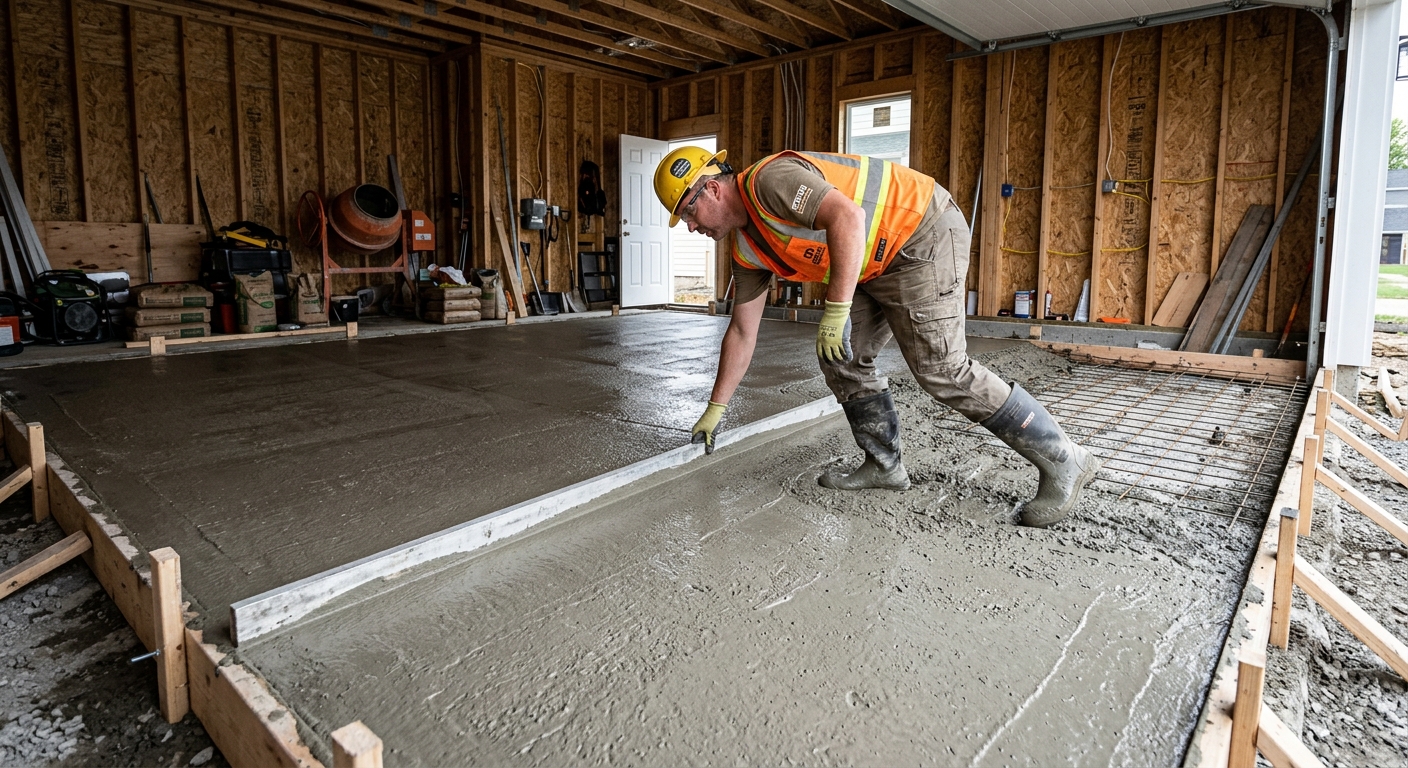
| Garage floor (interior slab) |
300–450 sq. ft. (approx. 20’ x 20’ or 22’ x 20’) |
Vapour retarder (where required), mesh/welded wire, proper sub-base |
Broom finish or smooth-trowel + sealer |
$14,000–$26,000 |
| Foundation footings (structural, below frost) |
Varies by design (typical 40–120 linear ft.) |
Excavation + forming + rebar, poured below design frost depth |
Structural concrete to engineered requirements |
$18,000–$36,000 |
Prices are estimates only and vary by project scope, site access and material selection.
What affects the price of concrete work in Tottenham
In Tottenham (and across the wider Toronto economic region), it’s common to see the same “type” of concrete project quoted 30–50% apart once you compare the details. The biggest reasons are foundation depth and freeze–thaw exposure for exterior work, plus how much preparation the contractor allows for. For structural work, footings must extend below the design frost depth to prevent frost heave and differential movement; in Ontario, that typically means going at least 1.2 m (about 4 ft) below grade for many structural situations, and the design frost depth range often pushes deeper. For exterior slabs, freeze–thaw cycles also dictate air-entrained mixes so the concrete can tolerate repeated wetting and temperature changes. If a crew can’t reliably protect and cure the pour—especially when temperatures drop toward 10 °C or below—cold-weather precautions (insulating blankets, heaters, scheduling adjustments) add real cost.
Local site conditions create additional variation. For example, a driveway poured over poorly drained fill or weak subsoil can require extra excavation and more granular base, raising the budget beyond a typical driveway project range such as the $18–$28 you’d expect for standard broom work. Conversely, a straightforward patio on stable, well-graded soil with good access may stay closer to the lower band like $16–$26 for plain flatwork. The Toronto-area labour market also affects availability: in peak season, scheduling tighter access work (flagpole removal, backyard forms, retaining walls) can add truck time and manpower. If your home is older with settled areas or mature landscaping, expect more demo, disposal and regrading—often measured in hundreds to a few thousand dollars that shows up quickly in itemised quotes.
| Price Factor |
Why It Matters |
Cost Impact |
| Frost line depth |
Determines footing depth and form height |
Deeper excavation and more rebar can add thousands of dollars to foundations/footings |
| Site preparation |
Excavation, grading, compacted granular base |
Weak soil or poor drainage increases base thickness and disposal; common driver of cost swings |
| Reinforcement |
Rebar or wire mesh requirement |
Material + labour time; missed reinforcement can lead to premature cracking |
| Mix design |
Air-entrainment and compressive strength spec |
Better durability often costs more but reduces spalling risk on exterior flatwork |
| Finish type |
Broom vs. stamped vs. exposed aggregate |
Decorative work adds colour, stamps/tools, extra labour and sealing |
| Pour size and concrete truck access |
How far the crew must carry/route concrete |
Tight access can require extra labour and plan changes; may reduce allowable load delivery speed |
| Cold-weather curing precautions |
Heating and blankets when temperatures drop |
Heaters/blankets and extended curing time can materially increase the total |
| Control joint pattern and sealing cost |
Controls cracking; sealing helps resist salt/porosity |
Proper jointing and penetrating sealer are usually a smaller cost than replacing failed surfaces |
Permits & regulations in Ontario
In Ontario, structural concrete work requires the right approvals because it affects how a building carries loads. Typically, a building permit is required for things like foundation footings, foundation walls, and grade beams—especially when drawings are engineered and reviewed as part of the building permit process. For concrete flatwork such as patios, walkways, and driveways, permits are often not required if the work is staying within the lot in the normal way. However, you may still need municipal approval if the project changes lot grading, affects stormwater handling, increases impervious surface coverage beyond municipal limits, or alters the municipal right-of-way (for example, adjusting a driveway apron at the road allowance). The safest approach is to confirm with your local authority before breaking ground.
Before signing, verify the contractor’s status and coverage in Ontario. Step-by-step: (1) Check the contractor’s licensing/registration information through the Ontario online registry channel they provide or that matches their trade category; many reputable concrete contractors also clearly list their registration details on the quote. (2) Ask for a current Certificate of Insurance and verify liability coverage is active and includes work at your address (you want the effective dates visible). (3) Confirm WSIB/WCB clearance or coverage status—your quote or pre-start paperwork should include a clearance letter or proof number. (4) Ask for references on similar-scale jobs in the Tottenham area or nearby GTA suburbs and visit photos/documentation of exterior freeze–thaw exposed work.
Getting concrete right in Tottenham's freeze-thaw climate
Concrete fails in Tottenham most often in three ways: it loses strength during poor curing, it cracks randomly because the joint plan is missing or wrong, and it spalls when water and salt enter a surface that wasn’t properly air-entrained. Our freeze–thaw cycles expand and contract moisture in and near the surface, so the spec matters as much as the workmanship. Start with base preparation: you need a compacted granular sub-base to the right depth and a slope that drains water away. Exterior slabs without dependable drainage become saturated, then the freeze–thaw movement attacks the concrete from below and at the edges.
Next, mix design and curing. For exterior flatwork, aim for air-entrained concrete with roughly 5–7% air content and minimum 32 MPa compressive strength (as specified for the exposure). Then plan control joints to limit random cracking—joints should be cut or formed on a schedule that matches slab dimensions and shrinkage behaviour. Curing is also critical: plan for a minimum 7-day curing period under proper conditions, and if temperatures are dropping in the evenings toward 10 °C, reputable crews add cold-weather protection so the concrete can gain strength. Finally, sealing helps protect against de-icing salts: a penetrating sealer is typically applied after the cure window (commonly around 28 days) to repel water rather than just coating the surface.
To justify costs: if you’re choosing between a plain patio around $16–$26 and a stamped patio in the $24–$40 band, the higher number is usually tied to labour for stamping, colour, and more steps—while the durability drivers (base, air-entrainment, joints, curing, and sealer) should be strong in both options. If a quote is “cheap” but cuts back on base thickness, air-entrainment, or jointing, that’s the risk you’re paying for later—often with patching or full replacement.
| Spec |
Why It Matters in Tottenham |
What to Ask For |
Impact if Skipped |
| Compacted granular base (depth?) |
Prevents settlement and limits water saturation under freeze–thaw |
Minimum base thickness for your soil + compaction method and proof |
Uneven slab, cracking, and faster edge spalling |
| Air-entrained concrete mix (target air %?) |
Improves resistance to freeze–thaw damage and surface scaling |
Air-entrainment target (typically 5–7% for exterior flatwork) and exposure notes |
Higher risk of spalling and flaking during winter |
| Compressive strength (MPa rating) |
Strength gain supports durability under repeated loads and temperature swings |
Minimum 32 MPa (or the specified rating on your quote) |
Weak concrete leads to early wear, cracking and repairs |
| Control joints (spacing per ACI guidelines) |
Controls where shrinkage cracks form |
Planned joint spacing and whether/when joints are cut |
Random cracks that look worse and can become water paths |
| Minimum 7-day curing period |
Ensures strength development despite Ontario weather swings |
How they protect the pour if temps drop (covers/heaters/blankets) |
Surface damage, reduced strength and poor long-term performance |
| Penetrating sealer (when applied after cure) |
Repels moisture and helps resist salt-related deterioration |
Type of sealer and application timing after cure (commonly ~28 days) |
More rapid staining, scaling and spalling on exterior surfaces |
How to choose a concrete work contractor in Tottenham
Choosing a concrete contractor in Tottenham is mostly about verification and detail. First, confirm Ontario licensing/registration for the trade category your contractor falls under, and insist they provide proof without being vague. Next, verify liability insurance: ask for a current Certificate of Insurance and check the coverage is active (effective dates) and covers the type of work they’re doing at your property. Third, confirm WSIB/WCB coverage by requesting a clearance letter or proof document with their current status—don’t rely on verbal assurances.
For pricing, don’t accept a single lump-sum without supporting breakdown. Get 2–3 itemised written quotes showing labour + materials, including excavation/disposal, granular base, reinforcement, concrete mix details, forms, finishing, joints, sealing, and any permit-related items (if applicable). Pay attention to what’s excluded: removal of existing concrete, grading/slope corrections, drainage adjustments, hauling distance, and patching of adjacent surfaces can change the job significantly. Ask about warranty too: workmanship coverage length, whether it covers only labour or also materials, and whether it’s transferable if you sell the home.
On payments, never pay more than about 10–15% upfront. Hold back a portion until the job is complete, inspected, and cleaned up. Finally, lock in timeline expectations in writing—include the start date target, pour schedule contingencies for weather, and the completion estimate for finishing and sealing so you can compare contractors fairly.
- Request itemised pricing (labour, materials, haul/excavation, disposal, base, rebar/mesh, finishing, sealing).
- Confirm air-entrainment and minimum strength are stated in writing for exterior work.
- Ask how they handle drainage and what base thickness/compaction they’ll achieve.
- Verify control joint spacing and whether joints are cut or formed.
- Clarify curing plan, including what they do if the weather drops.
- Get a written concrete delivery/truck access plan for your site.
- Confirm cleanup and removal of waste (dump fees and disposal locations should be clear).
- Ask if permit pull/coordination is included (for structural work) or excluded.
- Check insurance dates and confirm liability coverage limits are appropriate for the scope.
- Get WSIB/WCB clearance proof before work starts.
- Review warranty terms in writing and ask who the manufacturer covers.
- Hold back payment until final inspection and sealing steps (where included) are complete.
Concrete red flags in Tottenham: “We don’t need air-entrainment” for an exterior slab; vague curing (“we’ll pour and it’s fine” with no cold-weather plan); no mention of control joints or sealing; quotes that don’t include base thickness/compaction details; and contractors asking for large upfront payments (more than 10–15%) without a signed schedule.
Frequently asked questions — concrete work in Tottenham
Why does concrete crack in Tottenham and how is it prevented?
Cracking is common in Tottenham because exterior concrete experiences shrinkage and then freeze–thaw movement as moisture gets in and out of the slab every winter. Most “random” cracks happen when the base isn’t properly prepared and compacted, or when there’s no engineered plan for control joints. Prevention comes from doing the unglamorous work right: a well-compacted granular sub-base, air-entrained concrete for exterior exposure, and a joint pattern that limits where cracks can form. Equally important is curing—Ontario weather can shift quickly, and strength gain needs protection when temperatures slide toward 10 °C or lower. If you’re comparing options, a standard broom driveway often sits around $18,000–$28,000, but the durability difference isn’t the broom texture—it’s the base, mix, joints, and curing quality.
Stamped vs broom-finish concrete — cost difference?
Stamped concrete costs more because it’s not just placing concrete—it also includes colour hardeners or release colour, stamping labour, pattern/layout time, and usually an anti-slip sealer step. In the Toronto region’s freeze–thaw conditions, the cost premium should not mean corners are cut on base and air-entrainment; those spec items should still be built into the quote for both stamped and broom finishes. Typical expectations in Tottenham: a plain broom-finish driveway is often closer to the $18,000–$28,000 band for comparable areas, while stamped concrete driveway/patio projects commonly land around $24,000–$40,000 depending on size and complexity. If your quote for stamped work is close to broom pricing, ask what’s excluded—particularly base depth, reinforcement, jointing, and whether sealing is included after the cure.
When is the best time to pour concrete in Tottenham?
The best time is during the warmer months when crews can reliably cure concrete and avoid cold-weather strength issues. In the Toronto economic region, that typically means planning exterior pours for periods with stable temperatures and scheduling around rainy stretches that can saturate sub-bases. Concrete can be poured later in the season, but then you need cold-weather curing precautions—insulating blankets, heaters, and tighter protection timing—because durability depends on strength gain in the early days. If you’re trying to reduce risk, prioritize a window where overnight temperatures are less likely to drop sharply and allow proper curing for at least 7 days. For homeowners, a practical approach is to confirm the contractor’s weather plan before booking; if they can’t explain how they’ll manage pours when temperatures trend down toward 10 °C, you’ll want to consider moving the schedule.
How long does concrete take to cure?
Concrete curing has two timelines: strength gain and full cure. For most exterior concrete work in Ontario, you should plan for a minimum 7-day curing period under proper conditions to reach early strength. However, many durability steps—especially sealing—are timed after the concrete has fully cured, commonly around 28 days, so the sealer can penetrate and repel moisture effectively. In Tottenham’s freeze–thaw climate, rushing curing is a common reason for early surface problems like scaling. This is why reputable contractors discuss curing protection if temperatures are dropping, since strength gain can slow dramatically when nights are cold. If you’re budgeting for a patio or walkway that’s in the $16,000–$26,000 range, ask whether the quote includes the curing protection plan and the required sealing timing if it’s part of the scope.
Do I need a permit for concrete work in Ontario?
In Ontario, structural concrete work typically requires a building permit. That includes foundation footings, foundation walls, and grade beams. Concrete flatwork like patios, walkways, and driveways often doesn’t require a permit if it stays within normal lot grading and doesn’t change drainage in a way that triggers municipal approval. That said, permits can be needed if the work affects lot grading, impervious surface limits, or any portion that interacts with municipal right-of-way. For Tottenham homeowners, the key is to confirm with your municipality before you begin excavation. Also verify your contractor can provide proof of insurance and WSIB/WCB clearance; those are separate from permits but just as important for your risk management. If your plan is structural, ask the contractor whether they’re coordinating drawings/permit steps; if it’s flatwork, ask about grading/drainage checks and whether any municipal approval is expected.
Concrete vs pavers for a patio in Tottenham?
Concrete and pavers both work well in Tottenham, but they fail differently in a freeze–thaw climate. Concrete patios (when built with the right base, air-entrained mix, joints, and proper curing) tend to be a low-maintenance, continuous surface; good sealing can help resist salt-related deterioration. Pavers offer flexibility and easier spot repairs if individual stones settle, but joints can clog or allow washout if the bedding and edge restraints aren’t done right. Cost-wise, plain concrete patio/work often falls around $16,000–$26,000 for typical areas, while decorative options like stamped concrete are higher (often in the $24,000–$40,000 band). If you want a uniform, modern look with fewer lines to maintain, concrete is usually the stronger value. If you expect future landscaping changes or want quick localized repairs, pavers may fit better—just insist on drainage details and a proper edge restraint system either way.