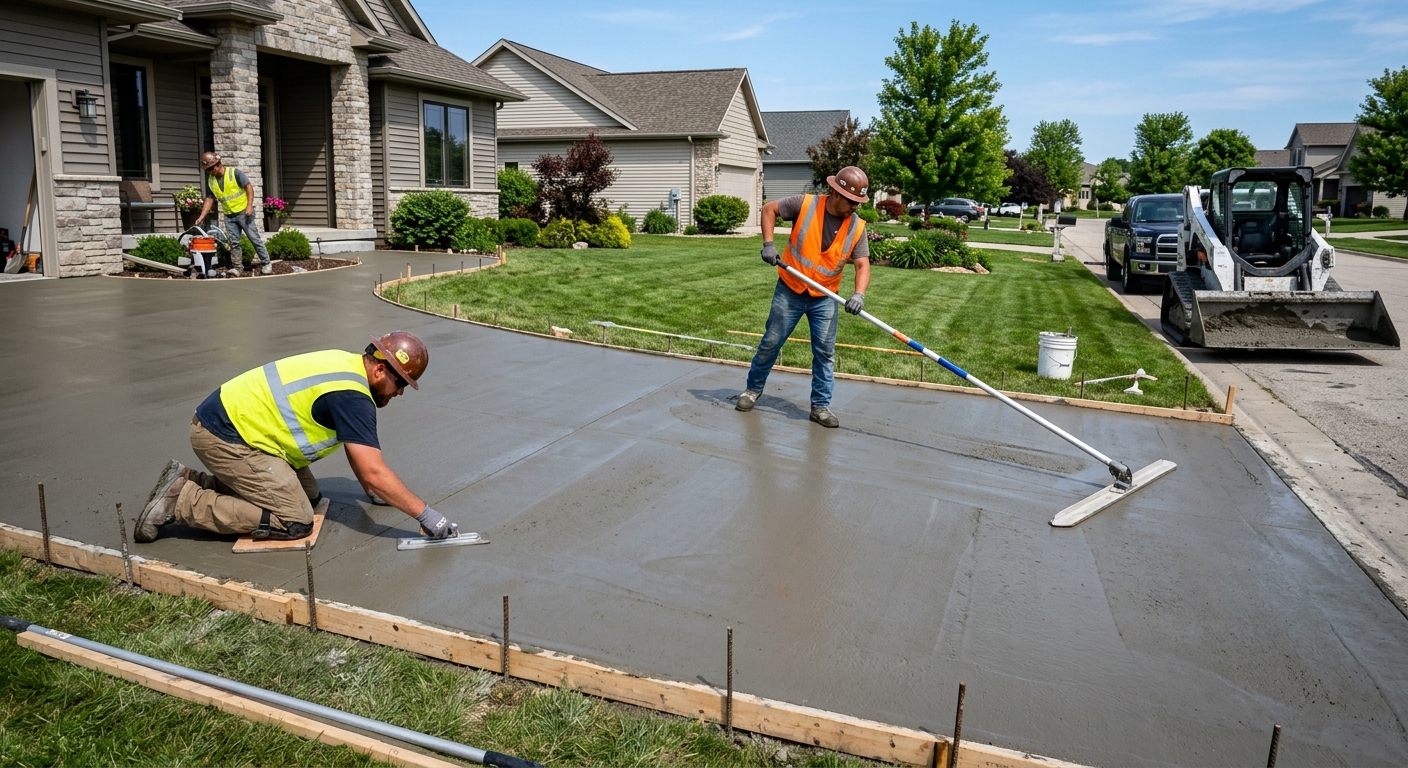
Concrete work options and costs in Runnymede-Bloor West Village
Runnymede-Bloor West Village is one of those Toronto neighbourhoods where concrete flatwork gets a real workout—think daily drive-in traffic, winter salt, and the area’s recurring freeze–thaw swings. With a population of 10,070 (Statistics Canada, 2021 Census), there’s steady local demand, especially where families want durable driveways, patios, and walkways that match older bungalow streetscapes. Concrete contractors in the west end are also busier near retail and transit corridors like the Bloor West Village area, because homeowners often plan exterior upgrades around the spring and early summer building windows.
In the Toronto market, your cost is heavily influenced by frost depth and freeze–thaw. Ontario’s building practice typically pushes structural footings to extend about 1.2 m (roughly 4 ft) below grade to reduce frost heave and differential movement, and exterior flatwork usually requires air-entrained mixes plus proper drainage and well-compacted granular base. When the soil stays saturated through fall, concrete can fail early—so base prep and water management show up in every quote. That’s why two jobs that look similar can still land far apart: one site may need deeper excavation and more base, while another may pour over a firm, properly graded subgrade.
For homeowners weighing options, price differences mostly come down to reinforcement, mix design, surface finish, and how much time the crew has for curing. Below is a practical pricing comparison for common Runnymede-Bloor West Village applications, so you can line up quotes before you spend time on specs.
| Application |
Typical Size |
Key Spec |
Finish Option |
Price Range |
| Concrete driveway (standard broom finish) |
400 sq ft |
Air-entrained mix, compacted granular base, control joints |
Broom finish |
$7,500 – $11,000 |
| Exposed aggregate driveway |
400 sq ft |
Air-entrained mix, proper curing, aggregate retarder/cleaning |
Exposed aggregate |
$9,000 – $14,500 |
| Stamped concrete driveway or patio |
300–500 sq ft |
Air-entrained mix, integral colour, release agent and stamping |
Stamped pattern |
$10,000 – $18,500 |
| Plain concrete patio or walkway |
200 sq ft |
Air-entrained mix, base prep, thickness sized for footing plan |
Plain finish |
$3,200 – $5,200 |
| Garage floor (interior slab) |
480 sq ft |
Vapour barrier, proper subgrade compaction, reinforcement as required |
Light broom or trowel-finish |
$8,000 – $12,500 |
| Foundation footings (structural, below frost) |
Per linear foot / typical small foundation |
Below-grade frost depth, formwork, rebar, engineered dimensions |
Structural concrete |
$180 – $300 |
Prices are estimates only and vary by project scope, site access and material selection.
What affects the price of concrete work in Runnymede-Bloor West Village
In Toronto and across Ontario, you can see concrete quotes vary by 30–50% for what looks like the same job. The main reason is that concrete is unforgiving: small differences in excavation depth, base preparation, reinforcement, and curing protection can change both material use and labour time. Another driver is availability—during the busier spring pour window, crews prioritize jobs that are ready to build, and delays (permits, site access, underground issues) often get priced in.
Every exterior pour in this region is shaped by frost depth and freeze–thaw cycles. Footings must extend below the design frost depth (typically around 1.2 m or more for many Ontario structural applications) to prevent frost heave and differential movement. For driveways, patios, and walkways, contractors commonly specify air-entrained concrete so the mix survives repeated freezing and thawing. When temperatures drop toward 10 °C or below, the reliable pour season shortens and crews add cold-weather curing precautions—heating, insulating blankets, and longer protection time. Add in de-icing salts and you’ll see why sealing and surface management matter; poor sealing can lead to scaling and early spalling, which then becomes a repair cost you hoped to avoid.
In Runnymede-Bloor West Village, the street-level reality matters: older homes with established grades may require regrading and drainage adjustments, which increases excavation and base material. Tight side-yard access near Bloor West Village can also mean more labour and smaller equipment setups. By contrast, a straightforward replacement over a firm subgrade can land closer to the lower end of the driveway band (from about $18–$28 per sq ft). For example, upgrading from a plain patio/walkway finish to decorative stamped work may push the project into the $24–$40 per sq ft range—often justified when you’re replacing a larger area or want fewer visible joints and better curb appeal.
| Price Factor |
Why It Matters |
Cost Impact |
| Frost line depth |
Determines footing depth and form height |
Higher excavation and formwork; can add significant labour/material cost for structural work |
| Site preparation |
Excavation, grading, compacted granular base |
More trucking/materials if soil is soft, saturated, or needs correction |
| Reinforcement |
Rebar or wire mesh requirement |
Increased material cost and labour; may be required depending on slab use and thickness |
| Mix design |
Air-entrainment and compressive strength spec |
Air-entrained/strength-specified mixes cost more but reduce freeze–thaw failure risk |
| Finish type |
Broom vs. stamped vs. exposed aggregate |
Stamped and exposed work add time for colour, tooling, curing management and finishing |
| Pour size and concrete truck access to site |
Scheduling and distance from truck to placement area |
Hard access increases labour and may require smaller batch handling |
| Cold-weather curing precautions |
Heating and blankets |
Can add daily labour plus extra materials/protection time when conditions aren’t ideal |
| Control joint pattern and sealing cost |
Crack control and water/salt resistance |
Better joint planning plus sealing can add cost upfront but reduces early deterioration |
Permits & regulations in Ontario
In Ontario, structural concrete work typically needs oversight: footings, foundation walls, and grade beams generally require a building permit, and engineered drawings may be reviewed by the municipality before you can proceed. Concrete flatwork—like most patios, walkways, and standard driveways—often does not require a permit unless the work affects lot grading, changes drainage patterns, or triggers impervious surface coverage / right-of-way considerations. Because details vary by property and scope, you should confirm with the local authority before breaking ground.
Before the first bucket arrives, verify the contractor’s coverage. Ask for proof of liability insurance and WSIB/WCB coverage (or a clearance letter showing status, depending on their situation). For small concrete projects, many reputable contractors still provide references for similar work so you can see how they handle base prep, joints, and finishing in a Toronto climate.
Here’s how a homeowner in Runnymede-Bloor West Village can check things step-by-step:
- Confirm the scope: ask whether any structural elements are included (footings/foundation walls vs. flatwork only).
- Request the certificate of insurance and review coverage limits (and expiry dates).
- Ask for WSIB clearance documentation and confirm it covers the relevant period.
- Ask for the contractor’s business details and references on comparable driveway/patio work in Toronto.
- Before work starts, ensure the permit status is clear in writing if the project includes structural components.
Getting concrete right in Runnymede-Bloor West Village's freeze-thaw climate
Concrete can fail fast here when the base isn’t right, the mix isn’t designed for freeze–thaw, or the finishing and curing are rushed. In Runnymede-Bloor West Village, freeze–thaw cycles and humid fall/spring conditions mean saturated soils can expand and contract against your slab every winter. That’s why successful jobs start underground: (1) compacted granular base sized for local soil and frost conditions, with proper drainage and slope; (2) (2) air-entrained concrete designed to resist freeze–thaw; (3) (3) control joints placed to limit random cracking; (4) (4) curing protected long enough for strength gain; and (5) (5) sealing scheduled after full cure to defend against de-icing salt scaling.
When you’re comparing specs, aim for air-entrainment around 5–7% for exterior flatwork and a minimum 32 MPa compressive strength for durability. Joint spacing should be planned so contraction/expansion has a predictable release path rather than uncontrolled cracks. After pour, plan on at least 7 days of proper curing conditions, but remember that in cold snaps crews often add insulation/heating so the concrete doesn’t get shocked too early. Sealing is typically a penetrating sealer applied after cure—commonly around 28 days post-pour—to help repel salt and water.
To keep your quote grounded: if a broom-finished driveway is priced near the lower driveway band (about $18–$28 per sq ft), you’re paying for core durability. Upgrading to stamped concrete may land higher (often within the $24–$40 per sq ft range) because the work includes integral colour and added finishing steps—but it’s still only “worth it” if base prep, mix design, and joints are not compromised. Otherwise, decorative surfaces just expose the same structural problems sooner.
| Spec |
Why It Matters in Runnymede-Bloor West Village |
What to Ask For |
Impact if Skipped |
| Compacted granular base (depth?) |
Controls settlement and reduces frost-related movement |
Confirm excavation depth and granular base thickness; ask about compaction method |
Settlement, uneven slab, premature cracking and trip hazards |
| Air-entrained concrete mix (target air %?) |
Improves freeze–thaw durability in Toronto’s winter cycles |
Air content around 5–7% for exterior flatwork; verify admixture used |
Spalling and scaling from freeze–thaw damage (often within a few winters) |
| Compressive strength (MPa rating) |
Strength gain supports load and long-term performance |
Minimum 32 MPa for durability; confirm mix design sheet if available |
Surface wear, raveling, and reduced resistance to de-icing salt impacts |
| Control joints (spacing per ACI guidelines) |
Gives concrete a planned crack path during shrinkage/temperature change |
Ask for joint layout plan and spacing based on slab dimensions/thickness |
Random cracking, wider cracks, and more water infiltration |
| Minimum 7-day curing period |
Allows strength development and durability formation |
Confirm curing method, protection plan, and temperature precautions if cold |
Reduced strength and higher risk of scaling/spalling |
| Penetrating sealer (when applied after cure) |
Helps repel salt and water in winter road-treatment conditions |
Apply after cure (commonly around 28 days post-pour); specify sealer type and coverage |
Faster surface deterioration and increased maintenance/repairs |
How to choose a concrete work contractor in Runnymede-Bloor West Village
Start with coverage and capability—concrete jobs that go wrong are expensive to fix, and in Ontario you want proof that the contractor can legally and safely run the work. For licensing, ask what registration applies to the scope (structural vs. flatwork) and confirm they have the required business information for Ontario. For insurance, request a certificate of liability insurance and read the effective/expiry dates. For workplace coverage, ask for WSIB/WCB documentation or a clearance letter showing their status for the period of the job.
Next, get 2–3 itemised written quotes. You want line items that separate excavation and disposal, granular base and compaction, reinforcement, concrete supply/mix design, forming, finishing, joints, and sealing (if included). Avoid lump-sum quotes that don’t show what’s in or out—especially for things like drainage adjustments, regrading, and protection during cold weather. Also check the warranty section: workmanship warranty length, what it covers (cracking vs. spalling vs. joint performance), and whether any manufacturer coating/material warranty is transferable.
For payment, never hand over most of the money upfront. A fair schedule is usually 10–15% to mobilize, with progress payments tied to verified milestones, and a holdback until completion and cleanup. Finally, require a written timeline with a start date, pour date target, and completion estimate—Toronto schedules can shift fast, so clarity matters.
- Provide proof of liability insurance (certificate) with coverage dates.
- Provide WSIB/WCB clearance documentation (or clearance letter).
- Show references for similar Runnymede-Bloor West Village driveway/patio sizes.
- Use itemised quotes (base prep, reinforcement, mix design, finishing, joints, sealing).
- Confirm if permits are required for your scope and who pulls them (if applicable).
- Ask whether disposal of concrete/asphalt/asphalt cuttings is included.
- Confirm site protection and cleanup (no residual washout, no damage to shrubs/sidewalks).
- Ask for a joint layout plan (where saw cuts or formed joints go).
- Confirm air-entrainment and minimum strength in writing for exterior flatwork.
- Ask how they handle temperatures near or below 10 °C (blankets/heating plan).
- Clarify sealing: product type and when it’s applied (after cure).
- Use a payment schedule with a holdback until final acceptance.
Concrete red flags in Runnymede-Bloor West Village include: promises of “no air” or “just regular mix” for exterior slabs, vague answers about joint spacing and sealing, skipping base inspection/compaction proof, no clear curing plan for cold snaps, and quotes that don’t include disposal or drainage tie-ins (you’ll pay later through change orders).
Frequently asked questions — concrete work in Runnymede-Bloor West Village
How long does a concrete driveway last?
In Runnymede-Bloor West Village, a properly built exterior driveway commonly lasts 20–30 years, depending on thickness, base prep, mix design and winter maintenance. The Toronto climate makes durability more sensitive than in milder regions: freeze–thaw cycles and de-icing salts punish concrete that lacks air-entrainment or has poor drainage. If your driveway is well-graded, has control joints placed to manage cracking, and is sealed after cure, it typically holds up well through repeated winters. If you’re planning replacement, budget matters too—driveway projects in the local market often price within the $18–$28 per sq ft range for standard broom finish, which usually reflects the real work of base preparation and the right mix. Cutting corners usually shows up as scaling or spalling within a few seasons.
What is air-entrained concrete and why does it matter here?
Air-entrained concrete is mixed with microscopic air bubbles that give freezing water room to expand, reducing damage during Toronto’s winter freeze–thaw cycles. In Ontario, exterior flatwork is especially vulnerable because moisture can get under the slab or sit in the paste, then expand when temperatures drop. That’s why reputable GTA concrete contractors commonly specify air-entrainment for driveways, patios, and walkways—and often target about 5–7% air content for exterior work. If a quote doesn’t address air-entrainment, ask directly; skipping it can lead to scaling and spalling even when the surface looks fine at first. Sealing helps too, but it can’t fully compensate for the wrong mix. In short: air-entrainment is one of the biggest differences between a driveway that stays smooth for decades and one that deteriorates early.
How do I prepare the base for a concrete slab?
Base prep is where most failure prevention starts in Runnymede-Bloor West Village. A correct base typically means excavating to the right depth, removing soft or organic soil, then installing a well-compacted granular sub-base (and sometimes additional base layers) to support the slab without settlement. The crew should compact in lifts and confirm the grade so you get correct slope and drainage away from your house. For exterior pours, they also need to plan around frost conditions—while structural footings often need to extend about 1.2 m below grade, slabs still require the right thickness and granular support. When quotes are itemised, base prep should be a line item with details on excavation, granular materials, and compaction. If a contractor can’t clearly explain the base depth and drainage slope, that’s a sign you might be paying later for repairs.
How do I compare concrete quotes?
To compare concrete quotes in Runnymede-Bloor West Village, don’t focus only on the total price—line up the scope. Ask for an itemised breakdown: excavation, granular base and compaction, reinforcement, concrete mix design (including air-entrainment), forming, finishing, joint layout, curing/protection, disposal, and sealing (if included). Confirm what “standard” means: broom finish vs. stamped or exposed aggregate, and whether sealing is included or an add-on. Also verify whether the quote assumes good truck access; limited access can change labour costs. Finally, compare local price bands: for example, driveways commonly fall around $18–$28 per sq ft for standard broom finish, while decorative options like stamped work often run higher (within about $24–$40 per sq ft). A lower quote that omits sealing, proper base prep, or the right mix can cost you more over time.
Can concrete be poured in cold weather in Runnymede-Bloor West Village?
Yes, concrete can be poured in cold weather in Ontario, but it must be done correctly—otherwise you risk weak surface performance, poor curing, and durability issues. In the Toronto region, many exterior pours are concentrated in warmer months because curing is more predictable and crews can protect the slab as needed. When temperatures trend near or below about 10 °C, contractors typically add cold-weather curing precautions such as heating, insulating blankets, and careful curing time management. A responsible contractor should spell out their plan in writing: what temperatures trigger protection, how long they’ll keep insulation/heat on the pour, and how they prevent premature freezing of the concrete surface. If a quote assumes the pour will be “fine” without describing curing protection, treat it as a risk. Even with protection, results depend on mix design and execution.
How do I maintain concrete in Runnymede-Bloor West Village's freeze-thaw climate?
Maintenance is straightforward but matters more in Runnymede-Bloor West Village because of winter salt exposure and freeze–thaw cycles. Start with sealing: a penetrating sealer applied after cure (often around 28 days post-pour) helps repel water and de-icing salts that accelerate scaling. Keep drainage working—avoid letting water pool at edges or near the garage threshold, and clear debris from weep areas so moisture doesn’t linger. For snow and ice, use non-abrasive methods when possible; aggressive tools and gritty salt blends can wear the surface. Inspect annually for hairline cracking that might allow water ingress—control joints are meant to crack, but you still want joints kept clean and in good condition. If your driveway was built with an air-entrained mix and proper joints, routine sealing and careful de-icing usually keep it looking good much longer.