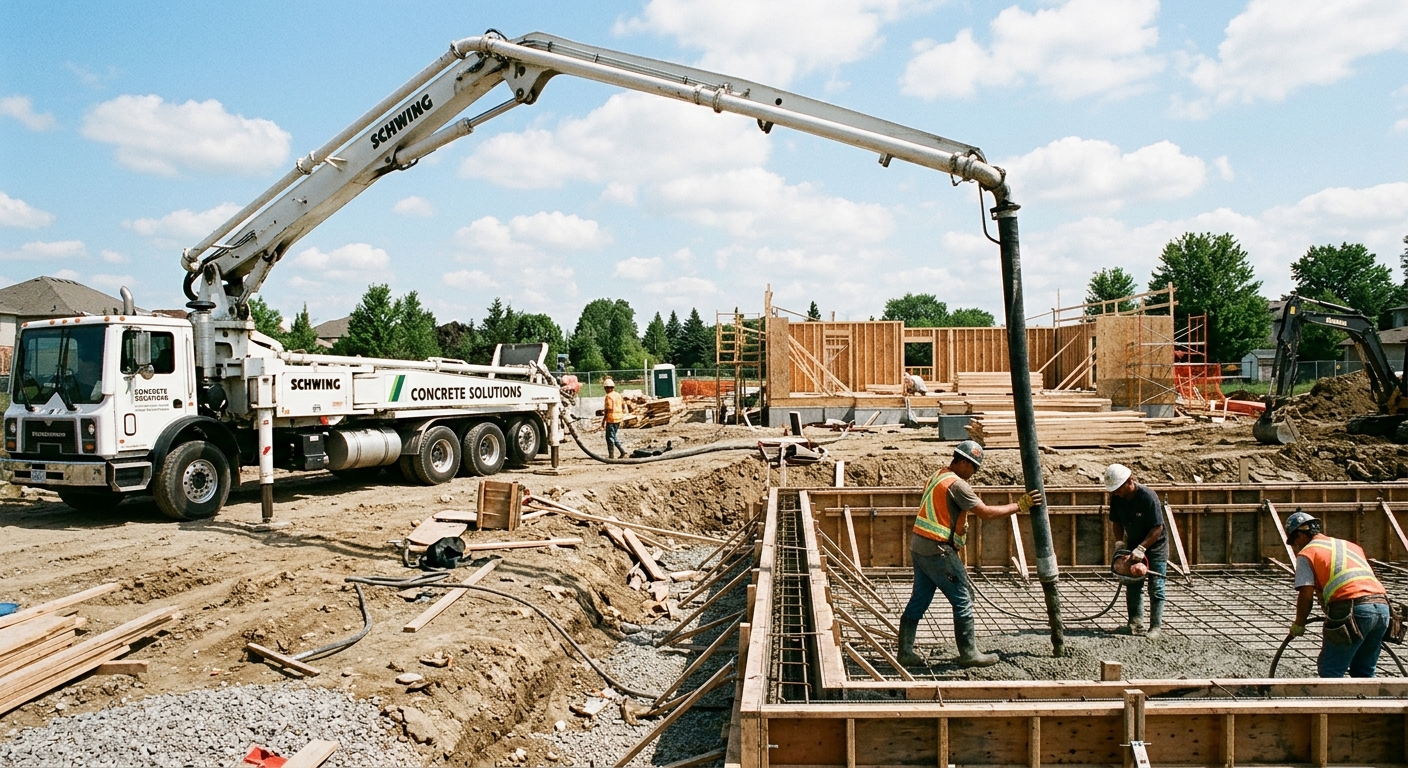
Concrete work options and costs in Vineland
Concrete contractors in Vineland, Ontario regularly price everything from simple walkways to frost-protected foundation footings. Vineland’s population is 4,074 (Statistics Canada, 2021 Census), and the local housing stock is dominated by owner-occupied homes where curb appeal matters—especially for driveways, patios and walkways. In practice, that’s why flatwork demand is steady in established pockets such as Vineland Station, where homeowners often renovate hardscaping around older homes and adjust drainage toward the street.
In the Toronto market, concrete costs are shaped less by “brand” and more by build science: frost depth, freeze–thaw cycles, and the short, weather-dependent pour season. Ontario Building Code expectations generally mean most structural footings must extend at least 1.2 m (about 4 ft) below grade to reduce frost heave and differential movement. For exterior slabs, crews typically use air‑entrained concrete and plan for proper thickness, base prep, and control joints to manage winter expansion and random cracking. When temperatures trend toward 10 °C or below, contractors may need longer cure times and additional protection (and sometimes temporary heating), which can raise labour and scheduling costs.
Because access and site conditions vary—especially soil moisture after rainy springs—quotes can move quickly. The table below compares typical options and the realistic price ranges you’ll see in Vineland, so you can start apples-to-apples conversations with bidders.
| Application |
Typical Size |
Key Spec |
Finish Option |
Price Range |
| Concrete driveway (standard broom finish) |
10 m x 3 m (about 30 m²) |
Air-entrained exterior mix, compacted granular base, control joints |
Broom finish + light edging |
$1,350–$2,750 |
| Exposed aggregate driveway |
10 m x 3 m (about 30 m²) |
Air-entrained mix, proper base, wash/retard technique |
Exposed aggregate with sealer |
$2,200–$3,600 |
| Stamped concrete driveway or patio |
8 m x 4 m (about 32 m²) |
Air-entrained mix, reinforcement as required, joint layout |
Stamp pattern + colour hardener/antiquing |
$2,500–$4,200 |
| Plain concrete patio or walkway |
4 m x 3 m (about 12 m²) |
Air-entrained exterior mix, compacted base, edging |
Broom or smooth-trowel finish |
$900–$1,700 |
| Garage floor (interior slab) |
6 m x 6 m (about 36 m²) |
Vapour barrier (if required), proper compaction, fibres or mesh as specified |
Plain trowel + sealer (optional) |
$1,400–$3,100 |
| Foundation footings (structural, below frost) |
Per linear foot / per footing segment |
Excavation, formwork, rebar cages, pour below frost depth |
Structural concrete only (no finish) |
$180–$300 |
Prices are estimates only and vary by project scope, site access and material selection.
What affects the price of concrete work in Vineland
In the Toronto economic region, it’s common to see the “same” concrete job land with differences of 30–50% between quotes. The usual reasons aren’t marketing—they’re the items that are hardest to measure up front: excavation complexity, granular base thickness, reinforcement needs, and how crews manage curing during cool wet stretches. Two contractors can quote a patio that’s the same square footage, yet one includes extra sub-base depth and air-entrained mix with proper protection; the other “saves” cost and leaves you with higher crack or spall risk.
Frost protection drives structural pricing. Frost line depth dictates footing form height and excavation volume, and Ontario expectations generally require footings to extend at least 1.2 m (about 4 ft) below grade to prevent frost heave. For exterior slabs and flatwork, freeze–thaw cycles push contractors to use air-entrained concrete and a realistic thickness with control joints. When the forecast drops toward 10 °C or below, crews may add blankets, temporary heating, and longer cure time management—labour and scheduling costs rise.
In Vineland, local conditions can raise or lower cost quickly. For example: (1) after spring rain, saturated subgrade may force contractors to over-excavate and replace base, which adds trucking and granular material; (2) driveway widening on a tight lot in older neighbourhoods around Vineland Station often increases labour due to shoring, forms, and restricted truck access; (3) heavy de-icing use increases the importance of sealing—skipping it can lead to early surface scaling, which effectively “restarts” the project. If you’re comparing typical bands, a plain patio may land around $16–$26, while stamped work usually sits higher (often $24–$40) because of extra labour, base preparation attention, and finishing time.
| Price Factor |
Why It Matters |
Cost Impact |
| Frost line depth |
Determines footing depth and form height |
More excavation and rebar placement = higher labour and concrete volume |
| Site preparation |
Excavation, grading, compacted granular base |
Wet or unstable soils can force additional base replacement and disposal |
| Reinforcement |
Rebar or wire mesh requirement |
Grid placement time + materials can add meaningful cost |
| Mix design |
Air-entrainment and compressive strength spec |
Air-entrained exterior mixes and strength targets can cost more but protect against freeze–thaw damage |
| Finish type |
Broom vs. stamped vs. exposed aggregate |
Stamped/exposed systems add labour, materials, and cure/finishing steps |
| Pour size and concrete truck access to site |
Traffic control, pump needs, distance from truck |
Pumping or long wheelbarrow carries can increase labour and restrict scheduling |
| Cold-weather curing precautions |
Heating and blankets |
Protective equipment and longer supervision add cost in cooler weeks |
| Control joint pattern and sealing cost |
Joint layout controls cracking; sealing protects surface |
Better joint spacing and sealing add line-item costs, but reduce maintenance and spalling risk |
Permits & regulations in Ontario
In Ontario, the permit picture depends on what you’re building and whether it affects the structure, grading, or drainage. In general, structural concrete work—including footings, foundation walls, and grade beams—requires a building permit and often engineered drawings that the municipality reviews. Concrete flatwork (patios, walkways and driveways) usually does not require a permit, unless your project affects lot grading, impervious surface limits, drainage to neighbouring areas, or work within the municipal right-of-way. Always confirm with the local authority before breaking ground.
For contractor accountability in Vineland, homeowner checks should be practical and step-by-step. First, request the contractor’s insurance certificates and verify they name you (or your property) as required under the work agreement, with coverage appropriate for concrete activities. Next, ask for proof of liability insurance and confirm the coverage is active for the project dates. For workers’ compensation coverage, verify WSIB coverage (or the applicable clearance letter where contractors provide it). Then, confirm whether any licensing is required for the scope and your municipality’s expectations.
Finally, ask for references from similar-scale projects in the area—driveway and walkway jobs are often won or lost on base prep and curing management, not just finishing.
Getting concrete right in Vineland's freeze-thaw climate
Concrete failures in Vineland usually trace back to two things: water movement and weak freeze–thaw resistance. If the base isn’t properly compacted and drained, the soil can saturate and expand/contract against the slab each winter. If the mix isn’t built for exterior exposure, inadequate air-entrainment can lead to spalling (surface flaking) after repeated freeze–thaw cycles and de-icing exposure. And if joints and curing aren’t managed, you’ll see early cracking that becomes a maintenance issue.
To spec the job correctly for the Toronto/Vineland climate, start with (1) base preparation: compacted granular sub-base to the correct depth based on soil and frost considerations, plus proper drainage away from the slab. (2) mix design: air-entrainment typically around 5–7% air for exterior flatwork, and a minimum 32 MPa compressive strength target. (3) control joints: an engineered or proven spacing plan so shrinkage and temperature movement crack in predictable lines instead of random patterns. (4) curing: minimum 7 days under appropriate conditions; in cooler periods, crews may need protection to maintain temperature for adequate strength gain. (5) sealing: a penetrating sealer applied after cure—commonly at 28 days—to repel meltwater and reduce surface scaling from de-icing salts.
Here’s where a price difference is justified: a stamped patio may cost more (often in the higher band, roughly $24–$40 per square foot equivalent in design scope), but if the contractor also includes the correct base thickness, air-entrained mix, joint layout, and cure protection, that extra cost can be the difference between a showpiece that lasts 10–15+ years and one that needs repairs sooner. Ask bidders to quote these specifications clearly, not just a “finish price.”
| Spec |
Why It Matters in Vineland |
What to Ask For |
Impact if Skipped |
| Compacted granular base (depth?) |
Prevents saturated soil movement during freeze–thaw |
State the granular base depth, compaction method, and drainage plan |
Settlement, rocking slabs, and premature cracking |
| Air-entrained concrete mix (target air %?) |
Improves durability in winter freeze–thaw cycles |
Ask for exterior air content target, typically 5–7% for exposed flatwork |
Spalling and surface scaling after winters |
| Compressive strength (MPa rating) |
Ensures strength gain for structural and surface durability |
Confirm minimum 32 MPa compressive strength and test/certification plan |
Lower durability and increased risk of surface damage |
| Control joints (spacing per ACI guidelines) |
Controls where cracking occurs during shrinkage and temperature swings |
Request the proposed joint spacing/layout and cut timing |
Random cracking and a rough, uneven appearance |
| Minimum 7-day curing period |
Cold snaps slow strength development and increase damage risk |
Ask how curing will be protected if temperatures drop |
Weak concrete surface and higher chance of early failure |
| Penetrating sealer (when applied after cure) |
Helps repel meltwater and reduces de-icing salt effects |
Confirm a penetrating sealer and timing—commonly after 28 days |
Faster scaling and staining; more frequent maintenance |
How to choose a concrete work contractor in Vineland
Start with verification. In Ontario, you want a contractor who can document coverage and compliance for the work they’re doing. Ask for a liability insurance certificate and confirm it’s active for the project dates and scope. For worker protection, request proof of WSIB coverage (or a clearance letter if they use that format). If the contractor is doing any structural or permit-required work, also confirm the permitting responsibility is clear in writing—who pulls the permit, who provides engineered documents if needed, and who schedules inspections.
Next, get 2–3 itemised written quotes. Don’t accept “lump sum with no breakdown” for concrete—ask for separate lines for excavation/grading, granular base, reinforcement, formwork, concrete supply, finishing, and surface protection/sealing. Clarify exclusions: Is disposal included? Is saw cutting included? Is equipment included for truck access challenges? Is permit pulling included, or billed separately? A contractor should be able to answer directly.
Warranty matters in freeze–thaw climates. Ask for (1) the length of the workmanship warranty, (2) whether it covers cracking/spalling related to workmanship or only labour, (3) manufacturer warranty terms for any admixtures/sealers, and (4) whether warranties are transferable if you sell the home. Payment schedule should protect you: never pay more than 10–15% upfront; hold back a meaningful portion until completion and cleanup. Finally, get a written timeline with a start date and a realistic completion estimate—concrete in Ontario often depends on weather windows.
- Verify WSIB coverage with a current clearance letter/certificate.
- Confirm liability insurance limits and that coverage is active for the job dates.
- Request 2–3 itemised quotes (labour + materials + accessories like reinforcement and sealer).
- Ask if the quote includes permit pulling where required (footings/foundation work).
- Confirm base prep depth, compaction method, and drainage slope plan.
- Ask for mix specs: exterior air-entrainment target and minimum compressive strength.
- Request the control joint plan (spacing and timing of cutting).
- Confirm curing protection plan if temperatures drop (blankets/heating as needed).
- Clarify reinforcement: rebar/wire mesh type, placement, and coverage.
- Check what’s included for disposal, haul-away, and restoration of sod/edges.
- Ask for the exact finish method (broom, stamped system, exposed aggregate process).
- Get a written schedule and a completion checklist before the first pour day.
Red flags to watch for in Vineland: contractors who refuse to specify air-entrainment, won’t discuss footing depth below frost for foundation work, quote concrete without a base prep description, ask for large upfront payments beyond 10–15%, or provide no written joint/cure plan—those shortcuts are the most common reason for winter surface failure.
Frequently asked questions — concrete work in Vineland
What is the difference between concrete and cement?
In plain terms, cement is one ingredient inside concrete. Concrete is the full mix: cement plus water, sand/aggregate (like crushed stone), and often additives such as air-entrainment for exterior work. In Ontario—especially around Vineland where freeze–thaw is a constant—contractors specify the concrete mix design, not just the cement brand, because the air content and strength development are what protect against spalling and cracking.
When you get quotes, ask for the contractor to state the mix is air-entrained for exterior slabs/driveways, and the target compressive strength. That’s the specification that matters for performance in a GTA winter.
How much does concrete work cost in Vineland?
Costs in Vineland generally align with the broader Toronto-region pricing bands, but your final number depends on base prep, access, reinforcement, and finishing. For example, a plain patio or walkway often falls around the $16–$26 band, while stamped & decorative concrete commonly lands closer to $24–$40 because it takes more labour and finishing time. Driveways also vary—standard broom-finish work typically comes in around the lower end of the driveway band, while exposed aggregate and decorative systems push the price up.
For budgeting, foundation work is priced differently (structural footings are typically around $180–$300 per footing segment/linear-foot equivalent depending on the scope). A good contractor will itemise labour, granular base, reinforcement, and sealing—so you can compare quotes fairly.
How deep must footings be for Vineland's frost line?
For most structural concrete in Ontario, footings are designed to extend below the design frost depth to prevent frost heave and differential movement. As a practical reference for many GTA builds, structural footings are commonly placed at least 1.2 m (about 4 ft) below grade, which is below the local frost considerations used in Ontario building design.
Your exact depth should be confirmed for your property conditions and engineering, because soil type, grade, and drainage matter. If a quote mentions “foundation below frost” but can’t state the depth or doesn’t discuss excavation and rebar placement, treat that as a concern—especially in freeze–thaw areas where poor footing depth can show up as movement years later.
Why does concrete crack in Vineland and how is it prevented?
Concrete cracks are often caused by shrinkage during curing, temperature swings, and—most importantly for Vineland—freeze–thaw movement combined with water in the base. If water saturates the subgrade, it can expand and contract against the slab. If joints are missing or poorly spaced, shrinkage and temperature stress create random cracking instead of controlled lines.
Prevention comes from a package: compacted granular base, an air‑entrained exterior mix, correct thickness, and a deliberate control joint layout with proper cut timing. Curing protection also matters when temperatures drop, because early freezing can weaken the surface. If you plan to use de-icing salts, sealing after the cure period helps reduce surface scaling that can look like cracking over time.
Stamped vs broom-finish concrete — cost difference?
Stamped concrete costs more than broom-finish because it requires extra steps: colour hardeners or release agents, moulding/stamping, and a more controlled finishing process. In the Toronto/Vineland market, that typically places stamped & decorative concrete in the higher range of the pricing band—about $24–$40—while broom-finish driveway/flatwork options generally sit lower, often based on the standard concrete driveway/slab band.
The important part is that you don’t “pay for looks only.” The best stamped jobs still include the right air-entrained exterior mix, correct base prep and joints, and curing protection for winter durability. If a low bid skips those specs, the stamping won’t prevent premature spalling—only good materials and methods will.
When is the best time to pour concrete in Vineland?
The best time is during the warmer months when crews can achieve proper curing conditions without extensive protection. In the GTA region, exterior pours are often concentrated in the spring through early fall windows because once temperatures trend toward 10 °C or below, crews need more curing protection (blankets and sometimes heating) and must manage longer protection periods for strength gain.
That’s not just a comfort issue—it directly affects durability in Vineland’s freeze–thaw cycles. A responsible contractor will discuss the forecast, specify how they’ll maintain curing temperature, and explain the minimum cure period (commonly 7 days for protection/strength gain, plus longer-term expectations for sealing readiness around 28 days). Always confirm that protection is included in the quote during cooler weather.