Concrete work options and costs in Dufferin Grove
Concrete work in Dufferin Grove is a year-round need in this Toronto neighbourhood, even though most exterior pours are concentrated in the warmer months. With a population of 11,785 (Statistics Canada, 2021 Census), local homeowners tend to focus on long-lasting driveways, patios, walkways, and—where needed—structural foundation repairs for older housing stock. In Toronto’s housing mix, most concrete flatwork demand comes from single-family homes and townhomes that want durable exterior surfaces through our freeze–thaw winters.
In the Toronto economic region, frost depth and repeated freezing and thawing strongly shape concrete specifications and costs. Structural footings must extend to at least about 1.2 m below grade in Ontario to reduce frost heave and differential movement, and exterior flatwork typically uses air-entrained mixes plus proper base drainage. When temperatures dip toward 10 °C or below, contractors often spend extra time and money protecting pours (insulation blankets, heaters, and scheduling buffers) so curing is reliable.
Availability also matters: during spring and early summer, driveway and patio crews can be booked solid because many projects need the same weather window for finishing and curing. If your property is in high-demand pockets around Dovercourt Village and the lanes connecting toward the neighbourhood’s main streets, it’s common to see faster lead times for standard broom finishes and longer waits for stamped or exposed aggregate.
Below is a realistic comparison of common options you’ll see in Dufferin Grove, along with the specs that drive pricing—then you can use these bands to sanity-check any quote.
| Application |
Typical Size |
Key Spec |
Finish Option |
Price Range |
| Concrete driveway (standard broom finish) |
400–600 sq. ft. |
Air-entrained exterior mix; compacted granular base; joints as required |
Broom finish + light sealer |
$18,000–$28,000 |
| Exposed aggregate driveway |
400–600 sq. ft. |
Proper base drainage; air-entrainment; wash timing controls |
Exposed stone texture |
$22,000–$34,000 |
| Stamped concrete driveway or patio |
300–500 sq. ft. |
Air-entrained mix; thickened edges where needed; release + curing care |
Stamp pattern + coloured surface (optional) |
$20,000–$40,000 |
| Plain concrete patio or walkway |
150–300 sq. ft. |
Compacted base; edge forms; control joints |
Float + light broom (or trowel finish where appropriate) |
$8,000–$15,000 |
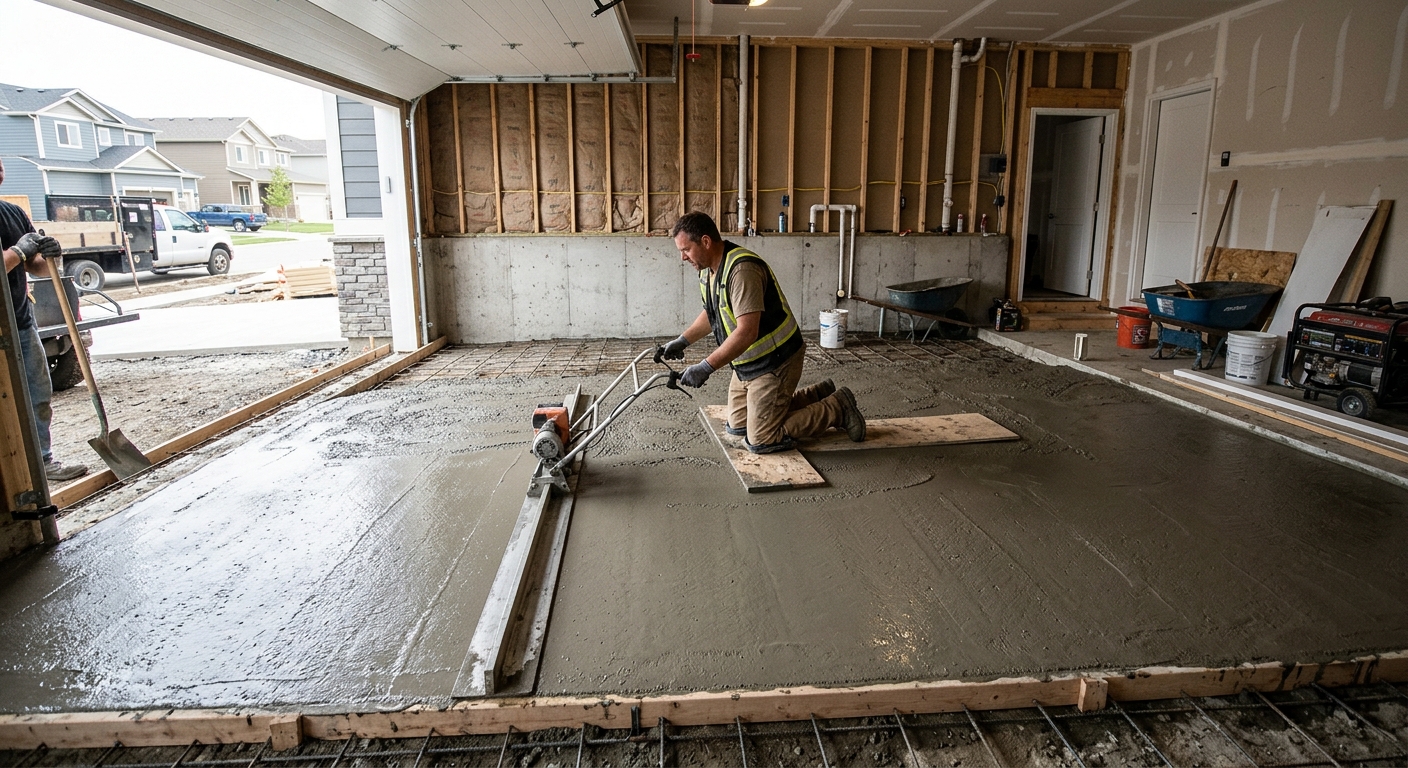
| Garage floor (interior slab) |
300–500 sq. ft. |
Vapour control/insulation as required; proper reinforcement; consistent thickness |
Standard broom or hard trowel |
$12,000–$22,000 |
| Foundation footings (structural, below frost) |
Varies by foundation size |
Engineered design; excavation to frost depth; reinforced structural concrete |
Not an appearance finish (structural concrete) |
$9,000–$18,000 |
Prices are estimates only and vary by project scope, site access and material selection.
What affects the price of concrete work in Dufferin Grove
In Dufferin Grove and across the Toronto economic region, quotes for the “same” concrete job can swing by 30–50% because the scope of preparation and the climate-driven specs aren’t identical from one lot to another. Two driveways may both measure 500 sq. ft., but one property may need extra excavation for weak soil, drainage rework, and a more robust base—while the other is straightforward. Likewise, exterior concrete pricing is influenced by the mix design (air-entrainment), thickness requirements, and finishing complexity (broom vs. stamped or exposed aggregate).
Frost line depth and freeze–thaw cycles dictate every part of the spec. In Ontario, structural footings are typically required to extend at least about 1.2 m below grade to help prevent frost heave and differential movement. Exterior slabs also need air-entrained concrete to survive repeated freezing and thawing, and properly planned control joints to limit random cracking. Cold-weather curing precautions add cost when pours are scheduled near colder periods; contractors may use heating and insulating blankets to protect early-age strength gain. Finally, de-icing salt can accelerate surface spalling if the concrete isn’t properly air-entrained and if sealing is skipped—so sealing often becomes part of a “whole durability” plan.
Local examples that raise or lower cost in Dufferin Grove include: (1) an interlock removal and regrading requirement after landscaping changes; (2) soft or saturated subgrade that forces deeper granular replacement; and (3) limited truck access that increases labour time. If you’re choosing between a plain patio and a stamped patio, you’ll often see the biggest jump justified by finish labour and materials—plain work aligns with the $16–$26 band for patios/walkways, while stamped finishes typically follow the $24–$40 band. When base prep is extensive, even a “standard broom” driveway can drift toward the higher end of the $18–$28 driveway band.
| Price Factor |
Why It Matters |
Cost Impact |
| Frost line depth — determines footing depth and form height |
Deeper excavation increases labour, disposal, and concrete volume. |
+5% to +25% |
| Site preparation — excavation, grading, compacted granular base |
Weak or wet soils require granular replacement and more base thickness. |
+10% to +40% |
| Reinforcement — rebar or wire mesh requirement |
Reduces cracking and movement for driveways, patios, and slabs. |
+3% to +15% |
| Mix design — air-entrainment and compressive strength spec |
Air entrainment improves freeze–thaw durability; strength affects thickness and performance. |
+2% to +12% |
| Finish type — broom vs. stamped vs. exposed aggregate |
Stamping/exposure adds labour, tools, and finishing time control. |
+15% to +60% |
| Pour size and concrete truck access to site |
Access determines batching logistics, pump use, and crew duration. |
+5% to +30% |
| Cold-weather curing precautions — heating and blankets |
Protects early strength when temperatures drop toward ~10 °C or below. |
+5% to +20% |
| Control joint pattern and sealing cost |
Joints manage cracking; sealing helps resist salt-driven surface deterioration. |
+2% to +10% |
Permits & regulations in Ontario
In Ontario, structural concrete work typically needs a building permit and, in many cases, engineered drawings reviewed through the municipal process. That means foundation-related items such as footings, foundation walls, and grade beams are generally “permit-required” concrete scopes. By contrast, concrete flatwork—driveways, patios, sidewalks, and walkways—usually does not require a permit unless your project affects lot grading, stormwater handling, or triggers impervious surface coverage limits, or involves changes near the municipal right-of-way. Even when a permit isn’t required for the slab itself, homeowners should confirm with the local authority before breaking ground, especially if there are drainage changes or any work near property lines.
Next, verify contractor coverage before signing anything. For Ontario work in Dufferin Grove, ask for proof of liability insurance and WSIB/WCB coverage (or the applicable provincial coverage status your contractor should hold). Then request references on similar-scale projects—driveway tear-outs, slab replacements, or foundation repairs—so you can see freeze–thaw durability outcomes.
A simple step-by-step homeowner check:
- Confirm the contractor’s business identity and standing via the relevant Ontario licensing/registration resources available online.
- Request a current Certificate of Insurance and check the coverage dates and whether concrete work activities are included.
- Ask for WSIB/WCB proof or clearance documentation and verify it matches the contractor’s legal name.
- Get a written scope and ask whether permits (if needed) are included in the contractor’s responsibility.
- Verify the work schedule and how curing protection will be handled if temperatures drop.
Getting concrete right in Dufferin Grove's freeze-thaw climate
In Dufferin Grove, concrete failures almost always trace back to a few predictable causes: poor base support, inadequate mix properties for freeze–thaw, weak early curing, or missing control-joint and sealing plans. To spec the job correctly, start with base preparation. Exterior flatwork needs a compacted granular sub-base to the right depth for your local soils and to manage drainage—if water sits under the slab, it freezes, expands, and pushes against the concrete.
Next is the mix design. For exterior work, air-entrainment is critical—commonly targeted around 5–7% air content—so the concrete can tolerate freeze–thaw cycling without spalling. On strength, a typical minimum spec is 32 MPa compressive strength (or as required by the design). Control joints should be cut or formed in a planned pattern so cracking occurs where you expect it, not randomly across the surface.
Curing is where many DIY or rushed jobs get into trouble. Plan for at least 7 days of proper curing under suitable conditions; in cold periods, contractors should use protection measures so the slab gains strength reliably. Then apply a penetrating sealer after the cure—often around 28 days post-pour—so the surface resists de-icing salts and moisture penetration during late fall and winter.
For homeowners deciding between options: a basic broom-finished patio might fall into the $16–$26 per sq. ft. band, while stamped work typically lands higher due to finish labour and materials. The price difference is justified when you’re getting the same durability specs (base, air-entrainment, joints, curing and sealing), not just decorative appearance. The most expensive mistake is a beautiful stamp over a weak, salt-vulnerable slab.
| Spec |
Why It Matters in Dufferin Grove |
What to Ask For |
Impact if Skipped |
| Compacted granular base (depth?) |
Prevents water retention and reduces frost-related movement under slabs and driveways. |
“What thickness of granular sub-base are you compacting, to what grade, and how is drainage handled?” |
Settlement, rocking slabs, early cracking |
| Air-entrained concrete mix (target air %?) |
Reduces freeze–thaw spalling risk in Toronto’s winter cycles and salt exposure. |
“Confirm the air content target (typically 5–7% for exterior flatwork) and the mix design.” |
Surface scaling/spalling within a few winters |
| Compressive strength (MPa rating) |
Ensures adequate early and long-term strength for traffic and seasonal stress. |
“What is the minimum compressive strength (e.g., 32 MPa) and will it be documented?” |
Wear, dusting, and cracking under normal use |
| Control joints (spacing per ACI guidelines) |
Manages shrinkage and movement so cracks don’t form randomly. |
“What joint spacing are you using, and where exactly will joints be placed?” |
Random cracking and expensive patching |
| Minimum 7-day curing period |
Cold snaps can slow strength gain and increase early-age damage. |
“How long will you cure, and what protection will you use if temperatures drop?” |
Weak surface, increased cracking and scaling |
| Penetrating sealer (when applied after cure) |
Repels moisture and helps defend against de-icing salts during winter. |
“Will you apply a penetrating sealer after cure (commonly around 28 days) and which product?” |
Faster deterioration and salt-driven spalling |
How to choose a concrete work contractor in Dufferin Grove
Choosing the right contractor in Dufferin Grove starts with verifying coverage and credentials. First, request proof of Ontario liability insurance—your certificate should list current dates and the correct legal name of the contractor you’re hiring. Second, ask for WSIB/WCB documentation (or the appropriate proof of coverage status) before work begins, and confirm the paperwork matches the company on the contract. Third, look for references on comparable Toronto freeze–thaw projects: driveways with proper air-entrainment and joints, and patios that have held up through winter.
Get 2–3 itemised written quotes rather than lump sums. You want a breakdown that covers labour, concrete supply, excavation, disposal, base preparation (including granular depth and compaction), reinforcement, finishing and jointing, and whether sealing is included. Pay close attention to what’s excluded: some contractors omit disposal, drainage rework, or saw-cut jointing until change orders—this is where budget overruns happen. Ask whether permits (if required for structural work) are included in their scope and who pulls them.
Warranty matters. Ask for a clear workmanship warranty length for flatwork and foundation pours, what it covers (cracks due to shrinkage vs movement), whether product/manufacturer warranties apply to sealers or admixtures, and whether the warranty is transferable if you sell the property. On payment, avoid large deposits—never pay more than 10–15% upfront; hold back a portion until the job is complete and cleaned up. Finally, insist on a written timeline with a start date and completion estimate, including how they’ll protect curing if temperatures swing in Toronto’s shoulder seasons.
- Confirm liability insurance certificate dates and coverage limits.
- Verify WSIB/WCB coverage documentation matches the contractor’s legal name.
- Ask for at least 2–3 recent photos of similar exterior flatwork in Toronto winter conditions.
- Require an itemised quote: base prep, excavation, disposal, reinforcement, concrete, joints, finishing, sealing.
- Check whether truck access/pumping is included or billed separately.
- Ask for the mix design details: air-entrainment and minimum strength (e.g., 32 MPa).
- Confirm the joint plan (spacing and locations) and how/when joints are cut.
- Ask how they protect curing if temperatures drop toward ~10 °C or below.
- Request the sealer type and timing (commonly after ~28 days cure).
- Make sure the contract states who is responsible for permits where required.
- Keep payment staged: 10–15% max upfront, holdback until completion.
- Ensure the crew will leave the site grade and drainage correct, not “good enough.”
Concrete contractor red flags in Dufferin Grove include: refusing to provide proof of insurance/WSIB/WCB, quoting only a single “per sq. ft.” number without base depth or joint details, skipping air-entrainment or curing protection language, pressuring for large upfront payments, and not providing a written warranty that clearly describes what’s covered.
Frequently asked questions — concrete work in Dufferin Grove
How long does a concrete project take in Dufferin Grove?
In Dufferin Grove, the timeline depends on whether you’re doing exterior flatwork (driveway, patio, walkway) or structural work (footings). For typical flatwork replacements, the scheduling rhythm is excavation and base prep first, then placing and finishing the concrete, followed by curing and protection. Even when the pour day itself is quick, you should plan for at least a week of curing-related handling before heavy use—especially if weather cools into the 10 °C range or below. If you’re installing a standard broom driveway, many crews can pour within 1 day after prep, then complete finishes and saw cuts the same day. Sealing, if included, is commonly applied after the concrete cure (often around 28 days). For reference, driveway pricing commonly fits the $18–$28 band in the Toronto area, and higher finish scopes (stamped/exposed) typically require more labour days for layout and finishing.
What is a concrete overlay and is it suited to Dufferin Grove?
A concrete overlay is a new layer of concrete or resurfacing product applied over an existing slab to restore appearance and function without full demolition. In Dufferin Grove’s freeze–thaw climate, overlays can be suited for the right existing surface—when the original slab is structurally sound, drains properly, and isn’t lifting or heavily failing from moisture under the slab. The key risk is that an overlay can hide ongoing movement: if the base underneath is saturated and freezing, the overlay may crack or debond too. Before choosing an overlay, ask the contractor to assess bond readiness, existing joint condition, and whether drainage and base issues are addressed. If your current surface has spalling tied to de-icing salt and freeze–thaw, it may be better to replace rather than overlay. For those considering cost versus longevity, a driveway replacement typically lands around the $18–$28 driveway band, but an overlay may look cheaper initially—without guaranteed durability if the sub-base is failing.
How do I seal concrete to protect it in Dufferin Grove?
Sealing helps protect exterior concrete from moisture and de-icing salt impacts common in Ontario winters. The biggest rule is timing: seal only after the concrete has cured properly—often around 28 days post-pour—so you don’t trap excess moisture beneath the surface. Use a penetrating sealer designed for freeze–thaw performance on exterior slabs; this type repels water rather than forming a thick film that can wear unevenly. In Dufferin Grove, plan the sealing window in a stretch of suitable weather (dry conditions) and confirm the surface is clean and fully prepared (no curing compounds, dust, or contaminants). Many contractors include sealing in flatwork pricing toward the middle of the band; for example, plain patio/walkway work often sits in the $16–$26 range, and adding sealing can nudge you toward the higher end depending on size and product. Ask your contractor to specify the sealer product, coverage rate, and whether an initial cleaning or etching step is required.
What is the difference between concrete and cement?
Concrete is the final construction material you see—the mixture of cement, water, and aggregates (like crushed stone and sand), plus sometimes admixtures for performance. Cement is one ingredient inside concrete: it’s the binder that reacts with water to form the paste that holds everything together. In freeze–thaw conditions like those in Dufferin Grove, what matters to performance is the concrete mix design—especially air-entrainment for exterior flatwork, appropriate strength (often minimum 32 MPa), and correct curing. Two mixes can have the same “cement content” conceptually, but differ substantially in air content and curing protection, which directly affects spalling risk in Ontario winters. When you request a quote, ask for mix specifics: air-entrainment target, minimum compressive strength, and how they’ll protect curing if temperatures drop. This is one reason quotes can differ—even if the driveway size is similar—because the contractor isn’t just pouring “cement,” they’re supplying a properly engineered concrete.
How much does concrete work cost in Dufferin Grove?
Concrete costs in Dufferin Grove are driven by scope, excavation and base prep, finish type, and how much protection the contractor needs for curing in Toronto’s climate swings. As a practical reference point for Ontario projects, driveway pricing in the Toronto area commonly falls around the $18–$28 band for typical concrete driveways and slabs, while patios and walkways often sit around the $16–$26 band. Stamped concrete usually increases cost due to layout, form control, and finishing labour—often aligning with the $24–$40 range for decorative work. If you’re doing structural footings, that’s a different category; foundation/footings work is typically quoted based on engineered quantities and excavation, and it commonly lands in an $180–$300 per linear-foot style range for the footing portion (contractors still vary based on access and total volume). If you want an apples-to-apples comparison, require an itemised quote showing excavation depth, granular base, reinforcement, mix design, joints, and sealing.
How deep must footings be for Dufferin Grove's frost line?
For Dufferin Grove and the wider Ontario region, structural footings are generally required to extend below the design frost depth to reduce frost heave and differential movement. In practice, many Ontario footing specifications are around 1.2 m below grade (about 4 ft) or deeper, depending on the engineered design and site soil conditions. The exact depth isn’t something you should guess—your architect/engineer (or the permitting design package) will specify footing elevations and requirements based on the project and geotechnical information. If you’re dealing with foundation repairs or new structural footings, ask the contractor to confirm the design details and show how they’ll excavate to the required elevation. Also, because Toronto-area freeze–thaw cycles punish weak base support, contractors may include additional excavation and granular replacement—another reason quotes can vary. If you’re budgeting for footings, foundation work is typically priced separately from flatwork and often reflects the engineered, below-frost portion of the scope.