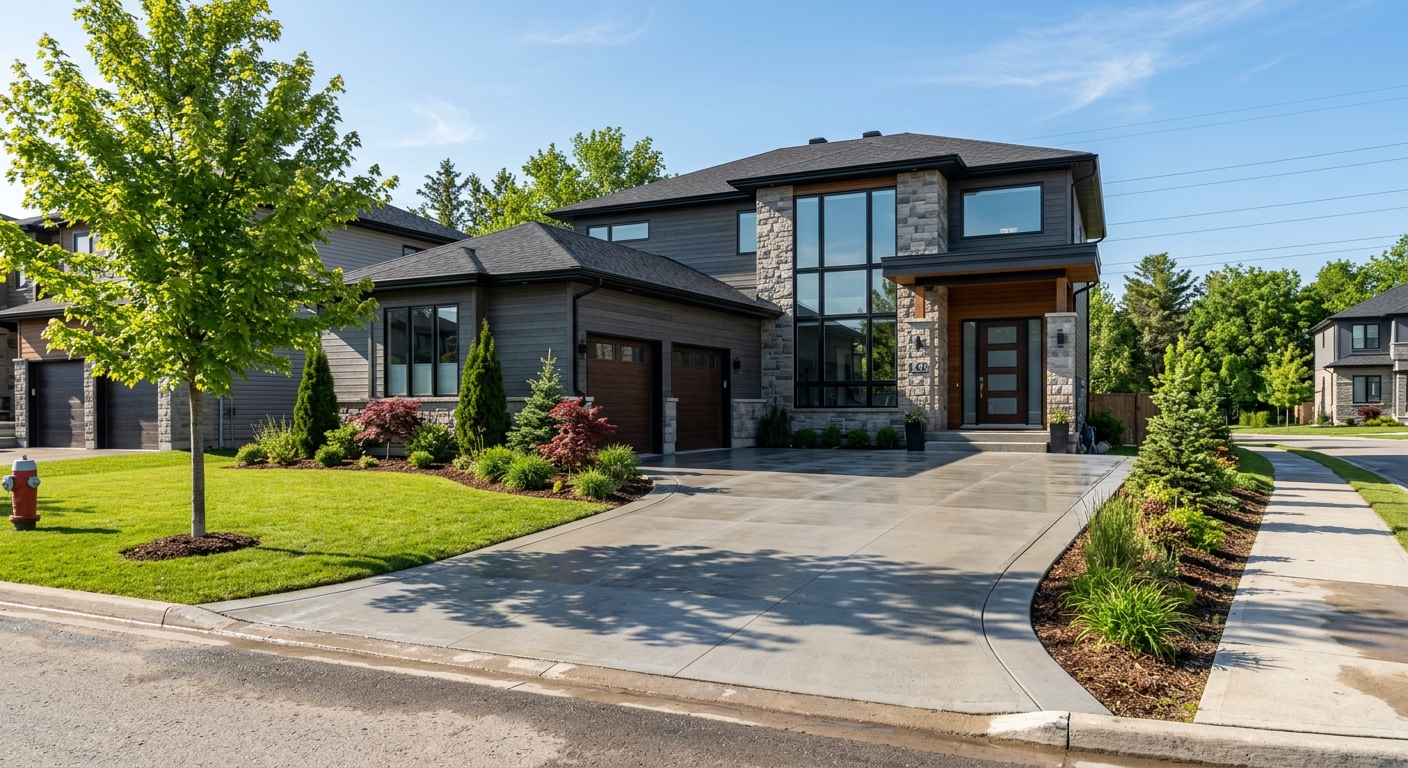
Concrete work options and costs in Barrie
Barrie homeowners typically choose concrete for driveways, patios and walkways because the area has a large owner-occupant market and a housing stock where single-detached homes make up 58.2% of dwellings (Statistics Canada, 2021 Census). With 37,435 homeowner households in the city and a median household income around $93,000 (Statistics Canada, 2021 Census), many projects are planned around exterior upgrades—especially in mature neighbourhoods where replacements are common.
The Kitchener–Waterloo–Barrie region’s cold, high freeze-thaw climate directly affects cost. Frost depth here is commonly in the 1.0–1.2 m (3–4 ft) range, so exterior work often needs footings set below the frost line and more excavation time than milder regions. Freeze-thaw cycles over winter also stress slabs and flatwork, which raises the importance of a proper granular sub-base, good drainage, and well-spaced control joints to reduce random cracking. On top of that, Ontario’s effective pour season is shorter, so contractors may schedule work tightly and use cold-weather curing protection more often.
In Barrie, trade demand is especially high around established areas like Allandale and along busy residential corridors where older driveways and patios are replaced for durability and curb appeal. The result is a wide but predictable price spread depending on prep, steel requirements, and finish choices—so use the comparison below to ground your conversations with bidders.
| Application |
Typical Size |
Key Spec |
Finish Option |
Price Range |
| Concrete driveway (standard broom finish) |
10 m x 4 m (40 m²) with simple forms |
Air-entrained mix; proper base & joints; drainage |
Broom finish, saw-cut joints |
$4,500 – $7,800 |
| Exposed aggregate driveway |
10 m x 4 m (40 m²) with surface exposure |
Air-entrained mix; controlled exposure process |
Exposed aggregate (wash/expose), sealed |
$6,500 – $11,000 |
| Stamped concrete driveway or patio |
8 m x 5 m (40 m²) |
Air-entrained mix; integral color; release agent |
Stamped pattern + border detailing |
$8,000 – $14,500 |
| Plain concrete patio or walkway |
6 m x 4 m (24 m²) |
Air-entrained mix; compacted granular base |
Float/trowel then light broom; control joints |
$2,000 – $5,300 |
| Garage floor (interior slab) |
6 m x 3 m (18 m²) |
Vapour barrier (if required), mesh or rebar as needed |
Medium trowel finish; saw-cut joints |
$3,000 – $6,000 |
| Foundation footings (structural, below frost) |
Per linear foot/meter, project-dependent |
Structural concrete + reinforcement; below frost |
Typical formwork finish for foundations |
$120 – $220 |
Prices are estimates only and vary by project scope, site access and material selection.
What affects the price of concrete work in Barrie
In the Kitchener–Waterloo–Barrie region, it’s common to see the “same” concrete job vary by 30–50% between quotes. The difference usually isn’t the cement—it’s the supporting work: excavation depth, granular base thickness, drainage detailing, reinforcement, and finish labour. In Ontario, these items get more expensive when frost considerations require deeper work and when contractors need more time to pour and cure correctly during cooler stretches of the year.
Frost line depth and freeze-thaw cycles dictate every spec. Footings must be extended below the design frost depth (Ontario commonly 1.5–2.4 m for structural foundations, depending on conditions) to prevent frost heave and cracking. For exterior slabs, air-entrained concrete is typically specified so freeze-thaw cycles don’t expand water inside the concrete and cause scaling. Cold-weather curing precautions—like insulating blankets or heating—add labour and material costs, and Ontario contractors are careful about de-icing salt use until adequate strength is achieved. Sealing is also important because early salt exposure can accelerate spalling on surface mortar.
In Barrie specifically, two factors often move the needle: (1) how deep the excavation goes to reach firm, compactable soil and the correct base depth for your site; and (2) whether your driveway is replacing an old slab with poor sub-base, which requires more removal and hauling. For example, upgrading from a plain broom-finished driveway (often in the $15–$25 per m² backbone band) to stamped concrete (often in the $22–$35 per m² band) can be justified when you’re adding colour and pattern across the full surface and want a longer curb-appeal payoff—rather than spending again in a few years.
Also, older homes built before 1981 account for 28.9% of Barrie’s housing stock (Statistics Canada, 2021 Census). Those properties frequently have older drainage patterns and settled approach slabs, so expect more site prep than a straightforward new-build flatwork install.
| Price Factor |
Why It Matters |
Cost Impact |
| Frost line depth — determines footing depth and form height |
Deeper excavation reduces heave risk in winter freeze-thaw. |
Higher excavation/formwork labour; can increase footing scope significantly. |
| Site preparation — excavation, grading, compacted granular base |
Controls settlement and helps manage water away from concrete. |
More trucking/hauling and compaction time if base is poor or soils are variable. |
| Reinforcement — rebar or wire mesh requirement |
Improves performance in heavier loads and reduces cracking. |
Additional material and placement labour, especially for driveways and garage slabs. |
| Mix design — air-entrainment and compressive strength spec |
Exterior durability depends on air-void system under freeze-thaw stress. |
Specialty mixes can raise material cost; incorrect specs risk early surface failure. |
| Finish type — broom vs. stamped vs. exposed aggregate |
Finish labour and surface treatment determine final durability and aesthetics. |
Stamped and exposed aggregate require more steps and skilled crews. |
| Pour size and concrete truck access to site |
Shortens or delays pours and affects labour efficiency. |
Small pours with tight access can cost more per m²; poor access may require extra handling. |
| Cold-weather curing precautions — heating and blankets |
Ensures adequate early strength when temperatures drop. |
Adds day-by-day labour and rental/material costs during shoulder seasons. |
| Control joint pattern and sealing cost |
Manages cracking locations and reduces water ingress at the surface. |
Better jointing may slightly increase labour, but sealing cost is usually a worthwhile upgrade. |
Permits & regulations in Ontario
In Ontario, structural concrete work in Barrie—such as footings, foundation walls, and grade beams—usually requires a building permit. Many projects also involve engineered drawings reviewed by the municipality because structural elements must meet code requirements for load capacity and frost protection. For exterior flatwork, many homeowners assume a permit is always needed, but in practice patios, walkways and typical driveways often do not require a permit unless they change drainage/lot grading or trigger municipal concerns around impervious surface coverage or work within or near the municipal right-of-way.
Before breaking ground, confirm requirements with the City of Barrie (or the applicable local authority) and ask bidders how they handle permits if one is required. At minimum, you should verify three contractor credentials:
- Ontario licence/registration where applicable for the contractor’s trade category and scope.
- Liability insurance (request a current certificate of insurance listing you as the named certificate holder if they do that).
- WSIB/WCB coverage for workers, to protect you if there’s an on-site injury or work-related claim.
Step-by-step, start by asking the contractor for their insurance certificate and WSIB/WCB clearance letter. Then, verify the information on the relevant public registries and by checking the certificate dates and coverage limits. Finally, request references on similar foundation or flatwork projects in Ontario so you know they’ve managed permitting and inspections before.
Getting concrete right in Barrie's freeze-thaw climate
Concrete failures in Barrie are usually predictable: water gets in, freeze-thaw expands it, and the surface pops (spalling) or the slab cracks randomly because the slab didn’t “move” in a controlled way. The fix is in the spec and workmanship. Start with (1) base preparation: a compacted granular sub-base to the right depth for local soil and frost; thin or poorly compacted base leads to settlement and cracking. Next (2) mix design: exterior flatwork should use air-entrained concrete with a 5–7% air content target and at least 32 MPa compressive strength for durability. If air-entrainment is wrong or skipped, you’re more likely to see surface scaling after winter cycles—one of the most common complaints in Southern Ontario.
Then get (3) control joints correct: joints should be saw-cut on a deliberate pattern to limit random cracking. (4) Curing matters more in cold weather—plan for at least 7 days of proper curing, and use protection like curing blankets or membranes if temperatures drop early. (5) sealing is typically applied 28 days after the pour to repel de-icing salts and reduce water ingress.
Ask bidders direct questions that reflect this climate reality: “What air content do you target?” “How deep is the granular base and how will it be compacted?” “What’s your control joint spacing plan for my slab size?”
As for cost trade-offs, a typical plain patio or walkway in Barrie can fall in the $14–$22 per m² range, while stamped options often land in the $22–$35 per m² range. That higher price is justified when the base and joints are already correct—otherwise, spending more on aesthetics while accepting a weak base is a common way homeowners end up paying twice.
| Spec |
Why It Matters in Barrie |
What to Ask For |
Impact if Skipped |
| Compacted granular base (depth?) |
Reduces settlement and manages moisture under freeze-thaw cycles. |
Granular base depth for your slab type + proof of compaction method. |
Uneven support, cracking, and premature failure around edges. |
| Air-entrained concrete mix (target air %?) |
Helps concrete resist freeze-thaw damage in Ontario winters. |
Documented air content target (typically 5–7% for exterior flatwork). |
Higher risk of scaling/spalling after repeated freeze-thaw. |
| Compressive strength (MPa rating) |
Supports early strength for curing and long-term durability under loads. |
Minimum 32 MPa (or project-engineered requirement) on the mix. |
Surface defects, reduced durability, and performance issues under traffic. |
| Control joints (spacing per ACI guidelines) |
Controls where cracking occurs when the slab contracts/expands. |
Planned joint spacing based on slab dimensions and finish type. |
Random cracking across the slab, water infiltration, and spalling. |
| Minimum 7-day curing period |
Proper cure is critical when temperatures swing in shoulder seasons. |
How curing is protected (blankets/membranes) if it’s cold or windy. |
Weaker surface, increased cracking, and reduced freeze-thaw resilience. |
| Penetrating sealer (when applied after cure) |
Repels salt and moisture that accelerate surface deterioration. |
Sealer scheduled about 28 days post-pour, with surface preparation steps. |
More water absorption and faster surface wear from winter maintenance. |
How to choose a concrete work contractor in Barrie
Choosing the right contractor in Barrie comes down to verification and clarity. First, confirm Ontario licensing/registration for their trade scope and ask for proof of liability insurance and WSIB/WCB coverage. The best approach is practical: request a current certificate of insurance (check dates and coverage limits), then request their WSIB/WCB clearance letter. If a bidder can’t provide documents quickly, that’s a red flag—especially on excavation and concrete pours where site injuries and property damage can be costly.
Next, get 2–3 itemised written quotes rather than a single lump sum. You want a breakdown that shows labour and materials for excavation, formwork, granular base, reinforcement, concrete supply, finishing, joints, curing protection, and disposal. Ask whether the permit (if required for structural work) is included and who pulls it. Also clarify exclusions like landscaping reinstatement, snow removal during scheduling, and whether costs include saw-cutting and sealing.
Look for a workmanship warranty (how long, what’s covered, and how they handle callbacks). Separate that from product/manufacturer warranty where relevant for sealers and admixtures, and ask if the warranty is transferable to future owners.
For payment, a solid standard is to avoid large advances—aim for no more than 10–15% upfront. Hold a portion back until key completion steps are done (for example, final jointing and sealing schedule). Finally, insist on a written start date and completion estimate that matches weather constraints in Southern Ontario.
- Ask for past projects in Barrie (especially similar sizes) and photos of control joints.
- Confirm they use air-entrained mix for exterior flatwork.
- Request how they confirm granular base depth and compaction method.
- Get a clear rebar/mesh plan: where it goes and whether it’s supported properly.
- Confirm saw-cut timing and joint spacing before they pour.
- Ask about curing protection if cold weather starts during the schedule.
- Clarify whether concrete disposal/hauling is included.
- Verify sealing: who applies it, when (about 28 days), and product type.
- Review whether drainage slopes are addressed at transitions and edges.
- Ask who provides the concrete and whether it’s batched for your mix spec.
- Ensure the quote includes protection for nearby structures and landscaping.
- Confirm warranty terms in writing and what triggers a workmanship claim.
Concrete red flags in Barrie include: a quote that doesn’t mention air-entrainment or curing steps, “we’ll figure out joints later,” refusing to show insurance/WSIB documents, rushing pours without cold-weather protection during shoulder season, and skipping sealing expectations when de-icing salts are used.
Frequently asked questions — concrete work in Barrie
How long does concrete take to cure?
In Barrie and across Ontario, concrete gains strength over time, and the curing schedule matters for winter performance. While you may be able to walk on many slabs after a shorter period, contractors typically plan around at least 7 days of curing for the slab to develop practical durability, especially for exterior flatwork exposed to cold nights and freeze-thaw cycles. Full strength takes longer—often up to 28 days—so you should avoid heavy loads and avoid aggressive de-icing practices early. If you’re sealing, many contractors apply penetrating sealer after the cure window (commonly around 28 days) to help repel moisture and salt. If your job is in late fall or early spring, ask how they’ll protect the pour with blankets or membranes so the concrete doesn’t lose heat too early.
Do I need a permit for concrete work in Ontario?
In Ontario, the answer depends on what you’re building. Structural concrete work—such as footings, foundation walls, and grade beams—typically requires a building permit, and engineered drawings are often reviewed by the municipality. For most homeowners in Barrie, typical flatwork like driveways, patios and walkways often doesn’t require a permit, unless it affects lot grading, drainage, or municipal right-of-way considerations. Before starting, confirm with the City of Barrie (or applicable authority) so you don’t get surprised during inspection. When you get quotes, ask whether the contractor includes permit pulling (if needed) and whether they’ve scheduled the right inspections. A reputable contractor will also provide proof of liability insurance and WSIB/WCB coverage—important regardless of whether a permit applies.
Concrete vs pavers for a patio in Barrie?
Both can work well in Barrie’s freeze-thaw climate, but the choice usually comes down to maintenance, look, and your base preparation tolerance. Concrete patios (plain or stamped) can be straightforward to install and finish, and they’re commonly priced in the $14–$22 per m² band depending on size, prep, and finishing. Pavers give you modular repair options—if a section settles, you can lift and reset a smaller area. Concrete, however, can deliver a seamless surface with correct slope, joints, and drainage. With freeze-thaw, what matters is not just the surface, but the foundation: both systems need a compacted granular base and good water management. If your goal is a strong, clean finish with fewer moving parts, concrete is often the simpler value; if you want maximum flexibility for future repairs, pavers can win.
How long does a concrete driveway last?
A well-built concrete driveway in Barrie can last decades, but “lasts” depends heavily on base preparation, air-entrainment, drainage, and how joints are executed. In a high freeze-thaw region, poor base compaction or inadequate air-void structure can lead to cracking, scaling, and spalling much earlier. Expect performance to be strongly tied to proper installation—footings and slab support below frost-impacted areas, correct thickness, and deliberate joint spacing. A standard broom-finished driveway typically falls in the $15–$25 per m² backbone band (project-dependent), while upgrades like exposed aggregate or stamped finishes can cost more due to added labour and finish steps. Spending on correct specs early is usually the difference between “looks good for a few winters” and a driveway that remains stable through many cycles.
What is air-entrained concrete and why does it matter here?
Air-entrained concrete is formulated with microscopic air bubbles that help relieve pressure when water inside the concrete freezes and expands. In Barrie, where winter freeze-thaw cycling is frequent, that air-void system is critical for exterior durability. If the concrete mix isn’t air-entrained (or the air content is wrong), water can damage the surface mortar, leading to scaling and spalling over time—often after repeated salt exposure and temperature swings. When you get bids, ask for the mix design details: target air content is commonly in the 5–7% range for exterior flatwork, and contractors should specify minimum compressive strength (commonly 32 MPa or as required). A credible quote should mention air-entrainment and curing/temperature protection—not just “regular concrete.”
How do I prepare the base for a concrete slab?
Base preparation is where many concrete failures are prevented, and it’s especially important in Barrie’s frost-affected conditions. The contractor should excavate to stable soil and then install a compacted granular sub-base to the correct depth for your slab type, site conditions, and drainage needs. The granular layer should be graded with the correct slope away from the house and compacted in lifts to avoid soft spots. For freeze-thaw durability, the goal is to keep water from pooling under the slab and to maintain consistent support so the concrete doesn’t settle unevenly. A good quote should describe excavation, granular base thickness, compaction method, and drainage treatment—not just the pouring and finishing. If you’re comparing options, remember that a “cheaper” quote often saves money by reducing prep, which can cost more later.