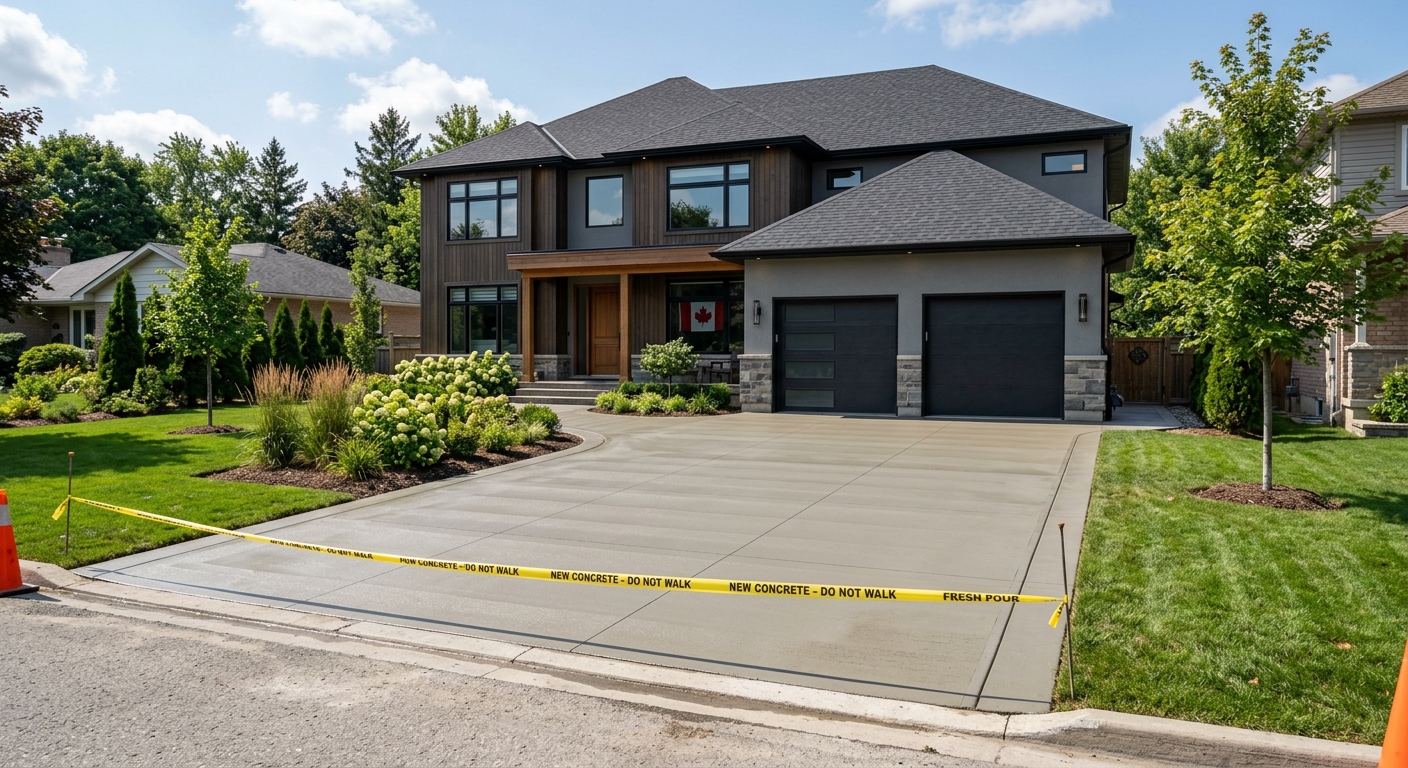
Concrete work options and costs in Conservation
Concrete work in Conservation, Ontario is all about getting the details right for a long freeze–thaw season. With a small population of about 3,095 residents (Statistics Canada, 2021 Census), most homeowners here rely on a limited pool of local contractors who can handle both residential flatwork and structural pours efficiently. Conservation’s housing stock is anchored by single-detached homes, which is why driveway replacements, walkways, and patio slabs are the most common calls I see. That demand is especially noticeable around established pockets like the downtown core and the surrounding residential neighbourhoods where access is tight and grading is often already settled.
In the Toronto economic region, costs are shaped by frost depth, freeze–thaw cycling, and municipal expectations for structural stability. Ontario typically requires structural footings to extend at least about 1.2 m (roughly 4 ft) below grade to reduce frost heave and differential movement. For exterior slabs, contractors almost always specify air-entrained concrete, adequate thickness, and control joints—because repeating winter expansion and contraction can lead to cracking and spalling if the mix or base prep is off.
Labour availability and the short, warmer-window pour season also affect quotes. When temperatures drop toward 10 °C or below, contractors spend more time on curing protection (insulating blankets, scheduling), and that labour/material overhead shows up in pricing. The table below gives practical, Conservation-ready ranges so you can compare options and decide what’s worth investing in before you book a site visit.
| Application |
Typical Size |
Key Spec |
Finish Option |
Price Range |
| Concrete driveway (standard broom finish) |
16 ft x 20 ft (320 sq. ft.) |
Air-entrained mix; compacted granular base; control joints |
Broom finish |
$5,760–$8,960 |
| Exposed aggregate driveway |
16 ft x 20 ft (320 sq. ft.) |
Air-entrained mix; proper slab thickness; consistent aggregate exposure |
Exposed aggregate (medium/large stone) |
$7,680–$11,520 |
| Stamped concrete driveway or patio |
12 ft x 24 ft driveway section (288 sq. ft.) |
Air-entrained mix; thicker slab for durability; release agents |
Stamped pattern + integral colour or antiquing |
$6,912–$11,520 |
| Plain concrete patio or walkway |
10 ft x 16 ft (160 sq. ft.) |
Air-entrained mix; compacted base; expansion/control detailing |
Plain broom or smooth finish |
$2,560–$4,160 |
| Garage floor (interior slab) |
20 ft x 20 ft (400 sq. ft.) |
Vapour control (as required); adequate thickness; jointing plan |
Broom finish or light trowel |
$7,200–$11,200 |
| Foundation footings (structural, below frost) |
Typical single-detached footprint |
Engineered design; concrete placement below design frost; rebar per plan |
Structural concrete |
$180–$300 |
Prices are estimates only and vary by project scope, site access and material selection.
What affects the price of concrete work in Conservation
Even when homeowners in Conservation ask for “the same driveway,” quotes can land 30–50% apart across the Toronto economic region because the real cost drivers are hidden in specs: base depth and compaction, reinforcement choice, mix design, and the time needed for cold-weather protection and proper curing. Contractors also price differently based on how much site work they must do to correct drainage and grade before concrete can last through Ontario’s winters.
In this region, frost depth and freeze–thaw cycles dictate nearly every structural decision. Footings must extend below the design frost depth to prevent frost heave and differential movement—Ontario’s typical requirement is about 1.2 m (about 4 ft) for many structural conditions. For exterior slabs, air-entrained concrete is essential to survive repeated freezing and thawing. When temperatures slide toward 10 °C or below, contractors need cold-weather curing precautions (insulating blankets, temperature monitoring, longer protection periods), which adds labour and sometimes equipment rental. Also, de-icing salt accelerates surface spalling, so sealing is often recommended for driveways and steps.
Concrete flatwork cost in Conservation can rise quickly on sites with poor drainage or clay-heavy soils where extra excavation and granular re-grade is needed. A typical standard broom-finish driveway might price in the $18–$28 per sq. ft. band, while stamped options can jump into the $24–$40 per sq. ft. range because of materials, finishing time, and greater attention to thickness consistency. If your home is older (common in established Conservation areas), existing slopes and drainage patterns can be off, and correcting them may add a few thousand dollars—especially if you’re replacing a larger portion of flatwork in one season window.
| Price Factor |
Why It Matters |
Cost Impact |
| Frost line depth — determines footing depth and form height |
Controls minimum excavation and structural stability against heave |
Can add significant excavation and forming labour |
| Site preparation — excavation, grading, compacted granular base |
Prevents settlement and reduces water saturation under slabs |
Higher if soil is poor or drainage correction is needed |
| Reinforcement — rebar or wire mesh requirement |
Helps control cracking and supports structural load transfer |
Adds material and placement time |
| Mix design — air-entrainment and compressive strength spec |
Improves freeze–thaw durability and scaling resistance |
Usually modest unit cost, but non-negotiable for longevity |
| Finish type — broom vs. stamped vs. exposed aggregate |
Extra labour for forms, stamping workflow, or aggregate exposure |
Stamped/exposed typically cost more per sq. ft. |
| Pour size and concrete truck access to site |
Affects crew time, hose/pumping needs, and schedule |
Hard access can add equipment and labour hours |
| Cold-weather curing precautions — heating and blankets |
Protects early-age strength gain when temperatures drop |
More common on late-season pours; increases overhead |
| Control joint pattern and sealing cost |
Reduces random cracking and helps limit salt-related spalling |
Small added line item that can protect the surface |
Permits & regulations in Ontario
In Ontario, the moment you get into structural concrete—such as footings, foundation walls, and grade beams—permits are typically required, and engineered drawings are commonly reviewed as part of the building permit process. For concrete flatwork (patios, walkways, driveways), many projects do not require a permit by default, but there are exceptions: if your work affects lot grading, drainage patterns, impervious surface coverage limits, or if it involves changes near a municipal right-of-way, the local authority may require approval. In Conservation, I strongly recommend confirming with the local building department before you break ground, especially if you’re lowering soil, removing topsoil, or changing how water flows away from the foundation.
For contractor verification, homeowners should take three steps in writing. First, verify the contractor’s Ontario licence status through the appropriate online registry, where applicable for their trades. Second, request a certificate of insurance (liability) that matches the project value and scope; the COI should list the correct insured parties and coverage limits. Third, confirm Workers’ Safety and Insurance Board (WSIB) coverage or the applicable workers’ compensation status (often shown as a clearance letter or proof of coverage). Ask for references on similar-scale Conservation jobs so you can compare how they handled base prep, joints, and drainage—those are the details that determine whether concrete lasts through the freeze–thaw cycle.
Getting concrete right in Conservation's freeze-thaw climate
Concrete failure in Conservation is usually not “bad concrete”—it’s poor spec and inadequate protection for winter. The most common issues I see are spalling and scaling (often from inadequate air-entrainment), random cracking from weak base or wrong joint patterns, and settlement when granular base isn’t excavated or compacted to the correct thickness. Toronto-area weather swings also make curing management crucial; when pours happen close to cooler nights, contractors must protect slabs long enough for early-age strength and durability.
To spec the job correctly, start with base preparation: use compacted granular sub-base sized for local soil conditions and install it to the proper depth so the slab doesn’t “float” on wet or unstable material. Next, require an air-entrained mix (commonly 5–7% air content for exterior flatwork) and a minimum 32 MPa compressive strength spec suitable for freeze–thaw exposure. Control joints matter too—spacing should be planned to limit shrinkage cracking to predictable lines. Curing is the next step: protect the slab for a minimum of 7 days under proper conditions, and use insulating blankets/heating if temperatures drop. Finally, sealing should be scheduled after the slab has properly cured (typically 28 days post-pour) using a penetrating sealer that helps repel de-icing salts.
As a practical example, a standard broom-finish patio might land around the $16–$26 per sq. ft. band, while stamped concrete often runs $24–$40 per sq. ft. The higher cost is justified when the contractor is also meticulous about thickness, air-entrainment, and jointing—otherwise you pay more for a surface that still can spall. If a quote for stamped concrete is only marginally above broom finish, ask what’s changing in the spec, not just the look.
| Spec |
Why It Matters in Conservation |
What to Ask For |
Impact if Skipped |
| Compacted granular base (depth?) |
Reduces moisture and settlement that worsen cracking in winter |
Granular sub-base type and compaction thickness (depth to match design) |
Settlement, rocking slab, early joint failure |
| Air-entrained concrete mix (target air %?) |
Prevents freeze–thaw scaling and spalling under de-icing exposure |
Air content target (typically 5–7% for exterior flatwork) |
Surface scaling, flaking, loss of durability |
| Compressive strength (MPa rating) |
Supports long-term load resistance through temperature cycling |
Minimum 32 MPa compressive strength at design age |
Reduced strength gain, higher risk of damage |
| Control joints (spacing per ACI guidelines) |
Channels shrinkage cracking into planned lines |
Joint spacing, layout around edges, and cutting timeline |
Random cracking, water intrusion, faster deterioration |
| Minimum 7-day curing period |
Builds early-age strength so the slab resists freeze–thaw later |
Protection plan; how curing is handled if nights get cold |
Lower durability and more cracking/spalling risk |
| Penetrating sealer (when applied after cure) |
Helps repel salts and moisture in winter |
Apply after proper cure (commonly ~28 days post-pour) and confirm product type |
More salt damage and faster surface wear |
How to choose a concrete work contractor in Conservation
Choosing a concrete contractor in Conservation is less about the cheapest bid and more about proof they’ll build to Ontario’s durability expectations. Start by verifying licensing/trade credentials where applicable in Ontario, then confirm liability insurance with a current certificate of insurance showing adequate limits and the correct project name/address. Next, ask for WSIB/WCB coverage documentation (often provided as a clearance letter or proof of coverage). These checks matter because concrete projects involve excavation, heavy deliveries, and lifting—your risk shouldn’t sit with you if something goes wrong.
Then get 2–3 itemised written quotes. I recommend quotes that break out labour and materials (concrete mix type, base prep scope, reinforcement, joints, sealing, and disposal). A lump-sum only quote makes it hard to compare apples-to-apples—especially in freeze–thaw work where base depth and mix design are non-negotiable.
Read the scope carefully: what’s excluded (site excavation, unplanned rock removal, hauling away concrete debris, snow/ice protection), is the permit pull included, and who handles forms, traffic control, and protection measures? Warranty matters too—look for a workmanship warranty length and confirm whether it’s tied to the installed slab and transferable if you sell. Finally, manage payment: never pay more than 10–15% upfront, and hold back a portion until the job is complete, broomed/finished as specified, and protected for curing.
- Written start date and completion estimate
- Proof of liability insurance (COI) before work begins
- WSIB/WCB clearance or proof of coverage
- Itemised concrete mix details (air-entrainment target and strength spec)
- Base prep scope: excavation limits, granular type, and compaction method
- Reinforcement plan (rebar/wire mesh and spacing) where applicable
- Joint layout: spacing, depth of cuts, and sealant plan (if required)
- Curing method and cold-weather protection plan
- Sealing included or excluded, and when sealing will be applied
- Traffic/access plan for safe footing and deliveries
- Disposal/haul-away responsibilities listed clearly
- Clear warranty terms (workmanship and materials)
Concrete red flags in Conservation include: a quote that doesn’t mention air-entrainment for exterior flatwork, refusing to discuss base depth and drainage, cutting corners on joint layout (“no joints needed”), rushing finishing and curing, or demanding a large upfront payment while omitting details like sealing and curing protection.
Frequently asked questions — concrete work in Conservation
How much does concrete work cost in Conservation?
Costs in Conservation usually track the Toronto-area reality of deeper frost considerations for structural work and freeze–thaw durability for exterior slabs. As a benchmark, concrete driveways and slabs commonly fall around $18,000 – $28,000 for typical driveway-size projects in the local pricing bands (often quoted per sq. ft. but translating into that total range depending on square footage). Patios and walkways are commonly in the $16,000 – $26,000 band for similar-size jobs, while stamped concrete tends to be higher—commonly $24,000 – $40,000 depending on complexity and pattern coverage. If your site needs extra base excavation or drainage corrections, the quote can move toward the higher end. Always ask for an itemised breakdown so you can see what’s driving the difference.
How deep must footings be for Conservation's frost line?
In Ontario, structural footings are generally required to extend below the design frost depth to reduce frost heave and differential movement. In the Toronto region, a common baseline you’ll see in construction details is at least about 1.2 m (roughly 4 ft) below grade for many residential structural conditions. That said, the exact depth can vary based on soil conditions, foundation type, and the municipality’s expectations—so your engineered foundation design governs. If a contractor tells you they’ll pour shallow footings “because everyone does,” that’s a major red flag in Conservation’s freeze–thaw climate. Ask to see the engineering details for the footing depth and confirm excavation and form height match the drawings.
Why does concrete crack in Conservation and how is it prevented?
Concrete cracks in Conservation primarily due to shrinkage as it cures and expansion/contraction from winter temperature swings. Freeze–thaw cycles add stress when moisture is present at the slab surface or in the base. The key prevention approach is not to try to “eliminate” cracks—it’s to control where they happen. Good base preparation with proper granular compaction reduces movement; air-entrained concrete improves freeze–thaw durability; and planned control joints channel shrinkage cracking into predictable lines. Joint spacing and proper cutting timing are critical. Sealing also helps limit moisture and salt exposure, which reduces surface scaling. If you’re comparing quotes, ensure the contractor specifies joint layout and air-entrainment for exterior flatwork—not just thickness.
Stamped vs broom-finish concrete — cost difference?
Stamped concrete costs more mainly because it requires additional labour and workflow: form/texture timing, release agents, curing discipline, and often higher attention to slab thickness consistency. In the Toronto economic region pricing bands, broom-finish driveway/flatwork is commonly around $18–$28 per sq. ft., while stamped/decorative concrete is commonly $24–$40 per sq. ft. That’s a meaningful difference, but it can be justified when the contractor also includes the durability spec work—air-entrainment, correct base prep, and a control joint plan. A cheap stamped quote that doesn’t address those factors is risky in Conservation winters because spalling from salt and freeze–thaw can ruin the surface quickly. Ask what changes in the mix and base prep, not just the finish.
When is the best time to pour concrete in Conservation?
The best time to pour in Conservation is when daytime temperatures stay reliably warm and overnight lows won’t compromise early-age curing. In the Toronto area, most exterior pours are scheduled in the warmer months so contractors can achieve proper curing without excessive cold-weather protection. When temperatures drop toward 10 °C or below, contractors may need insulating blankets, temperature monitoring, and longer protection periods—those add cost and time, even if the work is still done correctly. If you’re planning a driveway or patio replacement, aim for a window where the crew can complete finishing and curing protection before cold nights set in. For indoor slabs like garage floors, timing can be more flexible, but protection during the first days still matters for long-term performance.
How long does concrete take to cure?
Concrete curing is different from “drying,” and the timeline matters most in Ontario’s freeze–thaw climate. A common durability expectation is at least a 7-day curing period under proper conditions for many exterior flatwork projects. Early-age curing protects the slab while strength is developing—this is when cold nights can cause long-term weaknesses if blankets/heating aren’t used as needed. After the slab fully cures, sealing is typically scheduled around 28 days post-pour for penetrating sealers that help repel de-icing salts. That means you should plan for the practical timeline: finish and protect immediately, keep foot traffic controlled, then schedule sealing once the slab has reached the right cure window. Asking your contractor for a curing plan is one of the best ways to avoid surface spalling later.