Concrete work options and costs in Gravenhurst
Concrete work in Gravenhurst is shaped by a lot more than just square footage. With single-detached homes making up 78.4% of local dwellings, most driveway, patio, walkway, and garage-slab projects here start as homeowner upgrades rather than multi-unit builds. And since 54.9% of homes in Gravenhurst were built before 1981 (Statistics Canada, 2021 Census), many jobs involve replacing older, settled slabs or upgrading drainage around foundations. In the Muskoka–Kawarthas region, costs rise because frost lines typically run about the 4 ft range, so footings and foundations must be placed below frost to prevent heave. The freeze–thaw swings across fall, winter, and spring also increase demands for air-entrained mixes, solid granular base prep, and control joints to reduce cracking and surface spalling. Add to that a shorter practical pour season (often April to November) and it becomes harder to lock crews and trucks when temperatures fall—so both labour and equipment can price higher than in warmer markets.
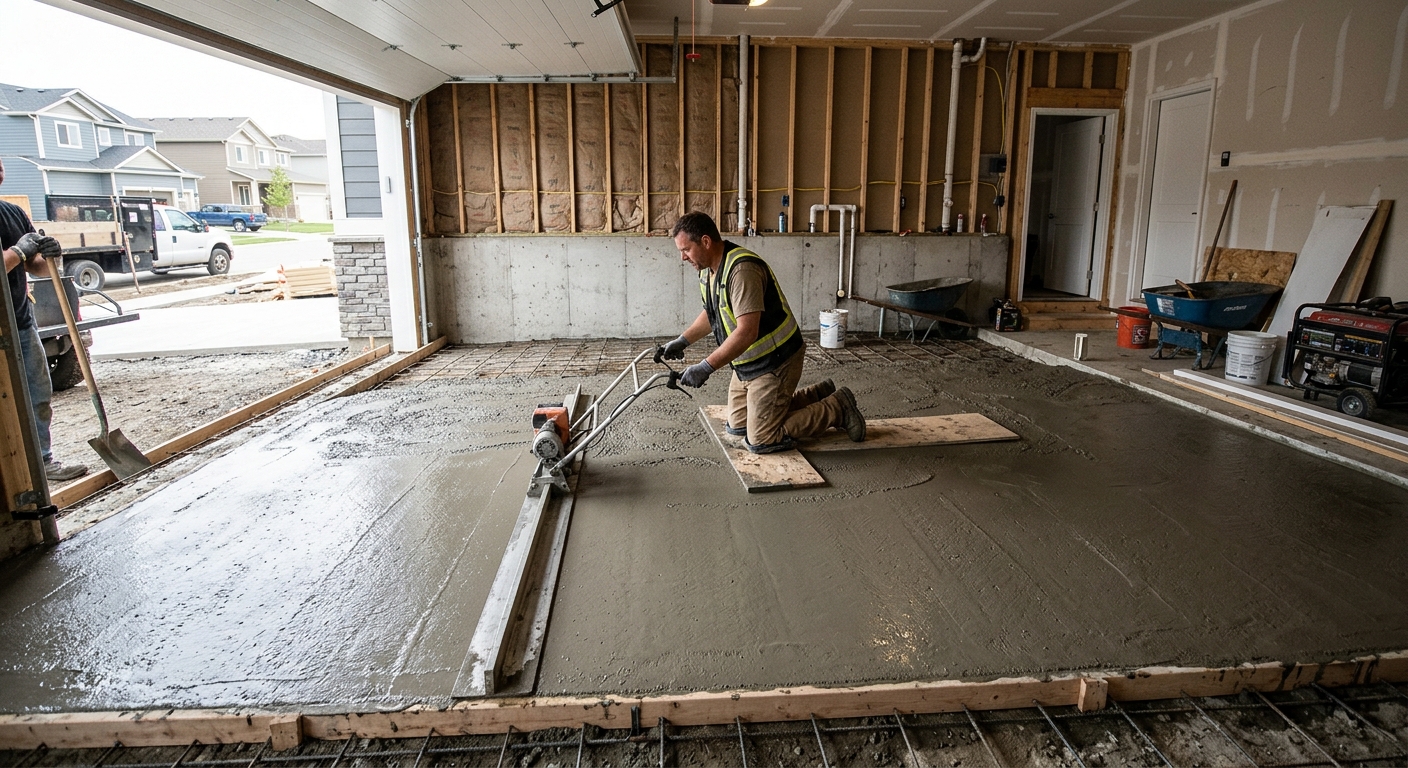
In Gravenhurst’s Lake Muskoka and downtown corridor, concrete flatwork is especially in demand because of heavy seasonal use and the higher moisture exposure around the lake. That’s where we see patios and driveways fail first if base drainage or air content is off. Below is a practical comparison of common options—so you can sanity-check your quote before you start detailed measurements.
| Application |
Typical Size |
Key Spec |
Finish Option |
Price Range |
| Concrete driveway (standard broom finish) |
400 sq. ft. |
Air-entrained mix, compacted granular base, control joints |
Broom-finished top, standard formwork |
$12,000–$25,000 |
| Exposed aggregate driveway |
400 sq. ft. |
Air-entrained mix, proper cure before wash |
Exposed stone finish (retarder/washout) |
$15,500–$30,000 |
| Stamped concrete driveway or patio |
300 sq. ft. |
Air-entrained mix, thicker surface design, release agent |
Stamped patterns (ashlar/fieldstone look) |
$15,000–$35,000 |
| Plain concrete patio or walkway |
200 sq. ft. |
Air-entrained mix, compacted base, scored joints |
Broom finish or light broom texture |
$4,000–$12,000 |
| Garage floor (interior slab) |
400 sq. ft. |
Vapour barrier (where needed), mesh/rebar reinforcement |
Float-finish with joints; optional sealer |
$14,000–$24,000 |
| Foundation footings (structural, below frost) |
Typical single home |
Excavation to frost depth, rebar cage, formwork, waterproofing coordination |
Structural concrete; workmanship under engineered design |
$18,000–$45,000 |
Prices are estimates only and vary by project scope, site access and material selection.
What affects the price of concrete work in Gravenhurst
Two homeowners in the Muskoka–Kawarthas region can receive quotes that differ by 30–50% for the same “concrete driveway” label because the hidden variables drive labour, excavation, materials, and scheduling. In Gravenhurst, the frost line depth and freeze–thaw cycles dictate nearly every spec: exterior work needs air-entrained concrete to survive repeated expansion and contraction, while footings and foundations must extend below the design frost depth (commonly around the 4 ft range) to prevent frost heave. That means deeper excavation, more forming height, and more concrete than many people expect from milder areas. The shorter practical pour season (often April–November) can also compress timelines, and cold-weather curing precautions (insulating blankets, heated enclosures for slabs and footings) add cost when crews have to work near temperature cutoffs.
Local conditions also matter. If your soil is sandy and drains well, the granular base prep can be straightforward; if you’re dealing with higher water tables or wet subgrades, you’ll likely see more undercut, drainage work, and thicker base layers—pushing pricing toward the higher end of the $12,000–$25,000 driveway band. If your project is in an older neighbourhood (54.9% pre-1981 housing stock; Statistics Canada, 2021 Census) you may uncover buried footers, old services, or settled approaches that increase demolition and regrading time. On the other hand, a simple 200 sq. ft. patio with a clear site and good access may fall closer to the $4,000–$12,000 range, especially if you keep to broom-finish rather than stamped or exposed aggregate.
| Price Factor |
Why It Matters |
Cost Impact |
| Frost line depth — determines footing depth and form height |
Deeper excavation and taller formwork required for code-compliant exterior foundations |
Often one of the biggest cost multipliers; typically pushes footing budgets toward the upper end of the band |
| Site preparation — excavation, grading, compacted granular base |
Proper drainage and compaction protect against settlement and heave |
Can add substantial labour and disposal if undercut and base replacement are required |
| Reinforcement — rebar or wire mesh requirement |
Controls cracking and improves load performance on driveways and slabs |
Material and labour increases, especially for garage floors and larger truck routes |
| Mix design — air-entrainment and compressive strength spec |
Freeze–thaw survival depends on correct air content and strength targets |
Premium materials and sometimes longer curing leads to higher rates but fewer failures |
| Finish type — broom vs. stamped vs. exposed aggregate |
Decorative finishes require extra labour, tools, and tighter timing |
Stamped and exposed work typically moves you toward the higher end of patio/driveway pricing |
| Pour size and concrete truck access to site |
Staging, pumping, and wheelbarrow distances affect labour and equipment needs |
Poor access can quickly add costs even with the same square footage |
| Cold-weather curing precautions — heating and blankets |
Gravenhurst temperatures can threaten early strength gain during marginal weather |
May require temporary heat/blankets, pushing labour and materials upward |
| Control joint pattern and sealing cost |
Joints limit random cracking; sealing helps repel de-icing salts |
Skipping or simplifying this is a false economy—repair risk increases after the first winter |
Permits & regulations in Ontario
In Ontario, structural concrete work—footings, foundation walls, grade beams, and other load-bearing components—generally requires a building permit and often engineered drawings that the municipality reviews before construction. For Gravenhurst homeowners, that typically means you should expect permit involvement when the work affects structural integrity or the building envelope. Concrete flatwork (like patios, walkways, and standard driveways) usually does not require a permit by default, unless it changes lot grading, touches drainage/impervious-surface rules, or involves work near municipal right-of-way features.
Before breaking ground, you should verify the contractor is properly insured and properly set up to work on your site. Start by asking for a current certificate of liability insurance and proof of WSIB/WCB coverage. Then, confirm licensing/eligibility through Ontario’s appropriate contractor registers/verification tools (what you look for depends on the contractor’s business structure, but the key is that they can legally perform the type of work you’re hiring). Finally, ask for references on similar-scale jobs in Muskoka—driveway and footing experience is a good sign if the contractor routinely handles frost-depth excavation, drainage details, and concrete finishing in freeze–thaw conditions.
Step-by-step, keep it simple: (1) request COI and WSIB/WCB proof, (2) ask for project references with addresses or neighbourhoods in the region, (3) confirm the scope clarifies permits and inspections if structural work is involved, and (4) document everything in writing.
Getting concrete right in Gravenhurst's freeze-thaw climate
Concrete failures in Gravenhurst most often come down to base problems, wrong mix design, inadequate joints, and short curing—then de-icing salts finish the job. To spec the work correctly, start with base preparation: you need a compacted granular sub-base to the right depth for local soil and frost conditions. If the base isn’t graded and compacted properly, the slab can settle and joints will open, which then accelerates freeze–thaw damage.
Next, the mix design matters. For exterior flatwork, request air-entrainment with a target of about 5–7% air content (for freeze–thaw durability) and a minimum compressive strength of 32 MPa for typical exterior applications. If the contractor provides a “standard” mix without confirming air content and strength, you’re gambling with spalling risk. Control joints are also critical—plan joint locations and spacing to limit random cracking, and ensure joints are cut or formed soon enough to manage shrinkage. Curing is where many schedules cut corners: aim for at least 7 days of proper curing, and if you’re near cooler temperatures, ask about curing blankets or temporary heat so the slab reaches strength reliably. Finally, sealing should be considered: a penetrating sealer applied 28 days after pour helps repel de-icing salt and reduces surface damage.
Here’s a realistic cost example: a stamped patio might be in the $15,000–$35,000 range depending on size and detailing, while a plain broom-finish patio may land in the $4,000–$12,000 range. The higher cost is justified if you want decorative results—just make sure the foundational specs (air content, base prep, joints, curing) are not “value engineered” down to hit the number.
| Spec |
Why It Matters in Gravenhurst |
What to Ask For |
Impact if Skipped |
| Compacted granular base (depth?) |
Reduces settlement and helps manage freeze–thaw moisture movement |
Minimum base thickness for your soil type plus proof of compaction |
Early cracking, pumping at joints, and uneven settling |
| Air-entrained concrete mix (target air %?) |
Protects against freeze–thaw scaling and spalling |
Confirm target air content for exterior work (commonly 5–7%) |
Spalling and surface scaling after one or more winters |
| Compressive strength (MPa rating) |
Ensures durability and reliable strength gain through cold seasons |
Minimum 32 MPa (and verify mix design) |
Lower durability and higher risk of performance issues under loads |
| Control joints (spacing per ACI guidelines) |
Controls where cracks will form during shrinkage |
Joint spacing plan based on slab thickness and layout |
Random cracking, water intrusion, and faster deterioration |
| Minimum 7-day curing period |
Early strength gain is essential during temperature swings |
How curing is handled; blankets/heat if curing temps are marginal |
Weak surface and reduced resistance to weathering |
| Penetrating sealer (when applied after cure) |
Repels de-icing salts and reduces water absorption |
Apply after cure—commonly around 28 days post-pour |
More scaling and staining; shorter surface lifespan |
How to choose a concrete work contractor in Gravenhurst
Choosing a concrete contractor in Gravenhurst comes down to verifying the basics and then pinning down the details that protect your concrete through freeze–thaw. First, confirm Ontario licensing/registration where applicable for the business, and always obtain proof of liability insurance and WSIB/WCB coverage (ask for the certificate and clearance documents—don’t accept “we’re covered” as a verbal claim). If you’re unsure what you should be looking at for a specific contractor, request it directly: they should be able to provide current documents on request.
Next, get 2–3 itemised written quotes rather than a lump sum. Ask for a labour + materials breakdown so you can compare base prep, reinforcement, curing methods, and finishing inclusions. Read the scope carefully: what’s excluded (old slab demolition, disposal, regrading, drainage adjustments), is a permit pull included where needed, and what happens if rock or unsuitable soil is found during excavation. For warranty, ask about workmanship warranty length and whether product/manufacturer warranties apply; also confirm if the warranty is transferable if you sell the home. For payment terms, avoid paying more than 10–15% upfront and request holdback until the job is complete and cured to a reasonable level for inspections and sealing. Finally, get the start date and completion estimate in writing—concrete schedules are weather-dependent here, and you want clarity on what triggers a delay.
- Request COI (liability) and confirm effective dates match your project timeline.
- Ask for WSIB/WCB proof and verify it covers workers on your site.
- Confirm they have experience with frost-depth excavation and below-frost footings (not just flatwork).
- Get quotes with measurements and a spec checklist (air-entrainment, joints, reinforcement, curing).
- Ensure base prep is itemised (granular type, thickness, compaction method).
- Confirm whether wire mesh vs rebar is included and where it’s placed (on chairs, not sitting on soil).
- Check finish details: broom texture type, edge finishing, and joint layout for your slab shape.
- Ask how they handle cold mornings and forecast swings (blankets/heating plan).
- Ask about concrete truck access and whether pumping is included.
- Confirm disposal and haul-away for removed concrete and unsuitable soil is included or priced separately.
- Clarify permitting: what is contractor-provided vs homeowner responsibility for structural work.
- Review warranty terms in writing (workmanship duration, what is excluded, and escalation path for fixes).
Concrete red flags in Gravenhurst: skipping discussion of air-entrainment for exterior slabs, promising “quick pours” without a curing plan, giving only a lump-sum number with no base/joint/sealing inclusions, refusing to provide insurance/WSIB/WCB documentation, or cutting corners on joint layout and sealing while expecting the slab to hold up through winter.
Frequently asked questions — concrete work in Gravenhurst
How much does concrete work cost in Gravenhurst?
Concrete pricing in Gravenhurst depends mainly on excavation depth, base prep quality, reinforcement, and finish level—especially because frost and freeze–thaw cycles drive specifications. For typical homeowners, a standard broom-finished driveway is often budgeted in the $12,000–$25,000 range, with higher costs when access is tight or when drainage and undercut are needed. For a simpler patio or walkway, many projects land in the $4,000–$12,000 band. If you go decorative, stamped concrete commonly moves upward (often $15,000–$35,000 depending on size and detailing). Quotes can vary a lot—30–50% isn’t unusual—because older homes may require extra demolition and regrading, and in Muskoka–Kawarthas we often spend more on curing and air-entrainment to prevent winter spalling.
How deep must footings be for Gravenhurst's frost line?
In Gravenhurst, footings must be placed below the local design frost depth to prevent frost heave—so excavation is typically around the 4 ft range for many residential structures in Ontario. The exact depth for your specific project depends on engineered drawings and your soil conditions, but the principle is non-negotiable: structural concrete elements like footings and foundation walls need to be below frost. This is why footing pricing sits higher than flatwork; the work includes deep excavation, more forming, rebar placement, and coordinated waterproofing details. If a contractor suggests a shallow footing “because it’s just a little extension,” that’s a red flag for a freeze–thaw region like Muskoka. For any structural work, confirm the permit path and engineered requirements up front before work begins.
Why does concrete crack in Gravenhurst and how is it prevented?
Concrete cracks in Gravenhurst largely due to shrinkage, settlement, and freeze–thaw stress. Even well-made concrete will crack if it doesn’t have a planned path for shrinkage; uncontrolled cracking then lets water in, which worsens damage over winters. Prevention starts with proper base preparation—compacted granular sub-base to the right depth—and correct reinforcement placement. Next is a freeze–thaw durable mix: exterior work should be air-entrained, typically targeting about 5–7% air for durability. Control joints are also essential: joint spacing and timing are designed to direct cracking to the joints instead of random locations. Finally, curing quality matters: at least 7 days of appropriate curing helps the concrete reach strength reliably. Sealing after cure can reduce de-icing salt impact. If your quote doesn’t address base, joints, curing, and air content, you’re likely buying future repairs.
Stamped vs broom-finish concrete — cost difference?
Stamped concrete costs more than broom-finished concrete because it requires premium materials and extra labour steps. Beyond the same core requirements (air-entrained mix, proper base, control joints, and curing), stamped work includes additional forming/detailing, release agents, stamping operations, and careful finishing timing. In Gravenhurst, decorative projects also tend to cost more when schedules are compressed by cooler shoulder-season temperatures. A plain broom-finished driveway may fall around $12,000–$25,000 for a typical size, while stamped concrete driveways or patios are commonly budgeted higher—often within $15,000–$35,000. The difference is justified if you want the decorative look, but make sure the contractor doesn’t “pay for appearance” by reducing the structural and durability specs. Ask specifically how air content, joint spacing, and curing blankets (if needed) are handled.
When is the best time to pour concrete in Gravenhurst?
The best time to pour concrete in Gravenhurst is during the warmer, stable part of the season—often from spring into early fall—typically April to November, depending on weather and temperature swings. The goal is to avoid freezing conditions during the critical early curing period. When temperatures drop, you may need heated enclosures, insulating blankets, or additional measures so concrete can develop strength properly. Even if a contractor can pour during shoulder season, you should ask for their cold-weather curing plan and how they monitor curing conditions. In a freeze–thaw region, “we’ll pour and hope” can lead to weak surfaces that spall earlier under de-icing salts. Scheduling can also affect crew availability—lake and downtown areas may see higher demand around peak construction periods. A good contractor will align your pour with forecast realities and provide a written curing approach.
How long does concrete take to cure?
Concrete cure time is often misunderstood. While concrete may be walkable sooner, it must reach strength over time. For typical exterior applications in Ontario, plan for at least a 7-day curing period under appropriate conditions to support durable performance in freeze–thaw cycles. Temperature and weather matter—if it’s cool, curing needs to be protected using methods like insulating blankets or controlled heat so strength development isn’t slowed. After about 28 days, it’s more common to apply penetrating sealers designed to repel water and de-icing salts (sealing sooner can trap moisture and reduce performance). If your project involves structural elements like footings, the timeline may be longer and must follow engineered and municipal inspection requirements. For homeowners in Gravenhurst’s colder winters, curing quality is a big driver of whether the slab survives the first winter without scaling or premature cracking.