Concrete work options and costs in Mill Courtland Woodside Park
Mill Courtland Woodside Park is a practical place to live, but winters are hard on exterior concrete—so getting the right mix, base, and joints matters just as much as the finishing. This neighbourhood is home to 3,639 residents (Statistics Canada, 2021 Census), and like much of the Greater Toronto Area, many homes are set up for frequent driveway, walkway, and patio upgrades over the years. In this market, concrete flatwork is typically in high demand in pockets where homeowners renovate between seasons—particularly around residential streets near Main Street area connections and busier corridors where access for concrete trucks is straightforward.
In the Toronto economic region, your costs are driven by freeze–thaw cycles and frost depth requirements. For most structural footings, Ontario spec calls for them to extend below the design frost depth to limit frost heave and differential movement; for exterior slabs and patios, contractors commonly use air-entrained mixes and plan control joints to manage cracking. You’ll also see seasonal impacts: crews focus exterior pours in warmer months to protect curing, since concrete quality drops when temperatures head toward 10 °C or below and protection isn’t used.
Even when two contractors quote the “same” driveway, the details often differ—base thickness, rebar or mesh, air content, joint spacing, and whether the work includes proper drainage and clean-up. The table below gives realistic starter ranges for Mill Courtland Woodside Park, so you can compare like-for-like and spot where a price is being earned.
| Application |
Typical Size |
Key Spec |
Finish Option |
Price Range |
| Concrete driveway (standard broom finish) |
10 ft x 20 ft (200 sq. ft.) |
6 in slab, compacted granular base, air-entrained concrete |
Broom finish + control joints |
$3,600–$5,600 |
| Exposed aggregate driveway |
10 ft x 20 ft (200 sq. ft.) |
6 in slab, properly graded stone, curing plan |
Exposed aggregate (surface retarder) |
$4,600–$7,200 |
| Stamped concrete driveway or patio |
10 ft x 20 ft (200 sq. ft.) |
6 in slab, release agent, integral colour |
Stamped pattern + stain/colour |
$5,000–$8,000 |
| Plain concrete patio or walkway |
12 ft x 16 ft (192 sq. ft.) |
4 in slab, compacted base, air-entrained mix |
Smooth or broom finish |
$2,300–$4,900 |
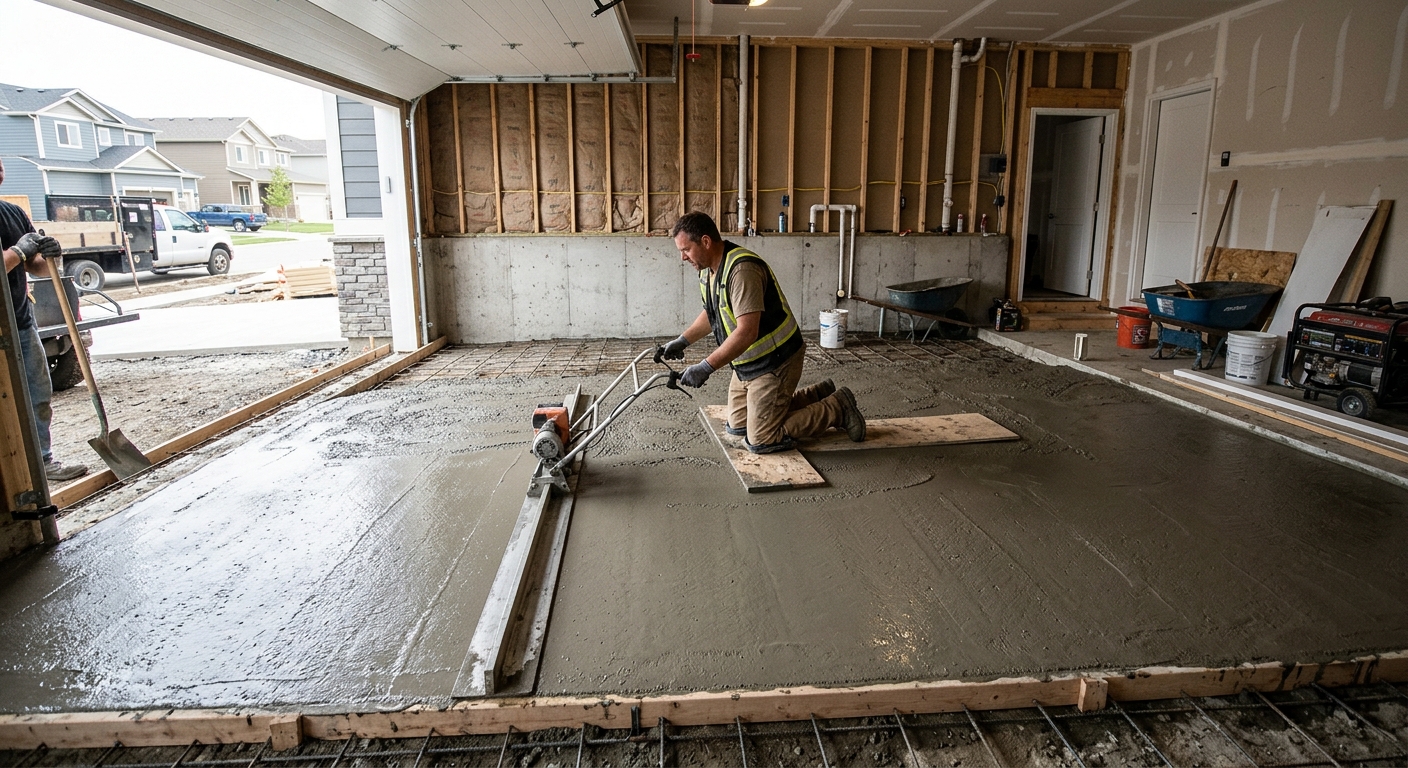
| Garage floor (interior slab) |
20 ft x 20 ft (400 sq. ft.) |
4 in slab, vapour considerations, jointing |
Broom or light trowel |
$7,200–$12,000 |
| Foundation footings (structural, below frost) |
Per project; typical home: multiple piers/footings |
Engineered/architectural plan, below-frost depth excavation |
Structural concrete placement |
$180–$300 |
Prices are estimates only and vary by project scope, site access and material selection.
What affects the price of concrete work in Mill Courtland Woodside Park
In Mill Courtland Woodside Park and across the Toronto economic region, it’s common to see the same type of concrete job come in 30–50% apart. Most of the difference isn’t the concrete itself—it’s the “hidden” scope: how much excavation and granular base is included, how the contractor manages frost protection and curing, what reinforcement is specified, and how much effort goes into drainage and jointing. A second quote that looks cheaper often has fewer layers, less steel/mesh (or none where it’s needed), or a finish plan that skips the steps that prevent winter damage.
Frost line depth and freeze–thaw cycles dictate the specs everywhere in Ontario. Structural footings generally must extend at least 1.2 m below grade to help prevent frost heave and differential movement, and that pushes excavation and formwork costs. Exterior slabs and driveways are also typically made with air-entrained concrete to survive repeated freeze–thaw. When temperatures drop toward 10 °C or below, crews need cold-weather precautions—extra protection, longer curing time, and sometimes heated enclosures—which adds labour and consumables. Plus, Toronto-area winters rely on de-icing salt; inadequate surface prep and sealing can accelerate spalling, so many responsible contractors include sealing as a recommended (or scheduled) step.
Here are a few Mill Courtland Woodside Park examples of where pricing moves: a driveway that requires heavy regrading or longer truck access can add thousands; a 200 sq. ft. broom-finished driveway might land around the lower end of the $18–$28 per sq. ft. backbone band, but switching to stamped concrete commonly pushes you into the $24–$40 per sq. ft. range because of higher material and labour. Older homes with established grades may also require more drainage correction before concrete is poured—often saving you from premature settlement that costs more to fix later.
| Price Factor |
Why It Matters |
Cost Impact |
| Frost line depth — determines footing depth and form height |
Below-frost placement reduces frost heave and movement |
More excavation and concrete volume; can swing structural costs by hundreds |
| Site preparation — excavation, grading, compacted granular base |
Base thickness and compaction control settlement and cracking |
Often the biggest “scope” difference between quotes |
| Reinforcement — rebar or wire mesh requirement |
Controls cracking from shrinkage and load stress |
Material + labour; may add 5–20% depending on layout |
| Mix design — air-entrainment and compressive strength spec |
Air entrainment supports freeze–thaw durability |
Higher-spec mix and QA notes; modest material increase with big longevity payoff |
| Finish type — broom vs. stamped vs. exposed aggregate |
Surface durability and appearance drive extra steps |
Can add material, release agents, saw-cut/joint work time |
| Pour size and concrete truck access to site |
Access affects pump use, lift requirements, and scheduling |
Long carries and pump/extra trips can raise costs noticeably |
| Cold-weather curing precautions — heating and blankets |
Protects strength development when cold slows curing |
Added labour and supplies; more common in shoulder seasons |
| Control joint pattern and sealing cost |
Joints manage cracking; sealing reduces moisture + salt damage |
Measured layout work plus sealer material and application time |
Permits & regulations in Ontario
In Ontario, permit rules depend on whether the concrete is part of a structure or part of “flatwork.” Structural concrete work—such as footings, foundation walls, and grade beams—typically requires a building permit, and engineered drawings may be reviewed by the municipality. For concrete flatwork like driveways, patios, and walkways, a permit is usually not required by default, unless the work affects lot grading, stormwater drainage, impervious surface coverage limits, or involves work within the municipal right-of-way. Always confirm requirements with the local authority before the first shovel hits the ground.
To verify a contractor properly in Mill Courtland Woodside Park, follow a simple step-by-step process. First, ask for their proof of liability insurance—you want to see the certificate of insurance for the correct legal entity and job address (where practical). Next, confirm WSIB coverage for workers performing the work (or the appropriate exemption if applicable), and request documentation. Then, check licensing/registration through the correct Ontario online resources for the contractor category (and make sure you’re not only dealing with a “crew” without proper coverage). Finally, request references for similar exterior concrete projects and confirm whether the contractor pulls permits when structural work is involved.
Getting concrete right in Mill Courtland Woodside Park's freeze-thaw climate
Concrete in Mill Courtland Woodside Park commonly fails due to moisture getting into the slab and then expanding during freeze–thaw cycles. The most frequent culprits I see are inadequate base prep, poor drainage, and—most importantly—insufficient air-entrainment. When exterior concrete lacks the right air content, water inside the mix freezes, expands, and can break paste, leading to surface scaling or spalling. That’s why the Ontario/Toronto market tends to prioritize an air-entrained mix, correct thickness, and a joint plan designed to reduce uncontrolled cracking.
To spec the job correctly, start with base preparation: ensure a compacted granular sub-base to the depth required for local soil conditions and frost protection, not just “whatever fits.” Next, confirm the mix design: for exterior flatwork, air-entrainment of about 5–7% is typical, with a minimum 32 MPa compressive strength stated in the quote and understood by the crew. Then lock in the control joints: spacing should limit random cracking and help joints act as the planned crack locations. Curing should be treated seriously—aim for minimum 7 days of proper curing conditions, especially if weather is cool. Finally, seal after cure—use a penetrating sealer applied about 28 days post-pour to repel moisture and reduce salt-driven deterioration.
As a cost example, on a 200 sq. ft. driveway, going from standard broom finish to stamped concrete might add roughly $1,400–$3,000 depending on thickness and colour complexity. That extra cost can be justified for appearance, but it never replaces the need for air-entrained concrete, proper base, and jointing—those are the parts that protect your wallet in year 5+.
| Spec |
Why It Matters in Mill Courtland Woodside Park |
What to Ask For |
Impact if Skipped |
| Compacted granular base (depth?) |
Prevents settlement and reduces cracking from movement |
Base depth and compaction method documented in the scope |
Uneven slab, early cracking, and pooling water |
| Air-entrained concrete mix (target air %?) |
Protects against freeze–thaw scaling and spalling |
Target air content stated (about 5–7% for exterior) |
Higher risk of spalling in winter |
| Compressive strength (MPa rating) |
Helps concrete reach design durability and strength |
Minimum 32 MPa (as stated in quote/spec) |
Surface wear, reduced long-term performance |
| Control joints (spacing per ACI guidelines) |
Controls where cracks occur during shrinkage |
Joint spacing plan and saw-cut timing confirmed |
Random cracking and moisture pathways |
| Minimum 7-day curing period |
Cold slows strength gain; protection is critical |
Curing plan for cool or wet weather |
Lower strength and increased surface damage risk |
| Penetrating sealer (when applied after cure) |
Repels moisture and reduces de-icing salt impact |
Sealer application at about 28 days post-pour |
Faster deterioration, scaling, and staining |
How to choose a concrete work contractor in Mill Courtland Woodside Park
Choosing the right concrete contractor in Mill Courtland Woodside Park comes down to verifying coverage, comparing scopes, and making sure they build to a durable exterior spec. First, confirm Ontario requirements: request liability insurance and ensure the certificate is issued to the correct legal business name and lists the work site where applicable. Next, verify WSIB coverage for workers (or obtain the contractor’s documentation for the applicable status). Don’t accept “we’re covered” without proof—ask for the certificate before work begins.
Second, get 2–3 itemised written quotes that break out labour and materials (base prep, granular, formwork, reinforcement, concrete supply, finishing, joints, cleanup, and any permit work). A quote that’s lower but doesn’t state base depth, joint spacing, reinforcement, or disposal often costs more after the fact. Read scope exclusions carefully: is haul-away and concrete disposal included? Is permit pulling included where required? Is sealing included or only offered later?
Third, check warranty terms. Ask for the workmanship warranty length, what it covers, and whether it’s transferable to the next homeowner. For payment schedule, never pay more than about 10–15% upfront; use a holdback until the job is complete and protected. Finally, lock in schedule: you should receive a start date and a completion estimate in writing, especially since colder nights can affect curing and surface quality.
- Proof of liability insurance before any materials are ordered
- WSIB coverage documentation for workers
- Itemised scope (base depth, thickness, reinforcement, joint pattern)
- Concrete spec stated: air-entrainment and minimum compressive strength
- Finish method explained (broom vs. exposed aggregate vs. stamped)
- Control joint spacing and planned saw-cut timing
- Curing and protection plan for cool or rainy conditions
- Whether de-icing salt durability is addressed with sealing
- Disposal and site clean-up included or clearly excluded
- Traffic plan and driveway access during the pour
- Warranty details in writing (workmanship + any product warranty)
- Payment schedule with a holdback until completion
Red flags I’d treat seriously in Mill Courtland Woodside Park: a quote that ignores air-entrainment for exterior work, no clear joint spacing plan, vague “we’ll handle permits” promises without specifics, lowball pricing that doesn’t mention base thickness or compaction, and requests for large upfront payments with no holdback or written timeline.
Frequently asked questions — concrete work in Mill Courtland Woodside Park
What causes concrete to spall in Mill Courtland Woodside Park winters?
Spalling in Mill Courtland Woodside Park usually comes from moisture getting into the concrete and then expanding as it freezes during Ontario’s freeze–thaw cycles. The biggest preventable cause is inadequate air-entrainment in the exterior mix—without enough microscopic air bubbles, freezing water damages the paste and can break the surface over time. Other contributors include insufficient compaction or base drainage (so water sits under or on the slab), missing or poorly planned control joints (so random cracking creates new water pathways), and sealing being skipped after the cure window. De-icing salts can accelerate deterioration once water is present. If your driveway or walkway was placed without proper winter-oriented specs, you can see scaling first, then spalling as the freeze–thaw cycle repeats.
What is rebar and when is it required in Ontario?
Rebar is steel reinforcement installed in concrete to control cracking from tension and to improve load capacity for structural elements. In Ontario, rebar requirements depend on the design loads and the specific part of the structure—flatwork thickness alone doesn’t always account for vehicle loads, soil conditions, or restrained edges. For many exterior slabs and driveways, contractors may use wire mesh or reinforcing bars depending on thickness, base, and whether the slab is designed to carry vehicles. For foundations and structural footings, reinforcement is typically specified by engineered drawings or structural design because the loads and frost environment are critical. When in doubt, ask your contractor to point to the structural drawings/specs and explain what reinforcement (size, spacing, and cover) is included.
How long does a concrete project take in Mill Courtland Woodside Park?
Timing varies by weather, curing conditions, and the scope of prep. For exterior flatwork like a driveway or patio, the actual concrete placement is usually fast—often just a day—but the schedule includes excavation, base prep, forms, and grading beforehand. After placement, you typically need at least 7 days of proper curing conditions before you treat it as fully durable; during cool or wet periods around Mill Courtland Woodside Park, crews may protect the surface longer. If you’re sealing, plan for application after the cure window—commonly around 28 days post-pour. As a realistic expectation, a broom-finished patio/walkway may be a multi-day project (prep + pour + cure protection), while stamped work often adds extra time for patterning and finishing.
What is a concrete overlay and is it suited to Mill Courtland Woodside Park?
A concrete overlay is a thin new layer placed over an existing concrete slab to improve appearance or extend service life, usually after surface preparation (profiling, cleaning, patching, and sometimes bonding methods). It can be suited to Mill Courtland Woodside Park when the existing slab is structurally sound—no major settlement, deep spalling, or severe cracking that has shifted. Overlays are less suitable when water has undermined the slab, because the movement will continue and telegraph through the overlay. For winter environments with freeze–thaw and de-icing salt, surface prep and bonding are non-negotiable. If your existing driveway is scaling or rocking, a full removal and replacement—often in the $18–$28 per sq. ft. band for standard work—may be the more durable value than an overlay.
How do I seal concrete to protect it in Mill Courtland Woodside Park?
Sealing helps repel water and reduce the impact of moisture and de-icing salts, which is especially important in Ontario’s freeze–thaw winters. In Mill Courtland Woodside Park, you generally want to apply a penetrating sealer after the concrete is fully cured—commonly about 28 days post-pour—so the concrete is dry enough to accept the sealer. The surface should be clean and free of dust or curing compounds; some sealers require light pressure washing and complete drying. Your contractor should also confirm whether the product is intended for exterior horizontal flatwork and whether it needs reapplication cycles. A quote for a driveway might vary significantly depending on whether sealing is included; if it’s not in the scope, ask when it can be added.
What is the difference between concrete and cement?
Cement and concrete are related but not the same. Cement is one ingredient—typically Portland cement—that acts as the binder. Concrete is the final engineered material made by mixing cement with water and aggregates (sand and stone), often with additives like air-entrainment for exterior freeze–thaw durability. In Ontario, the “air content” and strength spec you see in a driveway quote refers to the concrete mix design, not just cement. When you hear contractors talk about protecting against winter spalling, they’re mainly referring to concrete formulation (air-entrained mix and proper cure), correct base prep, and jointing. So when comparing quotes in Mill Courtland Woodside Park, focus on the full concrete spec—air-entrainment, thickness, reinforcement, and curing—rather than only the cement brand.