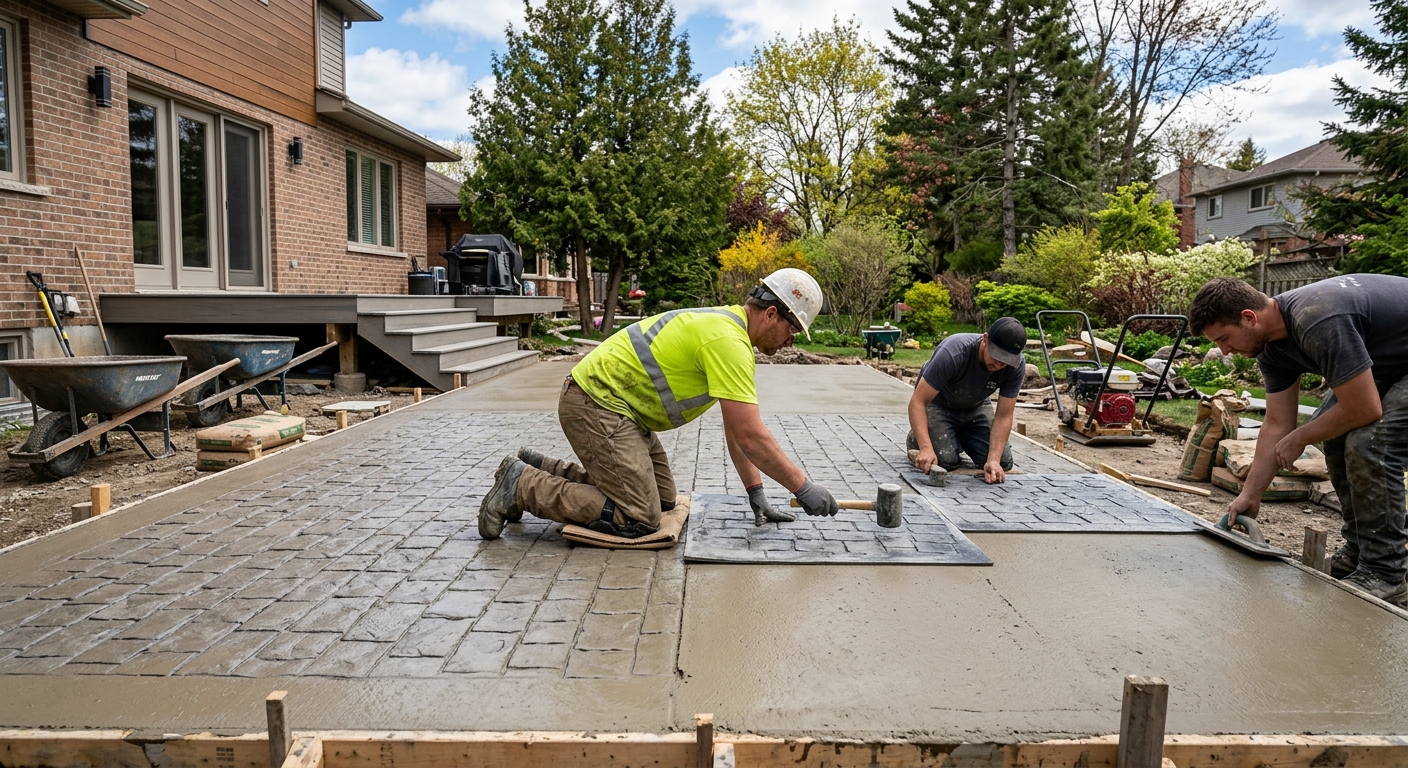
Concrete work options and costs in Smiths Falls
In Smiths Falls, Ontario, concrete options range from practical broom-finished driveways to decorative work like stamping—most local homeowners choose concrete because it handles the region’s freeze-thaw swings and heavy seasonal moisture when it’s detailed properly. Smiths Falls has a housing mix where 53.0% of dwellings are single-detached homes, which is exactly the kind of property that typically needs driveways, patios, walkways and garage slabs. With 79.8% of homes built before 1981, many projects are also renovations or additions (replacing settled flatwork, reworking drainage, or tying new concrete into older foundations).
In the Kingston–Pembroke market, the price difference is often less about the “slab” and more about what’s underneath and around it: site excavation, compaction, drainage, reinforcement, and getting the pour scheduled into a workable weather window. Frost protection also drives spec—exterior footings generally need to be set below frost to reduce heave, and exterior flatwork should use air-entrained concrete to better resist surface scaling and spalling. Because the warm pour season is shorter, contractors sometimes charge more to manage scheduling and cold-shoulder protection with blankets and curing discipline.
Demand is particularly steady in established neighbourhoods like Downtown and the West end, where older homes commonly need re-levelled driveways and refreshed front steps tied into municipal sidewalks and curb lines. With that in mind, here’s a realistic comparison of typical project costs you’ll see from local contractors.
| Application |
Typical Size |
Key Spec |
Finish Option |
Price Range |
| Concrete driveway (standard broom finish) |
400–600 sq. ft. |
Air-entrained mix; fibre or mesh as required; control joints |
Broom finish |
$3,200–$10,800 |
| Exposed aggregate driveway |
400–600 sq. ft. |
Air-entrained mix; washed topping; proper base prep |
Exposed aggregate |
$5,400–$13,500 |
| Stamped concrete driveway or patio |
300–500 sq. ft. |
Air-entrained mix; colouring; densifier/sealer system |
Stamp + colour + sealer |
$5,000–$14,000 |
| Plain concrete patio or walkway |
150–300 sq. ft. |
Air-entrained mix; slope to drain; joints |
Float/surface broom + simple edging |
$1,800–$4,500 |
| Garage floor (interior slab) |
400–700 sq. ft. |
Fibre/mesh as required; vapour barrier (if applicable) |
Standard trowel/finish |
$4,200–$12,600 |
| Foundation footings (structural, below frost) |
Per project |
Engineered footings; excavation and forming below grade |
Structural concrete |
$8,500–$28,000 |
Prices are estimates only and vary by project scope, site access and material selection.
What affects the price of concrete work in Smiths Falls
If you ask for bids for the “same” driveway in Smiths Falls, it’s common to see quotes land 30–50% apart across the Kingston–Pembroke region and Ontario. The slab thickness can be similar, but the cost swings are driven by site conditions and workmanship details that affect performance during freeze-thaw cycles. Local soil conditions, drainage, and the amount of excavation for proper base depth can easily add thousands—even before concrete is ordered.
In Ontario, the frost line depth and repeated freezing and thawing cycles dictate critical specs. Footings generally must extend below design frost depth (often around 1.2 m below grade as an Ontario practice baseline, with colder areas sometimes requiring deeper design). Exterior flatwork should use air-entrained concrete so it can better tolerate cycles without premature scaling. The shorter warm-season pour window also matters: in late fall or shoulder-season conditions, contractors may need heating, insulated blankets, and extra protection so concrete can achieve strength gain without surface damage. Another Ontario reality is de-icing salt; it can accelerate spalling if the mix and finish weren’t built for exterior exposure, and that’s why sealing discipline is important.
Two real examples from local jobs: (1) a driveway over old, poorly compacted fill often needs deeper granular base and re-compaction—this pushes the project toward the higher band for standard driveways; (2) a stamped patio with colouring and tighter finishing tolerances is usually where you see the jump into the $160–$280 per sq. ft. equivalent cost universe for decorative work, compared with simpler broom-finish work in the $120–$180 driveway band. Housing stock matters too: many pre-1981 homes have mature landscaping and tighter access, so excavation and disposal costs can be higher.
| Price Factor |
Why It Matters |
Cost Impact |
| Frost line depth — determines footing depth and form height |
Prevents frost heave by keeping structural concrete below freezing zones |
Can add major excavation/formwork time (higher end for foundations/footings) |
| Site preparation — excavation, grading, compacted granular base |
Controls settlement and directs water away from slab edges |
Often the biggest variable; poor base prep increases labour and materials |
| Reinforcement — rebar or wire mesh requirement |
Limits cracking and improves load capacity (especially driveways and garage slabs) |
Adds material and placement labour; sometimes required by design |
| Mix design — air-entrainment and compressive strength spec |
Improves durability against freeze-thaw and de-icing salts |
Higher-spec exterior mixes cost more per load and may require scheduling |
| Finish type — broom vs. stamped vs. exposed aggregate |
Changes labour intensity, tooling time, and curing/sealer steps |
Decorative finishes typically move you into higher bands |
| Pour size and concrete truck access to site |
Determines how much can be placed efficiently and in one workflow |
Limited access may require pumping/long carry, raising labour and logistics |
| Cold-weather curing precautions — heating and blankets |
Ensures proper strength gain and reduces surface damage risk |
Typically adds setup materials and time when conditions are cool/damp |
| Control joint pattern and sealing cost |
Joints manage crack locations; sealing helps protect surfaces |
Sealing adds a line item, but it prevents early deterioration |
Permits & regulations in Ontario
In Ontario, structural concrete work generally requires a building permit because it’s part of the structural system. That includes foundation footings, foundation walls, and grade beams (and any engineered structural concrete elements). In many cases, engineered drawings are reviewed by the municipality before work proceeds—so it’s not just “pour and go.” For concrete flatwork like patios, walkways, and driveways, a permit is usually not required, but it can become necessary if the work affects lot grading, changes impervious surface coverage rules, or ties into municipal or right-of-way constraints. When in doubt, confirm with the local authority before breaking ground in Smiths Falls.
Here’s a homeowner-friendly way to verify a contractor step-by-step:
- Ask for their Ontario licence details (and the specific company name registered to the work).
- Request a certificate of insurance showing liability coverage that matches the project scope.
- Confirm WSIB coverage (or the appropriate clearance documentation if applicable). A clearance letter is a good sign.
- Verify they carry coverage for employees/subcontractors they use on site.
- Check references for projects of similar size and exposure (exterior flatwork that sees salt and freeze-thaw).
- Get a written scope before you sign—don’t rely on verbal “we’ll handle it.”
Getting concrete right in Smiths Falls's freeze-thaw climate
Concrete failures in Smiths Falls usually come from a few repeat offenders: inadequate base preparation, incorrect mix design for exterior exposure, and weak curing discipline when temperatures drop. In a region with repeated freeze-thaw cycles and winter de-icing, the two most important performance choices are (1) the base being properly compacted to the right depth for frost protection, and (2) the concrete being air-entrained for durability. If these are wrong, you’ll often see scaling and spalling—especially at slab edges and within the first few winters.
To spec the job correctly, focus on five essentials. First, base preparation: use a compacted granular sub-base to the depth required for the local soil and frost considerations, not “whatever is on site.” Second, mix design: exterior flatwork should typically target 5–7% air content and meet at least a 32 MPa compressive strength spec (exact mix depends on design). Third, control joints: plan spacing to limit random cracking and to keep cracks tight. Fourth, curing: plan for at least 7 days of proper curing conditions; in cold weather, this often means blankets/insulating protection. Fifth, sealing: apply a penetrating sealer after the concrete has fully cured—commonly around 28 days post-pour—to repel moisture and salt.
When comparing options, decorative costs can be justified if you’re also investing in durability. For example, a stamped patio might cost more than a plain broom-finish walkway—say you’re choosing between a standard patio budget near the $90–$150 band and a stamped option that may land higher—but the extra cost is only worthwhile if the base prep, air-entrainment, joints, and curing are done right. A well-built plain patio will outperform a decorative one that’s been rushed or under-specified.
| Spec |
Why It Matters in Smiths Falls |
What to Ask For |
Impact if Skipped |
| Compacted granular base (depth?) |
Reduces settlement and helps frost protection perform over winter cycles |
Granular base depth plan based on soil conditions; compaction method documented |
Uneven slab, cracking, and water pooling at joints |
| Air-entrained concrete mix (target air %?) |
Improves resistance to freeze-thaw scaling and spalling from moisture and salt |
Air content target (commonly 5–7% for exterior flatwork) and mix design details |
Surface scaling/spalling within a few winters |
| Compressive strength (MPa rating) |
Supports long-term durability and wear resistance in an Ontario winter |
Minimum 32 MPa (or higher if specified), plus curing approach |
Lower strength gain; early surface damage under foot/vehicle loads |
| Control joints (spacing per ACI guidelines) |
Controls where cracks occur so they don’t travel randomly |
Joint layout and spacing plan; saw-cut timing |
Random cracking and wider fractures that allow water intrusion |
| Minimum 7-day curing period |
Cold or damp conditions slow strength gain without protection |
Curing method (blankets/heating if needed), timeline, and protection steps |
Surface weakness, increased cracking risk, reduced durability |
| Penetrating sealer (when applied after cure) |
Helps repel de-icing salts and reduces moisture ingress |
Penetrating sealer applied after full cure—commonly at ~28 days |
Faster deterioration at edges and in salted walk paths |
How to choose a concrete work contractor in Smiths Falls
Choosing the right concrete contractor is about proving capability and coverage, not just getting the lowest number. For Ontario work, verify three things: Ontario licensing details for the legal entity doing the work, liability insurance (ask for a current certificate showing project coverage), and WSIB coverage. To check WSIB, ask the contractor for a current status/clearance letter and confirm they’re set up for the type of work they’re performing. If they use subcontractors, insist that those parties are covered as well—don’t let the job become your liability.
Next, get 2–3 itemised written quotes. You want a breakdown that separates labour and materials (excavation, base, reinforcement, concrete supply, finishing, joints, sealer, disposal). A lump sum can hide scope gaps—like whether reinforcement is included or if truck access/pumping is allowed for. Read the scope for exclusions: Is permit pulling included (if required)? Is removal and disposal of old concrete included? Are accessibility constraints (narrow driveways, soft ground near the street) addressed?
For warranty, ask for both workmanship warranty length and any product/manufacturer warranty for sealer or specialty materials. Make sure the warranty terms are clear and whether they’re transferable. Payment should be controlled: never pay more than 10–15% upfront; use a holdback until the job is complete and any curing/protection steps are finished. Finally, ask for the start date and completion estimate in writing so you can understand the weather-window plan in Smiths Falls.
- Insurance certificate (liability) matches your address and job value
- WSIB clearance letter is current
- Clear licence/company name on paperwork matches the quote
- Itemised quote includes excavation and granular base prep
- Reinforcement is stated (mesh/rebar) and where it sits
- Concrete mix is specified for exterior durability (air-entrainment)
- Finishing method is detailed (broom direction, stamp patterns, aggregate wash)
- Control joint plan: spacing and cutting method/time
- Curing and cold-weather protection process is described
- Sealer type and application timeline (after cure) are stated
- Disposal/haul-away of old concrete is explicitly included or excluded
- Payment schedule aligns with completion milestones and holdback
Red flags in Smiths Falls: a contractor who won’t discuss air-entrainment for exterior slabs, quotes that omit base depth/compaction details, pressure to pay the full amount upfront, vague joint/curing timelines, and no written scope explaining disposal, pumping/access, or sealing responsibility.
Frequently asked questions — concrete work in Smiths Falls
Concrete vs pavers for a patio in Smiths Falls?
For most homeowners in Smiths Falls, the choice comes down to maintenance and how the patio handles winter moisture. Concrete patios are typically more budget-friendly and easier to detail for drainage with one continuous slab—especially if you’re using air-entrained concrete and proper control joints. Pavers look great, but they depend on excellent bedding sand, edging restraint, and frequent settling checks. With Smiths Falls’ older housing stock (many homes built before 1981) and established landscaping, access constraints can also make excavation/disposal costs similar for both options. If you’re comparing price bands, plain concrete patios often sit in the $90–$150 band, while decorative concrete (stamped) usually climbs into higher decorative pricing. If your base is questionable, concrete may be the simpler route as long as base prep is correct; if you want maximum flexibility for future repairs, pavers can be preferable.
How long does a concrete driveway last?
A well-built concrete driveway in Ontario commonly lasts 20 to 30 years, and sometimes longer—if the base is properly prepared, the concrete mix is air-entrained, joints are planned, and curing is protected. In the Kingston–Pembroke area, freeze-thaw and salt exposure tend to shorten service life when contractors skimp on the granular base or skip durability steps. If you’re starting from an older driveway, you might also be dealing with prior settlement, which can push cracking. That’s why “driveway price” varies so much even when the slab thickness looks the same. In Smiths Falls, standard driveways are often quoted within the $120–$180 per sq. ft.-style band (depending on size and site work), while higher-end conditions (tight access, extra prep, reinforcement) can bring you toward the upper end. A sealed exterior slab and good joint control can also slow surface deterioration.
What is air-entrained concrete and why does it matter here?
Air-entrained concrete is mixed with tiny air bubbles that give freezing water room to expand. That matters in Smiths Falls because the winter cycle of wetting, freezing, and thawing drives surface scaling and spalling if the concrete isn’t designed for freeze-thaw exposure. Standard concrete without air can deteriorate faster when de-icing salt is applied, particularly at edges and joints where water penetrates. In Ontario practice, exterior flatwork should use an air-entrained mix, and contractors should be able to explain the target air content for the project (commonly around 5–7% for exterior work) and the compressive strength spec (often at least 32 MPa). When contractors include air-entrainment and a joint/sealer plan, you’re paying for durability—not just aesthetics. That’s one reason two driveway quotes can differ significantly even if both mention “4 inches of concrete.”
How do I prepare the base for a concrete slab?
Base prep is where most performance problems begin. A proper concrete slab starts with excavation to reach suitable material and the installation of a compacted granular sub-base to the right depth for the soil and frost considerations. The key is consistent grading, correct compaction (not just dumping gravel and pouring), and drainage that prevents water from sitting under or beside the slab. For Smiths Falls, where freeze-thaw cycles are predictable, base compaction and drainage are essential because water movement increases frost risk and can worsen settlement. Ask your contractor to show (in the quote and plan) the granular base depth and how they compact it, and whether they include any reinforcement strategy needed for your application (mesh/rebar). Also ask what they include for site access and disposal, because excavation and haul-away can be a major cost driver.
How do I compare concrete quotes?
Comparing quotes is about comparing scope. In Smiths Falls and the broader Kingston–Pembroke region, it’s normal to see different totals because excavation, base prep, reinforcement, finishing complexity, and curing protection differ. Start by asking for itemised pricing (labour and materials) instead of lump sums. Confirm whether the quote includes excavation and compacted granular base, reinforcement (if needed), concrete mix design for exterior exposure, and a control joint plan. Check whether sealing is included and when it will be applied. For reference, if you’re comparing a plain patio budget, you might see pricing near the $90–$150 band, while decorative work like stamping generally moves into a higher range. A good quote will also address truck access, concrete delivery distance, disposal of old concrete, and what happens if weather conditions aren’t ideal.
Can concrete be poured in cold weather in Smiths Falls?
Concrete can be poured in cold weather in Smiths Falls, but it requires discipline and the right precautions. The main risk is that cold conditions slow strength gain, which can lead to surface damage if the concrete is opened to traffic too early. Contractors typically use cold-weather curing practices—insulation blankets, controlled heating, and careful scheduling—to keep the concrete within an acceptable temperature range for hydration. A reputable crew will also protect edges and avoid pouring when conditions exceed what their mix and curing plan can handle. Ask specifically about their heating/blanket method, curing duration, and what temperature triggers change their plan. If the job is exterior, don’t assume “any concrete will work”—exterior durability still depends on proper air-entrainment. Also, confirm the timeline in writing, because the shortened pour season in Ontario can affect when they can mobilize and finish safely.