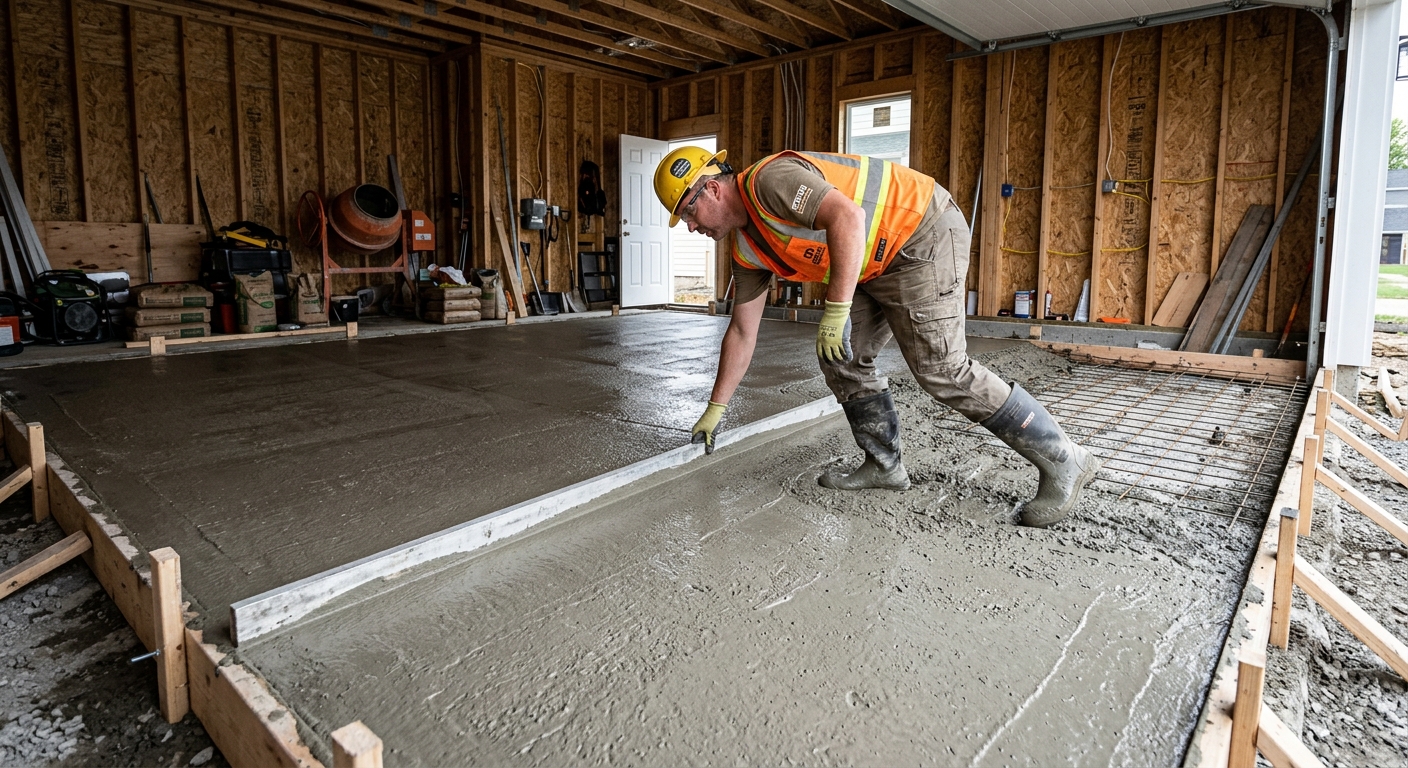
Concrete work options and costs in Rosedale-Moore Park
In Rosedale-Moore Park, concrete work is a year-round need, but the best-performing results still come from matching the mix and build-up to Toronto-area freeze–thaw conditions. With a population of 20,923 (Statistics Canada, 2021 Census), the neighbourhood market is busy enough that contractors often prioritize driveways, patios and walkway renewals for homeowners in the more established pockets near Yonge Street and the surrounding residential lanes. Rosedale-Moore Park is also dominated by traditional detached and semi-detached housing stock, which means demand is highest for exterior flatwork—especially replacements where older slabs have heaved at the edges or settled where drainage wasn’t routed away.
In the Toronto economic region, pricing is strongly tied to frost depth requirements and the need for air-entrained concrete on all exterior slabs. Typical structural footings need to extend at least 1.2 m (about 4 ft) below grade to reduce frost heave and differential movement, and that extra excavation and concrete volume can noticeably raise your total. Labour and material availability also tighten in peak summer pour windows, so scheduling flexibility can help. Because winters still bring frequent cold nights and freeze–thaw in shoulder seasons, contractors spend more attention on base preparation, proper drainage, control joints, and curing management—especially when daytime temperatures hover near 10 °C or when pours are pushed later in the fall.
Below is a practical comparison of common concrete options you’ll see quoted in Rosedale-Moore Park, using current Toronto-area price bands to help you sanity-check proposals.
| Application |
Typical Size |
Key Spec |
Finish Option |
Price Range |
| Concrete driveway (standard broom finish) |
300–450 sq. ft. |
Air-entrained mix; compacted granular base; control joints |
Broom finish, edges sealed |
$18,000 – $28,000 |
| Exposed aggregate driveway |
300–450 sq. ft. |
Air-entrained mix; proper surface retarder; robust base |
Exposed aggregate surface with sealer |
$22,000 – $34,000 |
| Stamped concrete driveway or patio |
250–400 sq. ft. |
Air-entrained mix; thickness per design; integral colour |
Stamp pattern + colour hardener; sealer |
$24,000 – $40,000 |
| Plain concrete patio or walkway |
200–350 sq. ft. |
Compacted base; drainage slope; control joints |
Float + broom finish |
$16,000 – $26,000 |
| Garage floor (interior slab) |
300–500 sq. ft. |
Vapour control as needed; mesh or rebar depending on loads |
Standard trowel or broom finish |
$18,000 – $28,000 |
| Foundation footings (structural, below frost) |
Varies by house plan |
Below frost depth; engineered rebar placement; proper formwork |
Construction-grade finish (not exposed) |
$180,000 – $300,000 |
Prices are estimates only and vary by project scope, site access and material selection.
What affects the price of concrete work in Rosedale-Moore Park
In Toronto, you can see the same-looking concrete job vary by 30–50% between quotes, even when the homeowner is comparing “similar” square footage. The difference usually comes from what’s underneath the visible slab: excavation depth, the granular base specification, reinforcement, mix design, and how well the contractor manages curing in the real temperatures you’ll experience around Rosedale-Moore Park. For structural work, footing depth is non-negotiable—Ontario requires footings to extend below the design frost depth (typically in the 1.2 m range for many residential conditions) to prevent frost heave and differential movement. For exterior flatwork, GTA contractors commonly specify air-entrained mixes so the concrete survives repeated freeze–thaw cycles. Those requirements push total cost higher than in milder climates.
Cold-weather pacing matters too. The Toronto corridor has a shorter reliable pour season than many homeowners expect, and concrete that’s poured when temperatures drop toward 10 °C or below needs cold-weather protection—heating, insulating blankets, and extra crew attention. On top of that, de-icing salt accelerates spalling if the slab isn’t built to last; sealing and correct finish choices (like broom vs. textured surfaces) often become part of the durability discussion.
Here are a few ways local conditions raise or lower cost in Rosedale-Moore Park:
- Edge heave repairs: if drainage is poor and the base is saturated, contractors must remove and rebuild the base, not just patch the surface—this can swing a walkway project toward the higher end of the $16–$26 band.
- Later-season pours: pouring too late can add curing protection; for patios or driveways, that’s one reason stamped work at $24–$40 can climb when scheduling pushes into cooler weeks.
- Access constraints: narrow laneways or limited truck access can mean more labour for wheelbarrowing, which typically increases driveway and slab costs.
With older homes and established landscaping common in this area, removal of existing concrete and hauling/disposal can also become a large portion of the quote—sometimes nearly as significant as the pour itself.
| Price Factor |
Why It Matters |
Cost Impact |
| Frost line depth — determines footing depth and form height |
Footings must extend below design frost depth to reduce heave and movement |
Major cost driver for foundations/footings; adds excavation, concrete and rebar |
| Site preparation — excavation, grading, compacted granular base |
Proper base stops water saturation and supports stable slab movement |
Can swing quotes significantly if soil is disturbed or drainage is poor |
| Reinforcement — rebar or wire mesh requirement |
Controls cracking for loads; improves performance in exterior freeze–thaw |
Adds materials and labour; often required for driveways/garage slabs |
| Mix design — air-entrainment and compressive strength spec |
Air-entrainment helps the concrete resist freeze–thaw damage |
Higher-spec mixes cost more but reduce failures and early spalling |
| Finish type — broom vs. stamped vs. exposed aggregate |
Surface durability and labour intensity differ by finish method |
Stamped/exposed typically higher, especially with colour and sealing |
| Pour size and concrete truck access to site |
Large pours need efficient placement; access affects labour and equipment |
Limited access increases handling time and crew size |
| Cold-weather curing precautions — heating and blankets |
Curing slows in cooler temps; protection preserves strength development |
Adds equipment and time; more common later in the pour season |
| Control joint pattern and sealing cost |
Joints manage shrinkage/cracking; sealing reduces salt intrusion |
Small line item individually, but critical for long-term performance |
Permits & regulations in Ontario
In Ontario, most structural concrete work needs a building permit and often engineered drawings reviewed through the municipal process. That includes foundation footings, foundation walls and grade beams, because those elements are structural and directly tied to building safety and load paths. For many homeowners in Rosedale-Moore Park, it’s best to plan for permit time before demolition or excavation—especially if you’re replacing compromised footings or supporting a basement renovation.
Concrete flatwork—driveways, patios, walkways and similar exterior slabs—often does not require a permit by itself. However, it can trigger review when it affects lot grading, changes drainage patterns, or increases impervious surface coverage near municipal constraints, or when work is close to the municipal right-of-way. If your project involves regrading for water management, check early with the municipality so you don’t end up needing revisions after the forms are booked.
Step-by-step, here’s how a homeowner in Rosedale-Moore Park can verify a contractor in Ontario:
- Confirm the contractor’s registration/credentials using Ontario’s public business resources (and the contractor’s own stated licence details where applicable).
- Request an insurance certificate of liability and ensure it’s active for the project period.
- Ask for evidence of WSIB/WCB coverage (or the applicable proof of clearance/coverage status) before work starts.
- Get at least two references on similar-scale concrete flatwork or foundation-related work.
- Verify the written scope matches what the permit (if required) will cover.
Getting concrete right in Rosedale-Moore Park's freeze-thaw climate
Concrete fails in Rosedale-Moore Park when the slab can’t handle water and temperature cycling. The most common problems we see around Toronto are cracking, edge heaving, and spalling from inadequate freeze–thaw durability. To spec the job correctly, start below grade: (1) ensure base preparation with a compacted granular sub-base to the right depth for local soil and frost performance; saturated subgrade leads to expansion and contraction and can “pump” under the slab. (2) specify a proper mix design—for exterior flatwork, contractors should use air-entrainment (typically in the 5–7% air content range) and meet minimum 32 MPa compressive strength targets. (3) plan control joints so the slab cracks where you intended, not randomly. (4) manage curing—you need a minimum 7-day curing period under proper conditions, and later-season pours may require cold-weather protection to keep strength gain on track. (5) add sealing: a penetrating sealer applied about 28 days after the pour helps repel de-icing salts and moisture ingress.
These aren’t “nice-to-haves” here; they’re the reason Toronto-area bids can differ. For example, a plain broom-finish patio might sit in the $16–$26 per project band (depending on size and site prep), while a stamped finish at $24–$40 costs more due to colouring, stamping labour, and often higher finishing coordination. If you cut corners on air-entrainment or base thickness to chase the low end, you can end up paying again for patching and joint repairs—often within a few winters.
When you review quotes, ask technical questions tied to the freeze–thaw mechanism: “What air content are you targeting?” and “How thick is the compacted base and how is drainage handled?” Those two answers usually predict whether the concrete will last.
| Spec |
Why It Matters in Rosedale-Moore Park |
What to Ask For |
Impact if Skipped |
| Compacted granular base (depth?) |
Prevents water saturation and stabilizes the slab through freeze–thaw |
Base depth in inches/mm, compaction method, drainage slope plan |
Edge heave, pumping, early cracking and uneven settlement |
| Air-entrained concrete mix (target air %?) |
Air voids protect concrete from freeze–thaw damage and spalling |
Target air content (commonly 5–7% for exterior flatwork) |
Spalling and surface scaling after winters and de-icing cycles |
| Compressive strength (MPa rating) |
Ensures durability and strength development for exterior exposure |
Minimum 32 MPa specified for the mix design |
Reduced long-term performance; greater risk of cracking under load |
| Control joints (spacing per ACI guidelines) |
Limits random cracking by creating predetermined weak points |
Joint spacing, saw-cut timing, and layout drawings |
Random cracks, water intrusion, and faster freeze–thaw deterioration |
| Minimum 7-day curing period |
Curing governs strength gain before winter exposure |
How curing is protected; cold-weather blankets/heating if needed |
Lower strength at early age; cracking and surface weakness |
| Penetrating sealer (when applied after cure) |
Helps repel moisture and de-icing salt intrusion |
Application around 28 days post-pour and surface prep method |
Higher risk of scaling, staining, and faster deterioration |
How to choose a concrete work contractor in Rosedale-Moore Park
Choosing the right concrete contractor is mostly about proof, not promises. In Ontario, confirm the crew is properly covered and that you can verify it before any concrete is delivered. Start by asking for (1) an up-to-date certificate of liability insurance that lists the policy effective dates, (2) WSIB/WCB coverage (or the applicable clearance evidence), and (3) references for similar Rosedale-Moore Park projects—driveways and patios that survived the last few winters are a good sign. Also request details on the specific mix design (air-entrainment and strength target) because exterior durability depends on it.
Next, don’t just request a single number. Get 2–3 itemised written quotes that break out labour, concrete supply, forms/rebar/mesh, base prep, reinforcement, disposal, and finishing (including joints and sealing). The quote should say what’s included—permit pull if required, excavation limits, hauling, and whether removal of existing concrete is part of the price. Make sure you know how control joints will be laid out and when they’ll be saw-cut.
For warranty, ask for the workmanship warranty length and whether it’s tied to a specific period (for example, 1 year labour) and whether any product or admixture warranties are passed through from manufacturers. In terms of payment scheduling, never accept a plan that asks for most of the money upfront—aim for no more than 10–15% deposit, with a holdback until the final walkthrough and punch-list items are completed.
Finally, lock down a timeline: request a written start date, pour date (if known), curing/sealing schedule, and estimated completion date.
- Ask who the concrete supplier is and confirm the mix is air-entrained for exterior work.
- Require the quote to include excavation limits and compacted granular base thickness.
- Confirm reinforcement spec: mesh vs. rebar, and slab thickness assumptions.
- Get joint layout details (spacing and saw-cut/finishing sequence).
- Ask how they manage curing in cool weather (blankets/heating if needed).
- Confirm sealing plan and timing (about 28 days post-pour for penetrating sealer).
- Verify they provide liability insurance documentation before signing.
- Verify WSIB/WCB coverage status or clearance letter before work starts.
- Request disposal/hauling inclusion or an itemised line for it.
- Check scope exclusions: permit responsibility, neighbour property work, and utility locates.
- Look for a written schedule with start date and concrete delivery coordination.
- Insist on a detailed, itemised quote rather than a vague lump sum.
Concrete red flags we see in Rosedale-Moore Park include: skipping or under-specifying air-entrainment on exterior slabs, vague promises like “we’ll figure it out on site,” no written joint or curing plan, asking for most payment before any work is complete, and refusing to provide insurance/WSIB documentation or recent references.
Frequently asked questions — concrete work in Rosedale-Moore Park
How much does concrete work cost in Rosedale-Moore Park?
In Rosedale-Moore Park, your concrete price is driven by excavation, base prep, freeze–thaw durability requirements and finish level. For typical homeowner projects, driveway and slab work often clusters around Toronto-area bands; for example, plain patio or walkway work is commonly estimated in the $16,000 – $26,000 range depending on area size, access, and whether existing concrete is removed. Stamped work is higher because of labour and materials, often landing in the $24,000 – $40,000 range for many driveway/patio footprints. Foundation footings are a different category entirely; major structural scope can fall in the $180,000 – $300,000 band because frost-depth excavation, rebar placement, and engineered requirements drive cost. Always compare quotes item-by-item—especially base depth, reinforcement, and whether sealing and curing protection are included.
How deep must footings be for Rosedale-Moore Park's frost line?
For Rosedale-Moore Park and the wider Toronto area, footings generally need to extend below the region’s design frost depth to limit frost heave and differential movement. In practical residential terms for much of Ontario, that often means around 1.2 m (about 4 ft) below grade, though the exact requirement depends on your specific soil conditions, groundwater, and local design parameters. This is why footing-related quotes aren’t “one size fits all”: excavation depth affects formwork height, concrete volume, and rebar spacing and can change the total substantially. If you’re doing foundation work, rely on the engineer’s drawing and municipal permit requirements. Don’t accept footing depth estimates that aren’t tied to the design or permit package.
Why does concrete crack in Rosedale-Moore Park and how is it prevented?
Cracking in Rosedale-Moore Park is usually a predictable outcome of shrinkage, movement, and water—made worse by Toronto’s freeze–thaw cycles. Concrete shrinks as it cures; if it can’t move slightly, stresses build and cracks appear. That’s why good exterior construction uses control joints to create predetermined crack locations, and it builds the slab on a properly compacted granular base that manages water saturation. The durability part is also critical: exterior slabs should be made with air-entrained concrete to resist freeze–thaw damage, otherwise surface spalling can occur and then widen into larger failures. Prevention is a combination of correct mix design, joint pattern, base preparation, and proper curing. When reviewing quotes, ask for the joint spacing plan and the air-entrainment target, not just the finish.
Stamped vs broom-finish concrete — cost difference?
Stamped concrete typically costs more than broom-finish because it adds labour-intensive steps like colouring, stamping, release agents, and more coordinated finishing timing. In the Toronto market, that difference often shows up in the finish band you choose: stamped driveway or patio work commonly lands in the $24,000 – $40,000 range, while plain patio or walkway work is often estimated in the $16,000 – $26,000 range for comparable project footprints. If you’re comparing, make sure the contractor is also comparing apples to apples on thickness, air-entrainment, base prep, joint pattern and sealing. A stamped slab with the wrong base or missing air-entrainment may look good at first but can still crack or scale during winter cycles.
When is the best time to pour concrete in Rosedale-Moore Park?
The best time is typically during the warmer months when temperatures are consistently favourable for curing and finishing. In the Toronto area, contractors commonly concentrate exterior pours in the warmer season because proper curing is harder when temperatures drop toward 10 °C or below. If you must pour later in the year, the contractor should plan for cold-weather protection—heating, insulating blankets, and careful scheduling—so the concrete reaches adequate early strength before freeze conditions. For driveways, patios and walkways, try to avoid mid-winter and wet, saturated subgrade days because base prep and drainage need dry, workable conditions for compaction. Your exact “best date” depends on weather forecasts, site access, and how quickly formwork and finishing must happen.
How long does concrete take to cure?
Concrete curing is a process, not a single day. For many residential exterior projects in Ontario, contractors should plan for at least 7 days of curing under proper conditions before you expect the slab to perform reliably, especially before it faces heavy weather stress. Full strength development continues beyond that, and durability treatments are often tied to timing: penetrating sealer is typically applied around 28 days after the pour so the concrete has had time to cure and dry enough for the sealer to work as intended. In colder weather, curing can slow down, so cold-weather protection becomes important to prevent reduced early-age strength. If a contractor proposes to strip forms or push traffic too early, or skips curing protection in cooler conditions, that’s when the risk of cracking and freeze–thaw damage increases.