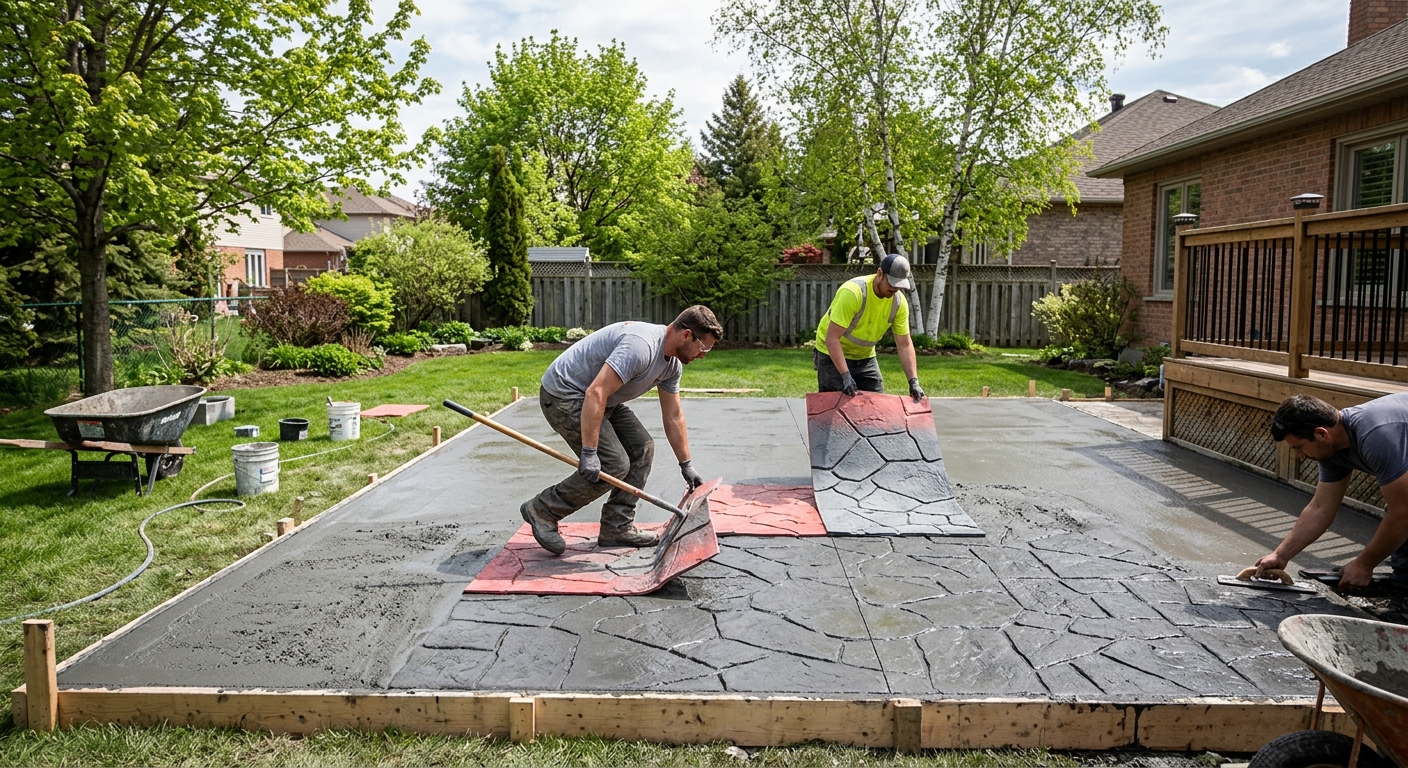
Concrete work options and costs in Omemee
In Omemee, Ontario, concrete options usually start with the practical jobs homeowners notice first: driveways, patios, walkways, and (for many properties) foundation footings during additions or basement work. With a small local population of 1,323 (Statistics Canada, 2021 Census), the town and surrounding area still gets steady demand from the same core homeowner base that builds and maintains single-family homes and older neighbourhood properties—where hardscaping, repairs, and drainage improvements are continuous. In the broader Toronto economic region, concrete pricing is heavily influenced by frost depth requirements, freeze–thaw cycles, and the availability of experienced crews who can schedule pours during the warmer, more reliable portion of the year.
Local costs can swing noticeably because exterior flatwork needs air-entrained mixes and good base prep to resist seasonal movement. Toronto-area contractors also plan for curing management when temperatures drop toward 10 °C or below, and GTA weather often brings damp shoulder seasons that complicate drying and finishing. For Omemee homeowners, jobs in and around the town’s more established residential areas tend to attract faster scheduling because there’s typically easier access for skid-steers and concrete trucks. That’s also where drainage grading issues show up most—especially where old soil base has become saturated over time.
Below is a practical cost comparison to help you align what you want with what the scope usually includes, before you request an itemised quote from a contractor.
| Application |
Typical Size |
Key Spec |
Finish Option |
Price Range |
| Concrete driveway (standard broom finish) |
400–600 sq. ft. |
Air-entrained mix, compacted granular base, control joints |
Broom finish, standard thickness |
$18,000–$28,000 |
| Exposed aggregate driveway |
400–600 sq. ft. |
Air-entrained mix, base prep + curing attention |
Exposed aggregate, sealed |
$24,000–$34,000 |
| Stamped concrete driveway or patio |
300–500 sq. ft. |
Air-entrained mix, adequate thickness, joint pattern |
Stamp texture + colour, sealer |
$24,000–$42,000 |
| Plain concrete patio or walkway |
150–300 sq. ft. |
Air-entrained mix, compacted sub-base, drainage slope |
Float/steel trowel then light broom |
$10,000–$18,000 |
| Garage floor (interior slab) |
300–500 sq. ft. |
Vapour barrier (if required), mesh/rebar, proper base |
Steel trowel finish, optional densifier |
$9,500–$17,500 |
| Foundation footings (structural, below frost) |
Varies by home/addition |
Engineered excavation, below-design-frost depth, rebar placement |
Structural concrete, formwork + waterproofing interface |
$3,600–$6,000 |
Prices are estimates only and vary by project scope, site access and material selection.
What affects the price of concrete work in Omemee
In the Toronto economic region, you can easily see quotes for the “same” concrete job differ by 30–50%. The reason is that exterior concrete in Ontario isn’t just a material price—it’s a full system: excavation, drainage, compacted base, the right mix design, reinforcement, finishing, and curing. When one contractor prices only the pour while another prices the full durability package, the difference can add up fast.
Frost depth and freeze–thaw cycles dictate every step. Structural footings generally must extend at least 1.2 m below grade to reduce frost heave and differential movement, and Ontario projects typically fall in the broader range of 1.5–2.4 m depending on site conditions and design. For exterior slabs, local crews commonly specify air-entrained concrete to survive repeated freeze–thaw. If a contractor uses a non-air-entrained or under-specified mix, you may get short-term looks but higher risk of spalling and scaling after winter salt and wet cycles.
Seasonality matters too. Pours are concentrated in warmer months, and when temperatures near or below 10 °C appear, extra curing precautions—insulating blankets and/or heating—can add labour and equipment costs. Surface sealing also helps; de-icing salt can accelerate spalling on unprotected concrete. In Omemee, older driveways and patios often need thicker base rework because saturated soils lose density—this raises material handling and compaction time. Conversely, a straightforward, level site with easy truck access can bring a driveway closer to the $18–$28 per sq. ft. style pricing band, while stamped work often moves toward the $24–$40 band because of labour intensity and colour/texture materials.
| Price Factor |
Why It Matters |
Cost Impact |
| Frost line depth — determines footing depth and form height |
Deeper excavations increase volume, hauling, and formwork. |
Can add substantial labour and equipment time for foundations. |
| Site preparation — excavation, grading, compacted granular base |
Good base prevents pumping, settlement and cracking. |
Higher where removal of poor soil or added drainage is needed. |
| Reinforcement — rebar or wire mesh requirement |
Rebar/mesh supports slab capacity and reduces cracking under load. |
Cost rises with heavier reinforcement and careful placement. |
| Mix design — air-entrainment and compressive strength spec |
Air-entrainment helps concrete survive freeze–thaw cycles. |
Small material uplift, but critical for exterior durability. |
| Finish type — broom vs. stamped vs. exposed aggregate |
Decorative finishes require more labour and specialized materials. |
Stamped and exposed aggregate typically cost more per sq. ft. |
| Pour size and concrete truck access to site |
Truck access affects batch planning, pumping needs and labour. |
Complicated access often adds pump time, equipment, and extra labour. |
| Cold-weather curing precautions — heating and blankets |
Stable curing conditions protect strength gain and surface integrity. |
Can increase labour/equipment costs during shoulder seasons. |
| Control joint pattern and sealing cost |
Proper joints reduce random cracking; sealing repels salts/chemicals. |
Adds line items but lowers long-term repair risk. |
Permits & regulations in Ontario
In Ontario, whether you need a permit depends on what concrete work you’re doing. Structural concrete work—such as footings, foundation walls, grade beams, and other load-bearing elements—typically requires a building permit and often engineered drawings that the municipality reviews. For concrete flatwork (driveways, patios, walkways), permits are usually not required unless the project affects lot grading, changes drainage patterns, impacts impervious surface/municipal requirements, or touches the municipal right-of-way (for example, works that alter curb/sidewalk areas). When in doubt, check with your local building department before breaking ground.
For your contractor vetting in Omemee, Ontario, I recommend you verify three items: (1) the contractor’s ability to do the job legally (licensing/registrations where applicable), (2) liability insurance, and (3) WSIB/WCB clearance (or the appropriate coverage status). Step-by-step: first, ask the contractor for a certificate of insurance showing general liability and confirm the effective dates align with your project. Next, request WSIB/WCB clearance and keep a copy in your records. Finally, confirm their information through the appropriate online registry and match the details on the certificate to the legal business name on the quote. Also ask for references from similar-scope concrete projects—ideally exterior flatwork done with Ontario freeze–thaw considerations.
Getting concrete right in Omemee's freeze-thaw climate
Concrete failures in Omemee usually trace back to a few predictable causes: water management problems, inadequate base prep, and poor freeze–thaw durability. In a Toronto-area freeze–thaw environment, the biggest red flag is spalling—small surface flakes that often appear after winter because the concrete freezes while salts and water penetrate the surface. The fix isn’t “a better finish”; it’s proper specs from the start.
First, base preparation: you need a compacted granular sub-base to the correct depth and slope so water drains away from the slab. If soils become saturated and then freeze, the slab can lift or crack. Second, mix design: for exterior flatwork, air-entrainment is typically targeted at about 5–7% air content, with a minimum compressive strength commonly set around 32 MPa so the slab achieves durable strength during curing. Third, control joints: the joint spacing needs a planned pattern to steer cracking, rather than letting it happen randomly. Fourth, curing: aim for at least 7 days of proper curing under suitable conditions; if temperatures dip, additional protection may be needed so the surface doesn’t cure too quickly or unevenly. Fifth, sealing: apply a penetrating sealer after full cure (often around 28 days) to repel de-icing salts and reduce moisture penetration.
To see where money is justified: choosing a standard broom-finish driveway is often a better value if you’re mainly targeting appearance and function, while stamped concrete can be worth the extra cost because it’s decorative labour-intensive (often tracking the $24–$40 band). But no decorative option replaces correct air-entrainment and base compaction; skipping those specs can turn a premium-looking driveway into an expensive repair within a few seasons.
| Spec |
Why It Matters in Omemee |
What to Ask For |
Impact if Skipped |
| Compacted granular base (depth?) |
Limits settlement and reduces frost-related movement in Ontario soils. |
Confirm base depth, granular type and compaction method; ask about drainage slope. |
Cracking, pumping, and uneven surface or failed joints. |
| Air-entrained concrete mix (target air %?) |
Improves freeze–thaw resistance and helps prevent scaling/spalling. |
Ask for exterior mix air content (typically 5–7%) and that it’s air-entrained. |
Surface deterioration after winters with wet cycles and de-icing salt. |
| Compressive strength (MPa rating) |
Durable strength supports loading and long-term weathering. |
Ask for minimum 32 MPa (or higher if engineered) and mix documentation. |
Soft surface, increased wear, and faster damage under freeze–thaw. |
| Control joints (spacing per ACI guidelines) |
Controls where cracking occurs as concrete contracts and expands. |
Ask for joint spacing plan and confirmation of saw-cut timing. |
Random cracking that can widen and allow water ingress. |
| Minimum 7-day curing period |
Strength gain and durability depend on protected curing conditions. |
Ask how curing is protected if temps drop toward/below 10 °C. |
Reduced strength development, surface scaling and premature failure. |
| Penetrating sealer (when applied after cure) |
Repels moisture and salts that accelerate spalling in Ontario winters. |
Confirm sealer type and that application occurs after full cure (often 28 days). |
Faster surface wear and higher risk of salt-related damage. |
How to choose a concrete work contractor in Omemee
Choosing the right concrete contractor in Omemee starts with verification—not just a nice quote. In Ontario, structural and exterior concrete performance depends on real jobsite practices: base prep, mix specs, finishing, and curing. Before you book, verify (1) licensing/registrations as applicable, (2) liability insurance, and (3) WSIB/WCB coverage. How to check: request a current certificate of insurance and confirm the policy is active during your project dates; make sure the certificate lists the correct legal business name. Then ask for WSIB/WCB clearance or confirmation of coverage status and keep a copy with your contract paperwork.
Next, get 2–3 itemised written quotes. You want line items for excavation, granular base and compaction, formwork, reinforcement, concrete supply, finishing, curing protection, saw-cutting/joints, and sealing (if included). Avoid “lump sum with exclusions.” Carefully compare what’s included: permit pull (if required), disposal of removed material, water management/drainage adjustments, and any patching at transitions. Warranty matters too: ask for a workmanship warranty period and whether it covers cracking, spalling, and joint performance, and if product/manufacturer warranties are separate and transferable. Payment schedule should be conservative—never more than about 10–15% upfront. Hold back the balance until the final walkthrough and punch-list items are complete. Finally, get a start date and completion estimate in writing, because concrete pours are schedule-sensitive in Ontario’s weather.
- Ask for proof of general liability insurance with project dates covered
- Ask for WSIB/WCB clearance (or proof of coverage status) before work begins
- Request an itemised quote, not a single lump-sum number
- Confirm concrete mix spec: air-entrainment and minimum strength (e.g., 32 MPa for exterior)
- Confirm base prep depth, granular type and compaction method
- Ask how they handle cold-weather curing if nights get cool
- Verify reinforcement details (mesh/rebar, placement method, and cover)
- Confirm joint layout: spacing plan and timing of saw cuts
- Clarify sealing: whether penetrating sealer is included and when it’s applied
- Check disposal/recycling of removed concrete and soil—what’s included
- Make sure truck access limitations and any pumping/crane needs are priced
- Get a written workmanship warranty and what it actually covers
Concrete red flags I often see around Omemee: no discussion of air-entrainment for exterior work, vague “we’ll do the base” wording without depth/compaction details, rushing curing (or no plan if temperatures drop), offering unusually low pricing with minimal excavation/disposal scope, and refusing to provide proof of WSIB/WCB coverage or insurance.
Frequently asked questions — concrete work in Omemee
What is the difference between concrete and cement?
Concrete is the full material system: cement plus water, plus aggregates (sand and stone), often with admixtures for workability and durability. Cement is only one component—basically the binder that reacts with water to create strength. In Ontario freeze–thaw conditions around Omemee, the concrete recipe matters as much as the “brand of cement.” For exterior driveways and patios, contractors typically specify air-entrained concrete and a minimum strength (commonly 32 MPa) so the slab can handle repeated winter wetting and freezing. When you compare quotes, ask what the contractor is specifying for air content and compressive strength, not just whether “cement” is included.
How much does concrete work cost in Omemee?
For Omemee, your costs usually track the Toronto economic region’s price bands because crew availability, concrete supply logistics, and freeze–thaw durability requirements are similar. As a quick reference: driveway and slab work often lands around the $18,000–$28,000 range for typical exterior driveway sizes when you include proper base prep and finish work. Plain patios/walkways often sit in the $16,000–$26,000 style band depending on size, thickness, and site conditions, while stamped/decorative concrete commonly runs higher due to labour and materials, often aligning with $24,000–$40,000 style pricing. If a quote is far below those ranges, it may be cutting out base depth, reinforcement, or air-entrainment.
How deep must footings be for Omemee's frost line?
Ontario projects generally require footings to extend below the local design frost depth to reduce frost heave and differential movement. In the Toronto region, structural footings are commonly required to be at least about 1.2 m below grade (exact depth depends on the design and site soil conditions). That’s why footing work—excavation, formwork, reinforcement placement, and concrete volume—can be a major cost driver compared with flatwork. In practice, if you’re planning an addition or foundation repair in Omemee, rely on the engineered plan/permit drawings for the required depth, and confirm the contractor is building to that spec. Don’t accept an estimate that guesses depth without tying it to engineering.
Why does concrete crack in Omemee and how is it prevented?
Concrete can crack because it shrinks as it cures, expands/contracts with temperature changes, and interacts with water and soil movement. In Omemee’s Ontario freeze–thaw cycle, the risks increase when the base isn’t compacted correctly or drainage is poor—water gets in, then freezes and pushes against the slab. The best prevention is a complete plan: compacted granular base, air-entrained mix for exterior durability, reinforcement where required, and a deliberate control joint pattern. Joints steer cracking so it occurs where it’s expected and easier to manage. Sealing after full cure also helps protect against salt-driven surface damage. A well-detailed driveway should have a joint plan; if a quote skips joints or sealing, expect a higher likelihood of visible cracking and repairs.
Stamped vs broom-finish concrete — cost difference?
Stamped concrete costs more than a standard broom finish because it requires more labour time and specialized materials. With stamped work, contractors typically add colour (integral or topical), stamp texture tools, release agents, and extra attention to timing so the texture cures evenly. In the Toronto region, this usually keeps stamped concrete closer to the $24,000–$40,000 style band depending on size and complexity, while broom-finished driveway work often aligns with $18,000–$28,000 style pricing for typical sizes. The key point for Omemee homeowners: either option should still use air-entrained exterior mix and correct base preparation—decorative finishing doesn’t replace durability specs.
When is the best time to pour concrete in Omemee?
The best time to pour concrete in Omemee is during the warmer, more stable weather window—when temperatures are consistently suitable for curing and finishing. In the GTA area, exterior pours are typically concentrated in the warmer months to reduce risks around curing when temperatures trend toward 10 °C or below at night. Cold conditions can slow strength gain and increase the chance of surface scaling or weak curing, especially on exterior slabs exposed to wet fall and spring cycles. If you’re scheduling a pour late in the season, ask your contractor about cold-weather curing precautions: insulating blankets, protection plans, and how they’ll maintain proper curing conditions for at least 7 days.