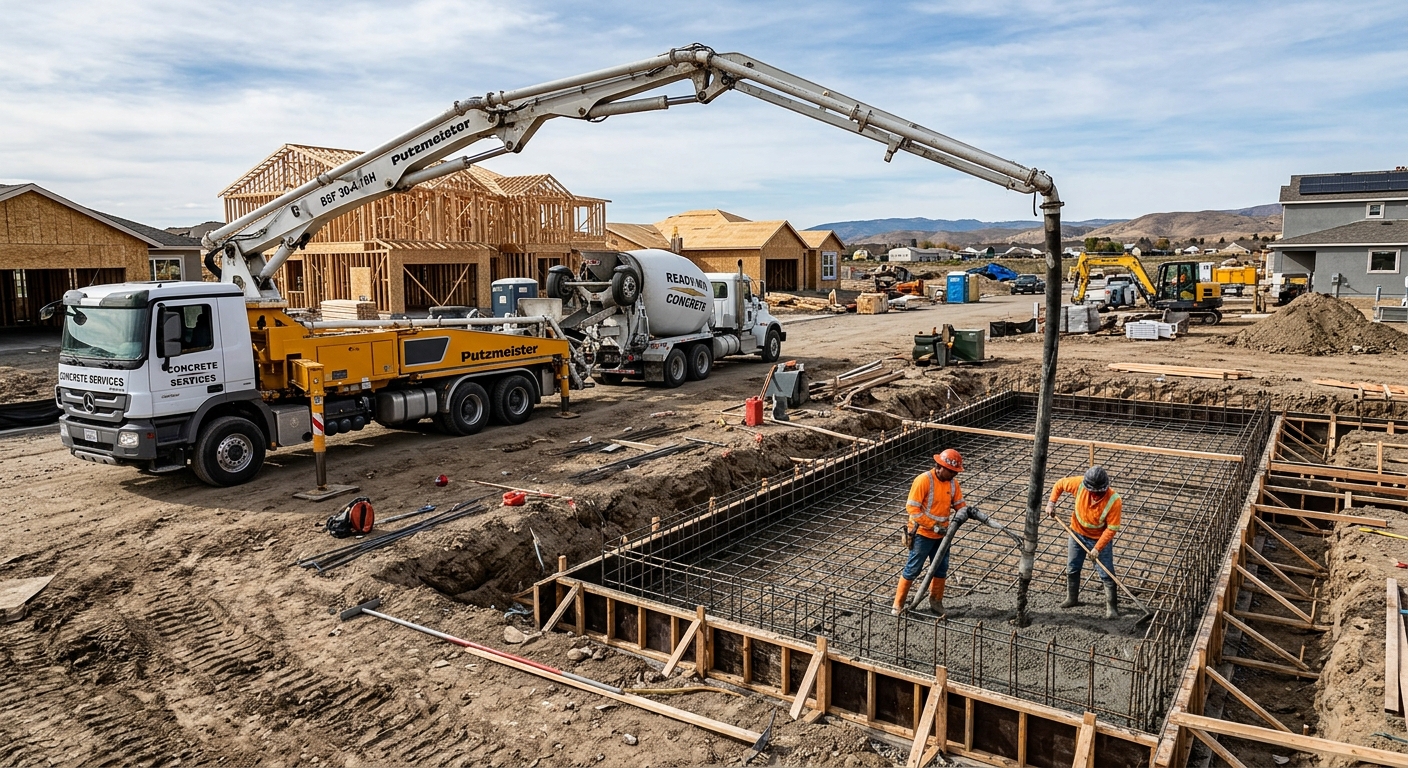
Concrete work options and costs in Blind River
In Blind River, concrete flatwork is a practical upgrade for the 3,422 people in town—especially with 77.8% of dwellings being single-detached homes, which is where most driveways, patios and walkways get updated. With 1,130 homeowner households (70.6% of households owning), you’ll see steady demand for durable, low-maintenance surfaces that can handle winter traffic, moisture and the wear from de-icing salts.
Pricing is shaped by the Northeast climate reality: cold snaps, moisture and repeated freeze–thaw conditions drive higher material and workmanship requirements than milder parts of Ontario. Even for “simple” slabs, the base prep (excavation, granular base, compaction and drainage) and the concrete spec matter, because frost-related movement can lead to heaving and cracking. Northeast-market scheduling can also tighten the availability of experienced crews and equipment during the short pour window, so last-minute scheduling usually costs more.
In Blind River, trade demand is especially noticeable around residential pockets like the downtown/riverfront area, where older housing stock (67.2% built before 1981) often has older entrances, settling approaches and drainage issues that need correction before the new concrete goes in.
Below are typical cost ranges homeowners in Blind River budget for, so you can compare options like broom-finished driveways versus stamped concrete and structural footings.
| Application |
Typical Size |
Key Spec |
Finish Option |
Price Range |
| Concrete driveway (standard broom finish) |
16 ft x 24 ft (384 sq. ft.) |
4 in (100 mm) slab, air-entrained, rebar or wire mesh as required |
Broom finish + control joints |
$7,000–$10,700 |
| Exposed aggregate driveway |
16 ft x 24 ft (384 sq. ft.) |
Air-entrained mix, proper retarder and wash timing |
Exposed aggregate finish |
$10,000–$15,600 |
| Stamped concrete driveway or patio |
12 ft x 20 ft (240 sq. ft.) for patio; 16 ft x 22 ft (352 sq. ft.) for drive |
Air-entrained mix, colour hardener/colour release |
Stamped pattern + sealer |
$10,000–$14,800 |
| Plain concrete patio or walkway |
10 ft x 14 ft (140 sq. ft.) or 3 ft x 30 ft (90 sq. ft.) |
4 in slab on granular base, joints as required |
Float/smooth or broom finish |
$2,200–$3,800 |
| Garage floor (interior slab) |
20 ft x 22 ft (440 sq. ft.) |
Vapour barrier (as applicable), properly compacted base, mesh where required |
Float finish + jointing |
$6,000–$11,000 |
| Foundation footings (structural, below frost) |
Per linear foot (varies by foundation layout) |
Excavation to frost depth, reinforced concrete footings |
Structural grade, engineered reinforcement |
$55–$90 |
Prices are estimates only and vary by project scope, site access and material selection.
What affects the price of concrete work in Blind River
In Blind River—and across Northeast Ontario—two quotes for what looks like the same concrete job can swing by 30–50% once you compare the real drivers: how deep the contractor must dig for stable, frost-protected foundation support; how much granular base and reinforcement is included; what mix design is specified; and how much work is required to make the drainage and surface performance last. The “cheap option” is usually a lower-spec mix, fewer prep steps, or missing reinforcement—problems you feel later as scaling, spalling or random cracking.
For concrete work in this region, frost protection dictates the spec. Footings must extend below the design frost depth to prevent frost heave and slab movement; in Ontario, that’s commonly in the 1.5–2.4 m range depending on location and engineering assumptions. Exterior slabs also require air-entrained concrete to survive freeze–thaw cycling, and colder-season conditions mean more curing protection. That can include insulated curing blankets, heated enclosures for critical pours, and tighter scheduling to protect set and strength gain. On top of that, de-icing salt is hard on exposed surfaces, so sealing is often recommended for driveways and patios.
In Blind River, pricing differences show up fast. For example, a basic broom-finish driveway may land in the $18–$28 per sq. ft. tier, while stamped work typically runs higher (often in the $25–$40 per sq. ft. decorative band) because of colour hardeners, stamping mats, release agents and careful finishing. Similarly, if your home was built before 1981, you may need additional drainage corrections or settlement repairs before the new slab—those site issues can add cost even before concrete is poured.
| Price Factor |
Why It Matters |
Cost Impact |
| Frost line depth — determines footing depth and form height |
Deeper footings reduce frost heave risk and stabilize foundation support |
Higher excavation, shoring and concrete volume; can noticeably raise costs on structural work |
| Site preparation — excavation, grading, compacted granular base |
Concrete fails when the base is soft or drainage is wrong |
More labour/equipment for regrade, hauling and compaction; prevents future repairs |
| Reinforcement — rebar or wire mesh requirement |
Controls cracking and adds capacity where required |
Material and tie-in labour increase; often non-negotiable on driveways and footings |
| Mix design — air-entrainment and compressive strength spec |
Freeze–thaw resistance and strength gain depend on correct mix |
Premium concrete supply and QC; reduces spalling/scaling risk |
| Finish type — broom vs. stamped vs. exposed aggregate |
Complexity impacts labour time and material consumables |
Stamped/exposed styles typically add cost; broom finishes are more budget-friendly |
| Pour size and concrete truck access to site |
Access affects pumping, placement method and number of truck trips |
Extra equipment/placement time can add significant cost |
| Cold-weather curing precautions — heating and blankets |
Early freezing can prevent concrete from reaching design strength |
Heating, insulated covers and longer protection add both labour and materials |
| Control joint pattern and sealing cost |
Joints manage cracking locations; sealing improves salt/durability performance |
Jointing and sealer add line-item cost but reduce long-term surface damage |
Permits & regulations in Ontario
In Ontario, homeowners usually need a building permit for structural concrete work, while many concrete flatwork projects can proceed without one—provided they don’t affect grading, drainage, or site coverage rules. Structural work such as foundation footings, foundation walls, and grade beams typically requires a building permit, and in many cases engineered drawings are reviewed as part of the process by the municipality or through the building permit authority. For flatwork—driveways, patios and walkways—a permit is commonly not required unless the work changes lot grading, impacts impervious surface coverage limits, alters required drainage patterns, or touches municipal right-of-way areas.
Before breaking ground in Blind River, verify your scope and ask the contractor to confirm whether a permit is required for your specific layout. Also ensure the contractor carries proper protection: liability insurance and the correct workplace coverage (WSIB for most construction work providers). A homeowner should not accept “we’re covered” without documentation.
Step-by-step checks are straightforward:
- Confirm the contractor’s Ontario business/contractor standing using the appropriate online registry sources available to the public.
- Ask for a certificate of insurance naming you/your property as additional interest if their process requires it, and verify expiry dates.
- Request WSIB clearance documentation (or a clearance letter where applicable) and confirm the coverage is active.
- Ask for references on similar-scale pours in the same season and climate conditions.
- Ensure the written contract clearly states who pulls permits (if required) and what inspections are expected.
Getting concrete right in Blind River's freeze-thaw climate
Concrete failures in Blind River’s freeze–thaw conditions usually come down to one or more of these: weak base support, incorrect mix for durability, poor jointing, inadequate curing, or no surface protection. Exterior slabs are especially vulnerable because moisture finds its way into the concrete and then expands during freezing. If the air-entrainment is off or the concrete isn’t protected long enough to build strength, the result is often spalling—tiny surface flakes that can turn into larger pops during winter.
To spec the job correctly, focus on five checkpoints. First, base preparation: compacted granular sub-base to the proper depth for your soil and frost conditions, with drainage so water doesn’t sit under the slab. Second, mix design: air-entrainment is critical for exterior durability—commonly 5–7% air content for freeze–thaw exposed flatwork—plus minimum compressive strength (often 32 MPa for typical residential exterior flatwork). Third, control joints: plan joint spacing so cracking happens where it’s intended, not randomly. Fourth, curing: aim for at least 7 days under appropriate conditions; when it’s cold, that can require insulation blankets or heating to prevent early freezing. Fifth, sealing: apply a penetrating sealer after the concrete has fully cured—commonly 28 days—so de-icing salt impacts the surface less aggressively.
As an example of where price differences can be justified: a plain broom-finished patio might be budgeted in the $15–$25 per sq. ft. tier, while a stamped driveway is often $25–$40 per sq. ft. The extra cost is usually warranted when you’re also getting the right prep, correct air-entrained mix and proper joint/sealer strategy—not just decorative tooling.
| Spec |
Why It Matters in Blind River |
What to Ask For |
Impact if Skipped |
| Compacted granular base (depth?) |
Prevents frost-driven movement by supporting the slab properly |
Granular sub-base depth based on soil and frost conditions; compaction test method if requested |
Settlement, cracking and uneven slab performance |
| Air-entrained concrete mix (target air %?) |
Freeze–thaw durability relies on microscopic air voids for expansion room |
Air content target (commonly 5–7% for exterior flatwork) and proof of mix design |
Spalling and rapid surface deterioration from de-icing salt and moisture |
| Compressive strength (MPa rating) |
Strength gain ensures the slab tolerates loading and cold-season stresses |
Minimum 32 MPa rating (or project-specific engineered requirement) |
Surface weakness, scaling and higher cracking risk |
| Control joints (spacing per ACI guidelines) |
Controls where cracks occur, reducing random, unsightly splitting |
Joint layout plan showing spacing and timing of cutting |
Random cracking through the slab and increased maintenance |
| Minimum 7-day curing period |
Curing protects strength development during early cold exposure |
How they handle curing if temperatures drop (blankets/insulation/heating as needed) |
Early freezing damage and lower design strength |
| Penetrating sealer (when applied after cure) |
Reduces salt/meltwater penetration that accelerates freeze–thaw damage |
Penetrating sealer schedule after full cure (commonly 28 days) |
Faster scaling/spalling and shorter surface lifespan |
How to choose a concrete work contractor in Blind River
Choosing the right contractor for concrete work in Blind River is less about the lowest number on page one and more about proof—specs, coverage, and how they handle cold-weather risk. In Ontario, you should verify three things before any work starts: Ontario business legitimacy, liability insurance, and WSIB coverage where applicable. Ask for an active certificate of insurance (with dates) and a WSIB clearance letter or similar proof of coverage. If they can’t provide documents quickly, pause the process.
Next, get 2–3 itemised written quotes. You want labour and materials broken out—concrete supply and delivery, excavation/haul-off, granular base, reinforcement, finish materials (colour hardener/release for stamped work), and curing/sealing steps. Avoid “lump sum” quotes that don’t explain what’s included in site prep, disposal, and jointing details.
Read the scope for exclusions: Is disposal of excavated material included? Are permits included if they’re required for your foundation or drainage-altering work? Is the quote clear on how they protect concrete during cold snaps (blankets/heating) and what the warranty covers?
For payment, use a schedule that protects you. Never pay more than about 10–15% upfront; hold back the remainder until the work is completed and surfaces are cured as specified. Always ask for a written start date and completion estimate—seasonal constraints can shift schedules, but you still want commitments.
- Provide certificate of insurance and verify expiry dates.
- Provide WSIB clearance documentation (where applicable).
- List supervisors/crew lead and show relevant past projects in similar winter conditions.
- Use itemised quotes (labour, concrete, base, reinforcement, finishing, sealing).
- Confirm disposal/haul-away is included if excavation is required.
- Confirm joint plan (spacing and where control joints will be placed).
- Ask for mix specification: air-entrainment and minimum strength (commonly 32 MPa for many exterior residential slabs).
- Ask how they handle curing if temperatures fall (blankets/insulation/heating).
- Confirm reinforcement type and placement method (not just “mesh included”).
- Check the warranty in writing: workmanship length and what’s excluded.
- Ask whether the product/manufacturer warranty is transferable (if you’re using a specific sealer system).
- Agree on a holdback amount and final payment timing after curing/sealer steps.
Concrete red flags in Blind River: contractors who won’t discuss air-entrainment or curing; “too-good-to-be-true” pricing that omits granular base depth or reinforcement; no written scope for joints and sealing; pressure to pay full amount upfront; and vague warranties that don’t specify what happens if spalling or cracking occurs within the first season.
Frequently asked questions — concrete work in Blind River
What is the difference between concrete and cement?
Concrete is the finished building material—made by mixing cement with water, aggregates (sand and stone) and often admixtures. Cement is only one ingredient inside concrete. For homeowners in Ontario, the big practical point is that concrete durability in freeze–thaw weather depends on the whole mix design, not just “cement strength.” When contractors talk about air-entrainment (often 5–7% air for exterior flatwork), that’s part of the concrete specification that helps prevent spalling as moisture freezes and expands. A quote might mention “32 MPa” compressive strength; that refers to performance of the concrete mix. If you’re comparing options in Blind River, ask for the mix details and curing plan—those are what control winter survival, not just the word “cement.” (Statistics Canada, 2021 Census)
How much does concrete work cost in Blind River?
For Blind River, typical budgets generally fall within the city tier you’ll see across Northern Ontario jobsites: a standard concrete driveway often prices around $18–$28 per sq. ft., while decorative work (like stamped concrete) usually runs higher—commonly $25–$40 per sq. ft. Plain patios and walkways tend to sit around $15–$25 per sq. ft. Exposed aggregate and premium finishes can push the driveway cost upward because of additional materials and more careful finishing steps. Foundation footings are usually priced differently, often in the $55–$90 per linear foot range depending on depth and reinforcement requirements. Exact totals depend heavily on site prep (excavation and granular base), truck access and how many corrections are needed due to older drainage or settled entrances common in homes built before 1981. (Statistics Canada, 2021 Census)
How deep must footings be for Blind River's frost line?
In Ontario, footing depth is determined by frost protection requirements and design assumptions, and it’s not a single “one size fits all” number for every lot. As a practical guideline, the Ontario frost depth commonly used in design ranges from about 1.5–2.4 m, depending on the specific location and engineering assumptions. The key is that footings must extend below the local design frost depth to reduce frost heave and help prevent movement-related cracking. Your engineer or foundation designer should confirm the design depth for your property. If a contractor proposes a shallower footing to cut cost, that’s a major long-term risk in cold-season conditions and could lead to settlement or cracking that’s far more expensive to fix later. For structural concrete, ensure a permit and engineered details are included where required by the municipality.
Why does concrete crack in Blind River and how is it prevented?
Concrete cracks are common, and in Blind River most issues are manageable when the job is designed correctly. Cracking happens because concrete shrinks slightly as it cures, because temperatures move with winter cycling, and because moisture and frost can cause movement if the base isn’t properly prepared. Freeze–thaw cycling and moisture exposure are big drivers of durability problems. Prevention starts with a compacted granular base and correct drainage, plus air-entrained concrete for exterior slabs to reduce freeze–thaw damage that leads to spalling. Control joints are also essential: they provide “preferred crack locations” so cracks don’t show up randomly in high-visibility areas. The sealing step after curing is important too, because de-icing salts accelerate surface deterioration. If you’re quoting options, ask about the joint spacing plan and curing protection—those are the practical steps that reduce cracking and surface failure in Ontario winters.
Stamped vs broom-finish concrete — cost difference?
Stamped concrete generally costs more than broom-finish because it requires extra consumables and more labour time. A broom-finish driveway focuses on a durable slab with proper base prep, joints, and finishing for traction; it’s typically in the $18–$28 per sq. ft. range. Stamped work is usually in the $25–$40 per sq. ft. range because of colour hardeners, release agents, stamping mats, and more careful finishing so the texture and lines look consistent. That cost difference can be worth it if you also get the right freeze–thaw durability specs: air-entrainment, minimum strength (often 32 MPa for typical residential exterior flatwork), and proper curing. Homeowners sometimes compare only the decorative line item and forget to ask whether the mix and curing plan are the same—if the prep or curing is reduced to “make room” for stamping, you can pay more upfront and still get a shorter lifespan.
When is the best time to pour concrete in Blind River?
The best time to pour concrete in Blind River is when temperatures allow proper set and curing—typically during the warmer months with stable weather. Ontario winter conditions can cause early freezing, which can severely weaken slabs and exposed surfaces. Even if a contractor can pour in colder weather, you’ll usually pay for cold-weather protection such as insulated curing blankets and sometimes heating to control set time and strength gain. That added protection is why some quotes can rise for end-of-season scheduling. For homeowners planning ahead, aim for a period when crews can complete finishing and curing protection without rushed exposure to freezing night temperatures. If your project timing is flexible, scheduling earlier in the pour season usually reduces risk and helps keep costs closer to the base price bands (like $18–$28 per sq. ft. for standard driveways).