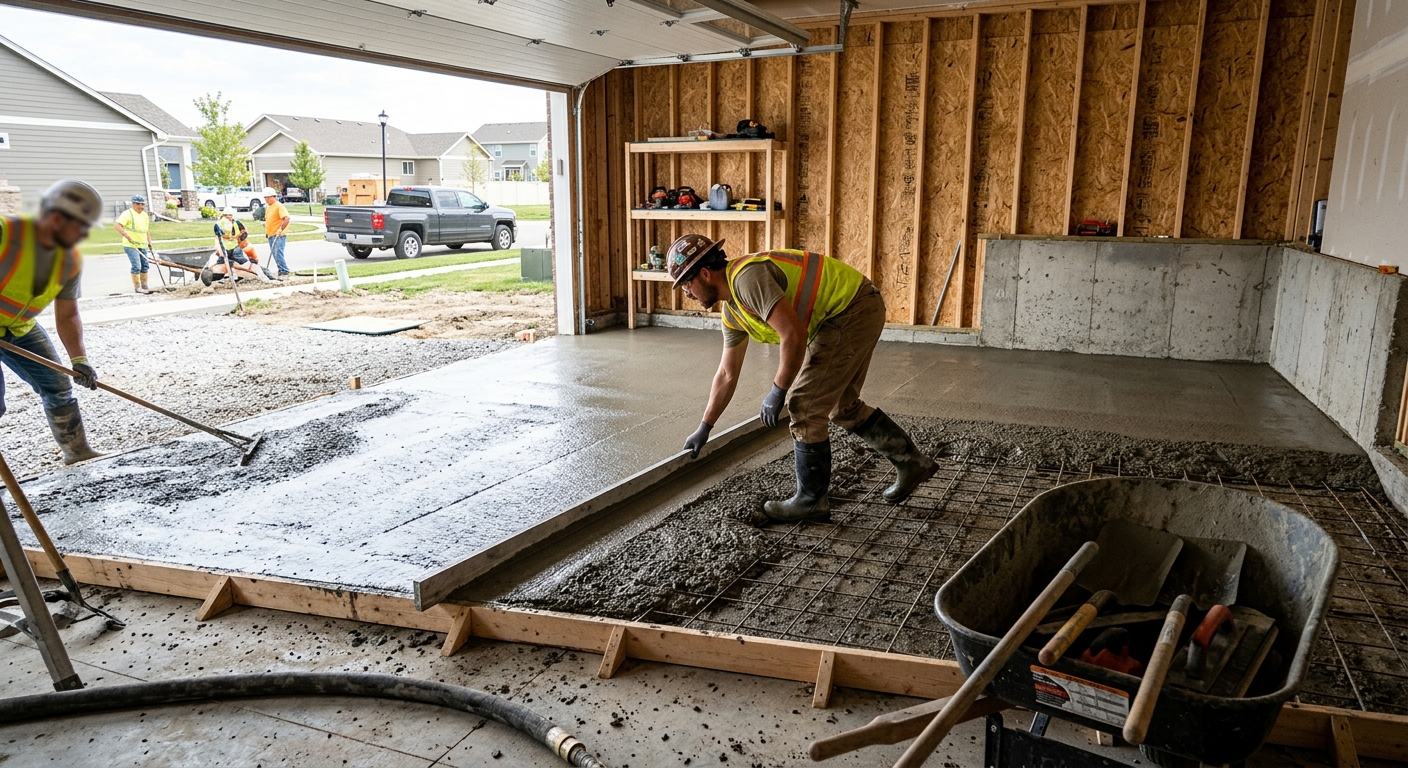
Concrete work options and costs in Peterborough
Concrete work in Peterborough supports everything from driveways and patios to major structural foundations, and it’s a practical choice for many homeowners across this city. With Peterborough having 57.2% single-detached homes, concrete flatwork is often a top exterior upgrade. It’s also common to see older housing stock—63.7% of homes were built before 1981—meaning many properties have aging slabs, settled approaches, or foundations that need attention during renovations.
In the Muskoka–Kawarthas economic region, pricing is heavily shaped by climate and scheduling. Frost lines typically run around the 4 ft range, so footings and foundation elements must be placed below frost to reduce heave. That drives deeper excavation, more forming, and more concrete than in milder markets. Freeze–thaw cycles across fall, winter, and spring also increase the need for air-entrained mixes, careful base prep, and robust control joint planning to limit cracking and spalling. Add lake-adjacent wet microclimates and shorter practical pour season (often April–November), and you’ll find contractor availability and equipment costs tighten up during peak months—especially for larger pours.
In Peterborough, these jobs are especially in demand in established family neighbourhoods such as Ashburnham–Smithfield and the West End, where many lots have mature trees, tighter access, and common drainage issues that affect base preparation and forming.
Below are typical project scopes and realistic cost ranges you can use to compare contractor quotes for your property, before we get into what drives the differences.
| Application |
Typical Size |
Key Spec |
Finish Option |
Price Range |
| Concrete driveway (standard broom finish) |
400–600 sq. ft. |
Reinforcement as required; air-entrained exterior mix |
Broom finish; standard edging |
$12,000–$25,000 |
| Exposed aggregate driveway |
400–600 sq. ft. |
Exposed stone mix; proper surface curing |
Exposed aggregate finish |
$15,000–$28,000 |
| Stamped concrete driveway or patio |
300–500 sq. ft. |
Air-entrained mix; integral colour; proper release/bonding |
Stamped pattern with colour |
$15,000–$35,000 |
| Plain concrete patio or walkway |
200–400 sq. ft. |
Sloped for drainage; air-entrained exterior mix |
Broom or trowel-smooth (site dependent) |
$4,000–$12,000 |
| Garage floor (interior slab) |
400–600 sq. ft. |
Vapour barrier; thicker slab if required; reinforcement as needed |
Power trowel or broom finish |
$6,500–$15,500 |
| Foundation footings (structural, below frost) |
Varies by footprint; typically 1.5–3 ft wide trench |
Below-design frost depth; excavation + rebar + waterproofing prep |
Structural concrete formwork and pours |
$18,000–$45,000 |
Prices are estimates only and vary by project scope, site access and material selection.
What affects the price of concrete work in Peterborough
In Peterborough and across Muskoka–Kawarthas, it’s common to see quotes for the “same” concrete job swing by 30–50%—and it’s not just because of contractor markup. The drivers are tied to how frost, water, and labour intensity change the way we have to build. In colder climates, we design for frost heave: footings must extend below the design frost depth (about 1.5–2.4 m in Ontario), which means deeper excavation, more forming, and more materials. Exterior slabs also need air-entrained concrete to handle freeze–thaw cycling, and curing is more demanding when temperatures drop—often requiring curing blankets and cold-weather precautions that add labour and equipment time. Even de-icing salt matters: it can accelerate surface spalling if the surface treatment and mix design aren’t right, so sealing becomes part of a durable plan.
Two concrete examples show how local conditions raise or lower costs in Peterborough. First, a basic broom-finished driveway can land in the $12,000–$25,000 band when the base is already stable and access is straightforward. If the contractor needs thicker granular base, additional drainage work, and deeper frost-compliant excavation around wet areas, the project often pushes toward the upper end. Second, stamped or decorative work may start at the $15,000–$35,000 band, but the cost can jump further when the site requires more detail forming, tighter edging, or patch-and-prepare work on an uneven base.
Housing age also plays a role. In neighbourhoods with more pre-1981 homes, it’s common to find older subgrades, existing slabs with cracks, and drainage patterns that have shifted over time; that typically increases prep scope, and prep is where quality is won or lost.
| Price Factor |
Why It Matters |
Cost Impact |
| Frost line depth |
Determines footing depth and form height |
Higher excavation and more concrete; can add thousands |
| Site preparation |
Excavation, grading, compacted granular base |
Unstable soils or extra granular base increase labour and materials |
| Reinforcement |
Rebar or wire mesh requirement |
Pricing rises if steel quantity, tie-wire, and bar placement are heavier |
| Mix design |
Air-entrainment and compressive strength spec |
Air-entrained exterior mixes and specified strength can raise material cost |
| Finish type |
Broom vs. stamped vs. exposed aggregate |
Decorative work increases labour, materials, and finishing time |
| Pour size and concrete truck access to site |
Access affects pumping/placement method and scheduling |
Tight driveways or long carry distances can add equipment and crew time |
| Cold-weather curing precautions |
Heating and blankets |
Additional curing supplies and time; more likely in shoulder months |
| Control joint pattern and sealing cost |
Controls cracking and protects from de-icing salts |
More sawcuts/primer/sealer work increases scope (but reduces failures) |
Permits & regulations in Ontario
In Ontario, structural concrete work generally requires a building permit. That includes footings, foundation walls, grade beams, and any load-bearing foundation elements that support the structure above. In many cases, engineered drawings must be reviewed as part of the permit process, and the municipality may request documentation showing sizes, reinforcing details, and inspection steps. For concrete flatwork like patios, walkways, and most driveways, a permit often is not required—unless the work affects lot grading, impervious surface coverage limits, drainage approvals, or municipal right-of-way boundaries.
For homeowners in Peterborough, the practical approach is to confirm the specifics with the municipality before you break ground, especially if you’re altering slopes, tying into existing drainage, or expanding the hardscaped footprint. It’s also smart to verify the contractor’s business and coverage before work begins.
Step-by-step, here’s how to confirm coverage and licensing in Ontario:
- Check the contractor’s Ontario business details and any applicable trades registration through the provincial and/or listing sources they provide.
- Request a current Certificate of Insurance (general liability) that names you as an additional insured where appropriate.
- Ask for proof of coverage for WSIB (or WCB clearance/coverage letter where applicable) for their workers.
- Verify it matches the work being quoted (concrete is labour-intensive and high-risk for jobsite injuries).
- Collect references from similar-scale local jobs and ask about any foundation or winter curing challenges they encountered.
Getting concrete right in Peterborough's freeze-thaw climate
Concrete failures in Peterborough usually trace back to water movement and temperature swings: water gets in, freezes, expands, and then works against the slab or surface. In the Muskoka–Kawarthas market, we solve this by building the system from the ground up—base, mix, reinforcement, joints, curing, and sealing. If you want fewer callbacks, your spec should start with compacted granular base prep to the proper depth for your soil conditions and local frost considerations. Next comes mix design: exterior slabs and driveways should use air-entrained concrete with target air content in the 5–7% range, and commonly a minimum 32 MPa compressive strength so the cured concrete performs under Ontario freeze–thaw cycling.
Then focus on joints and finishing. Control joints are what limit random cracking: you want a planned spacing and timely cutting so shrinkage doesn’t create uncontrolled cracks. Curing is just as critical. Even though concrete “sets” quickly, you should plan for a minimum 7-day curing period under proper conditions; in cold snaps, we use curing blankets and, when needed, temperature control to protect strength gain. Finally, apply a penetrating sealer about 28 days after pour to repel de-icing salts and reduce surface deterioration.
Ask your contractor how they prevent spalling from inadequate air-entrainment. That’s the most expensive kind of failure because repairs usually involve surface removal, re-prep, and rework—often costing far more than the modest difference between a basic mix and a properly air-entrained exterior spec. For example, choosing a correctly air-entrained mix and proper curing can mean moving within the typical patio/walkway range of $4,000–$12,000 for comparable sizes, but it’s often what keeps that investment from turning into a premature resurfacing project.
| Spec |
Why It Matters in Peterborough |
What to Ask For |
Impact if Skipped |
| Compacted granular base (depth?) |
Supports slab through frost and wet cycles |
Granular base depth based on site soils and frost considerations |
Settlement, cracking, and uneven drainage |
| Air-entrained concrete mix (target air %?) |
Reduces freeze–thaw surface damage |
Exterior target air content typically 5–7% for flatwork |
Higher spalling risk and faster surface deterioration |
| Compressive strength (MPa rating) |
Strength gain affects long-term durability |
Minimum 32 MPa for exterior flatwork |
Lower resistance to scaling and abrasion |
| Control joints (spacing per ACI guidelines) |
Controls where cracks occur |
Planned joint spacing and cutting timeline |
Random cracking and water infiltration |
| Minimum 7-day curing period |
Ensures strength gain despite cold nights |
Cold-weather plan: blankets/heating when needed |
Reduced strength and increased cracking risk |
| Penetrating sealer (when applied after cure) |
Helps repel de-icing salt and water |
Apply penetrating sealer at about 28 days after pour |
Accelerated scaling/spalling during winter |
How to choose a concrete work contractor in Peterborough
Choosing a concrete contractor in Peterborough is mostly about verifying you’re buying the right spec and the right winter-ready process—not just a low bid. Start with Ontario coverage checks. Ask for a current Certificate of Insurance for general liability, and confirm they have WSIB/WCB coverage (or the appropriate clearance documentation) for their workers. If they hesitate, that’s a serious red flag. Next, get 2–3 itemised written quotes that break out labour and materials, not just a lump sum. You want to see what’s included for excavation, granular base, reinforcement, concrete mix type (including air-entrainment), control joints, curing approach, and disposal of excess material.
Read the scope carefully: are permits included where required? Is existing concrete removal part of the price if you’re replacing a slab? Is drainage work included if there’s ponding or poor slope? Ask about warranty terms—what’s covered for workmanship, how long it lasts, and whether product/manufacturer warranties apply (and if they’re transferable if you sell your home). For payment schedule, don’t accept a plan that requires large upfront deposits; in practice, keep deposits around 10–15%, and hold back funds until key completion milestones and cleanup are done. Finally, get a start date and completion estimate in writing; in this region, schedule management during colder shoulder months matters.
- Ask for proof of general liability insurance and that it’s current.
- Ask for WSIB/WCB coverage or clearance letter for workers.
- Confirm they include air-entrained mix for exterior work in their spec.
- Require a written scope covering base prep depth and grading/slope.
- Request the reinforcement approach (rebar vs mesh) and where it’s placed.
- Verify control joint spacing and when joints will be cut/saw-cut.
- Ask how they protect curing in cold weather (blankets/heating plan).
- Confirm whether sealing is included and the timing (about 28 days).
- Make sure concrete truck access and placement method are explained.
- Check disposal is included for excavation spoils and old concrete (if applicable).
- Get an itemised labour/materials quote (not just one number).
- Review warranty length for workmanship and what triggers coverage.
Concrete red flags I see too often in Peterborough: quotes that don’t mention air-entrained mix for exterior slabs, no discussion of curing blankets/heating when pours happen in shoulder months, vague scope language like “proper base prep” without depth or thickness, payment terms asking for most of the money upfront, and contractors who won’t put joint layout, sealing timing, and disposal details in writing.
Frequently asked questions — concrete work in Peterborough
How do I maintain concrete in Peterborough's freeze-thaw climate?
In Peterborough, maintenance comes down to keeping water and salts out of the surface system. Use a penetrating sealer after the slab has fully cured—typically around 28 days after the pour—so de-icing salts don’t keep attacking the top layer. During winter, avoid aggressive chipping tools that scrape the surface; use plastic shovels where possible and apply de-icer in moderation. Keep landscaping mulch and soil from holding moisture against edges, and watch for ponding that indicates drainage or slope issues. If you have cracks, don’t ignore them—small issues can let water in during freeze–thaw cycles. For exterior flatwork, a well-finished broom texture plus correct air-entrainment and proper curing during installation is what makes maintenance easier and longer-lasting.
What causes concrete to spall in Peterborough winters?
Spalling is usually a symptom of freeze–thaw damage combined with water exposure and insufficient resistance at the surface. In Muskoka–Kawarthas, repeated freezing and thawing drives water into pores and along microcracks; when water freezes, it expands and breaks off small pieces of concrete. The most common root cause is inadequate air-entrainment for exterior exposure—air bubbles create space for freezing expansion. Another major contributor is poor base drainage and weak curing, which can leave the surface more vulnerable. If a driveway or walkway is regularly hit by de-icing salts, the surface must be protected (often with sealing after cure). A contractor who quotes “standard concrete” without specifying air content and curing precautions is the quickest way to end up with spalling complaints later.
What is rebar and when is it required in Ontario?
Rebar is reinforcing steel bars embedded in concrete to control cracking and provide strength in tension. In Ontario, whether rebar is required depends on the structural design and the engineered details for the application. For foundations and footings below frost, reinforcement is commonly required by structural requirements and engineering. For exterior slabs like driveways and some patios, reinforcement may be specified based on slab thickness, subgrade conditions, spans, and load expectations. Many contractors include rebar or mesh for driveways to reduce shrinkage and help with longevity, especially where base prep is less than ideal. The best approach is to ask for the reinforcement specification in your quote and confirm thickness, placement spacing, and cover depth. A properly designed driveway replacement that includes reinforcement and proper air-entrained exterior mix is typically aligned with the region’s $12,000–$25,000 driveway budget.
How long does a concrete project take in Peterborough?
Timing depends on whether you’re doing flatwork or structural concrete and on seasonal conditions. For exterior flatwork like patios or walkways, the active work may be just a few days—excavation, forming, base prep, pour, finishing, and joint work—followed by curing time. For driveways, schedules are often similar but more equipment time is typical due to larger surface area and more detailing. The concrete doesn’t “reach full readiness” immediately; you should plan around cure time. For foundations and footings, the timeline is longer because excavation to frost depth, forming, inspections (often required for structural work), reinforcement placement, and waterproofing-related steps can extend the schedule. In Peterborough’s April–November pour window, cold snaps can pause pours. Your contract should clearly state the start date, expected pour date, and weather contingency plan.
What is a concrete overlay and is it suited to Peterborough?
A concrete overlay is a new cementitious surface placed over an existing concrete slab, typically after cleaning and preparation. It can be suited to Peterborough when the original concrete is still structurally sound—meaning it’s not severely heaved, broken, or losing base support—and when drainage and slope are correct. However, an overlay can fail if the original slab is already moving due to frost heave or poor subgrade drainage; the overlay may crack or delaminate as the old slab shifts. For older pre-1981 properties in Peterborough (where slab issues are more common), I often recommend an inspection to determine whether the base and concrete are stable. If you can’t fix the drainage and subgrade, overlaying may only postpone the problem. If a full replacement fits your budget, many homeowners compare it against the typical patio/walkway range of $4,000–$12,000 or driveway bands depending on scope.
How do I seal concrete to protect it in Peterborough?
Sealing helps protect against de-icing salts and water penetration that can contribute to scaling and spalling in Peterborough winters. The key is timing: allow the concrete to cure fully—commonly about 28 days for many sealers—before applying a penetrating sealer. Before sealing, the surface should be clean and dry; remove dirt, stains, and any curing compounds. Apply the sealer evenly according to the manufacturer’s instructions, and avoid sealing over wet or actively scaling areas. If your contractor already included sealing in the scope, confirm what type of sealer is specified and when it will be applied after cure. Proper sealing won’t “fix” a poor air-entrained mix or inadequate curing, but it can extend service life and reduce winter damage when the installation was done correctly.