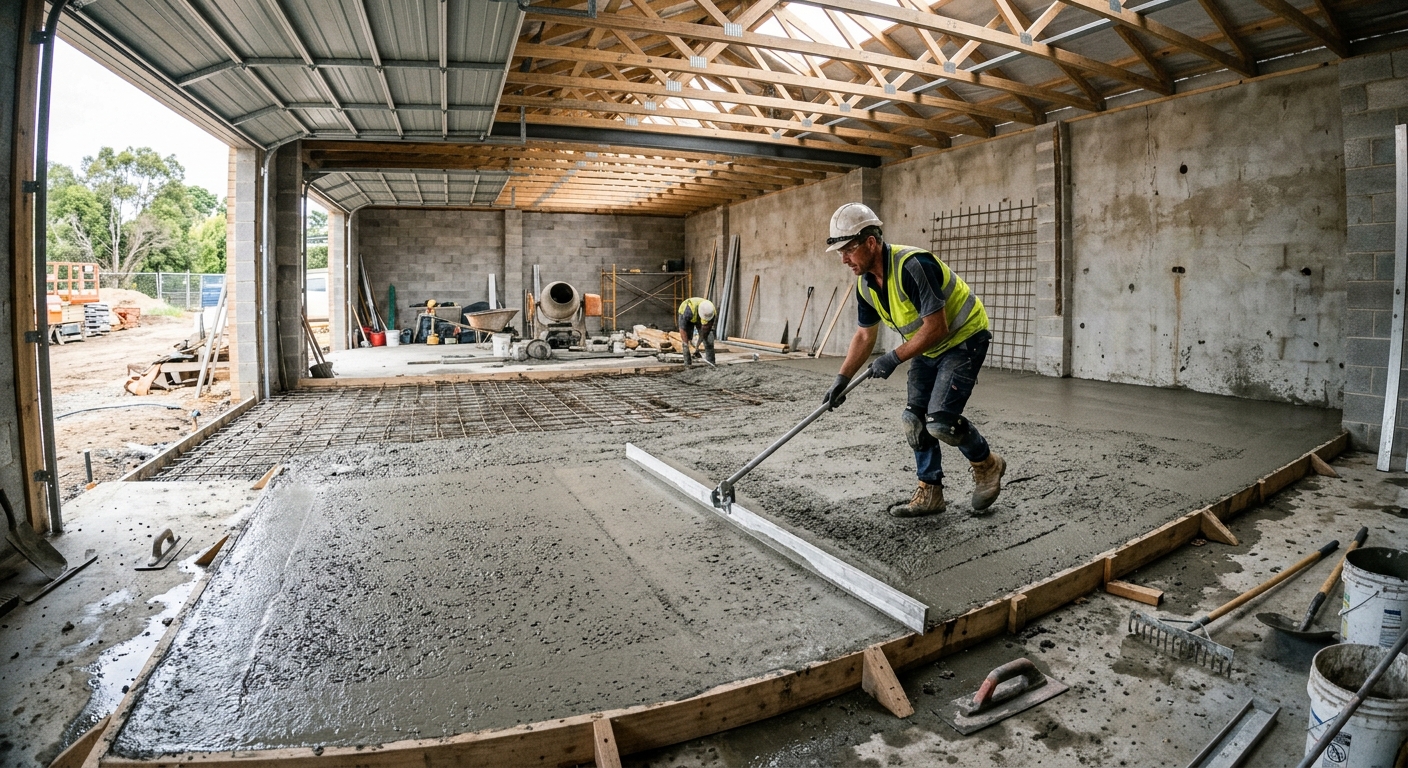
Concrete work options and costs in Thamesford
In Thamesford, Ontario, homeowners usually start with three common concrete jobs: driveways, patios/walkways, and foundation footings. The area’s housing stock is a major reason contractors stay busy—Thamesford is a small town with a population of 2,622 (Statistics Canada, 2021 Census), and most residents rely on detached and low-rise neighbourhood lots where exterior flatwork is the first thing people notice and budget for. It’s especially in demand around the residential pockets near the downtown core, where older driveways often show spalling edges and surface scaling after winter.
Concrete pricing in the Toronto economic region is heavily shaped by frost depth and freeze–thaw cycling. That means “the same” driveway or slab spec can cost quite a bit more than you’d expect elsewhere, because exterior work needs air-entrained mix design, a properly compacted granular base, and a control-joint plan to control cracking. Local contractors also tend to concentrate outdoor pours in the warmer months to keep curing consistent; when temperatures drop toward 10 °C or below, crews spend extra effort on protection (insulating blankets/heating blankets, faster scheduling of finishing). Add to that the reality that many Thamesford properties have mature trees and tighter access, which affects equipment placement and concrete truck turnaround times.
Below are realistic price bands you’ll see for typical sizes in Thamesford, along with the key specs that drive the cost differences. Use the table to compare bids before you sign—then confirm details like base depth, reinforcement, and curing method.
| Application |
Typical Size |
Key Spec |
Finish Option |
Price Range |
| Concrete driveway (standard broom finish) |
12’ x 20’ (240 sq. ft.) |
Air-entrained exterior mix, compacted granular base, control joints |
Broom finish |
$4,320–$6,720 |
| Exposed aggregate driveway |
12’ x 20’ (240 sq. ft.) |
Air-entrained mix, uniform exposure, curing protection |
Exposed aggregate |
$5,040–$7,920 |
| Stamped concrete driveway or patio |
12’ x 20’ (240 sq. ft.) |
Air-entrained mix, release agent control, joint pattern |
Stamped + colour (typical) |
$5,760–$9,600 |
| Plain concrete patio or walkway |
8’ x 16’ (128 sq. ft.) |
Proper slope/drainage, granular base, jointing |
Plain trowel + broom edge (typical) |
$2,048–$3,328 |
| Garage floor (interior slab) |
22’ x 22’ (484 sq. ft.) |
Slab thickness per design, vapour control as needed, finishing |
Standard float/trowel (non-slip options available) |
$8,712–$13,552 |
| Foundation footings (structural, below frost) |
Typical 1’ wide perimeter and piers (varies) |
Below-grade structural concrete, formwork, reinforcement, inspection-ready |
Structural concrete only (no finish) |
$180–$300 |
Prices are estimates only and vary by project scope, site access and material selection.
What affects the price of concrete work in Thamesford
In Thamesford and across the Toronto economic region, two bids for the same concrete work can differ by 30–50% because the “hidden” scope changes: base depth and compaction, reinforcement detail, how much protection is used during curing, and how much site prep is required to get to solid bearing. Even though the visible finish might look identical, the structural and durability specs underneath are what keep your driveway, patio, or footing from failing during Ontario’s freeze–thaw winters.
Here’s the key: frost depth and freeze–thaw cycles dictate every spec in this region. For structural work, Ontario Building Code requirements generally push footings to extend at least 1.2 m (about 4 ft) below grade to help prevent frost heave and differential movement. Exterior slabs and flatwork must use air-entrained concrete so the mix survives repeated freezing and thawing. When conditions are colder, contractors also need cold-weather curing precautions—heating or insulating blankets—to maintain proper strength gain and reduce early-age damage. Finally, de-icing salts accelerate surface spalling if the mix and curing aren’t right, which is why sealing is often recommended.
Local site conditions move the price, too. In Thamesford, older lots sometimes have weaker fill or drainage issues—adding more granular base and regrading raises costs. On the flip side, newer subdivisions with better access and clearances can land closer to the lower end of bands like driveway work at $18–$28 per sq. ft. and patios/walkways at $16–$26 per sq. ft. As a rough guide, upgrading from a plain patio to stamped concrete can add meaningful labour and materials—often $24–$40 per sq. ft.—but it only makes sense if the base prep and jointing are done to a high standard. A well-made base is what actually determines whether that higher-end finish stays attractive for years.
| Price Factor |
Why It Matters |
Cost Impact |
| Frost line depth |
Determines footing depth and form height |
Deeper excavation increases labour, shoring, and concrete volume |
| Site preparation |
Excavation, grading, compacted granular base |
More hauling/disposal and more granular material for unstable soils |
| Reinforcement |
Rebar or wire mesh requirement |
Material and placement labour; can prevent future widening cracks |
| Mix design |
Air-entrainment and compressive strength spec |
Better durability mix costs more but reduces freeze–thaw surface failure |
| Finish type |
Broom vs. stamped vs. exposed aggregate |
Stamp mats, release agents, decorative finishing labour adds cost |
| Pour size and concrete truck access to site |
Truck placement affects crew efficiency and line pumping needs |
Tight access can require more labour and sometimes pumping/extra equipment |
| Cold-weather curing precautions |
Heating and blankets |
Extra materials/time to protect the slab until adequate strength gain |
| Control joint pattern and sealing cost |
Limits random cracking and protects against de-icing salt damage |
Joint saw cutting + sealant adds line-item cost, but improves long-term appearance |
Permits & regulations in Ontario
In Ontario, most structural concrete work needs a building permit and often engineered drawings that the municipality reviews. This includes the kinds of concrete you can’t just “patch later” safely—foundation walls, grade beams, and structural footings. If you’re doing anything that changes the structure or supports loads (for example, replacing/remediating foundations), treat it as permit-required work until proven otherwise.
Concrete flatwork like patios, walkways, and typical driveways usually does not require a building permit, provided it doesn’t affect lot grading, impervious surface coverage limits, or municipal requirements around drainage and right-of-way. That said, some municipalities may still require approvals if the project changes runoff patterns, ties into municipal services, or impacts egress/sidewalk areas. Always confirm before breaking ground.
For contractor compliance in Thamesford, verify three things before scheduling:
- Ontario licence/eligibility: check the contractor’s business registration and any trade licensing where applicable, using provincial/municipal listings available online.
- Liability insurance: ask for a current Certificate of Insurance (COI) naming the proper insured parties and the jobsite address.
- WSIB (WCB): request clearance/standing documentation. In Ontario, workers’ compensation coverage is commonly confirmed through a clearance letter or equivalent proof.
Step-by-step: ask the contractor for COI + WSIB clearance, verify the certificate details match the business name, then confirm permit responsibility with the municipality (especially for structural foundation work). Finally, ask for references on similar-scale projects with photos.
Getting concrete right in Thamesford's freeze-thaw climate
Concrete fails in Thamesford mostly due to freeze–thaw stress, not because the finish “looks bad.” When water gets into a slab—through poor base drainage, weak consolidation of the granular sub-base, or surface wear—freeze expansion expands microscopic damage. Over time you can get spalling at edges and joints, scaling, and widening cracks that let more water in. The Toronto market drives contractors to build for durability: proper base prep, air-entrained concrete, a sensible joint plan, and curing/protection that reaches adequate strength before the weather turns.
To spec the job correctly, you want five things in the scope. First, base preparation: compacted granular sub-base to the right depth for local soil and frost behaviour, plus proper slope so water doesn’t pond. Second, mix design: for exterior flatwork, air-entrainment is critical, and minimum compressive strength is typically 32 MPa. Third, control joints: place them to limit random cracking; if joints are skipped or spaced too far apart, cracks will choose their own locations. Fourth, curing: a minimum of 7 days under proper conditions matters, and cold-weather pours need extra protection. Fifth, sealing: apply a penetrating sealer after the concrete has cured (commonly around 28 days) to repel de-icing salt and reduce surface breakdown.
Here’s where dollars make sense. If you’re choosing between a plain broom-finished driveway and a stamped one, the stamped option often costs more (for example $24–$40 per sq. ft. versus $18–$28 per sq. ft.). That premium is justified when the contractor also nails the base depth, joint pattern, and sealing plan—because those are what keep the driveway both attractive and serviceable through Ontario winters.
| Spec |
Why It Matters in Thamesford |
What to Ask For |
Impact if Skipped |
| Compacted granular base (depth?) |
Limits water and reduces frost-related movement |
Minimum excavation depth and granular base thickness; proof of compaction |
Ponding, settlement, cracking, and edge spalling |
| Air-entrained concrete mix (target air %?) |
Improves freeze–thaw durability |
Air content target for exterior (commonly 5–7%) and mix design sheet |
Surface scaling/spalling and faster deterioration from de-icing salt |
| Compressive strength (MPa rating) |
Ensures strength gain for service life |
Minimum 32 MPa spec and curing plan to achieve it |
Soft, fragile concrete and increased risk of early cracking |
| Control joints (spacing per ACI guidelines) |
Controls where cracks form |
Joint spacing/locations based on slab size and thickness; show joint layout on plan |
Random cracking and water intrusion through uncontrolled cracks |
| Minimum 7-day curing period |
Cold snaps can reduce strength gain if curing is rushed |
Specify curing duration and protection when temperatures drop |
Reduced durability, surface damage, and lower long-term performance |
| Penetrating sealer (when applied after cure) |
Helps repel salt and moisture |
Penetrating sealer applied after cure (often around 28 days) with surface prep |
More scaling/spalling in winter and less lasting finish |
How to choose a concrete work contractor in Thamesford
Choosing a concrete contractor is mostly about verifying responsibilities and confirming the details that protect your slab from freeze–thaw failure. Start with compliance: ask for proof of liability insurance (COI that matches the business name and jobsite), and ask for WSIB/WCB clearance or equivalent proof of worker coverage in Ontario. For licensing/eligibility, confirm the contractor’s business registration and any relevant trade credentials required for the type of work they’re advertising. If they hesitate, that’s a red flag.
Next, get 2–3 itemised written quotes. Don’t accept a vague lump sum that only lists a finish name. You want line items that show labour and materials, including excavation and disposal, granular base depth/compaction method, reinforcement (if any), concrete mix specification, finishing, saw-cutting/joint materials, curing protection (especially for late-season dates), and sealing (if included). Also ask what’s excluded: removing old concrete, hauling, topsoil restoration, trenching for drainage, and permit handling (where applicable for structural work).
Warranty and payment terms matter. Ask for workmanship warranty length and what it covers. Clarify whether product/manufacturer warranty is provided separately and if it’s transferable to you. On payment, never pay more than 10–15% upfront; a practical holdback is held until the work is complete, cleaned up, and meets finish/joint expectations. Finally, get a start date and completion estimate in writing—Toronto-area crews sometimes tighten schedules during warm periods, and you want clarity before deposits.
- Ask for COI and WSIB clearance before the first deposit.
- Confirm the quote includes base preparation details (not just “granular” generically).
- Verify concrete mix is air-entrained for exterior flatwork.
- Request compressive strength spec (e.g., minimum 32 MPa).
- Confirm thickness and reinforcement/mesh or rebar plan if applicable.
- Ask for joint layout: spacing, saw-cut timing, and sealant plan.
- Check whether cold-weather protection is included if pouring near shoulder season.
- Clarify disposal and site clean-up (old concrete removal, waste handling).
- Ensure runoff/drainage is addressed (slope, edge forms, tie-ins).
- Review the finish scope: broom vs. trowel vs. exposed aggregate vs. stamped.
- Get curing and sealing schedule in writing.
- Insist on an itemised written contract and a realistic timeline.
Concrete contractor red flags I see in Thamesford include: quotes that don’t mention air-entrainment or joint spacing, promises of “no joints” to reduce labour, refusing to provide COI/WSIB documentation, finishing that skips proper curing protection during cooler stretches, and change orders that arrive after the truck is scheduled because the base prep or drainage details were left out.
Frequently asked questions — concrete work in Thamesford
What is the difference between concrete and cement?
In Thamesford, homeowners often use the terms interchangeably, but cement is only one component of concrete. Cement is the binding material (a powder) mixed with water and aggregates (sand and gravel) to create concrete. When contractors talk about durability for Ontario freeze–thaw conditions, they’re usually referring to the whole concrete mix design—especially air-entrainment for exterior work and the required compressive strength. For example, exterior slabs and driveways commonly need an air-entrained mix so water that soaks into the surface can freeze without causing rapid scaling or spalling. The finish (broom vs. stamped) changes appearance, but the mix and curing are what determine how long the slab survives winters with repeated thawing.
How much does concrete work cost in Thamesford?
In Thamesford, pricing typically follows the local Toronto-region bands that reflect labour, materials, and freeze–thaw driven requirements. For a standard broom-finished driveway, you’ll often see estimates around $18–$28 per sq. ft. For patios and walkways, common pricing is roughly $16–$26 per sq. ft. Decorative upgrades can move higher: stamped concrete driveways and patios often land around $24–$40 per sq. ft. Foundation footings are priced differently because they’re structural and installed below grade—typically quoted on a per linear-foot or similar basis, often in the $180–$300 range for that work category depending on conditions. Actual totals depend on base depth, reinforcement, truck access, excavation/disposal, and whether cold-weather curing protection is needed.
How deep must footings be for Thamesford's frost line?
For Thamesford and most of southern Ontario, structural footings are typically designed to extend below the frost depth to reduce frost heave and differential movement. In the Toronto economic region, local requirements commonly mean footings extend at least 1.2 m (about 4 ft) below grade for typical structural applications, aligning with municipal and Ontario Building Code expectations. Exact depth depends on your soil conditions, drainage, and the engineered foundation design for your specific house. This is one reason you shouldn’t compare quotes that don’t include engineering or show the footing detail. A deeper or more complex excavation can increase cost significantly, but it’s a durability requirement, not an optional upgrade—especially with Ontario’s repeated freeze–thaw cycles.
Why does concrete crack in Thamesford and how is it prevented?
Concrete cracks in Thamesford mainly because concrete is rigid and Ontario winters repeatedly cycle water between freezing and thawing. Cracking becomes more likely when the base isn’t properly compacted, when water can pond under the slab, or when the mix and curing aren’t right for freeze–thaw durability. The prevention strategy is mostly about controlling where cracks happen. Exterior flatwork should use air-entrained concrete, proper drainage and a compacted granular base, and a planned control joint pattern with saw cutting at the right time. Sealing after cure also helps limit moisture and de-icing salt exposure that accelerates surface deterioration. If you skip joints or ignore sealing, you may still get “hairline cracks,” but they tend to widen and become more visible and damaging over time.
Stamped vs broom-finish concrete — cost difference?
In Thamesford, the price gap between stamped and broom-finish concrete is usually justified by labour and materials, not by structural differences. Broom-finish driveways are typically the budget-friendly option, often around $18–$28 per sq. ft., because they focus on proper finishing, slope, and jointing. Stamped concrete often runs higher, commonly $24–$40 per sq. ft., because the contractor applies mats/release agents, colours, and extra finishing steps to achieve consistent texture and pattern. However, you only get the “premium look for the long term” if the base prep, air-entrained mix, joint layout, and curing/protection are done properly. A stamped surface over a weak base will still crack and fail; the decorative work can’t fix poor subgrade and freeze–thaw exposure.
When is the best time to pour concrete in Thamesford?
The best time to pour concrete in Thamesford is during the warmer months when temperatures stay stable enough for curing. In the Toronto economic region, contractors typically schedule outdoor pours in late spring and summer because curing is more predictable. When temperatures drop toward about 10 °C or below, contractors often need additional cold-weather precautions (insulating blankets, heating where feasible) to maintain strength gain and reduce early-age damage. That extra protection adds cost and can affect scheduling. If you’re planning a driveway or patio, aim for weather windows with reliable temperatures and good access for crews and concrete trucks. For structural concrete like footings, engineering and inspection timing also guide the schedule.