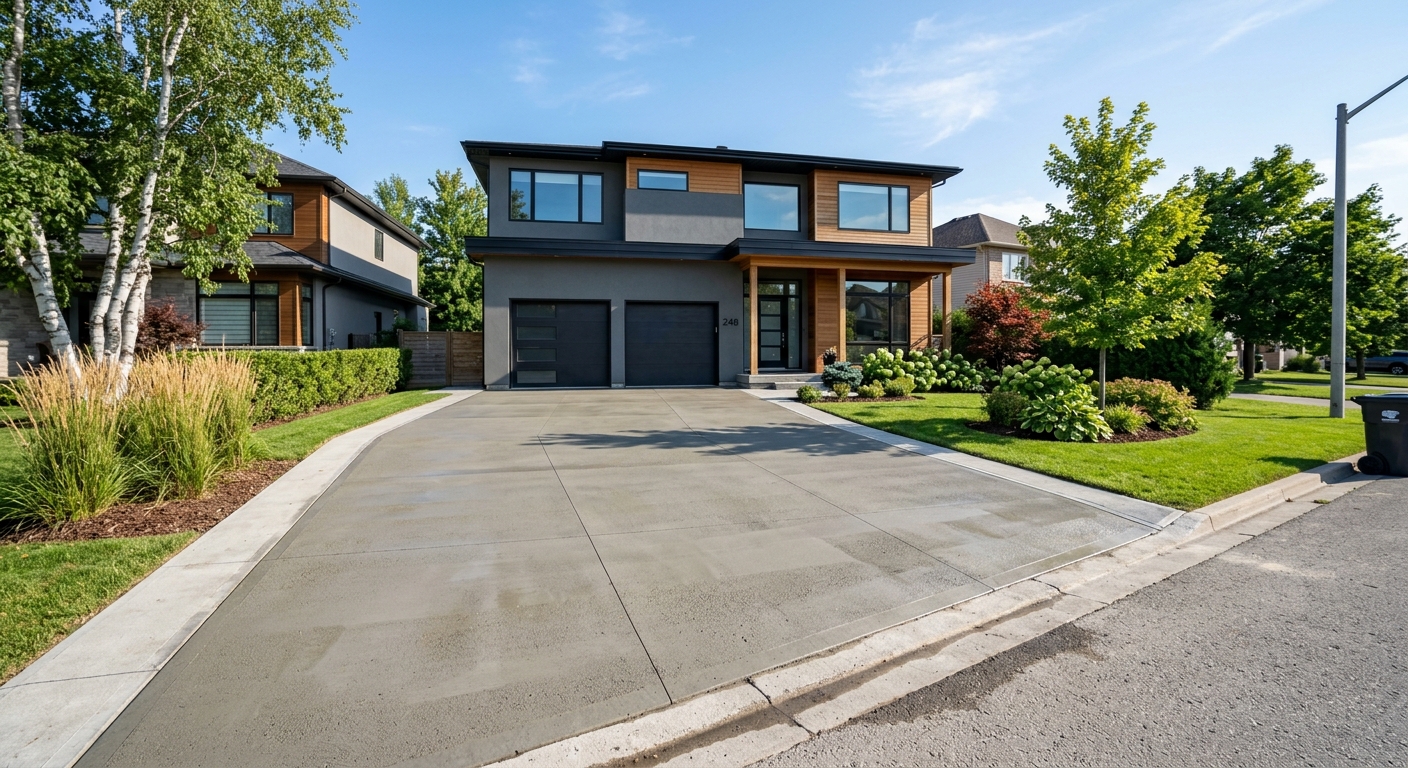
Concrete work options and costs in Central
Concrete work in Central, Ontario is priced and scheduled around the Toronto economic region’s freeze–thaw cycles and deep frost protection requirements. In a small community profile of about 12,650 people (Statistics Canada, 2021 Census), homeowners still tend to rely on concrete flatwork—driveways, patios, and walkways—for daily usability and curb appeal. Housing stock patterns here are similar to the wider GTA: a lot of single-family property work means steady demand for exterior pours and foundation repairs as homes age, get additions, or change landscaping.
Compared with milder climates, Toronto-area concrete costs are often higher because contractors must plan for foundation/footing depth, air-entrained mixes, and more robust base prep. Exterior concrete also needs careful curing in shoulder seasons—when conditions hover around 10 °C or lower, the risk of surface wear and early cracking goes up unless proper protection is used. That means you’ll typically see higher labour time on layout, excavation, drainage detailing, and finishing discipline, not just the price of the concrete itself.
In Central, this trade is especially in demand around long-established residential streets and neighbourhood pockets that see frequent driveway renewals and walkway replacements after landscaping updates—one common hotspot is the “infill-and-renewal” corridor around the local downtown edge (many homeowners time projects in late spring to early fall to avoid cold snaps). With that context, the table below shows typical options and what drives the ranges you’ll see on quotes.
| Application |
Typical Size |
Key Spec |
Finish Option |
Price Range |
| Concrete driveway (standard broom finish) |
16 ft x 20 ft (320 sq ft) |
Air-entrained mix, compacted granular base, control joints |
Broom finish |
$5,760 – $8,960 |
| Exposed aggregate driveway |
16 ft x 20 ft (320 sq ft) |
Air-entrained mix, base prep and curing discipline |
Exposed aggregate with sealer |
$7,680 – $10,880 |
| Stamped concrete driveway or patio |
12 ft x 18 ft (216 sq ft) |
Air-entrained mix, colour hardener, control joints planned |
Stamped pattern + release + sealer |
$5,184 – $8,640 |
| Plain concrete patio or walkway |
10 ft x 16 ft (160 sq ft) |
Proper drainage, compacted granular base, joints |
Broom/float finish |
$2,560 – $4,160 |
| Garage floor (interior slab) |
20 ft x 22 ft (440 sq ft) |
Vapour barrier (as required), fibre/wire reinforcement, proper base |
Steel-trowelled or broom-smooth |
$7,920 – $12,320 |
| Foundation footings (structural, below frost) |
Varies by design (example: 40 linear ft) |
Excavation to design frost depth; engineered rebar and concrete |
Structural finish (below grade) |
$7,200 – $12,000 |
Prices are estimates only and vary by project scope, site access and material selection.
What affects the price of concrete work in Central
If you receive two quotes for what looks like the same driveway or patio in Central, it’s not unusual to see differences in the 30–50% range. That spread usually comes from what’s included—base depth and compaction, drainage, reinforcement details, and the concrete mix specification for freeze–thaw durability—not just finishing style. In the Toronto economic region, contractors also price in longer planning and more stringent curing protection during the shoulder seasons. Even if you pour “in the window,” humidity and nighttime temperatures can change how long crews must protect and how quickly surfaces can be handled.
Key specs are dictated by frost depth and freeze–thaw cycles. Ontario structural footings generally need to extend at least 1.2 m (about 4 ft) below grade, below the regional frost line, to prevent frost heave and differential movement. Exterior slabs are typically built with air-entrained concrete mixes because without proper air, freeze–thaw can drive spalling and surface scaling. When temperatures drop toward 10 °C or below, crews may need cold-weather curing precautions—insulating blankets, temporary heating, and longer cure time—raising labour costs. Finally, de-icing salts accelerate wear on poorly finished or unsealed surfaces, so sealing is often recommended, especially in driveways.
Two quick examples from Central homeowners: upgrading from broom-finish driveway concrete to stamped can cost more (a common jump within the $18–$28 driveway band to decorative pricing in the $24–$40 range), but the added cost is justified when you’re resurfacing a visible, high-traffic area. Conversely, choosing a thicker, properly drained base often costs less than “patching later”—it reduces the chance of settlement and early cracking, which can otherwise mean expensive rework within a few years.
| Price Factor |
Why It Matters |
Cost Impact |
| Frost line depth — determines footing depth and form height |
Deeper excavation and more concrete are required to prevent frost heave and movement. |
Higher labour and materials; can add hundreds to thousands depending on scope. |
| Site preparation — excavation, grading, compacted granular base |
Weak or saturated base can pump under freeze–thaw, leading to settlement and cracking. |
Often one of the largest drivers of price variation across quotes. |
| Reinforcement — rebar or wire mesh requirement |
Rebar and correct placement control cracking and improve load distribution. |
Moderate material cost plus labour for tying/positioning. |
| Mix design — air-entrainment and compressive strength spec |
Air-entrainment improves freeze–thaw durability; strength affects performance under load. |
Higher concrete unit cost, especially with stricter air/strength targets. |
| Finish type — broom vs. stamped vs. exposed aggregate |
Decorative work requires extra materials, labour time, and sealing. |
Stamped/exposed typically increases the price within the local decorative bands. |
| Pour size and concrete truck access to site |
Access affects pumping, line-watching, and crew time; tight sites raise equipment needs. |
Can add significant labour/equipment charges on driveways and sloped lots. |
| Cold-weather curing precautions — heating and blankets |
Protects early-age concrete when temperatures drop toward 10 °C or lower. |
Adds materials and labour time; may extend schedule. |
| Control joint pattern and sealing cost |
Joints direct shrinkage cracking; sealing improves resistance to de-icing salts. |
Usually small compared with the cost of premature surface failure. |
Permits & regulations in Ontario
In Ontario, structural concrete work in Central—like foundation walls, grade beams, and footing systems—typically requires a building permit and often engineered drawings that the municipality reviews. Concrete flatwork (patios, walkways, and most driveways) usually does not require a permit unless it impacts lot grading, changes drainage patterns, alters impervious surface coverage limits, or touches municipal right-of-way issues. Because these triggers vary by lot and by how drainage is handled, confirm with your local authority before breaking ground.
For homeowner confidence, verify the contractor’s insurance and compliance before work starts. Start by asking for a copy of their liability insurance certificate and proof they have the required workplace coverage (commonly WSIB coverage, where applicable) for their workers. Then request recent references on similar-scale concrete jobs—driveways and footings in the Toronto area—and ask to see photos of completed work (including base prep and joints, not just the final colour).
Step-by-step verification you can do in Central:
- Contractor licensing: check the Ontario licensing/registry path provided by the contractor (or the relevant provincial registry page when available for their trade category).
- Liability insurance: review the certificate for policy validity, the correct legal name, and whether the policy covers the scope of concrete construction.
- Work coverage: confirm WSIB/WCB clearance or coverage documentation, especially if crews include employees.
- Ask for a permit responsibility statement in writing: who pulls permits (if required), and when.
When in doubt—especially for structural foundation work—ask your contractor to explain the permit trigger and provide documentation before the first excavation.
Getting concrete right in Central's freeze-thaw climate
Concrete fails in Central primarily due to freeze–thaw stress, moisture movement, and poor base/drainage. When water saturates the granular base and cannot escape, it expands and contracts with winter cycles. On the concrete surface, if the mix lacks proper air entrainment or if curing is rushed, freeze–thaw can cause scaling and spalling—small defects that become bigger in a hurry once de-icing salts start hitting the surface.
To spec the job correctly in the Toronto economic region, insist on five fundamentals. (1) Base preparation: use compacted granular sub-base to the correct depth and grade for your site’s drainage, with proper thickness and compaction so the slab doesn’t settle. (2) Mix design: exterior flatwork typically needs air-entrainment in the 5–7% range and a minimum 32 MPa compressive strength. (3) Control joints: plan their placement and spacing to limit random cracking. (4) Curing: use proper curing protection for at least 7 days, which is critical when temperatures fall toward 10 °C or lower. (5) Sealing: apply a penetrating sealer after the cure period (commonly around 28 days) so the surface repels water and resists de-icing salts.
Use these requirements as question prompts to protect against spalling. For example, a plain broom-finish patio in the local band may land around $2,560 – $4,160 for a typical 160 sq ft pour, while stamped work for similar area often runs higher. The price difference is justified when you’re treating a high-visibility surface—but only if the contractor still specifies air-entrainment, correct joints, and proper curing. Decorative appearance without durability specs is where homeowners lose money.
| Spec |
Why It Matters in Central |
What to Ask For |
Impact if Skipped |
| Compacted granular base (depth?) |
Prevents moisture pumping and settlement during freeze–thaw in Central. |
Granular base thickness, compaction method, and drainage grading plan. |
Uneven slab, heaving, and cracking that can show up within 1–3 winters. |
| Air-entrained concrete mix (target air %?) |
Improves durability against repeated freezing and thawing. |
Confirm air-entrainment target (typically 5–7% for exterior flatwork). |
Spalling and scaling, especially once de-icing salts are used. |
| Compressive strength (MPa rating) |
Supports load and surface performance through winter conditions. |
Minimum 32 MPa spec in writing. |
Surface wear, cracking under load, and premature deterioration. |
| Control joints (spacing per ACI guidelines) |
Directs shrinkage cracking to predictable locations. |
Joint layout diagram and spacing that matches slab dimensions and finish. |
Random cracking that ruins appearance and can admit water. |
| Minimum 7-day curing period |
Develops strength and reduces early-age damage during cool spells. |
How they protect the pour; confirmation of curing plan if temps drop. |
Reduced strength and higher chance of early surface problems. |
| Penetrating sealer (when applied after cure) |
Repels moisture and helps resist salt scaling in the Toronto area. |
Application timing (often around 28 days post-pour) and product type. |
Faster surface wear, staining, and increased freeze–thaw vulnerability. |
How to choose a concrete work contractor in Central
Choosing the right concrete contractor in Central is mostly about verification and scope clarity. First, verify Ontario compliance and jobsite coverage. Ask for their Ontario licensing information for the trade they perform, then check liability insurance by reviewing the certificate of insurance (make sure it’s valid and matches the contractor’s legal business name). Next, confirm workplace coverage (commonly WSIB/WCB) for their employees—request a clearance letter or proof of coverage before the first day on site.
Then request 2–3 written, itemised quotes instead of a single lump sum. A good concrete quote breaks down labour and materials (excavation, base, rebar/wire mesh, concrete mix spec, finishing, joints, sealing, and disposal). Read the scope carefully for exclusions: is permit pulling included for structural work? Is demolition disposal included, or will you pay separately? Will they replace removed sod/aggregate, and who handles site restoration?
For warranty, ask for (1) workmanship warranty length and what it covers, (2) product/manufacturer warranty for items like sealers or admixtures, and (3) whether the warranty is transferable if you sell the property. Finally, payment schedules matter: never pay more than 10–15% upfront; hold a portion back until key milestones and cleanup are complete, and get the start date and completion estimate in writing.
- Confirm Ontario licence details for the specific concrete work scope.
- Request proof of liability insurance before signing anything.
- Verify WSIB/WCB coverage (or clearance) for employed workers.
- Get 2–3 itemised quotes with labour + materials listed separately.
- Ensure concrete mix spec includes air-entrainment for exterior flatwork.
- Ask for base thickness and compaction method, not just “proper base.”
- Confirm reinforcement type and placement method (rebar ties/mesh support).
- Ask for joint layout and spacing, plus how joints are cut/formed.
- Require curing protection details for cool spells.
- Clarify whether sealing is included and the timing (after cure, often ~28 days).
- Check what’s included for demolition, haul-away, and site cleanup.
- Use a payment schedule with 10–15% maximum upfront and milestone holdback.
Concrete red flags in Central: (1) no air-entrainment mentioned for exterior slabs, (2) “we’ll pour whenever” with no cold-weather curing plan, (3) quotes that skip base thickness/compaction details, (4) vague joint plans with no spacing or diagram, and (5) requiring a large upfront payment without written milestones.
Frequently asked questions — concrete work in Central
How do I seal concrete to protect it in Central?
In Central, sealing helps because freeze–thaw and de-icing salts can accelerate surface wear. For exterior flatwork (driveways, walkways, patios), most homeowners use a penetrating sealer applied after the concrete has fully cured—commonly around 28 days post-pour. Before sealing, the slab should be clean and fully dry; contractors typically wash off dirt and allow it to dry thoroughly so the sealer can penetrate instead of sitting on top. If your driveway is broom-finished, a breathable penetrating sealer is usually preferred over film-forming products for long-term durability in Ontario’s wet fall and spring conditions (Statistics Canada, 2021 Census).
What is the difference between concrete and cement?
Concrete is the final construction material you see—cement plus water plus aggregates (sand and stone), often with admixtures. Cement is only one component inside concrete; it’s the binding ingredient that reacts with water to harden. In Central and the Toronto economic region, the performance you care about—freeze–thaw durability and strength—comes from the entire concrete mix design: aggregate size, water-cement ratio, air-entrainment level for exterior work, and curing. That’s why two “concrete” quotes can differ even when the driveway size is the same. A durable exterior mix for freeze–thaw is one reason driveway work often lands in the local band of $18,000 – $28,000 for typical sized projects.
How much does concrete work cost in Central?
In Central, costs depend on scope, base prep, access, and the finish you choose. For concrete driveways (standard broom finish), a typical local band is $18 – $28 per square foot, so a 320 sq ft driveway often lands around $5,760 – $8,960 depending on excavation, disposal, drainage, and reinforcement details. Patios and walkways often run $16 – $26 per square foot, and stamped or decorative options typically sit higher, commonly $24 – $40 per square foot for the decorative work and finishing steps. Foundation footings vary widely by design and excavation depth but are often quoted around $180 – $300 per linear foot because Ontario footings must extend below frost protection requirements.
How deep must footings be for Central's frost line?
For Central (Ontario), most structural footings generally need to extend at least 1.2 m (about 4 ft) below grade to reduce frost heave and differential movement. The exact depth is based on the frost protection requirements in the Ontario Building Code and your engineered foundation design, including local soil conditions. Because Toronto-area freeze–thaw cycles drive the risk, contractors plan excavation to the required depth before placing the structural concrete. If a quote seems to assume shallow footing excavation for a foundation repair or new footings, treat that as a major concern—wrong depth can lead to long-term settlement and cracking.
Why does concrete crack in Central and how is it prevented?
Concrete cracks mainly from shrinkage and movement as it cures, plus stresses from freeze–thaw and moisture movement in Central’s Ontario climate. Even well-built slabs will crack if shrinkage isn’t controlled, which is why control joints are crucial. Preventing problems starts with a properly compacted granular base and good drainage so the slab isn’t sitting over moisture that freezes and expands. Next is mix design: exterior concrete should be air-entrained to reduce freeze–thaw damage that can lead to scaling and spalling. Finally, joint spacing and correct curing matter—if you rush curing or skip protection during cool periods (near or below 10 °C), cracks can appear sooner and in less predictable locations. Proper sealing also helps protect the surface once installed.
Stamped vs broom-finish concrete — cost difference?
Stamped concrete costs more than broom-finish because it involves extra steps, materials, and labour: colour hardener/release products, pattern stamping, and careful finishing so the surface stays consistent. In the Toronto economic region, homeowners often compare a driveway or patio in the standard driveway band versus decorative pricing. For example, standard broom-finish driveway work commonly falls around $18 – $28 per square foot, while decorative stamped work typically runs roughly $24 – $40 per square foot depending on pattern complexity and site conditions. The best value comes when the contractor still follows durability fundamentals—air-entrained exterior mix, proper base prep, and a planned control joint layout—because decorative surfaces without freeze–thaw durability tend to fail early in Central winters.