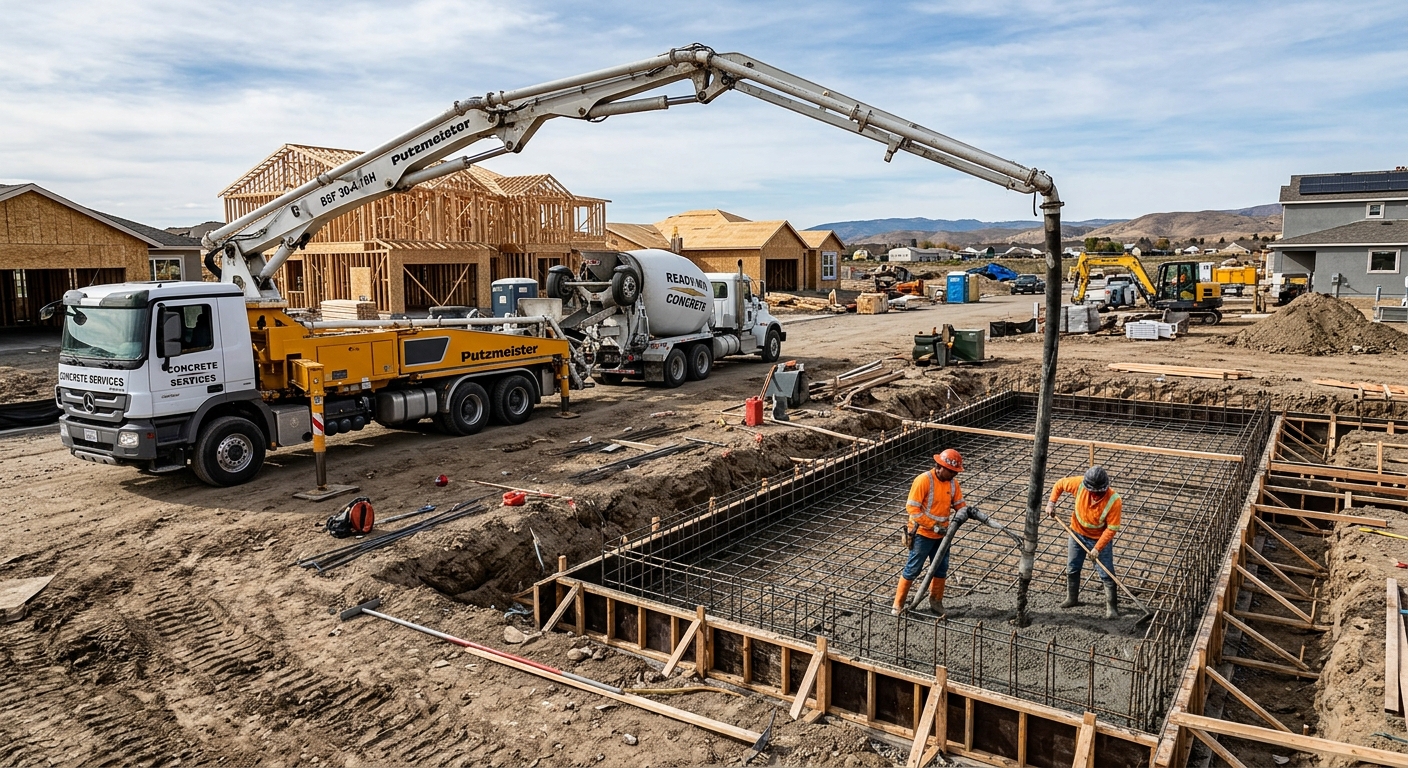
Concrete work options and costs in Thunder Bay
Concrete in Thunder Bay is a practical choice for homeowners because it holds up well to daily life—snow storage, ploughing, and winter de-icing. In a city where about 67.7% of households own their homes and single-detached houses make up 65.5% of dwellings, driveways, patios, and walkway slabs are among the most common exterior concrete projects I see. The Northwest market also leans older: 72.9% of homes were built before 1981, which often means replacing tired driveways and upgrading drainage around existing foundations.
Pricing is shaped by Northwestern Ontario’s long cold winters and freeze–thaw cycles. Exterior slabs and foundations must be built with deeper frost-resistant footings (commonly in the 4–6 ft range below grade for residential work) and air-entrained mixes to reduce scaling and spalling from salt and repeated thawing. On top of that, the pour season in the Thunder Bay–Kenora–Dryden corridor is typically late spring through early fall, so scheduling windows can be tighter. If the weather turns cold or wet during a pour, curing precautions (blankets/insulation or temperature control) can add cost but protect long-term durability.
In demand areas include the east-end and west-end neighbourhoods where many properties are older and need driveway and walkway renewals—think around Atikokan?—but locally it’s especially frequent near Westfort where replacement flatwork is common due to mature landscaping and long driveway runs. Use the table below to compare typical options and budgets before you get itemised quotes.
| Application |
Typical Size |
Key Spec |
Finish Option |
Price Range |
| Concrete driveway (standard broom finish) |
12 ft × 24 ft (288 sq ft) |
Air-entrained exterior mix, wire mesh or rebar, compacted granular base |
Broom finish + edges |
$3,800 – $6,200 |
| Exposed aggregate driveway |
12 ft × 24 ft (288 sq ft) |
Air-entrained exterior mix, exposed stone surface with proper curing |
Exposed aggregate |
$5,500 – $8,200 |
| Stamped concrete driveway or patio |
12 ft × 24 ft (288 sq ft) or 300 sq ft patio |
Air-entrained exterior mix, colour hardener/top colour, proper jointing |
Stamped patterns (slate/stone look) |
$6,200 – $10,500 |
| Plain concrete patio or walkway |
10 ft × 12 ft (120 sq ft) |
Air-entrained mix, compacted base, control joints |
Float/screed + light broom |
$1,600 – $2,400 |
| Garage floor (interior slab) |
22 ft × 24 ft (528 sq ft) |
Vapour barrier, compacted base, fibre or mesh reinforcement |
Float finish (and optional densifier) |
$4,200 – $7,000 |
| Foundation footings (structural, below frost) |
Typical residential perimeter |
Concrete below design frost depth, formwork, excavation, reinforcement |
Structural finish (no decorative) |
$180 – $260 |
Prices are estimates only and vary by project scope, site access and material selection.
What affects the price of concrete work in Thunder Bay
In Northwestern Ontario, two quotes for “the same” concrete project can land 30–50% apart because the real drivers aren’t just concrete volume—they’re how the job is engineered and scheduled for Thunder Bay’s freeze–thaw climate. In practice, differences in excavation effort, base thickness, reinforcement choices, and finishing complexity (broom vs. stamped or exposed aggregate) can swing costs quickly. Also, because the pour season is shorter, contractor availability and mobilization during suitable weather often changes the price.
Frost line depth dictates every critical spec in our region. For exterior work, footings generally need to extend below the design frost depth to prevent frost heave—locally that often lands around 4–6 ft below grade once you account for local conditions and typical residential methods. Exterior slabs also need an air-entrained concrete mix to survive repeated freeze–thaw and exposure to de-icing salts. When cold weather hits the tail end of the season, cold-weather curing precautions (insulating blankets, temperature control, or heated enclosures) can add labour and materials cost. And don’t forget surface sealing: salt-driven scaling is harder to manage if sealing is skipped, even if the slab “looks fine” at first.
Here are a few Thunder Bay examples that move the number: (1) a driveway on a poorly drained clay edge may require thicker granular base and improved drainage, pushing you toward the higher end of exterior slab budgets; (2) a stamped patio costs more (often aligned with the stamped price band) because colour, texture mats, and more precise jointing are labour-intensive; (3) an interior garage slab is usually cheaper than outdoor work because there’s no de-icing exposure, but it still needs correct base/vapour barrier details.
If you’re comparing options, plain patios and walkways often sit closer to the $12–$20 per sq ft band, while stamped or decorative work typically runs higher, around $20–$32 per sq ft. Meanwhile, structural footing work varies more because excavation and formwork depth depend on the site.
| Price Factor |
Why It Matters |
Cost Impact |
| Frost line depth — determines footing depth and form height |
Deeper excavation increases labour, shoring, and concrete volume to stay below frost |
Higher excavation/formwork can add large cost swings; often the biggest structural variable |
| Site preparation — excavation, grading, compacted granular base |
Compacted base and drainage prevent settlement and uneven freeze–thaw movement |
Unplanned base replacement or soft soils push cost toward the upper end |
| Reinforcement — rebar or wire mesh requirement |
Helps control cracking; supports loads (vehicle traffic, garage slabs) |
More steel and labour increases price, especially on driveways/garage floors |
| Mix design — air-entrainment and compressive strength spec |
Air entrainment resists scaling/spalling during freeze–thaw; strength supports durability |
Better mix design raises material cost but reduces warranty headaches |
| Finish type — broom vs. stamped vs. exposed aggregate |
Decorative finishes need colour systems, tooling time, and careful curing |
Stamped/exposed typically costs more per sq ft due to labour and materials |
| Pour size and concrete truck access to site |
Traffic control, pumping needs, and limited access can change crew time and equipment |
Hard access (narrow driveways, slopes) can raise labour and equipment charges |
| Cold-weather curing precautions — heating and blankets |
Early freeze or weak early strength can lead to surface damage and scaling |
Adds cost when pours occur near shoulder-season temperatures |
| Control joint pattern and sealing cost |
Joints guide shrinkage cracking; sealing protects against salt and moisture ingress |
Proper jointing is labour; sealing adds a materials line item |
Permits & regulations in Ontario
In Ontario, structural concrete work generally needs a building permit—particularly when it involves components that support the house. That typically includes foundation footings, foundation walls, grade beams, and other structural elements. Many of these projects are also supported by engineered drawings that the municipality reviews as part of the permit process. Even when the concrete work itself seems straightforward, the permit requirement is about structural safety and compliance.
Concrete flatwork like driveways, patios, sidewalks, and walkways usually does not require a permit in Thunder Bay unless your project affects something the municipality regulates—examples include changing lot grading in a way that impacts drainage, touching impervious surface coverage limits, or altering work near the municipal right-of-way (such as driveway approaches). The safest approach is to confirm with the local authority before you excavate, especially if you’re changing drainage patterns or removing/raising existing curbs and approach materials.
Contractor qualification is equally important. Ask for proof of liability insurance and WSIB/WCB coverage before work begins. In Ontario, homeowners can verify a contractor’s standing by: (1) checking the contractor’s registration and licence status through Ontario’s online licensing resources (where applicable to the trade), (2) reviewing the certificate of insurance and ensuring it covers your project scope and property location, and (3) requesting a current clearance letter or proof of coverage related to WSIB/WCB—then matching the dates to your work start.
If the contractor can’t provide these documents promptly, that’s a red flag.
Getting concrete right in Thunder Bay's freeze-thaw climate
Thunder Bay concrete fails for predictable reasons: poor drainage and base preparation, weak or wrong mix design, missed air-entrainment, inadequate jointing, and curing that doesn’t protect the concrete during early strength gain. In our freeze–thaw climate, water enters tiny surface pores and along shrinkage cracks; then it freezes, expands, and contributes to spalling and scaling—especially when de-icing salts are used. The goal is to specify a system, not just a slab.
Start with base preparation: use compacted granular sub-base to the correct depth for local soils and the required thickness above frost-affected movement zones. Next, mix design: exterior flatwork should use air-entrained concrete—commonly targeting 5–7% air—and meet a minimum strength such as 32 MPa (or higher if engineered). Control joints matter because shrinkage cracking is inevitable; the job’s job is to make those cracks go where you want them. On curing, plan for at least 7 days under suitable conditions. In cooler weather, contractors should use curing blankets/insulation or other cold-weather methods so the surface doesn’t freeze before it gains adequate strength. Finally, sealing should be done after the cure period—often a penetrating sealer applied after full cure (commonly at 28 days post-pour) to help repel salt water and reduce surface deterioration.
When asking questions, focus on: “What’s your air-entrainment target?” and “How do you cure in Thunder Bay shoulder-season temperatures?” Those two answers prevent the most common failure I see: spalling from inadequate air-entrainment. A practical example: if a standard broom driveway budget is in the $14–$22 per sq ft range, spending toward the higher end usually buys correct air content, better base drainage, and more control joints—cost that’s justified because resurfacing and replacement after freeze–thaw damage is far more expensive.
| Spec |
Why It Matters in Thunder Bay |
What to Ask For |
Impact if Skipped |
| Compacted granular base (depth?) |
Provides load support and drainage to reduce freeze–thaw movement |
“Confirm base thickness and granular type, and how it’s compacted.” |
Settlement and heaving; slab cracks and uneven surface |
| Air-entrained concrete mix (target air %?) |
Resists scaling and spalling during repeated freeze–thaw and salt exposure |
“What air content do you target (5–7% for exterior) and how is it verified?” |
Surface deterioration, flaking, and faster warranty failures |
| Compressive strength (MPa rating) |
Ensures durability under traffic and environmental stress |
“What is the minimum 32 MPa rating (or higher if required)?” |
Reduced strength gain, cracking, and early surface damage |
| Control joints (spacing per ACI guidelines) |
Controls where shrinkage cracks occur to limit water pathways |
“Show the joint layout and cut timing strategy.” |
Random cracking, wider cracks, and more freeze–thaw damage |
| Minimum 7-day curing period |
Correct early curing helps achieve design strength and surface resistance |
“What curing method do you use in Thunder Bay cold/wet conditions?” |
Weak surface, increased scaling risk, and long-term durability loss |
| Penetrating sealer (when applied after cure) |
Repels moisture and helps slow salt-driven deterioration |
“Will you apply a penetrating sealer after cure—around 28 days post-pour?” |
Faster salt damage and surface breakdown |
How to choose a concrete work contractor in Thunder Bay
Choosing the right concrete contractor in Thunder Bay is mostly about verifying the basics—and then confirming they understand our climate. Before you sign anything, verify Ontario compliance and jobsite coverage. Ask for: (1) evidence of appropriate Ontario registration/licensing for their trade and scope, (2) liability insurance with your address on the certificate and adequate coverage limits, and (3) current WSIB/WCB clearance or proof of coverage. Don’t accept “we’re covered” without documents.
Next, get 2–3 itemised written quotes. You want labour and materials broken out (excavation, granular base, reinforcement, concrete supply, finishing, joints, sealing, disposal), not only a single lump-sum number. Scope clarity matters: what’s included for access roads, saw-cutting and jointing, permit or engineering support (if structural), and concrete waste disposal? Confirm whether the quote assumes removing existing concrete and how it handles haul-away.
Warranty should be in writing. Ask about workmanship warranty length and whether it covers freeze–thaw issues related to base, jointing, air-entrainment, and curing. If they offer a manufacturer product warranty (for sealers/adhesives), ask if it’s transferable to future owners. For payment, use a realistic schedule: never more than 10–15% upfront; hold back a meaningful final portion until the job is complete and cleaned.
Finally, timelines should be realistic for the Thunder Bay season. Get the proposed start date and an estimated completion date in writing, including contingency wording if weather changes mid-pour.
- Provide a written quote with itemised labour/materials, not just one total.
- Show proposed base thickness and compaction method; don’t guess.
- Confirm an air-entrained mix for all exterior concrete.
- Ask how long they cure and what they do if it’s cool/windy during pours.
- Require a joint layout plan (spacing and cut timing).
- Confirm reinforcement type (mesh vs rebar) and where it’s placed (mid-depth/cover).
- Ask who performs concrete finishing and finishing timing; late finishing can trap bleed water.
- Clarify sealing scope: material type and when it’s applied after cure.
- Check disposal/excavation hauling is included or itemised.
- Verify liability insurance and WSIB/WCB proof before work starts.
- Request a workmanship warranty in writing with clear exclusions.
- Avoid large deposits; keep a holdback until broom-clean final walkthrough.
Concrete red flags in Thunder Bay include: promises to “save money” by reducing air content or skipping cold-weather curing; quotes that don’t mention base preparation depth/compaction; unclear jointing/cutting plans leading to random cracking; paying most of the cost upfront with no holdback; and crews that can’t show proof of insurance/WSIB/WCB or recent similar references.
Frequently asked questions — concrete work in Thunder Bay
How do I seal concrete to protect it in Thunder Bay?
In Thunder Bay, sealing matters because de-icing salts accelerate surface scaling when moisture can penetrate the concrete. The best approach is to seal after the slab has properly cured—often around 28 days post-pour—so the sealer can bond to a stabilized surface. For exterior flatwork like driveways and patios, a penetrating sealer is typically the go-to because it helps repel water without creating a slippery membrane. Before sealing, the surface should be clean and dry; power washing and allowing drying time are usually necessary. Ask your contractor what product they use and whether they recommend reapplication on a schedule based on traffic and winter salt exposure. In terms of budget, sealing is often a smaller line item compared to replacing a failed surface, which is why a correct air-entrained mix plus sealing is the cost-effective pairing.
What is the difference between concrete and cement?
This is a common question in Ontario, and it matters when you’re reading specs. Cement is one component—essentially the binder—that reacts with water to create strength. Concrete is the full material system: cement plus water, sand, and gravel/aggregate, plus admixtures (like air-entrainment for exterior work). In Thunder Bay’s freeze–thaw climate, the “admixtures” piece is critical for durability. That’s why reputable contractors talk about air-entrainment targets and curing—not just the word “cement.” For homeowners, you don’t need to measure ingredients yourself; instead, ask for the air-entrainment requirement and the minimum compressive strength (often 32 MPa for typical exterior specs) and confirm cold-weather curing practices. If a contractor can’t discuss concrete as a system, that’s a practical red flag.
How much does concrete work cost in Thunder Bay?
Pricing in Thunder Bay depends on what you’re building and how complex the site is, but you can use local bands to sanity-check quotes. For example, concrete patios and walkways often come in around $12–$20 per sq ft, while stamped and decorative work typically sits around $20–$32 per sq ft. Driveways generally land higher due to reinforcement and traffic loading; standard broom-finish driveways are commonly priced within a typical driveway band (for many projects, about $14–$22 per sq ft when calculated as slab area). Structural footing work is priced differently because excavation and formwork depth vary—typical foundation/footings pricing commonly tracks a $180–$260 per relevant unit band depending on scope. For accurate numbers, request an itemised quote that includes base prep depth, reinforcement placement, and whether sealing is included for exterior slabs.
How deep must footings be for Thunder Bay's frost line?
Thunder Bay requires footings to be built below the design frost depth so the ground doesn’t heave and lift the foundation. In residential practice across Northwestern Ontario, that typically means excavating to somewhere around 4–6 ft below grade, depending on site conditions and how the frost penetrates locally. The exact depth is ultimately tied to Ontario building requirements and any engineered foundation design for your soil conditions and structure. Because Thunder Bay has repeated freeze–thaw cycles and significant frost penetration, contractors must also match the excavation depth with proper base and drainage. If someone proposes shallow footings “because the concrete will be stronger,” that’s not the right logic—strength doesn’t prevent frost movement. For your project, ask for confirmation that the foundation/footing design is to the required frost depth and whether your quote includes proper excavation support and reinforcement.
Why does concrete crack in Thunder Bay and how is it prevented?
Concrete can crack anywhere, including Ontario and Thunder Bay, but the type and severity of cracking is what matters. In our freeze–thaw climate, cracks can widen because water gets into them and freezes, expanding and stressing the slab. The most common causes are shrinkage (normal early-age movement), settlement from poor base preparation, and improper joint layout. Prevention is about building the system: compacted granular base to the right depth, air-entrained concrete for freeze–thaw durability, control joints placed on a sensible spacing and cut at the right time, and correct curing (at least 7 days under suitable conditions). De-icing salts increase the risk if cracks allow moisture pathways. A well-built driveway will still crack slightly where designed joints are—but it should be controlled and sealed over time. Ask your contractor to show your joint pattern and explain how they handle cold-weather curing.
Stamped vs broom-finish concrete — cost difference?
Stamped concrete usually costs more than broom-finish because it takes more labour and materials. A broom-finish driveway is straightforward: form, prep base, place and finish, then broom for slip resistance. Stamped concrete adds work like colour hardeners and release agents, pattern stamping, additional timing coordination, and more careful curing and jointing to keep the aesthetic consistent. In Thunder Bay, that price difference is commonly reflected in the local decorative band of $20–$32 per sq ft versus more basic exterior slab pricing (often around $14–$22 per sq ft for standard driveway-quality work, depending on thickness, reinforcement, and base prep). If your budget is tight, a broom-finish with good air-entrainment, correct joints, and a penetrating sealer can be the better durability-first choice. If you’re going decorative, insist on proper air content and joint planning so you don’t trade style for durability.