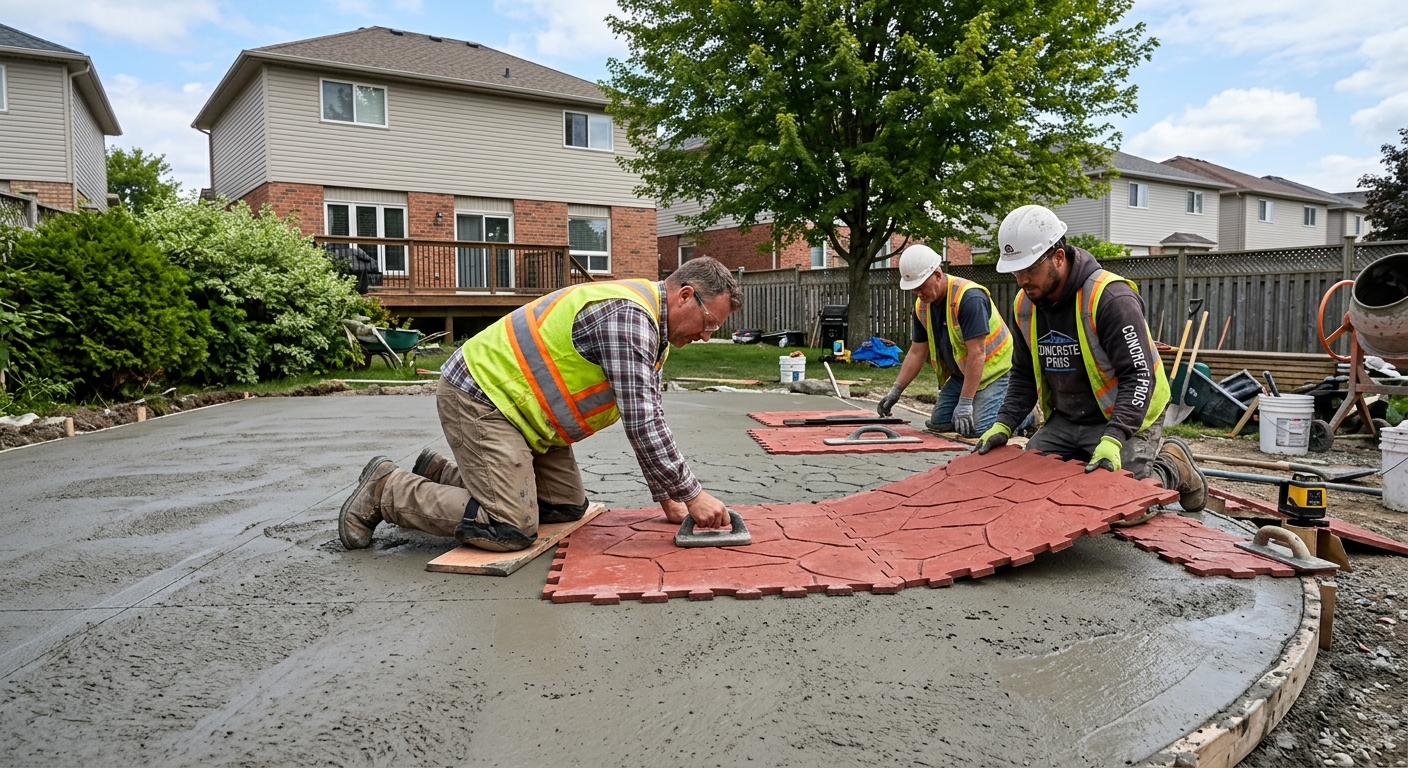
Concrete work options and costs in Waterloo
Waterloo homeowners typically choose concrete because it holds up well under our cold, high freeze-thaw winters—especially when the work is detailed for frost depth and drainage. In Waterloo, about 49.2% of dwellings are single-detached homes (Statistics Canada, 2021 Census), which is a major driver of demand for driveways, patios, and walkway replacements. The region’s housing stock is also older: 32.9% of homes were built before 1981 (Statistics Canada, 2021 Census), and many of those properties are due for flatwork upgrades as surfaces start to heave, crack, or shed water toward foundations.
In the Kitchener–Waterloo–Barrie market, pricing is shaped by the practical realities of winter work: frost depths commonly fall around 1.0–1.2 m (3–4 ft), and structural concrete must be placed on footings below the design frost line to prevent heave and random cracking. Exterior slabs are typically specified with air-entrained concrete for durability through freeze-thaw cycles, and cold-weather protection (insulating blankets and careful curing) can be required, which increases labour and equipment time. Availability can also tighten during short effective pour seasons, so booking earlier helps control costs.
Neighborhoods such as Westvale and Huron Park often see steady driveway and walkway work as families refresh curb appeal and manage drainage around garages and backyard entries.
Below are common Waterloo price ranges by application, assuming typical access and standard scope.
| Application |
Typical Size |
Key Spec |
Finish Option |
Price Range |
| Concrete driveway (standard broom finish) |
10 ft x 20 ft (200 sq. ft.) |
Air-entrained mix, compacted granular base |
Broom finish + control joints |
$3,000–$5,000 |
| Exposed aggregate driveway |
10 ft x 20 ft (200 sq. ft.) |
Air-entrained mix, proper curing |
Exposed aggregate finish |
$3,800–$6,000 |
| Stamped concrete driveway or patio |
10 ft x 20 ft (200 sq. ft.) |
Air-entrained mix, integral color or stain |
Stamped pattern + release agent |
$4,400–$7,000 |
| Plain concrete patio or walkway |
10 ft x 15 ft (150 sq. ft.) |
Air-entrained mix, compacted base |
Broom or smooth trowel finish |
$2,100–$3,300 |
| Garage floor (interior slab) |
20 ft x 20 ft (400 sq. ft.) |
Vapour barrier, proper base, fibres/mesh as specified |
Sealed broom or trowel-finish |
$6,000–$10,000 |
| Foundation footings (structural, below frost) |
Typical house/extension footing run (varies) |
Reinforced concrete designed below frost line |
Formed concrete with steel as required |
$5,000–$12,000 |
Prices are estimates only and vary by project scope, site access and material selection.
What affects the price of concrete work in Waterloo
Two quotes for the “same” concrete job in Waterloo can differ by 30–50% because the hidden work changes: excavation depth, base preparation, reinforcement, curing protection, and finish complexity are often where budgets move. In Kitchener–Waterloo–Barrie, that variation is heightened by our freeze-thaw climate, a shorter effective pour season, and higher demand for contractors during spring and early summer.
First, frost depth and freeze-thaw cycles dictate design. Structural concrete work must extend below the design frost depth to avoid frost heave and cracking; in Ontario, that often means deeper excavation than homeowners expect. Second, all exterior slabs are usually specified with air-entrained concrete to survive repeated freezing and thawing. Third, colder conditions can require cold-weather curing precautions—insulating blankets, adjusted batching timelines, and more attention to set time—which adds labour and equipment costs. Lastly, de-icing salt accelerates surface wear and spalling if the mix and surface protection aren’t right, so sealing becomes an important part of long-term durability.
Concrete examples that raise costs in Waterloo include removing oversized old slabs that are badly bonded to base material, adding reinforcing for thicker slabs, and repairing drainage so water doesn’t pool along foundation edges. Costs can be lower when existing base is sound and truck access is straightforward, because that reduces excavation time and minimizes rework. For reference, a standard driveway at the regional band of $15–$25 per sq. ft. may stay close to budget, while stamped or exposed options often land higher within the $22–$35 per sq. ft. range due to formwork, labour time, and finishing.
Also consider housing age: properties built before 1981 often have older site grading and drainage patterns. When those issues are corrected, you may pay more upfront for base and grading, but you’re reducing the likelihood of early failure—an expense you can’t “fix later” without tearing out the slab.
| Price Factor |
Why It Matters |
Cost Impact |
| Frost line depth |
Determines footing depth and form height |
Deeper excavation can add significant labour/equipment time; typically a major cost driver for foundations |
| Site preparation |
Excavation, grading, compacted granular base |
More trucking and longer compaction work increases cost, but it reduces future settlement cracking |
| Reinforcement |
Rebar or wire mesh requirement |
Material + placement time can raise cost, especially for thickened edges, garage floors, and load zones |
| Mix design |
Air-entrainment and compressive strength spec |
Air-entrained mixes and higher strength specs cost a bit more but protect against freeze-thaw damage |
| Finish type |
Broom vs. stamped vs. exposed aggregate |
Stamped/exposed finishes typically add labour steps and material allowances |
| Pour size and concrete truck access to site |
Placement method and timing |
Long pours or limited access can increase labour and may require specialized pumping/placement |
| Cold-weather curing precautions |
Heating and insulating blankets |
More crew time and materials during shoulder seasons; can add to the budget even if the square footage is the same |
| Control joint pattern and sealing cost |
Manages cracking and reduces water ingress |
More joints and professional sealing add cost, but they reduce random cracking and surface deterioration |
Permits & regulations in Ontario
In Ontario, the rules around permits come down to whether the concrete is considered structural and whether it changes drainage, grading, or impervious surface impacts. In Waterloo, structural concrete work such as foundation walls, grade beams, and footings generally requires a building permit, and it’s common for engineered drawings to be reviewed by the municipality. For concrete flatwork—like driveways, patios, and walkways—a permit is often not needed for a like-for-like replacement, unless the work affects lot grading, triggers impervious surface coverage considerations, or involves changes near a municipal right-of-way or drainage patterns. Always confirm with the local authority before you start excavation.
Equally important is contractor compliance. Ask for proof of liability insurance and WSIB/WCB coverage (as applicable). Then verify the contractor’s Ontario licensing/registration as required for the type of work they’re performing. Here’s a practical step-by-step homeowners can use:
- Request the contractor’s insurance certificate and check the coverage dates and jobsite address.
- Ask for their WSIB/WCB clearance letter or account proof (not just a verbal assurance).
- Confirm their Ontario registration/licence using publicly available online resources.
- Verify the quote includes any required permit work (or that the homeowner will be responsible to pull permits, if applicable).
- Request references for similar-scale Waterloo projects and verify the work type matches your scope.
Getting concrete right in Waterloo's freeze-thaw climate
In Waterloo, concrete failures are usually climate-driven: water gets into the slab or at the base, freezes, expands, and then slowly breaks the surface or lifts sections through frost action. The fix isn’t just “stronger concrete”—it’s correct detailing. Start with base preparation: a compacted granular sub-base placed to the right depth for local soil conditions and frost considerations. If the base is underbuilt or not compacted, you’ll see settlement and cracking even with a good mix.
Next, spec the mix design. For exterior flatwork in Southern Ontario, air-entrainment is essential. A typical target is 5–7% air content (air-entrainment level depends on exposure and aggregate sizing), and we commonly aim for at least 32 MPa compressive strength. Then include control joints and a sensible timing plan so cracks form where you want them. For curing, don’t rush. Waterloo pours often require protection in cold or damp conditions—plan for minimum 7 days of proper curing so strength develops before freeze-thaw cycling begins. Finally, use sealing: apply a penetrating sealer after the concrete has cured (commonly around 28 days) to help repel de-icing salts and reduce water ingress.
If you’re comparing options, the price difference should make sense. For example, a standard broom-finish patio in the regional band of $14–$22 per sq. ft. may be the best value if your main goal is long-term durability. Stamped concrete (often higher, around $22–$35 per sq. ft.) is worth it when you want decorative curb appeal—but only if the base, air-entrainment, joints, and curing are done correctly first.
When you talk to contractors, ask pointed questions about air-entrainment, base thickness/compaction testing, joint layout, curing blankets in shoulder weather, and the sealer type/timing.
| Spec |
Why It Matters in Waterloo |
What to Ask For |
Impact if Skipped |
| Compacted granular base (depth?) |
Controls settlement and frost-related movement under the slab |
Base thickness, granular type (e.g., 0.75” clear/crush where appropriate), and compaction method |
Early cracking, edge lifting, and uneven surfaces after freeze-thaw cycling |
| Air-entrained concrete mix (target air %?) |
Improves freeze-thaw durability by allowing space for ice expansion |
Air-entrainment target (commonly 5–7% for exterior flatwork) and confirmation it’s air-entrained on the pour ticket |
Spalling, scaling, and surface deterioration—especially with de-icing salts |
| Compressive strength (MPa rating) |
Helps the slab develop durability through winter cycles |
Minimum 32 MPa spec and mix design confirmation for the exposure |
Reduced surface strength and higher wear in salt and traffic zones |
| Control joints (spacing per ACI guidelines) |
Limits random cracking by guiding where the slab relieves stress |
Joint spacing plan, saw-cut timing, and sealant plan for joint protection |
Random cracks and water pathways that accelerate freeze-thaw damage |
| Minimum 7-day curing period |
Strength development before winter stresses hit |
How curing is handled in Waterloo conditions (blankets/membranes if needed) |
Weaker early-age concrete, increased cracking and surface breakdown |
| Penetrating sealer (when applied after cure) |
Reduces water and salt penetration during freezing weather |
Sealer type and application timing (commonly around 28 days post-pour) |
Faster scaling and spalling; more frequent resurfacing needs |
How to choose a concrete work contractor in Waterloo
Choosing the right contractor in Waterloo is mostly about verifying compliance and workmanship standards before you sign. First, confirm Ontario licensing/registration for the type of work being done. Next, check liability insurance: ask for a current certificate of insurance showing the contractor’s coverage for the project period. Then verify WSIB/WCB clearance (or proof of coverage where applicable). If a contractor can’t produce documents promptly, that’s a sign to pause—especially for excavation and concrete placement where risks are real.
For quoting, get 2–3 itemised written quotes instead of one lump sum. You want breakdowns for labour, concrete supply, reinforcement, excavation/grading, granular base, forms, finishing, sealing, and disposal. Carefully read the scope: what’s excluded (e.g., removal of old asphalt/sidewalk sections, permits if required, disposal and hauling, replacement of subdrain tie-ins)? Confirm whether truck access constraints or pumping are included, because that can change the final cost quickly.
Warranty matters too. Ask for a workmanship warranty length, whether it includes surface scaling/spalling issues related to proper mix and installation, and whether product/manufacturer warranties are separate and transferable. For payment, avoid large upfront amounts: a good rule is not more than 10–15% upfront, with a holdback until the job is complete and cleaned up. Also request a start date and completion estimate in writing, including weather-dependent scheduling.
- Use itemised quotes (materials, labour, base, reinforcement, finishing, sealing, disposal).
- Confirm whether the contractor provides air-entrained concrete for exterior work.
- Ask for base thickness and how compaction is verified.
- Require a clear joint layout plan (locations and timing of saw cuts).
- Ask how curing is protected in cold snaps (blankets/membranes).
- Confirm de-icing salt protection plan (sealer type and timing).
- Verify liability insurance and WSIB/WCB clearance with documents.
- Check the contractor’s Ontario registration/licence for their scope.
- Get a written start date and timeline that accounts for weather.
- Set payment milestones tied to concrete placement and final finishing.
- Ask who handles disposal/hauling of old materials.
- Confirm whether permit work is included or who is responsible for pulling permits.
Concrete red flags I see in Waterloo include: quotes that don’t mention air-entrainment for exterior slabs, no plan for base depth/compaction, delayed curing with no mention of blankets/membranes, cutting corners on control joints, and “too-good-to-be-true” pricing that excludes reinforcement, drainage fixes, or sealing where salt exposure is expected.
Frequently asked questions — concrete work in Waterloo
How long does a concrete project take in Waterloo?
In Waterloo, typical concrete projects often take about 1 to 3 days of active work on site, but the total timeline includes preparation and curing. For example, a driveway or patio usually involves excavation/base prep (often a full day), formwork and reinforcement (half to a day depending on complexity), then the pour day and finishing. Even after the surface can be walked on, proper curing time matters—especially in our freeze-thaw climate—so crews plan for at least 7 days of curing before you put heavy loads on it. If the work is in a shoulder-season cold snap, crews may extend the schedule with insulation blankets or membranes. Budget-wise, the price range might start around $15–$25 per sq. ft. for standard driveway work, but the weather and curing plan can influence labour time and crew availability.
What is a concrete overlay and is it suited to Waterloo?
A concrete overlay is a new layer of concrete placed over an existing slab after surface preparation—often with grinding, patching, and sometimes bonding methods. In Waterloo, an overlay can be suited when the original slab is still structurally sound and the issue is mostly surface wear or minor cracking. It’s usually not a good solution when the existing slab is actively heaving or when the base has failed, because the movement will telegraph through the overlay and can lead to faster deterioration under freeze-thaw cycles. Overlays can also be sensitive to drainage problems and de-icing salt exposure. If your patio or walkway has water pooling, sealing and drainage improvements may be necessary either way. If you’re considering an overlay, ask for core/condition assessment and a detailed plan for joints and curing—those are where Waterloo jobs succeed or fail.
How do I seal concrete to protect it in Waterloo?
To protect concrete in Waterloo’s winter conditions, sealing should focus on reducing water and salt penetration. After the concrete has cured fully—commonly around 28 days—a penetrating sealer is typically applied to help repel moisture and reduce scaling/spalling risks from de-icing salts. Before sealing, the surface should be clean and dry; if there’s trapped moisture, sealer performance drops. For exterior flatwork, sealing doesn’t replace proper base, air-entrainment, control joints, or drainage—it’s a last line of defence. When you get quotes, ask what sealer type will be used, whether it’s penetrating vs film-forming, how the surface is prepped, and whether the contractor will recommend reapplication intervals based on your salt exposure. If your project is on the decorative end (like stamped concrete), sealing is still important to protect the surface.
What is the difference between concrete and cement?
Concrete is the final building material you see and walk on; cement is one of its ingredients. Cement is the powder that reacts with water to create the binding paste. Concrete typically includes cement plus aggregates (sand and gravel), water, and admixtures (like air-entrainment for durability). In Waterloo, exterior slabs are commonly specified with air-entrained concrete so freeze-thaw doesn’t damage the surface. That air-entrainment comes from an admixture added into the concrete mix—cement alone doesn’t create it. When comparing quotes, focus on the concrete mix specification (air content, strength rating, and curing approach), not just the word “cement.” A well-detailed exterior slab may still cost near the typical driveway band (about $15–$25 per sq. ft. for standard work), but the durability depends on the whole mix design and installation details.
How much does concrete work cost in Waterloo?
Concrete costs in Waterloo depend on application, finish level, and site conditions. For quick ballparks, regional bands commonly used for this area are approximately $15–$25 per sq. ft. for a concrete driveway/slab, and $14–$22 per sq. ft. for patios/walkways. If you want stamped or decorative work, the typical band is about $22–$35 per sq. ft. Foundation footings are often estimated separately and commonly fall around $120–$220 per unit measure depending on design and scope. In practice, costs move with frost considerations, excavation depth, base preparation, reinforcement needs, and whether cold-weather curing precautions are required. To avoid surprises, ask for itemised quotes showing labour, materials, base depth/compaction approach, and what’s included for disposal and drainage adjustments.
How deep must footings be for Waterloo's frost line?
For Waterloo’s region, frost depth is commonly around 1.0–1.2 m (3–4 ft), and footings must be placed below the design frost depth to prevent frost heave and cracking. The exact depth can vary based on soil conditions, foundation design, and engineering requirements for your specific project. That’s why structural concrete work (footings, foundation walls, grade beams) typically relies on a building permit and engineered drawings. A common mistake homeowners make is assuming “a few feet” is enough—under Waterloo’s freeze-thaw cycles, shallow footings can lead to movement and long-term structural issues. When reviewing a quote for foundation work, ask what depth is being designed and confirmed below frost line, what reinforcement is included, and whether drainage and weeping tile integration are addressed to keep the foundation area dry.