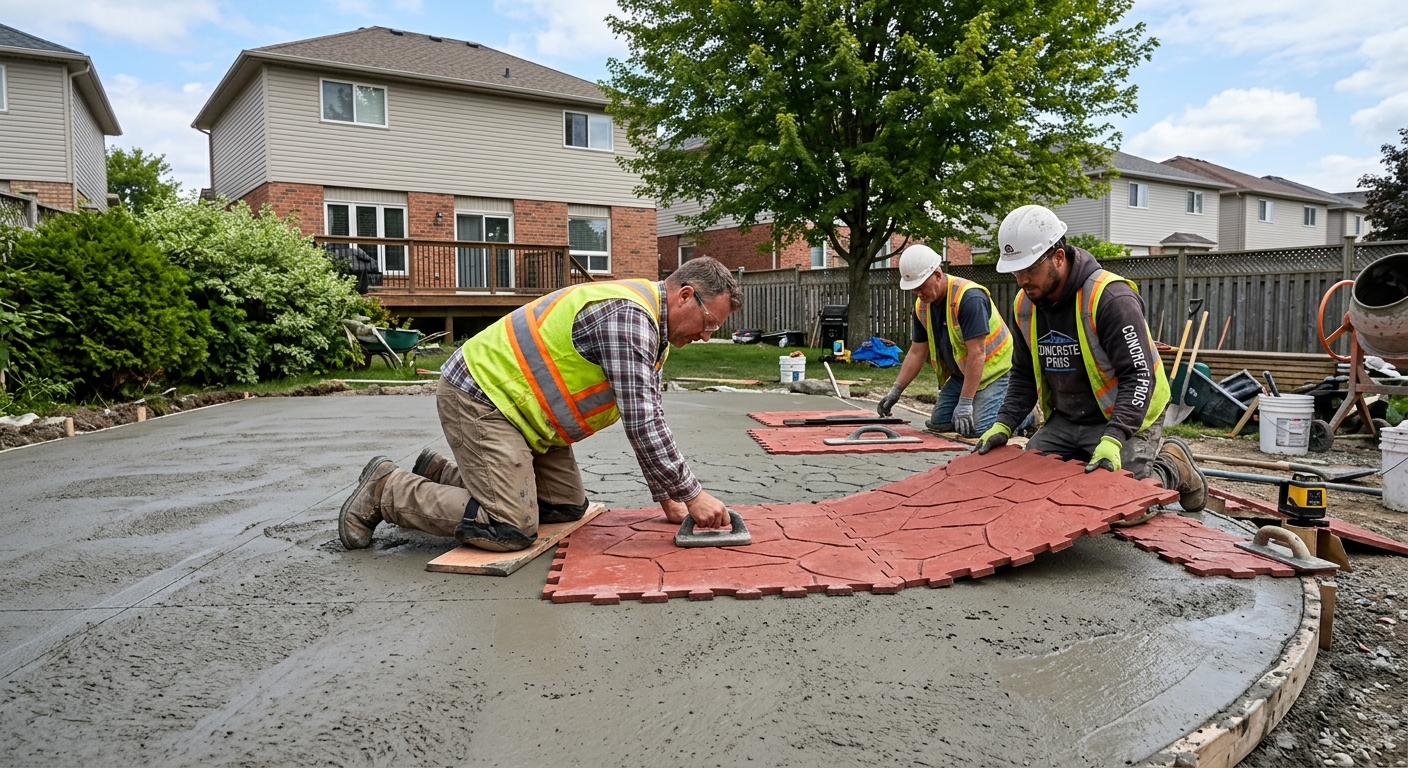
Concrete work options and costs in St. Marys
Concrete work in St. Marys is popular year-round, especially for homeowners updating driveways, patios, and walkways. With single-detached homes making up 69.8% of local dwellings (Statistics Canada, 2021 Census), most concrete flatwork demand comes from residential streets in established neighbourhoods where lots are being refreshed rather than rebuilt. The area’s housing profile also matters—54.2% of homes were built before 1981 (Statistics Canada, 2021 Census), so we often see older concrete removed or reworked due to cracking, uneven settling, or surface scaling.
In the Stratford–Bruce Peninsula region, pricing is driven by freeze–thaw cycles and deep frost. Contractors typically excavate and form to get structural footings below the design frost line, then build a well-drained, compacted granular base. For exterior slabs, crews also use air-entrained concrete to help resist scaling and spalling, particularly where de-icing salt is common. The region’s shorter pour season means more work is scheduled in late spring through early fall, and cold-weather pours require extra labour for heating and insulation blankets to keep curing controlled.
In St. Marys, trades are especially in demand around the downtown core and along the main corridors where driveways tie into sidewalks and municipal paving—there’s less room for staging, so access planning can affect labour and equipment time. Use the table below to compare common options and how finish choices typically move the budget before you request a detailed site quote.
| Application |
Typical Size |
Key Spec |
Finish Option |
Price Range |
| Concrete driveway (standard broom finish) |
400 sq. ft. |
Air-entrained exterior mix; compacted granular base; control joints |
Broom finish, sealer recommended |
$6,400–$8,800 |
| Exposed aggregate driveway |
400 sq. ft. |
Air-entrained exterior mix; proper base and drainage |
Exposed aggregate with sealer |
$8,000–$10,800 |
| Stamped concrete driveway or patio |
300 sq. ft. |
Air-entrained exterior mix; integral colour; joints |
Stamped pattern with release and sealer |
$6,600–$9,600 |
| Plain concrete patio or walkway |
250 sq. ft. |
Exterior air-entrained mix; adequate base and slope |
Smooth or broom finish; optional sealer |
$3,500–$5,000 |
| Garage floor (interior slab) |
500 sq. ft. |
Vapour control if needed; fibre or mesh as specified |
Broom finish or light trowel |
$6,000–$9,500 |
| Foundation footings (structural, below frost) |
Typical 1,000 sq. ft. footprint |
Engineered footing size; below frost excavation; rebar as required |
Structural concrete placement and finishing for forming |
$85–$140 (per linear foot) |
Prices are estimates only and vary by project scope, site access and material selection.
What affects the price of concrete work in St. Marys
It’s common to see the same concrete scope land 30–50% apart across Stratford–Bruce Peninsula and other parts of Ontario because the “hidden work” is where frost climate adds cost. In St. Marys, contractors must plan for deep freezing and frequent freeze–thaw. That means exterior work is typically built with air-entrained concrete mixes to resist surface damage, plus a more rigorous base preparation and drainage than you’d use in milder areas. The labour schedule also tightens: when the pour window closes early, crews spend more time coordinating access, heating, and cure protection.
Footings and foundations must extend below the design frost depth to prevent frost heave and cracking, which increases excavation depth and forming time. For exterior slabs, air-entrainment and correct mix design affect durability—especially where de-icing salts accelerate deterioration. Cold-weather curing precautions add cost too: heating the work area, insulating blankets, and controlling set and early-age strength. On the finishing side, upgrades like exposed aggregate or stamping can cost more than broom-finished flatwork; in this tier, standard concrete driveway work often lands in the $16–$22 per sq. ft. range, while stamped and decorative concrete is commonly $22–$32 per sq. ft. due to labour-intensive forming and finishing.
Two examples from St. Marys that move budgets: (1) a driveway near older neighbourhood curbs may require thicker bases and careful drainage grading, which raises excavation and granular supply; (2) replacing a small cracked section can be cheaper than full rebuilds, but only if the contractor can sawcut and match levels cleanly—otherwise partial pours escalate. Housing age also plays a role: with over half of homes built before 1981 (Statistics Canada, 2021 Census), we often see settled subgrades, so remediation may add thousands even when the visible area looks small.
| Price Factor |
Why It Matters |
Cost Impact |
| Frost line depth — determines footing depth and form height |
Deeper excavation and forming to resist frost heave and cracking |
Higher concrete and labour; can add significant cost on foundations |
| Site preparation — excavation, grading, compacted granular base |
Base thickness and compaction control settlement and slab failure |
More granular material and time increases total price |
| Reinforcement — rebar or wire mesh requirement |
Resists curling and improves load performance |
Materials plus tying/positioning labour |
| Mix design — air-entrainment and compressive strength spec |
Air-entrainment improves freeze–thaw resistance for exterior work |
Certified mix can be slightly higher, but prevents premature scaling/spalling |
| Finish type — broom vs. stamped vs. exposed aggregate |
Finish affects labour time, tools, and sealing requirements |
Stamped/exposed aggregate typically costs materially more |
| Pour size and concrete truck access to site |
Smaller access can require pumping or extra staging |
Pumping and additional crew time raise labour costs |
| Cold-weather curing precautions — heating and blankets |
Maintains early-age strength gain in cool, damp conditions |
Insulation/heaters and labour time add cost during shoulder season |
| Control joint pattern and sealing cost |
Proper jointing limits random cracking; sealing improves salt resistance |
Sawcutting and later application add line-item cost |
Permits & regulations in Ontario
In Ontario, structural concrete work typically requires a building permit and often engineered drawings that the municipality reviews. This includes concrete footings, foundation walls, and grade beams—work that supports the structure and must be designed to resist loads and frost conditions. If you’re building or significantly altering a foundation, ask your contractor whether a permit will be pulled and whether engineering is required for the design and reinforcement layout.
Concrete flatwork—like patios, sidewalks, and driveways—usually does not need a permit in Ontario unless it impacts lot grading, the property’s drainage plan, impervious surface coverage limits, or the municipal right-of-way (for example, work that ties into or changes areas near sidewalks/curbs). Even when a permit isn’t typically required, contractors still need to follow local requirements for drainage and cut depths so water doesn’t shed toward foundations.
To verify a contractor in St. Marys step-by-step: (1) request proof of liability insurance and confirm the certificate lists the correct legal business name; (2) ask for WSIB/WCB clearance (or applicable documentation for coverage status); (3) get the contractor’s Ontario business details and review their references for similar-scale concrete jobs; and (4) ensure the quote is detailed and includes what’s excluded (haul/disposal, permit responsibilities, and curing protection if weather is cold). If you’re unsure whether a permit applies to your scope, contact the City/municipal building department before work starts.
Getting concrete right in St. Marys's freeze-thaw climate
Concrete can fail quickly in St. Marys when it’s treated like “generic” flatwork and not engineered for freeze–thaw and salt exposure. Most problems we see—scaling, spalling, and random cracking—trace back to base preparation, air-entrainment, jointing, and curing. Start with the base: excavate to the correct depth for local soil and frost conditions, then install and compact a granular sub-base with proper grading so water drains away from the slab. Next, specify the mix: exterior flatwork should use air-entrained concrete with an air content around 5–7% and a minimum 32 MPa compressive strength so it can withstand repeated expansion and contraction.
Then manage shrinkage with control joints. For many slabs, joints should be cut early and spaced to reduce random cracking, with proper reinforcement or sawcut timing as your contractor recommends for the thickness and panel dimensions. Curing matters just as much: you should plan for at least 7 days of curing under suitable conditions, and if temperatures dip, cold-weather curing requires insulation blankets and/or heating to protect the slab while early-age strength develops. Finally, sealing: apply a penetrating sealer after the concrete has cured (often 28 days post-pour for best performance) to repel de-icing salts and help reduce surface breakdown.
Here’s where the price difference can be justified: upgrading a driveway to stamped concrete is often closer to $22–$32 per sq. ft., while broom-finished work commonly sits at $16–$22 per sq. ft. If you’re already paying for drainage upgrades and a strong base (which you should for durability), the incremental cost of stamping is easier to accept—because you’re not trading away the structural specs that prevent winter failures.
| Spec |
Why It Matters in St. Marys |
What to Ask For |
Impact if Skipped |
| Compacted granular base (depth?) |
Prevents settlement and reduces freeze–thaw pumping |
Granular base depth, compaction method, and drainage slope plan |
Uneven surface, early cracking, and water intrusion |
| Air-entrained concrete mix (target air %?) |
Helps resist scaling and spalling during winter cycles |
Documented air-entrainment (typically 5–7% for exterior flatwork) |
Premature surface damage and spalling in a few winters |
| Compressive strength (MPa rating) |
Early and long-term strength supports durability and load transfer |
Minimum 32 MPa spec for exterior flatwork |
Soft or weaker concrete that deteriorates faster |
| Control joints (spacing per ACI guidelines) |
Controls shrinkage cracking from temperature swings |
Joint spacing plan and sawcut timing |
Random cracks, spalls at stress points, harder repairs |
| Minimum 7-day curing period |
Protects early-age strength in cold, damp periods |
How curing will be protected; cold-weather method if needed |
Lower strength gain and higher risk of surface scaling |
| Penetrating sealer (when applied after cure) |
Helps limit salt/meltwater penetration |
Sealer type and confirmation of timing (often 28 days post-pour) |
Faster surface breakdown and staining |
How to choose a concrete work contractor in St. Marys
Choosing the right concrete contractor in St. Marys comes down to proof, not promises. First, verify Ontario licensing details where applicable to the contractor’s business type, then confirm liability insurance and WSIB/WCB coverage. Practical steps: (1) ask for a certificate of insurance showing liability coverage limits and the correct legal entity; (2) request WSIB/WCB clearance documentation and confirm coverage is active for the workers on your project; and (3) match the quote and contract to the same legal name that appears on the insurance and clearance—this is a common mismatch issue.
Next, get 2–3 itemised written quotes. You want line items that separate labour, concrete supply, reinforcement, excavation and granular base, sawcutting and joints, forming, disposal/haul-away, and finishing/sealing. Avoid a “lump sum” quote that doesn’t explain what’s included, because in freeze–thaw regions, base thickness and drainage details often change the price more than the surface finish. Confirm whether a permit is included (for foundations) or excluded (for flatwork that typically doesn’t require one), and whether disposal is included or billed separately.
For warranty, ask: how long is the workmanship warranty, and does it cover cracking/spalling issues related to finishing and jointing? Also ask about manufacturer warranties for products like sealers, and whether they’re transferable. On payment, don’t front-load the job—never pay more than about 10–15% upfront. Use a holdback until the work is complete and any finishing requirements (like sealer application timing) are met. Finally, insist on a written timeline with a start date and completion estimate, especially because the pour season in this area compresses scheduling.
- Ask what frost-depth standard they design to for footings/foundations and how they verify it on site.
- Confirm the mix is air-entrained for exterior slabs and that they can document the air target.
- Request base thickness and compaction specs (not just “we’ll prep it properly”).
- Ensure control joints will be cut early and spaced per the slab panel plan.
- Ask whether reinforcement (mesh or rebar) matches the engineering or slab use.
- Verify curing plan for shoulder-season pours (blankets/heaters if temperatures drop).
- Confirm drainage slope and that water will shed away from the house.
- Ask who is responsible for any permit pull if foundations or drainage changes are involved.
- Get disposal/haul-away details in writing (includes demo debris or not?).
- Request a detailed schedule: start date, pouring day(s), and curing/sealer timeline.
- Check warranty terms in plain language, including what is and isn’t covered.
- Make sure payment milestones align with completed deliverables—avoid large upfront deposits.
Red flags we see in St. Marys: contractors who won’t discuss air-entrained mix requirements, quotes that omit base thickness and drainage/slope, no written curing plan for cold or damp weather, vague jointing details (“we’ll see how it goes”), and refusal to provide insurance/WSIB/WCB proof before starting.
Frequently asked questions — concrete work in St. Marys
What is air-entrained concrete and why does it matter here?
Air-entrained concrete is designed to include microscopic air bubbles that give freezing water room to expand without breaking the surface. In St. Marys and the broader Stratford–Bruce Peninsula area, freeze–thaw cycles and de-icing salts are a big reason exterior slabs scale or spall if the wrong mix is used. That’s why reputable contractors specify air-entrainment for driveways, patios, and walkways, not just foundations. If a quote looks “cheap” but doesn’t confirm the mix is air-entrained, you’re likely buying risk. For reference, exterior driveway pricing in this tier is commonly around $16–$22 per sq. ft. for standard broom finish; paying attention to the mix spec is what protects that investment across winters.
How do I prepare the base for a concrete slab?
Base preparation is where durability is won or lost in Ontario’s frost climate. For a driveway, patio, or walkway in St. Marys, the contractor should excavate to the required depth, remove unsuitable soils, and install a properly graded, compacted granular sub-base. The goal is to create stable support and manage drainage so water doesn’t sit under the slab and pump during freeze–thaw cycles. Ask your contractor for the intended base depth, the compaction approach, and how they’ll handle soft spots or drainage swales. If they can’t explain slope/grading and granular specs, consider it a major gap—because you’ll pay twice when settlement or cracking forces repairs.
How do I compare concrete quotes?
To compare quotes fairly in St. Marys, insist on itemised pricing and the same technical specs across bidders. Look beyond the total: compare base preparation (depth and compaction), concrete type (confirm air-entrainment for exterior), reinforcement (mesh vs. rebar if required), jointing (spacing and sawcut timing), and curing protection if temperatures are cool. Also check inclusions like disposal/haul-away, forms, and whether sealer is included or excluded. A contractor might quote stamped concrete at a higher line, but in this region stamped pricing often sits around $22–$32 per sq. ft. because the finish process is labour intensive. If one quote includes sealer and the others don’t, adjust comparisons before deciding.
Can concrete be poured in cold weather in St. Marys?
Yes, concrete can be poured in cold weather in St. Marys, but it requires cold-weather curing controls to achieve proper early strength. The pour season is shorter here, and crews often plan around temperatures because freeze events during placement can damage the surface and reduce long-term durability. A proper cold-weather plan usually includes heating (as needed), insulated blankets, and protection until the concrete reaches adequate strength. Ask for the curing method in writing, including what triggers additional protection, and how they’ll prevent rapid cooling. If a contractor says “we pour no matter what” with no curing plan, that’s a concern—especially for exterior flatwork exposed to salt and freeze–thaw cycles.
How do I maintain concrete in St. Marys's freeze-thaw climate?
Maintenance in Ontario’s freeze–thaw climate is mostly about keeping water and salt from attacking the surface. Start with sealing: for exterior driveways and patios, ask for a penetrating sealer applied after adequate curing—commonly around 28 days post-pour—so it can better repel meltwater and de-icing salts. Keep drainage paths clear so runoff doesn’t pond near the slab edges. For snow and ice removal, use calcium chloride or magnesium-based products where possible and avoid over-salting; always follow the sealer manufacturer’s guidance. If you spot hairline cracks, fill them promptly so water doesn’t get under the slab. Proper joints and sealing are the biggest long-term protections against spalling in St. Marys.
What causes concrete to spall in St. Marys winters?
Concrete spalling in St. Marys is most often caused by freeze–thaw damage plus salt exposure, amplified by poor air-entrainment or inconsistent curing. When water gets into the concrete and freezes, it expands; without enough microscopic air voids, the surface can break down, leading to scaling and spalling. Salt accelerates the deterioration by driving moisture and ions into tiny pores and damaged zones. Spalling also happens when the base drains poorly—water sits under or near the slab edge—so the slab experiences more freeze pumping. The fix is prevention: specify air-entrained concrete for exterior work, ensure correct base prep and drainage, cut joints early, and use appropriate curing and sealing. If you want an apples-to-apples upgrade, it’s often smarter to protect the mix and curing than to chase the cheapest finish.