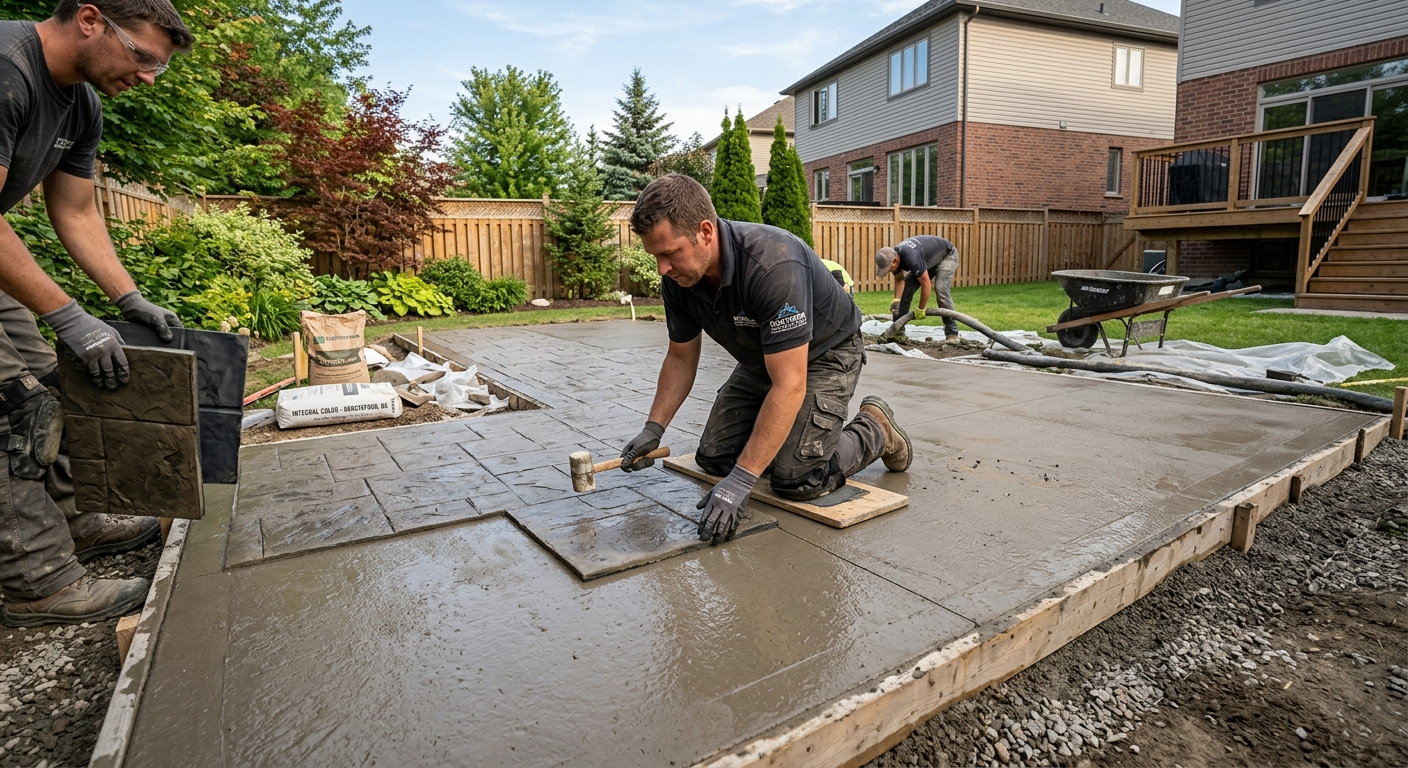
Concrete work options and costs in Church-Yonge Corridor
In Church-Yonge Corridor, concrete work is a year-round need, but the cost and the specs depend heavily on Toronto’s freeze–thaw swings and how deep local frost protection must go. This is a strong flatwork market: the Church-Yonge Corridor area supports a broad mix of homeowners, and with a city population of 31,340 (Statistics Canada, 2021 Census), contractors are constantly juggling tight scheduling, truck access, and neighbourhood-by-neighbourhood site conditions. In older pockets near Yonge Street and south toward Davisville, lots often have mature trees, narrower driveways, and tighter grading tolerances—so base prep and drainage details can become the deciding cost driver.
In the Toronto economic region, exterior flatwork is typically poured in the warmer months to manage curing. When temperatures trend toward about 10 °C or below, concrete needs added protection (blankets/temporary heat) and longer cure time to reduce surface weakness and cracking risk. That’s why Toronto quotes can shift meaningfully even for “the same” driveway size: deeper footing requirements (and the formwork they create), air-entrained mix selection for freeze–thaw durability, and labour availability all factor in. If you’re comparing finishes, expect broom-finished concrete to land in a lower band than stamped or exposed aggregate, while base preparation and joint layout remain the foundation for long-term performance.
Below is a practical comparison of common applications in Church-Yonge Corridor to help you budget, then refine your quote once you confirm thickness, drainage, and access constraints.
| Application |
Typical Size |
Key Spec |
Finish Option |
Price Range |
| Concrete driveway (standard broom finish) |
350–450 sq ft (typ.) |
4 in (100 mm) slab, air-entrained mix for exterior, wire mesh or rebar as required |
Broomed surface for traction |
$3,200–$5,500 |
| Exposed aggregate driveway |
350–450 sq ft (typ.) |
4 in (100 mm) slab, controlled mix, proper curing to protect surface quality |
Exposed aggregate finish (retarder/wash) |
$5,500–$8,500 |
| Stamped concrete driveway or patio |
250–400 sq ft (typ.) |
Thickness matched to load/usage, air-entrained exterior mix, reinforced as needed |
Stamped pattern + color hardener/release agent |
$6,000–$14,000 |
| Plain concrete patio or walkway |
150–300 sq ft (typ.) |
4 in (100 mm) slab, well-compacted granular base, drainage falls away from house |
Plain + broom edge/finish |
$2,200–$6,800 |
| Garage floor (interior slab) |
300–600 sq ft (typ.) |
4–5 in (100–125 mm) with proper sub-base, vapor barrier where required |
Standard trowel + seal (if requested) |
$4,500–$12,000 |
| Foundation footings (structural, below frost) |
Varies (per footing system) |
Structural concrete + reinforcement, typically below design frost depth (Ontario often around 1.2 m or more) |
Formed/structural finish (not decorative) |
$6,000–$18,000 |
Prices are estimates only and vary by project scope, site access and material selection.
What affects the price of concrete work in Church-Yonge Corridor
Even in the same Ontario neighbourhood, you can see concrete quotes swing by 30–50% for what looks like a similar job. In Church-Yonge Corridor, that gap usually comes down to whether the contractor is pricing for the right freeze–thaw spec (air entrainment, thickness, reinforcement, and joint pattern) versus a budget mix and fast schedule. Toronto-area labour and equipment availability can also vary week to week because exterior pours are concentrated in the warmer months. When the weather turns and crews are limited, mobilisation and curing protection (tarps, blankets, heaters) become part of the cost.
Frost depth and freeze–thaw cycles dictate everything: footings must extend below design frost depth to prevent frost heave and differential movement, and exterior slabs should use air-entrained mixes to survive repeated temperature cycling. If concrete is poured in cooler conditions, contractors may need cold-weather precautions; that can push a project out a few days or add materials for curing control. On top of that, de-icing salts accelerate surface spalling if the mix, air content, and sealing plan aren’t right—so sealing is often the difference between a surface that stays neat and one that starts to pit within a few seasons.
Two real-world examples from Church-Yonge Corridor: (1) if your driveway ties into a curb cut or sidewalk area with restricted access, truck placement and concrete pumping can add labour; (2) if you have a sloped yard and need drainage regrading, base prep increases material and compaction time. For budgeting, a standard broom-finish driveway typically sits near the lower end of the driveway range, while stamped surfaces move up into the decorative band—especially when colour hardener and intricate detailing are included.
| Price Factor |
Why It Matters |
Cost Impact |
| Frost line depth — determines footing depth and form height |
Deeper, structurally correct excavation and forms reduce frost heave risk |
Can add thousands where footing work is substantial or excavation is difficult |
| Site preparation — excavation, grading, compacted granular base |
Proper base prevents settlement and keeps exterior slabs level through seasons |
Major swing factor (soil conditions, access, disposal) |
| Reinforcement — rebar or wire mesh requirement |
Controls cracking and supports slab performance under loads |
Often moderate, but changes are significant if reinforcement is omitted or under-specified |
| Mix design — air-entrainment and compressive strength spec |
Air-entrainment is critical for freeze–thaw durability on exterior flatwork |
Typically mid-range cost; prevents expensive premature repairs |
| Finish type — broom vs. stamped vs. exposed aggregate |
Finish complexity drives additional labour, materials, and curing care |
Stamped/exposed usually adds substantial cost vs broom finish |
| Pour size and concrete truck access to site |
Narrow lanes, steep driveways, and limited staging increase labour and time |
Access constraints can raise cost quickly |
| Cold-weather curing precautions — heating and blankets |
Proper early strength development reduces cracking and surface weakness |
Can add equipment/material costs and shift scheduling |
| Control joint pattern and sealing cost |
Joints manage shrinkage cracking; sealing protects against de-icing salts |
Usually affordable relative to repairs; omission often costs more later |
Permits & regulations in Ontario
In Ontario, structural concrete work such as footings, foundation walls, and grade beams typically requires a building permit, and municipalities often expect engineered drawings for review before excavation. That’s because these elements directly support the building’s load path. Concrete flatwork—commonly driveways, patios, and walkways—usually does not require a permit by itself, but there are important exceptions. You may need approval if the work affects lot grading, alters impervious surface coverage rules, changes drainage toward neighbouring properties, or impacts the municipal right-of-way (for example, work that ties into sidewalks or curb infrastructure). Always confirm with your local authority before breaking ground.
For homeowners in Church-Yonge Corridor, verifying the contractor should be methodical. First, confirm the company has valid Ontario business credentials and check the scope of their work matches what they’re pricing. Next, request a Certificate of Insurance (liability) and verify it’s current and names you as required by contract terms. Then ask for proof of WSIB coverage (or the applicable documentation if they’re registered differently). Finally, ask for references tied to similar freeze–thaw exterior flatwork—driveways and patios are a good test because the weather exposure reveals whether the air-entrainment and curing details were done right.
Step-by-step: get copies (insurance + WSIB), confirm dates and coverage limits, and verify that the permit responsibilities align with your municipality’s requirements before work starts.
Getting concrete right in Church-Yonge Corridor's freeze-thaw climate
Concrete failures in Church-Yonge Corridor are usually predictable: surface spalling, widening cracks, and settlement. Most of that stems from a weak or contaminated sub-base, incorrect mix design for freeze–thaw, missing or poorly spaced control joints, and rushed curing. To spec the job correctly in the Toronto market, start with base preparation: excavate to stable material and install a compacted granular sub-base to the right depth and elevation plan so water can drain away and the slab doesn’t move during winter expansion and contraction.
Next, specify the mix. For exterior flatwork, air-entrainment is the line between a driveway that survives winters and one that pits from de-icing salts and freeze–thaw cycling. Typical targets are 5–7% air content, paired with a minimum 32 MPa compressive strength spec (confirm in writing). Control joints are then used to “tell” the concrete where cracking should happen, with spacing planned to reduce random cracking patterns. Finally, curing matters more than most people expect: plan for minimum 7 days curing under proper conditions. When you pour toward colder periods, insulating blankets or heating may be needed to protect early strength gain.
Budget wisely: sealing is not a luxury in Ontario—penetrating sealer applied at about 28 days helps repel salt and water. If you’re comparing options, a decorative stamped driveway may cost more than a standard broom finish (for example, decorative work commonly lands in the $24–$40 per sq ft band), but you don’t want to pay for appearance while cutting corners on base, air-entrainment, and joints—those are the elements that prevent the “pretty but failing” outcome. In short: get the freeze–thaw durability right first; then choose the finish.
| Spec |
Why It Matters in Church-Yonge Corridor |
What to Ask For |
Impact if Skipped |
| Compacted granular base (depth?) |
Prevents settlement and slab movement during freeze–thaw cycles |
State excavation depth + granular thickness, compaction method, and drainage slope plan |
More cracking, uneven surface, and accelerated deterioration |
| Air-entrained concrete mix (target air %?) |
Air voids help concrete resist freeze–thaw damage |
Ask for air-entrainment target (commonly 5–7% for exterior flatwork) and confirm it’s exterior-rated |
Spalling and pitting, especially after winter de-icing cycles |
| Compressive strength (MPa rating) |
Ensures early and long-term durability under loads |
Confirm minimum 32 MPa spec (or higher where required) in writing |
Surface weakness, increased wear, and premature cracking |
| Control joints (spacing per ACI guidelines) |
Directs shrinkage cracking to predictable locations |
Ask for joint spacing plan and where joints will be cut or formed |
Random cracking patterns that are harder to repair cosmetically |
| Minimum 7-day curing period |
Cold snaps can interrupt strength development |
Confirm curing time and protection method if temps fall toward 10 °C |
Surface scaling, cracking, and reduced performance |
| Penetrating sealer (when applied after cure) |
Helps limit salt and water intrusion during repeated winter events |
Request penetrating sealer applied after proper cure (commonly around 28 days) |
Faster salt-related deterioration and higher long-term maintenance |
How to choose a concrete work contractor in Church-Yonge Corridor
Choosing the right concrete contractor in Church-Yonge Corridor starts with verification. In Ontario, confirm the contractor’s business credentials and ask for a current Certificate of Insurance showing liability coverage appropriate for the project, and request proof of WSIB coverage. For concrete crews, coverage matters because excavation and site handling carry real risks—especially when driveways require saw-cutting, demolition, and disposal. When you ask for WSIB, don’t accept a screenshot; request documentation you can keep with your records.
Next, don’t just ask for a “price”—ask for 2–3 itemised written quotes with labour and materials line items (concrete, rebar/wire mesh, base materials, formwork, disposal, sealing, and any permit handling). Read the scope: what’s excluded (tree roots, ledge rock, removal of old asphalt, drainage tie-ins)? Is permit pulling included where structural work requires it? Is concrete truck access included in the pricing, or will pumping/extra equipment be added?
Warranty also needs specifics: ask for the workmanship warranty length (and what it covers), product/manufacturer warranty details for sealers or admixtures, and whether warranties are transferable if you sell your home. For payment terms, keep it controlled: never pay more than 10–15% upfront, and request a holdback until final grading, cleanup, and sealing (when included) are complete. Finally, get timing in writing—start date, concrete pour day, and completion estimate—because exterior pours are sensitive to weather and curing windows in the GTA.
- Ask for itemised quotes (labour + materials), not just a single lump sum.
- Confirm they’re using an exterior-rated, air-entrained mix for driveways/patios.
- Request their joint layout plan (spacing and where joints will be placed).
- Verify they’ll grade for drainage away from the house.
- Ask about sub-base depth and compaction testing or how they confirm compaction.
- Check insurance coverage limits and request the certificate before signing.
- Confirm WSIB coverage documentation is current.
- Get proof of previous similar-sized projects in Toronto (driveways/patios).
- Clarify whether disposal, saw-cutting, and edge restoration are included.
- Confirm curing protection plan if temperatures drop near 10 °C.
- Set a payment schedule with a holdback until completion and cleanup.
- Put start date, pour date, and completion estimate in writing.
Concrete red flags in Church-Yonge Corridor: contractors who won’t discuss air-entrainment targets for exterior slabs, quotes that skip base prep or joint layout, promises to pour in cold weather without curing protection, vague warranty language (no workmanship terms), and payment requests that exceed 10–15% upfront or refuse holdback until sealing/cleanup is complete.
Frequently asked questions — concrete work in Church-Yonge Corridor
Why does concrete crack in Church-Yonge Corridor and how is it prevented?
Cracking is common in Church-Yonge Corridor because concrete shrinks as it cures and then expands/contracts through freeze–thaw cycles. The biggest preventers are correct base preparation, air-entrainment for freeze–thaw durability, and an intentional joint plan. If the granular base isn’t compacted to the design grade, the slab can settle and crack even if the concrete mix is good. If joints are missing or spaced incorrectly, shrinkage cracking becomes random and harder to manage. A proper control joint layout plus sealing (especially after 28 days) helps reduce water and salt intrusion. In practice, it also protects the appearance and traction—important for Toronto driveways and sidewalks where de-icing is routine. When you compare quotes, ask whether the contractor is pricing for reinforcement and an exterior air-entrained mix, not just “pour and finish.”
Stamped vs broom-finish concrete — cost difference?
Stamped concrete costs more than broom-finish because it requires labour-intensive moulding, pattern alignment, and typically colour hardeners and release agents (and careful finishing to keep crisp edges). In the Toronto area, the price bands reflect this: standard driveway work is commonly budgeted around the concrete driveway band, while stamped work sits in the decorative tier. As a quick reference, stamped & decorative concrete commonly lands around $24–$40 per sq ft, while a standard broom driveway is usually less. Whether the higher cost is justified depends on what you’re really paying for: if a contractor’s base prep and air-entrainment are solid, stamped finishing can look great for years. If those basics are weak, the cheaper option is not the broom finish—it’s the long-term repair cost. For a driveway or patio near Yonge Street where curb and drainage details are tight, ask for the full scope: reinforcement, joint pattern, curing protection, and sealing are non-negotiable.
When is the best time to pour concrete in Church-Yonge Corridor?
The best time is generally during the warmer months when temperatures stay reliably above freezing and allow proper curing. In the GTA, many exterior pours are scheduled in spring and early fall before conditions become unpredictable—because when temperatures trend toward about 10 °C or below, contractors often need extra curing protection like blankets, temporary heat, and more careful timing. That adds both cost and schedule risk, but it’s also what prevents premature surface weakness. If you’re aiming to match a specific start date, plan around weather windows rather than only calendar dates. For patios, walkways, and driveways, contractors typically prefer forecasted stretches of stable weather so finishing, jointing, and curing can be completed correctly. If you’re getting a quote, ask the crew what they do for cold nights (or how they reschedule) and whether those curing measures are included in the written scope.
How long does concrete take to cure?
Concrete curing has two layers: early strength and long-term durability. For most exterior projects in Ontario, contractors plan for a minimum 7-day curing period under proper conditions for the slab to gain adequate early strength. However, full maturity takes longer, and that’s why sealing is commonly scheduled after cure—often around 28 days. In Church-Yonge Corridor, curing can be slower when temperatures dip, and de-icing salts can be a problem if you use the surface too early. A reliable contractor will coordinate curing protection if cold weather is expected (blankets or temporary heat) and will set realistic access restrictions. If your quote assumes “we’ll be done tomorrow,” ask how they protect the slab during the first week. This matters even more for driveways where the surface is exposed to salt and frequent traffic loads.
Do I need a permit for concrete work in Ontario?
In Ontario, structural concrete work—like footings, foundation walls, and grade beams—typically requires a building permit and often engineered drawings for municipal review. For exterior flatwork such as driveways, patios, and walkways, permits are usually not required by default, but exceptions do exist. You may need approval if the work affects lot grading, drainage patterns, impervious surface requirements, or the municipal right-of-way (for example, work tied to a sidewalk/curb). In Church-Yonge Corridor, where lots are often older and grading is more constrained, it’s smart to confirm early so you don’t end up redoing work. Practical step: ask your contractor whether your scope triggers permit handling, and if they claim “no permit needed,” request their basis in writing. You can also verify project requirements through your local municipal contact before excavation starts.
Concrete vs pavers for a patio in Church-Yonge Corridor?
Concrete and pavers can both work well in the freeze–thaw conditions of Church-Yonge Corridor, but they fail differently. Concrete is typically more uniform and can be more cost-predictable when base prep and jointing are correct. Pavers offer easier localized repairs—if a unit shifts, you can replace individual pavers—but the system depends on excellent base thickness, bedding sand, and edge restraints. Concrete also benefits from air-entrained mixes and planned control joints to manage cracking; sealing helps with de-icing salt and water intrusion. Cost-wise, concrete patios often fit the driveway/walkway/patio bands; for example, plain concrete patios and walkways commonly land in the $16–$26 per sq ft type range, while stamped decorative options are higher. If you want a decorative look, stamped concrete can compete with pavers aesthetically, but it must still be built for Toronto conditions (base, air content, curing, joints). The better choice usually depends on your budget for long-term maintenance and how much disturbance you can tolerate during installation or future repairs.