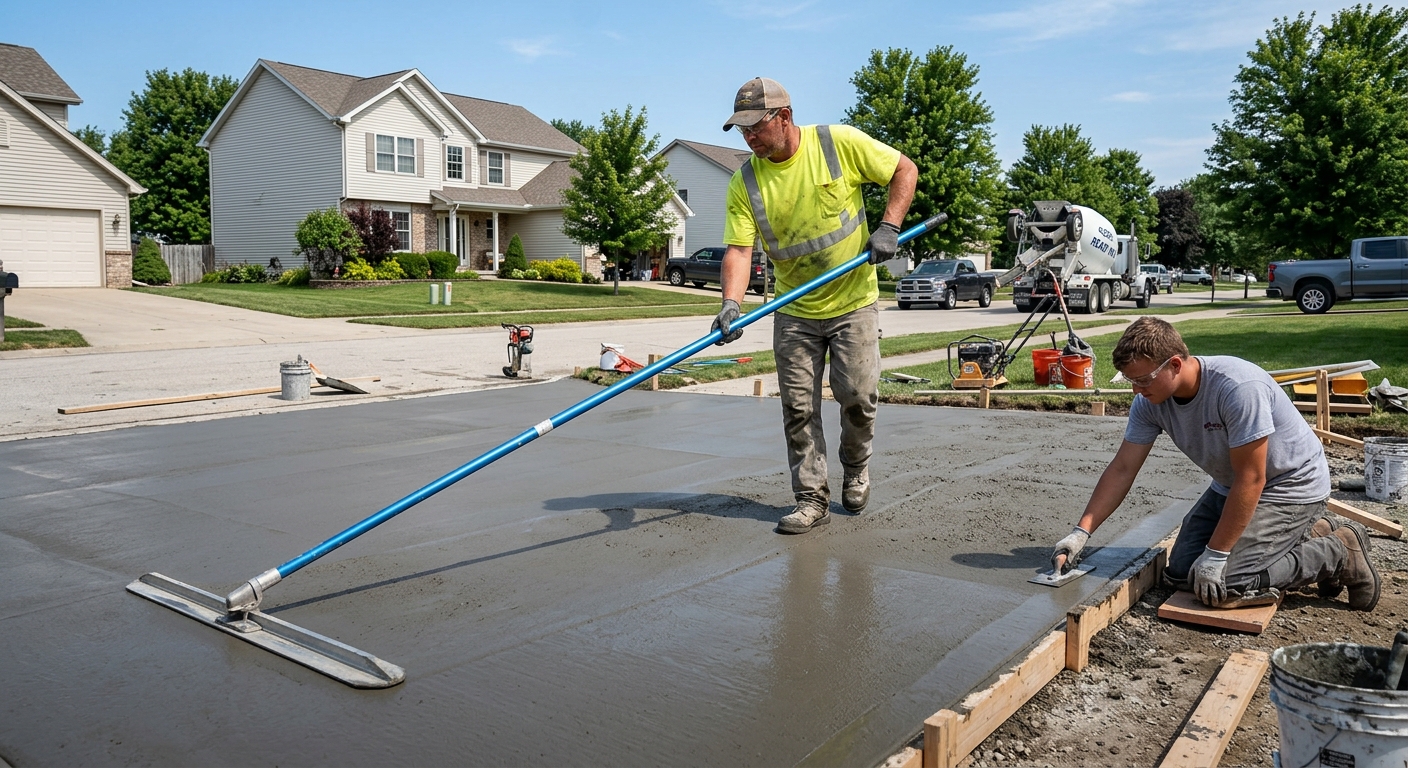
Concrete work options and costs in Azilda
In Azilda, concrete work is a practical upgrade for homeowners because it looks sharp, stands up to winter traffic, and can be built to handle freeze–thaw. Azilda’s population is 4,663 (Statistics Canada, 2021 Census), and the local housing base drives steady demand for exterior flatwork like driveways, patios and walkways. While the exact mix of housing types changes block to block, the majority of homeowners rely on single-family properties and garages, so concrete slabs and driveways are among the most common projects contractors bid each season.
In the Toronto economic region, concrete pricing is strongly shaped by frost depth and repeated freeze–thaw cycles. Most structural footings are required to extend at least 1.2 m (about 4 ft) below grade in Ontario, which increases excavation and rebar/formwork labour before any concrete is poured. Exterior flatwork also needs air-entrained mixes, well-compacted granular base, and control joints to manage cracking. Even when concrete itself is a “commodity,” Toronto-area overhead and schedule pressure can change labour availability and pour-day timing—especially when temperatures trend toward 10 °C or below late in the season.
In Azilda, trade demand is especially steady in and around the core areas where homeowners renovate older driveways and add smoother walkways from the street to front doors. If you’re comparing options, the table below shows realistic typical sizes and how finish choices affect cost—so you can match the spec to your budget and durability goals.
| Application |
Typical Size |
Key Spec |
Finish Option |
Price Range |
| Concrete driveway (standard broom finish) |
400 sq. ft. (e.g., 20’ x 20’) |
Air-entrained concrete, compacted granular base, control joints |
Broom finish + edge edging |
$7,200–$11,200 |
| Exposed aggregate driveway |
400 sq. ft. |
Air-entrained mix, proper curing, surface retarder/cleanup |
Exposed aggregate (wash/surface retarder) |
$9,600–$14,800 |
| Stamped concrete driveway or patio |
300 sq. ft. (e.g., driveway section or 15’ x 20’ patio) |
Reinforcement as needed, control joints planned for patterns |
Stamped pattern + release + border accents |
$7,200–$12,000 |
| Plain concrete patio or walkway |
240 sq. ft. (e.g., 12’ x 20’ patio) |
Granular base, air-entrained mix, drainage slope |
Float/smooth + light broom texture |
$3,800–$6,200 |
| Garage floor (interior slab) |
480 sq. ft. (e.g., 20’ x 24’) |
Vapour barrier (as required), fibre/wire mesh, proper finish timing |
Smooth trowel + light broom/traction cuts if desired |
$8,600–$14,400 |
| Foundation footings (structural, below frost) |
Typical single-house footing package |
Excavation to frost depth, rebar cages, inspected forms |
Structural concrete with engineered rebar layout |
$18,000–$33,000 |
Prices are estimates only and vary by project scope, site access and material selection.
What affects the price of concrete work in Azilda
It’s common to see quotes for the “same” concrete job differ by 30–50% in the Toronto area. In practice, that variation comes from site conditions, how deep the frost-related excavation goes, how much base and reinforcement is actually installed, and how the contractor handles scheduling and curing. Even small changes—like thicker slab plans, higher-strength specs, or added joints and sealing—can shift cost quickly.
In Ontario, frost depth and freeze–thaw cycles dictate every exterior spec. Footings generally must extend below the design frost depth (commonly about 1.5–2.4 m in Ontario, depending on design and local soil conditions) to prevent frost heave and differential movement. Exterior slabs should be built with air-entrained concrete to survive the repeated expansion/contraction of saturated soils. When temperatures drop toward 10 °C or below, the contractor may need cold-weather curing precautions—insulating blankets or temporary heat—so the concrete can develop strength. Also, de-icing salt accelerates surface spalling when the mix and curing aren’t right, which is why sealing and the right surface finishing matter.
In Azilda, two conditions frequently raise costs: clay-leaning or poorly drained soils (more granular base and undercutting), and tight driveway access (more labour time to manage forms, rebar placement, and concrete pumping). Conversely, straightforward access and clean, stable ground can lower costs closer to the lower end of Toronto-region pricing—for instance, a basic broom-finished driveway often aligns with the lower part of the $18–$28 per sq. ft. band, while stamped or exposed work typically moves toward the higher end due to finishing labour and materials (often tied to the $24–$40 per sq. ft. stamped/decorative band). If you’re redoing an older driveway (common in mature neighbourhood streets), additional base repair and demolition can add several thousand dollars compared with pouring on prepared grade, even when total concrete volume is similar.
| Price Factor |
Why It Matters |
Cost Impact |
| Frost line depth — determines footing depth and form height |
Deeper excavation and more formwork are required to prevent frost heave and movement |
Can add 15–40% on foundation/footing scopes |
| Site preparation — excavation, grading, compacted granular base |
Proper base reduces settlement and cracking; poor soils require undercut and replacement |
Usually shifts the job by several thousand dollars |
| Reinforcement — rebar or wire mesh requirement |
Traffic and structural requirements determine whether mesh is enough or rebar mats are needed |
May add 5–20% depending on design and steel quantity |
| Mix design — air-entrainment and compressive strength spec |
Air-entrainment helps resist freeze–thaw damage; strength spec affects mix and delivery |
Small per-yard difference, but can change total by 3–10% |
| Finish type — broom vs. stamped vs. exposed aggregate |
Labour and materials increase with decorative systems and extra surface steps |
Often pushes total toward the top of the pricing band |
| Pour size and concrete truck access to site |
Long reaches, ramps, and limited access can require pumping, additional labour, and time |
Access constraints can add 10–25% |
| Cold-weather curing precautions — heating and blankets |
Protecting fresh concrete keeps strength gain on track during cooler pours |
Can add 5–15% if extra protection is needed |
| Control joint pattern and sealing cost |
Joints reduce random cracking; sealing reduces salt-related surface wear |
Often 1–5% of total cost, but big impact on durability |
Permits & regulations in Ontario
In Ontario, most structural concrete work needs a building permit and often engineered drawings reviewed by the municipality. That typically includes foundation walls, footings, grade beams and other load-bearing concrete elements. For example, if you’re building a new foundation, adding a basement underpinning, or changing structural support, expect permitting and inspections as part of the process.
Concrete flatwork like patios, walkways and driveways usually does not require a permit on its own. That said, there are common exceptions. If the project affects lot grading or drainage, involves changes that impact impervious surface coverage limits, or touches municipal right-of-way items (like driveway approaches or work near curb lines), the municipality may require approval or specific conditions before work begins.
For your Azilda project, take these steps to protect yourself:
- Ask the contractor what they believe is required: permit pull included or not, and which drawings/engineering are needed.
- Verify liability insurance—request a current certificate of insurance showing the coverage amount and project details.
- Confirm WSIB/WCB coverage (or the applicable coverage proof your contractor uses in Ontario) and ensure it matches the scope of work.
- Check the contractor’s status through Ontario’s public business/contractor listing resources (and review any complaints or enforcement history if available).
- Require written proof of insurance and coverage before any demo begins.
If anything is unclear, contact the local authority for a quick confirmation before you sign—especially when drainage and grading are part of the job.
Getting concrete right in Azilda's freeze-thaw climate
In Azilda, concrete failure is usually a freeze–thaw and moisture problem, not a “bad batch” problem. The biggest culprits are inadequate base preparation, missing or wrong air-entrainment, and poor curing or surface protection. When saturated soils freeze, they expand and push against the slab, which leads to heaving, settlement, and cracks. At the surface, de-icing salts can accelerate scaling if the mix doesn’t have enough air and if the curing process is rushed.
To spec the job correctly, focus on five essentials that match the Toronto-region climate reality. First, base preparation: use a compacted granular sub-base to the right depth for your soil and frost considerations, with proper slope and drainage so water doesn’t sit under the concrete. Second, mix design: for exterior flatwork, you should ask for air-entrainment in the 5–7% range and a minimum 32 MPa compressive strength. Third, control joints: plan spacing to limit random cracking across driveway runs and patio panels. Fourth, curing: aim for at least 7 days under proper conditions—this becomes even more important during late-season pours when temperatures hover near 10 °C or below. Fifth, sealing: apply a penetrating sealer after curing (commonly at 28 days post-pour) to repel de-icing salts and help reduce surface spalling.
Where does the money difference actually make sense? For instance, moving from plain broom-finished exterior concrete toward stamped or exposed aggregate often costs more (often aligned with the $24–$40 decorative band). That higher finish cost is justified when you need better curb appeal and a more durable, textured surface—especially for driveways where tires track salt and grit. If you’re just trying to stop cracking on an older slab, you’ll often get better value spending on correct base prep, joints, air-entrained mix, and sealing rather than chasing a decorative finish.
| Spec |
Why It Matters in Azilda |
What to Ask For |
Impact if Skipped |
| Compacted granular base (depth?) |
Prevents settlement and reduces water movement that causes freeze–thaw damage |
Granular base depth to match soil conditions, plus compaction method and drainage slope |
Higher risk of heaving, rocking, and early cracking |
| Air-entrained concrete mix (target air %?) |
Air pores let water expand safely during freezing |
Target 5–7% air for exterior flatwork; confirm it in writing |
Spalling and scaling, especially with salt exposure |
| Compressive strength (MPa rating) |
Supports strength gain before and after temperature swings |
Minimum 32 MPa and the test/acceptance approach for your pour |
Surface wear and cracking can accelerate under traffic |
| Control joints (spacing per ACI guidelines) |
Controls where cracks occur during drying and seasonal movement |
Planned joint layout and saw-cut timing |
Random cracking and wider, uneven failures |
| Minimum 7-day curing period |
Ensures the concrete develops strength despite cool snaps |
Protection plan if temperatures dip; curing method and responsibilities |
Weak surface and poor durability in winter |
| Penetrating sealer (when applied after cure) |
Helps repel water and reduces salt-driven surface deterioration |
Confirm product type and application schedule (commonly after 28 days) |
Faster scaling and staining |
How to choose a concrete work contractor in Azilda
Choosing the right contractor is less about who has the lowest number and more about who will build to the right spec for Azilda’s freeze–thaw winters. In Ontario, verify licensing and coverage first. For liability insurance, request a current certificate of insurance and make sure it includes the work being quoted and an appropriate liability limit. For WSIB/WCB coverage, ask for proof that the contractor has coverage for workers involved in your scope; don’t rely on verbal reassurance. If you can’t get documentation before work starts, treat that as a red flag.
Next, get 2–3 itemised written quotes rather than one lump-sum estimate. A good quote breaks down labour and materials and clearly lists items like excavation, granular base, reinforcement, concrete supply, finishing, and jointing. It also states what’s excluded: permit fees, engineering, disposal/haul-away, saw-cutting existing slabs, and any landscaping restoration. If demolition is included, confirm whether they replace topsoil or only backfill to rough grade.
Warranty matters in concrete because workmanship issues (like poor finishing or jointing) can show up after the first winter. Ask for the workmanship warranty length, whether it’s transferable, and how product/manufacturer warranties apply to sealers or decorative materials. Payment schedules should be conservative: never pay more than 10–15% upfront, and use a holdback until key items are complete. Finally, demand a start date and a completion estimate in writing.
- Request proof of liability insurance and WSIB/WCB coverage before signing.
- Confirm they’ve poured similar driveways/patios in the Toronto frost zone (not just indoor slabs).
- Ask for a joint layout sketch and control joint plan.
- Verify concrete mix is air-entrained for exterior flatwork.
- Confirm base depth, granular type, and compaction method.
- Check whether reinforcement is included where needed.
- Ask how they handle cold-weather curing (blankets/heating if required).
- Ensure sealing is included or clearly stated as optional.
- Require disposal/haul-away details for demolition.
- Ask how they protect landscaping and adjacent surfaces during pour and finishing.
- Get start/completion timeline and weather contingency plan.
- Review the fine print for exclusions and change-order wording.
Concrete contractor red flags I see in Azilda: they won’t put joint spacing and air-entrainment in the quote; they ask for heavy upfront payment beyond 10–15%; they can’t provide insurance/WSIB/WCB proof; they promise an “instant cure” with no curing/protection plan in cool weather; or they avoid discussing drainage and base prep by calling everything “surface work.”
Frequently asked questions — concrete work in Azilda
Do I need a permit for concrete work in Ontario?
In Ontario, structural concrete work like footings, foundation walls, grade beams and other load-bearing elements typically requires a building permit and often engineered drawings that the municipality reviews before inspection. For concrete flatwork—driveways, patios and walkways—permits are frequently not required unless your project affects lot grading, drainage plans, impervious surface limits, or municipal right-of-way conditions (for example, work that impacts curb/approach areas). For an Azilda homeowner, the simplest way to avoid surprises is to ask your contractor in writing what they believe is required, then confirm with the local authority before breaking ground. Also verify contractor coverage: request liability insurance documentation and WSIB/WCB proof before they start site work.
Concrete vs pavers for a patio in Azilda?
Concrete and pavers both work well in Azilda, but freeze–thaw performance comes down to base preparation and how joints/movement are managed. Concrete patio costs often land in the $16–$26 per sq. ft. band for typical broom/float finishes, while stamped concrete or decorative work can be higher. Pavers can be cost-competitive when you factor in careful base leveling and edging, and they’re also easier to isolate and repair individual units if damage occurs. Where concrete wins is in a monolithic surface with a consistent slope and clean lines—provided the contractor uses an air-entrained mix, correct granular base, control joints, and proper curing. Where pavers win is often in complex design and when you want a removable top layer. Either way, ask both bidders how they’ll handle drainage and base depth.
How long does a concrete driveway last?
With correct build specs for Azilda’s winters, many driveways reach 25–40 years or more. The practical lifespan depends on three things: base quality and compaction, a properly air-entrained exterior mix, and good jointing. If a driveway is poured without air-entrainment or with weak curing, freeze–thaw and salt can cause early scaling and spalling, often showing up within a few seasons. Using control joints at the right spacing limits random cracking so damage doesn’t spread. Sealing after the concrete has cured (commonly after 28 days) adds a helpful barrier against de-icing salts. If you’re planning a full replacement, you’ll usually see pricing around the regional driveway band—often $18–$28 per sq. ft.—and that’s typically where contractors’ quality differences show up: base prep, mix spec, and finishing details.
What is air-entrained concrete and why does it matter here?
Air-entrained concrete is designed with tiny, evenly distributed air bubbles in the mix. Those bubbles give freezing water room to expand without breaking the concrete’s internal structure. In Ontario—including Azilda—freeze–thaw cycles and de-icing salt exposure are hard on exterior surfaces, so air-entrainment is a key durability spec for driveways, patios and walkways. Without it, moisture can expand as temperatures drop, which leads to scaling, spalling, and surface deterioration. When you compare quotes, look for a written statement that the concrete is air-entrained and confirm the target air content for exterior flatwork (commonly 5–7%). This isn’t a place to cut corners: a small per-yard material difference is usually far cheaper than paying again after one tough winter.
How do I prepare the base for a concrete slab?
Base prep is where most concrete failures start, especially in Azilda’s wet fall/spring and repeated winter freeze–thaw. The goal is a stable, well-draining foundation: remove topsoil and unsuitable material, then install compacted granular sub-base to the depth required for your site conditions. The contractor should compact in lifts, confirm drainage slope, and avoid leaving voids that can create settlement. You’ll also want the contractor to address any soft spots or localized undercutting for clay-leaning soils. In the quote, don’t just ask “how thick is the slab?”—ask what granular base depth is included, what material is used, and what compaction method they’ll follow. If the contractor only talks about the concrete finish, that’s a warning sign. Even when your budget is closer to the lower end of the $16–$26 patio/walkway band, the base spec still must be right.
How do I compare concrete quotes?
When comparing concrete quotes in Azilda, insist on apples-to-apples scope so you can explain any big spread. Request itemised quotes with labour and materials broken out, and confirm what’s included: excavation depth and removal, granular base supply and compaction, reinforcement (wire mesh vs rebar), concrete mix spec (including air-entrainment), finishing type, control joints, and disposal/haul-away. Also ask what’s excluded and how change orders are handled. Verify administrative essentials: contractor liability insurance and WSIB/WCB coverage before work begins. Compare warranties (workmanship length and what “service call” means if there’s cracking or surface scaling) and confirm the curing plan, especially if weather might dip near 10 °C. Finally, check the unit pricing against typical regional bands—for example, a basic broom driveway often sits near $18–$28 per sq. ft., while stamped/decorative work generally runs higher. If one quote is dramatically lower, look for missing base prep, mix spec, joints, or sealing.