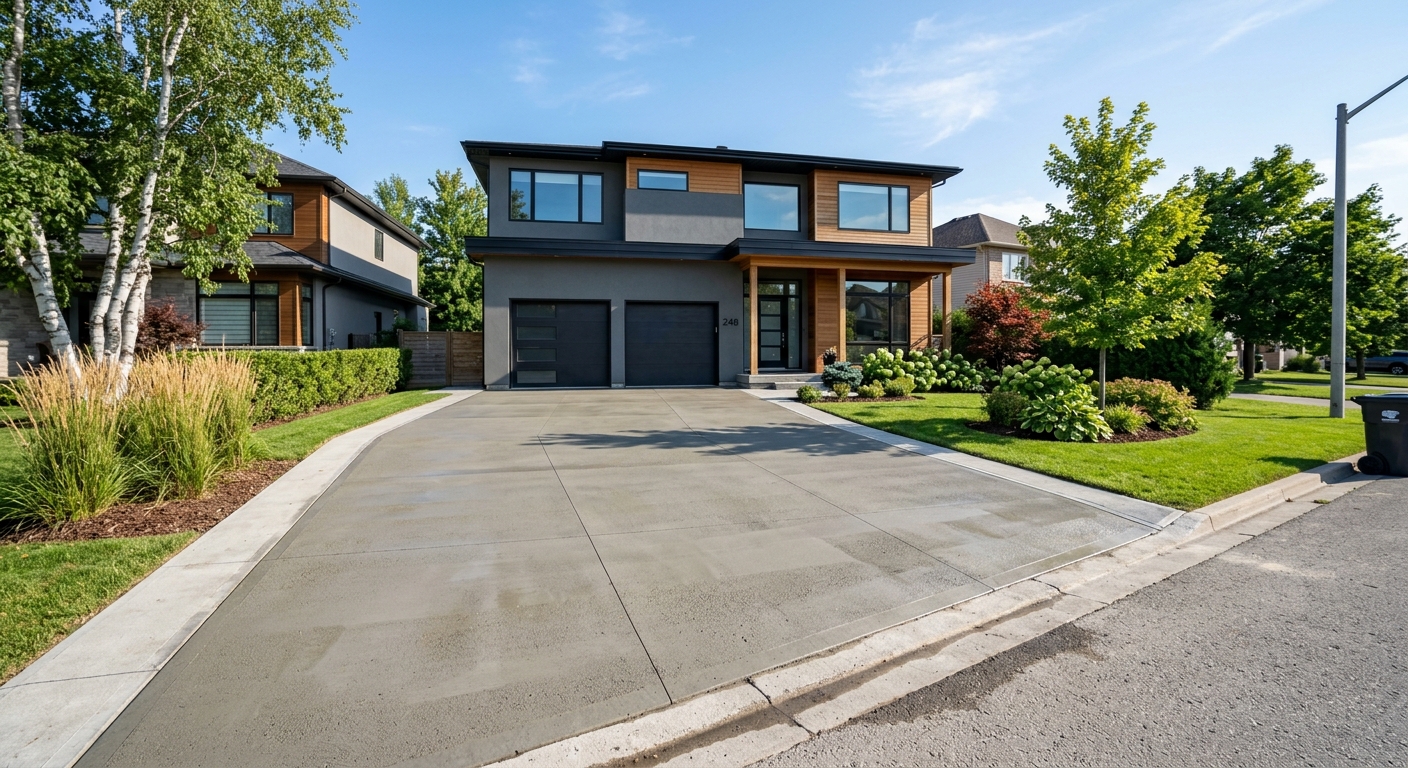
Concrete work options and costs in Toronto
Concrete work in Toronto is a mix of craftsmanship and climate engineering. With roughly 23.3% of dwellings being single-detached homes (Statistics Canada, 2021 Census), the demand for driveways, patios and walkways stays steady across the GTA year after year. It also means contractors are busy—so the timeline and availability you get in a neighbourhood like Etobicoke or North York can affect how you plan a pour and how competitive your quote is.
Toronto’s concrete pricing is particularly shaped by freeze–thaw cycles and frost depth. Exterior flatwork needs air-entrained concrete, well-compacted granular base, and thoughtful control joints to manage cracking. And because many homes in Toronto were built before 1981 (58.1% of housing stock), you often see older drainage patterns and soils that have compacted unevenly over decades—both of which increase prep time before any concrete can go down.
For homeowners comparing options, the biggest cost swing is usually not “concrete” itself—it’s the spec and labour intensity: base depth, reinforcement, access for the truck, finishing method, and whether the job is done in a temperature window that supports proper curing. A standard broom-finish driveway is typically the lowest cost per square foot, while stamped and decorative work adds labour, forms, and finishing steps that are worth it when you want curb appeal that lasts.
Below is a practical comparison of common concrete projects so you can anchor your budget before you request itemised quotes.
| Application |
Typical Size |
Key Spec |
Finish Option |
Price Range |
| Concrete driveway (standard broom finish) |
400–600 sq. ft. |
Air-entrained mix; compacted granular base; control joints |
Broom finish, 4 in. (typical) |
$7,000–$12,000 |
| Exposed aggregate driveway |
350–550 sq. ft. |
Air-entrained mix; proper aggregate exposure timing; cured/protected |
Exposed aggregate finish |
$9,000–$16,000 |
| Stamped concrete driveway or patio |
300–500 sq. ft. |
Air-entrained mix; thicker section if pattern requires; release agent & curing plan |
Stamped pattern + integral/colour topcoat (optional) |
$10,000–$20,000 |
| Plain concrete patio or walkway |
200–400 sq. ft. |
Grade/ drainage slope; air-entrained mix; base prep |
Plain trowel/broom texture |
$3,500–$8,500 |
| Garage floor (interior slab) |
300–600 sq. ft. |
Vapour barrier (as applicable); welded mesh; properly compacted sub-base |
Broom finish, hardener optional |
$5,000–$13,500 |
| Foundation footings (structural, below frost) |
Variable perimeter |
Excavation; formwork; reinforcement; engineered footing requirements |
Structural concrete (no surface finish) |
$18,000–$35,000 |
Prices are estimates only and vary by project scope, site access and material selection.
What affects the price of concrete work in Toronto
In Toronto, two quotes for what looks like the “same” concrete job can differ by 30–50% because the real scope is rarely identical—especially once you factor in base preparation, reinforcement, haul/access issues, and freeze–thaw durability specs. Concrete contractors also price risk: poor drainage, wet subgrades, and cold temperatures during curing can lead to callbacks if the job isn’t built to last.
For the Toronto economic region, frost depth and freeze–thaw cycles dictate the core specs. Structural footings must extend below the design frost depth (Ontario commonly lands around 1.5–2.4 m depending on conditions) to prevent frost heave and differential movement. For exterior slabs—driveways, patios and walkways—air-entrained concrete is essential to survive repeated freezing and thawing. When temperatures drop toward 10 °C or below, contractors may need cold-weather curing precautions such as insulated blankets, heating, and longer protection time; those steps add labour and materials cost.
De-icing salt in Toronto winters accelerates surface wear and can contribute to spalling if the mix and air content aren’t right. On older properties (many built before 1981), you may find uneven soils and older drainage that require extra excavation and re-grading to reach a stable, compacted granular base. A short, easy driveway replacement might land near the lower band for flatwork, while a larger stamped patio—where thickness, pattern prep, and finishing time are higher—typically shifts closer to the higher end of the local decorative range (for example, stamped & decorative work often tracks around $24,000–$40,000 for larger layouts).
Similarly, the difference between a standard broom driveway and an exposed aggregate driveway is often justified by finish labour and surface exposure steps. If access is tight (front street widening, narrow gates, or a long pump/haul route), even a straightforward broom finish can climb toward the upper flatwork range around $18,000–$28,000 for driveways when truck time and crew time increase.
| Price Factor |
Why It Matters |
Cost Impact |
| Frost line depth |
Determines footing depth and form height to prevent heave |
Higher excavation & concrete volumes; major driver for foundations |
| Site preparation |
Excavation, grading, and compacted granular base stability |
Wet/soft soils can add days and truckloads |
| Reinforcement |
Rebar/welded mesh controls shrinkage and helps structural performance |
Material + labour for placement and cover |
| Mix design |
Air-entrainment and required compressive strength for freeze–thaw durability |
Premium materials; wrong mix risks premature failure |
| Finish type |
Broom vs. stamped vs. exposed aggregate changes labour and tooling |
Stamped/exposed often increases labour and curing/protection steps |
| Pour size and concrete truck access to site |
Access affects pour speed, batching plan, and crew efficiency |
Long carry/pump time can raise labour and operational costs |
| Cold-weather curing precautions |
Heating/insulation protects strength gain and prevents surface damage |
Blankets/heaters and additional monitoring time |
| Control joint pattern and sealing cost |
Joints direct cracking and sealing limits water and salt intrusion |
More saw cuts + sealant materials; often worth it |
Permits & regulations in Ontario
In Ontario, structural concrete work such as footings, foundation walls, and grade beams typically requires a building permit, and in many cases engineered drawings are reviewed by the municipality before work proceeds. Concrete flatwork—like patios, walkways, and most driveways—usually does not require a permit on its own unless it changes lot grading, triggers impervious surface coverage limits, or affects municipal right-of-way conditions (for example, work close to a boulevard or driveway apron rules). Even when a permit isn’t required, the homeowner should confirm with the local authority before the first excavation.
Before signing, also verify the contractor is properly insured. You should request proof of liability insurance and WSIB/WCB coverage (as applicable for the contractor’s workforce), and ask for references from similar-scale Toronto jobs—especially freeze–thaw exterior work where base prep and air-entrainment matter.
To verify the contractor in a Toronto, Ontario context:
- Check the contractor’s Ontario licence/registration status through the appropriate provincial registry source used for your trade category (the contractor should provide licence details upfront).
- Ask for a current certificate of insurance and confirm the policy is active for the job dates and address.
- Request WSIB/WCB clearance or coverage documentation; ensure it matches the contractor and employer name on your contract.
- Compare the scope against the drawings/measurements so the liability for permit-related or drainage scope items is clear.
Once you confirm documentation, you’ll have a much safer footing—literally and financially.
Getting concrete right in Toronto's freeze-thaw climate
Concrete fails in Toronto most often for predictable reasons: water gets into the slab/sub-base, freeze–thaw stresses the material, and the concrete either cracks randomly or spalls at the surface. The fix is in the spec and the sequence—base first, then mix design, then finishing and curing management.
1) Base preparation: install and compact a granular sub-base to the right depth for local soil conditions, then shape it to drain. If the base is saturated or compresses later, your driveway or patio will settle and crack.
2) Mix design: for exterior flatwork, target air-entrainment around 5–7% and specify minimum 32 MPa compressive strength (or higher if your design requires it). This is what helps the concrete survive repeated freeze–thaw cycles.
3) Control joints: plan joint locations and spacing so cracks happen where you expect them, not randomly under decorative edges or near expansion points.
4) Curing: require minimum 7-day curing under proper conditions. When pours land in cooler shoulder-season weather, contractors may need protection to maintain curing temperatures and prevent surface damage.
5) Sealing: apply a penetrating sealer after the concrete has cured (often around 28 days) to repel de-icing salt intrusion and reduce moisture movement.
Ask these practical questions to avoid the costly failure you see after winter: “What air content do you target?” “What is your base depth and compaction method?” “Where are the control joints and what spacing do you follow?” “How will you protect curing if temperatures drop?” If you’re choosing between broom and stamped, the price difference can be justified—stamped concrete typically costs more because of pattern labour—while a poorly prepped broom-finish slab is rarely the cheaper option after the first settlement or winter.
| Spec |
Why It Matters in Toronto |
What to Ask For |
Impact if Skipped |
| Compacted granular base (depth?) |
Stabilizes soil and helps drainage during freeze–thaw |
Documented base depth and compaction method before the pour |
Settlement, voids, and cracking |
| Air-entrained concrete mix (target air %?) |
Prevents freeze–thaw damage in exterior slabs |
Target air content typically 5–7% for exterior flatwork |
Higher risk of spalling and surface scaling |
| Compressive strength (MPa rating) |
Ensures strength gain supports durability and handling |
Minimum 32 MPa (or higher if required) |
Reduced performance and increased early-age failure risk |
| Control joints (spacing per ACI guidelines) |
Directs cracking as concrete shrinks |
Joint spacing plan and locations before construction starts |
Random cracking across visible surfaces |
| Minimum 7-day curing period |
Allows strength development before exposure |
Protection plan if temperatures are cool during cure |
Surface weakness and damage from early moisture/traffic |
| Penetrating sealer (when applied after cure) |
Repels salt and moisture that drive deterioration |
Sealer applied after cure (often around 28 days) |
Accelerated surface wear in Toronto winters |
How to choose a concrete work contractor in Toronto
Choosing the right concrete contractor in Toronto is mostly about verifying proof, not just price. Start with licensing/registration for the trade category they claim, then verify insurance. Ask for a certificate of liability insurance and make sure it shows coverage for concrete work at your property address and the expected dates. Next, confirm WSIB/WCB coverage (or clearance documentation where applicable). If a contractor cannot provide documents quickly, that’s a serious process red flag—because it often means they’re shifting risk onto the homeowner.
Then request 2–3 itemised written quotes that break labour and materials separately, not a single lump sum. The scope details matter in Toronto: base thickness and compacted granular depth, whether air-entrainment is included, reinforcement type (mesh vs. rebar), joint layout, and whether excavation/disposal is part of the price. Clarify what’s excluded: removal of existing concrete, permits if required for structural work, any grading corrections, and sod/landscaping restoration.
Warranty should be in writing. Ask for the workmanship warranty length, whether there’s a product/manufacturer warranty for admixtures/sealers, and whether any warranty transfers to subsequent owners. Also pay smart: never pay more than 10–15% upfront, and hold a portion until the work is complete and reviewed.
Finally, get a start date and completion estimate in writing, and make sure the quote acknowledges curing and protection requirements when temperatures drop toward the cooler end of the season.
- Provide licence/registration details upfront for their concrete trade category in Ontario.
- Give a current certificate of liability insurance and confirm job-site coverage.
- Provide WSIB/WCB clearance or coverage documentation for their workforce.
- Share at least 3 references from similar Toronto concrete flatwork projects.
- Use itemised quotes: excavation/disposal, base prep, rebar/mesh, concrete supply, finishing, and sealing.
- State whether the mix is air-entrained and list target air content and strength.
- Include base depth and compaction method (not just “we’ll prep the ground”).
- Show control joint locations and spacing on the estimate/spec sheet.
- Clarify curing/protection plan if pour day or cure window is cool or wet.
- Confirm whether saw-cutting and sealing are included, and when sealing will occur.
- Define payment schedule and holdback amount in the contract.
- List exclusions clearly (haul distance, pump requirements, permit scope, landscaping restoration).
Concrete red flags in Toronto: (1) quoting “same day” finishes without base depth details, (2) refusing to discuss air-entrainment or joints, (3) asking for large upfront payments beyond 10–15%, (4) vague curing/temperature protection plans during cooler weeks, and (5) not providing insurance/WSIB/WCB documentation before starting.
Frequently asked questions — concrete work in Toronto
How much does concrete work cost in Toronto?
In Toronto, pricing depends on the spec (base depth, reinforcement, air-entrained mix, and finish labour) and how difficult the site is to access. For a driveway, typical Toronto-area budgets often fall around $18–$28 per square foot for concrete flatwork when you include proper base prep and an exterior-ready spec. For patios and walkways, many homeowners budget roughly $16–$26 per square foot. If you’re comparing plain to decorative, stamped & decorative concrete usually costs more because of pattern work and finishing steps, commonly tracking around $24–$40 per square foot. If your property has older drainage or soils (common in homes built before 1981), prep can add time and cost, so itemised quotes are important.
How deep must footings be for Toronto's frost line?
In Ontario, structural footings generally need to extend below the design frost depth to prevent frost heave and differential movement. For Toronto-area projects, that commonly means footings in the range of about 1.5 m to 2.4 m below grade, depending on the site conditions and engineered requirements (Statistics Canada, 2021 Census shows Toronto’s large homeowner base, which is why these specs are routinely enforced and explained by contractors). The exact depth isn’t a one-size-fits-all number—you should rely on the permit drawings/engineering for your lot’s design parameters. Any quote that doesn’t ask about or account for the engineered footing depth should be treated cautiously, because incorrect footing depth can lead to long-term settlement and cracking.
Why does concrete crack in Toronto and how is it prevented?
Concrete cracking in Toronto is mostly a shrinkage and freeze–thaw story. In cold winters, moisture moves in and out of the slab; repeated freeze–thaw plus de-icing salts can worsen surface damage. Random cracking happens when joints aren’t planned or when base preparation doesn’t provide stable support. Prevention comes from three core steps: (1) compacted granular base with correct drainage slope, (2) air-entrained exterior concrete so freeze–thaw doesn’t break the paste, and (3) a control joint layout that forces cracking into predictable lines. Contractors should also specify proper curing and timing for cutting and sealing. If a contractor promises “no cracks,” ask how they’ll manage joints and air-entrainment—those two specs are the real durability levers.
Stamped vs broom-finish concrete — cost difference?
Stamped concrete costs more than broom-finish because the decorative process adds labour and time: form/pattern planning, release materials, colour treatment (if selected), and more careful surface finishing and curing protection. In Toronto, you’ll typically see broom-finish driveway pricing anchored around the lower flatwork bands (for example, driveway concrete commonly aligns with about $18–$28 per square foot for standard work). Stamped or decorative jobs often land higher—commonly around $24–$40 per square foot depending on pattern complexity and whether colour topcoats and sealing are included. A stamped patio can be worth the premium when you’re matching entry steps, driveway edges, or front yard aesthetics, but make sure the base prep and freeze–thaw specs are not reduced to “save money,” because that’s where failures start.
When is the best time to pour concrete in Toronto?
For Toronto, the safest window is typically the warmer months when curing conditions are stable—often late spring through early fall. Toronto’s freeze–thaw cycles mean cold-weather pours require protection: insulated blankets, heating, and additional monitoring so the concrete develops strength properly before exposure. If you pour when temperatures drop toward around 10 °C or below, the contractor’s cold-weather plan becomes a major quality factor and can increase cost. Wet shoulder seasons also matter; if the ground is saturated, prep and base stabilization can take longer. Practically, schedule pours when the forecast supports proper curing and protection, and confirm in writing how the contractor will handle cooler nights.
How long does concrete take to cure?
Concrete curing is time and temperature dependent, but for most exterior flatwork in Toronto you should expect minimum protection/cure time of about 7 days under proper conditions before heavy exposure. Full strength gain continues beyond that, and many sealing systems call for waiting until around 28 days for the concrete to cure sufficiently before applying a penetrating sealer—important for repelling moisture and de-icing salt intrusion. If you’re pouring near cooler weather, the contractor should explain how they’ll maintain curing temperatures so surface strength isn’t compromised. Also ask about when saw cuts will occur for control joints; cutting timing affects cracking behaviour. For homeowners, the key is to build a schedule that respects cure and protection—not just the pour day.