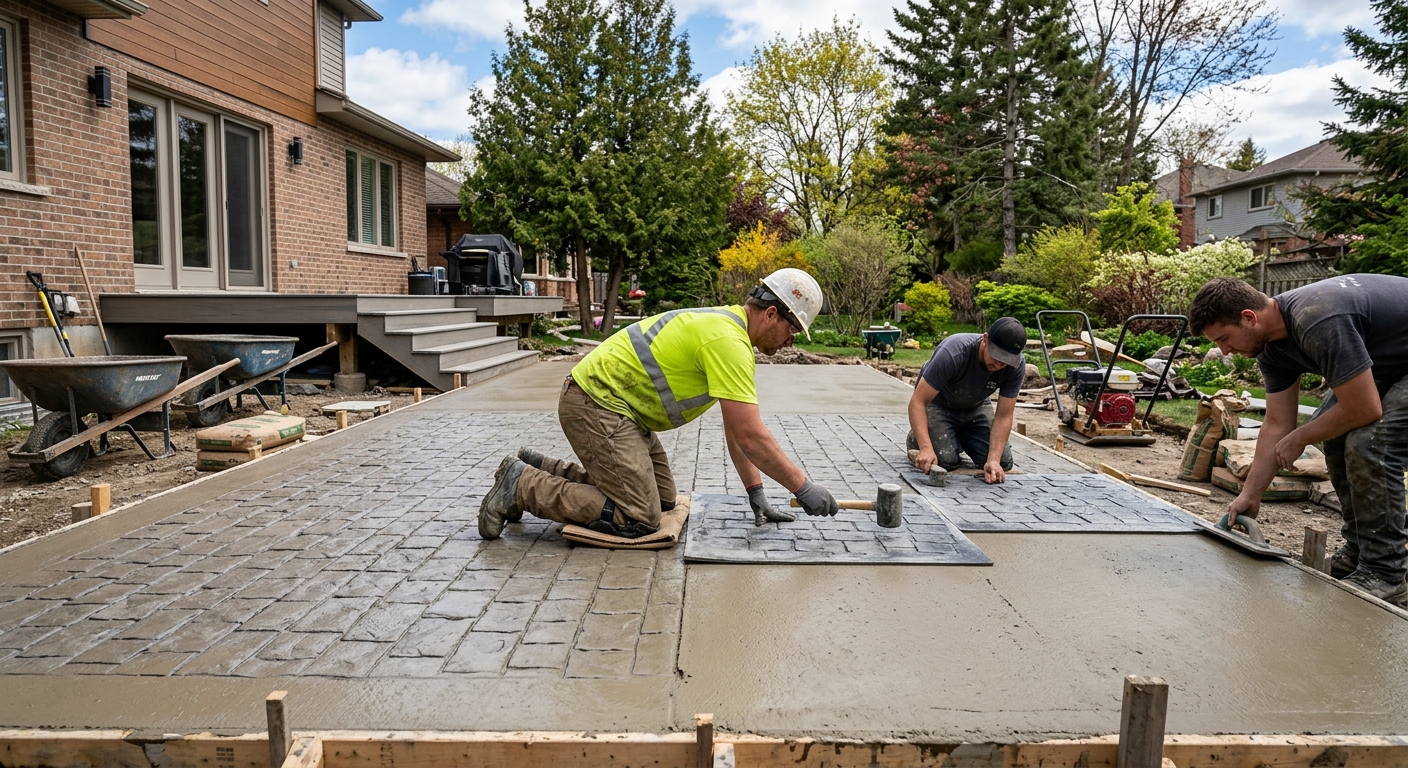
Concrete work options and costs in Thorold
Thorold homeowners usually start with the “big three” concrete jobs: driveway replacement, patio/walkway upgrades, and basement or foundation repairs. That makes sense locally—single-detached houses make up 69.1% of dwellings in Thorold (Statistics Canada, 2021 Census), and that housing mix drives demand for flatwork that needs to stand up to the Great Lakes freeze-thaw cycle. With 6,305 homeowner households (69.3% of households own), many projects are planned around curb appeal and long-term maintenance rather than just short-term fixes.
In the Hamilton–Niagara Peninsula, pricing reflects how hard concrete is worked to survive cold, wet conditions. Frost depth and moisture exposure push footings deeper (often to 4 ft or beyond), and exterior slabs typically need air-entrained mixes plus tighter control joint planning to reduce thermal and shrinkage cracking. Concrete season is also shorter; most structural and exterior pours are targeted roughly May–October, while winter work may require hoarding, heating, and accelerators—cost adders many out-of-town crews don’t factor until they’re on site. Availability can affect turnaround time, especially for decorative work like exposed aggregate and stamping, which require more labour and careful finishing.
In Thorold, these jobs are particularly common around the North End and in the newer growth areas near the Welland Canal corridor where properties often get updated landscaping and access improvements. Use the table below to compare common options and typical “per job” cost ranges, then we’ll talk about what actually drives the numbers in your quote.
| Application |
Typical Size |
Key Spec |
Finish Option |
Price Range |
| Concrete driveway (standard broom finish) |
16 ft × 24 ft (384 sq ft) |
Air-entrained exterior mix, rebar where required, compacted granular base |
Broom finish + control joints |
$5,300–$8,400 |
| Exposed aggregate driveway |
16 ft × 24 ft (384 sq ft) |
Air-entrained mix, approved aggregate selection, proper cure schedule |
Exposed aggregate with edging |
$7,000–$11,500 |
| Stamped concrete driveway or patio |
12 ft × 18 ft (216 sq ft) |
Air-entrained mix, stamping plan, integral colour + sealer |
Stamped pattern with colour hardener |
$5,000–$8,400 |
| Plain concrete patio or walkway |
10 ft × 14 ft (140 sq ft) |
Air-entrained mix, compacted base, drainage-aware slope |
Broom finish |
$1,700–$2,800 |
| Garage floor (interior slab) |
20 ft × 22 ft (440 sq ft) |
Vapour control, reinforcement where specified, thickened edges |
Light broom or trowel-broom finish |
$6,600–$9,900 |
| Foundation footings (structural, below frost) |
Per linear foot (typical home) |
Excavation, granular bedding, rebar as engineered |
Structural concrete (no decorative finish) |
$60–$120 |
Prices are estimates only and vary by project scope, site access and material selection.
What affects the price of concrete work in Thorold
In Thorold, you can see the same concrete scope come in 30–50% apart across the Hamilton–Niagara Peninsula and Ontario, even when the driveway “looks identical” from the street. The hidden drivers are always the details that protect the slab from Ontario’s freeze-thaw damage: excavation depth, base thickness, reinforcement needs, mix design, finishing time, and how the contractor cures and seals the concrete. Labour productivity also varies—crew size, pour logistics, and truck access can make a small job feel like a large one when material and pumping have to be coordinated.
Here’s the climate reality that dictates specs locally: frost line depth and freeze‑thaw cycles control every exterior foundation and slab decision. Footings must extend below the design frost depth to prevent frost heave; in practice, that often means about 4 ft or deeper in Ontario. Exterior flatwork is also specified with air-entrainment to survive repeated wetting and freezing off the Great Lakes corridor. When temperatures drop, the pour window shortens (most work targets May–October), and contractors may add heating, insulating blankets, and/or accelerators to keep strength gain on track—those winter precautions add to cost. De-icing salts accelerate surface spalling if the finish and curing aren’t done right; sealing is often recommended to reduce salt/chemical penetration.
Cost can go up or down based on site conditions. For example, a driveway in a tight entry near the North End may require more labour for forms and finishing, while a simpler, flat backyard patio on a well-drained lot can keep costs closer to the $12–$20 per sq ft patio/walkway band. Decorative options also shift budgets: stamped work typically lands in the $22–$35 per sq ft range because it takes longer to stamp, apply colour, and manage curing and sealing. For homes built before 1981 (55.1% of dwellings in Thorold), older lot grading and drainage patterns often mean we spend more time on base prep and slope corrections before we pour—sometimes adding hundreds to your project.
| Price Factor |
Why It Matters |
Cost Impact |
| Frost line depth — determines footing depth and form height |
Deeper excavation and taller forms are required to prevent heave |
Can add a large portion to foundation/footing scope; often the biggest driver in structural pricing |
| Site preparation — excavation, grading, compacted granular base |
Proper base thickness and compaction reduce settlement and surface cracking |
Increases cost when soil is poor, wet, or requires haul-away; can reduce cost when site is already well prepared |
| Reinforcement — rebar or wire mesh requirement |
Controls cracking and supports load transfer under freeze-thaw stresses |
Material + labour time; a thicker slab or engineered reinforcement raises unit cost |
| Mix design — air-entrainment and compressive strength spec |
Air entrainment helps resist freeze-thaw scaling and spalling |
Premium for correct mix proportions; usually worth it to avoid costly early failures |
| Finish type — broom vs. stamped vs. exposed aggregate |
Decorative finishes require more labour, seaming control, and cure timing |
Typically the biggest jump after base/reinforcement: stamped/exposed usually costs more per sq ft |
| Pour size and concrete truck access to site |
Access affects pour speed, equipment needs, and labour planning |
Tight sites can increase labour and may require pumping/alternate equipment |
| Cold-weather curing precautions — heating and blankets |
Ensures strength gain and dimensional stability despite temperature swings |
Adds direct costs for insulation/heating and can extend the project schedule |
| Control joint pattern and sealing cost |
Joint spacing manages shrinkage cracking; sealing helps resist salt ingress |
Moderate added material/labour; omission increases long-term maintenance risk |
Permits & regulations in Ontario
In Ontario, concrete gets treated differently depending on what you’re building. Structural concrete work—such as footings, foundation walls, and grade beams—typically requires a building permit and often engineered drawings that the municipality reviews. If your project involves adding, altering, or underpinning foundation elements, assume you’ll be pulling permits and coordinating inspection steps. Concrete flatwork (driveways, patios, walkways) usually does not require a permit on its own, unless it affects lot grading, impacts municipal requirements for stormwater drainage, or changes impervious surface coverage/right-of-way conditions.
Because Thorold sits in a freeze-thaw environment, municipalities also care about how the work manages water—especially where surfaces slope toward foundations or where drainage is altered. Before breaking ground, verify the contractor carries liability insurance and has WSIB/WCB coverage where applicable. Then request proof of coverage and references from similar-scale jobs.
How a homeowner verifies a contractor (step-by-step): (1) Confirm the business details match the quotes (legal name, address, and job supervisor/contact). (2) Ask for a certificate of insurance showing current general liability and the correct insured parties. (3) Request WSIB/WCB clearance or proof of registration/coverage. (4) Check credentials using Ontario’s online resources for business information and trade licensing (where applicable). (5) Look for proof of recent work in southern Ontario weather conditions—photos of slabs that weren’t poured hastily in cold snaps are a good sign.
Getting concrete right in Thorold's freeze-thaw climate
Concrete failures in Thorold are usually about one thing: the slab or structure wasn’t specified and built to handle wetting, freezing, thawing, and de-icing salts. The most common homeowner-visible symptom is spalling or scaling—often tied to inadequate air-entrainment or rushing the pour/cure so the concrete doesn’t reach strength under stable conditions. To spec correctly for the Hamilton–Niagara Peninsula, we focus on five layers: base, mix, joints, curing, and sealing.
1) Base preparation: build a compacted granular sub-base to the right depth for local soil and frost. If you shortcut excavation or compaction, the slab can settle and crack over time as freeze-thaw cycles pump moisture beneath it. 2) Mix design: use an air-entrained exterior mix (commonly 5–7% air content for exterior flatwork) and a minimum 32 MPa compressive strength when engineered/spec’d for the application. 3) Control joints: plan joint spacing so shrinkage cracks happen where you want them, not randomly through the middle. 4) Curing: minimum 7-day curing under proper conditions; in shoulder season, we protect with curing blankets and sometimes heat to prevent surface damage from rapid temperature drops. 5) Sealing: apply a penetrating sealer after cure—often around 28 days post-pour—to help repel de-icing salts.
Ask technical questions that target durability: “What air content are you targeting?” “What’s the base depth and compaction method?” “How are you spacing joints?” If you’re deciding between options, here’s where price differences make sense. A plain broom-finished patio might cost closer to the $12–$20 per sq ft band, while a stamped patio typically runs higher (often within the $22–$35 per sq ft decorative band). The extra cost is justified when it includes proper colour systems, controlled finishing timing, and sealing—otherwise you’re paying for appearance without the freeze-thaw protection you actually need.
| Spec |
Why It Matters in Thorold |
What to Ask For |
Impact if Skipped |
| Compacted granular base (depth?) |
Reduces settlement and limits moisture movement during freeze-thaw |
Base depth by your design and compaction proof/method |
Early cracking, uneven slabs, and pumping of fines |
| Air-entrained concrete mix (target air %?) |
Air bubbles provide freeze-thaw protection from scaling/spalling |
Target air content for exterior flatwork (commonly 5–7%) |
Spalling/scaling within seasons, especially with salt |
| Compressive strength (MPa rating) |
Ensures durability and strength gain despite cool, wet conditions |
Minimum 32 MPa (or higher if engineered for loads) |
Surface weakness, faster wear, and cracking |
| Control joints (spacing per ACI guidelines) |
Controls where cracks form as concrete shrinks and moves |
Planned joint spacing, saw-cut timing and depth |
Random cracking and water pathways that worsen freeze-thaw damage |
| Minimum 7-day curing period |
Stable curing improves strength and surface resistance to damage |
How you’ll cure in cold snaps (blankets/heating if needed) |
Surface damage, weak edges, reduced long-term performance |
| Penetrating sealer (when applied after cure) |
Helps repel de-icing salts and reduces moisture absorption |
Sealer type and application timing (often after ~28 days cure) |
Higher maintenance, more rapid salt-related deterioration |
How to choose a concrete work contractor in Thorold
Picking the right concrete contractor in Thorold is mostly about verifying protection and getting clarity on the spec—not just the bottom-line number. In Ontario, confirm the contractor carries liability insurance and has WSIB/WCB coverage (where applicable). Ask for certificates of insurance and WSIB/WCB clearance/confirmation before work starts. If they can’t provide documentation promptly, that’s a red flag. Then ask for the names of the people who will actually pour and supervise the job; concrete quality is about execution, not just marketing.
Next, get 2–3 itemised written quotes. You want a breakdown that separates labour (excavation, forming, finishing) and materials (concrete mix, air-entrainment spec, reinforcement, rebar/wire mesh), and ideally includes disposal/topsoil, temporary protection, and sealing. Watch for “lump sum” quotes with no mention of base depth, joint layout, curing method, or whether the price includes saw-cut joints on time. Also clarify what’s excluded: permits, municipal inspections, removals, and carting away old concrete.
Warranty matters too. Ask for the workmanship warranty length, what it covers (spalling? scaling? settlement?), and whether it’s tied to proper maintenance like sealing. Payment schedules should be conservative—never more than 10–15% upfront, with a holdback until the job is complete and final touch-ups are accepted. Finally, require a written start date and completion estimate, especially since the pour season in the Great Lakes corridor is shorter and weather can delay work.
- Request proof of liability insurance (certificate) and verify dates/coverage limits.
- Request WSIB/WCB confirmation/clearance and keep a copy for your records.
- Ask what air-entrainment target they use for exterior flatwork.
- Confirm base depth and compaction method before ordering concrete.
- Get joint spacing details and when saw cuts will be done.
- Ask how they’ll cure (blankets/heating) if temps drop.
- Clarify reinforcement requirements (rebar vs. mesh) for your slab type.
- Make sure the quote includes site protection, clean-up, and disposal of debris.
- Verify formwork method and edge finishing details (especially at garage entrances).
- Confirm concrete truck access and whether pumping/extra equipment is included.
- Request a product/spec sheet for decorative systems (stamps/aggregate/colour).
- Use a payment schedule with a holdback until deficiencies are fixed.
Concrete contractor red flags in Thorold: they won’t discuss air-entrainment or curing; they omit base prep depth and compaction details; they pressure you for large upfront deposits; they provide only “all-in” pricing with no scope exclusions; or they can’t show recent local photos from similar freeze-thaw conditions.
Frequently asked questions — concrete work in Thorold
What is the difference between concrete and cement?
In Ontario, people often use “cement” and “concrete” like they’re the same thing, but they’re not. Cement is one ingredient inside the concrete mix—it's the powdered binder that, when mixed with water, helps the overall material harden and gain strength. Concrete is the final product made from cement plus water, coarse and fine aggregates (like gravel and sand), and often additives such as air-entrainment for exterior work. For Thorold driveways, patios and walkways, the key for freeze-thaw durability is the concrete mix design—specifically air-entrainment—because it helps reduce scaling and spalling when the surface gets wet and then freezes.
How much does concrete work cost in Thorold?
Concrete pricing in Thorold usually comes in ranges because the scope varies: excavation, base depth, reinforcement, access, and finish type. For example, a standard broom-finished driveway commonly falls in the broader $14–$22 per sq ft band for concrete driveway/slab work, which can translate to a typical driveway budget that’s often in the low-to-mid thousands depending on size. If you choose stamped concrete, you’re generally budgeting toward the $22–$35 per sq ft decorative band because it includes integral colour and extra finishing time. Foundation/footings are costed differently (often per linear foot) and commonly align with the $60–$120 range depending on engineered requirements and how deep the excavation must go below frost.
How deep must footings be for Thorold's frost line?
For Thorold in Ontario’s Great Lakes corridor, footings are typically designed to extend below the design frost depth to prevent frost heave. In practice, that often means excavating to around 4 ft or deeper for structural foundation footings, but the exact depth should follow your engineered drawings and applicable design frost depth for the site conditions. The “why” matters: when moisture in soil freezes, it expands and can lift foundation elements if they aren’t placed deep enough. Deeper excavation also increases labour and trucking, which is why foundation work often has a wider cost swing than patios. If your project involves repairs or underpinning, rely on the engineer and municipality for the specified footing depth.
Why does concrete crack in Thorold and how is it prevented?
Concrete cracks are common in freeze-thaw areas like Thorold because the slab shrinks as it cures, then expands and contracts with temperature changes and moisture. Cracking is also more likely if the base isn’t properly prepared or if water can move under the slab. Prevention is about control: correct compacted granular base, air-entrained exterior concrete for durability, and a planned control joint layout so cracks form where they can be managed. Just as important, curing needs to be protected in cooler conditions so the concrete achieves strength without surface scaling. Finally, joint sealing after cure helps limit water ingress from snowmelt and de-icing salts, which reduces the freeze-thaw “cycle fatigue” that worsens cracking over time.
Stamped vs broom-finish concrete — cost difference?
Stamped concrete costs more than a broom finish because it requires additional labour time and materials. A broom-finished driveway or patio focuses on efficient finishing and a simple, durable surface texture. Stamped concrete typically uses integral colour and a stamping process that needs careful timing, plus sealing to protect the finished surface from Thorold’s wet freeze-thaw cycles and de-icing salts. In local terms, broom-finish driveway/slab work generally aligns with the $14–$22 per sq ft band, while stamped/decorative concrete commonly sits in the $22–$35 per sq ft range. If the contractor doesn’t include proper curing, air-entrainment, and sealing, the higher decorative cost won’t protect you from early spalling—so ask what’s included, not just what it looks like.
When is the best time to pour concrete in Thorold?
For Thorold and the Hamilton–Niagara Peninsula, the best time is typically late spring through summer—roughly May to October—when temperatures are more favourable and curing can be managed without heavy heating. Even then, we schedule based on weather forecasts and protect fresh concrete from rapid temperature swings. Pours in cooler shoulder months can still work, but you’ll usually pay for hoarding, insulation blankets, and sometimes accelerators to keep strength gain on track and reduce surface scaling risk. If de-icing salts are involved near the work area, you also want curing and sealing completed correctly so the surface isn’t exposed to salt before it’s properly mature. Your contractor should give a written date window and protection plan.