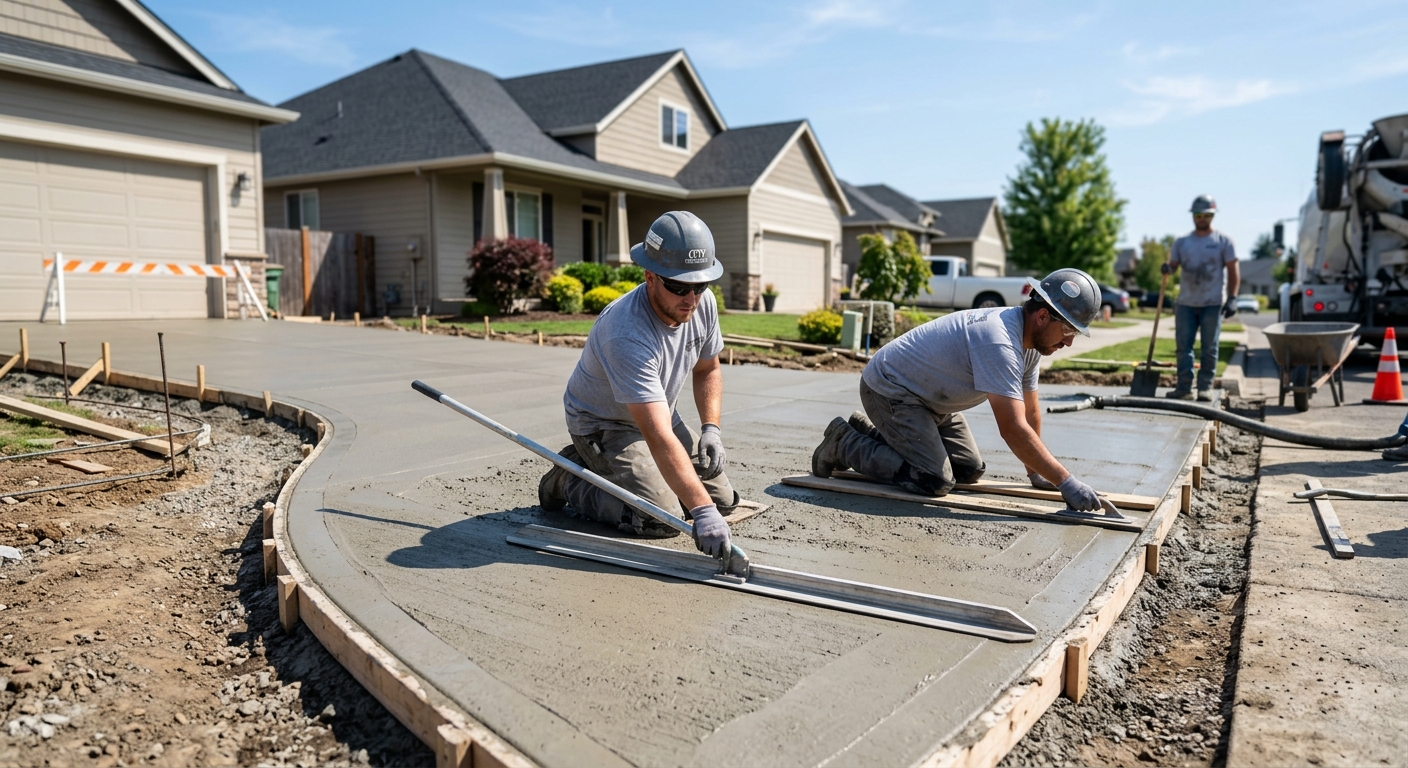
Concrete work options and costs in King
Concrete work is a big part of home life in King, Ontario—especially for the many single-detached households that make up most of the local housing stock (87.2% of dwellings). With a population of 27,333 (Statistics Canada, 2021 Census), the contractor pool is active, but scheduling can tighten in peak months when exterior pours line up across the Toronto economic region. In this area, frost depth and freeze–thaw cycles drive design: structural footings typically must extend below grade (about 1.2 m in most GTA designs) and exterior flatwork needs air-entrained concrete and a well-drained granular base to manage winter water and movement. That climate reality is why driveway and patio pricing often clusters into consistent bands—but the exact number still swings based on excavation, truck access, reinforcement, and finish level.
Demand is especially common around established residential pockets like Kleinburg, where many driveways and walkways were built alongside older housing and end up needing replacement or upgrades. The Toronto market also has a practical constraint: the reliable pour season for exterior work is mainly warmer months to ensure curing happens properly. When temperatures start dropping toward 10 °C or below, contractors spend more time on protection—insulating blankets, curing blankets, and surface management—which can add labour and materials cost.
Use the table below to compare common options (driveways, patios, walkways, and structural work) and understand what typically changes the price.
| Application |
Typical Size |
Key Spec |
Finish Option |
Price Range |
| Concrete driveway (standard broom finish) |
16 ft × 38 ft (~608 sq ft) |
Air-entrained mix; compacted granular base; typical reinforcement |
Broom finish, saw-cut control joints |
$18,000 – $28,000 |
| Exposed aggregate driveway |
16 ft × 38 ft (~608 sq ft) |
Air-entrained mix; proper base drainage; careful curing for surface exposure |
Exposed aggregate with sealer |
$22,000 – $34,000 |
| Stamped concrete driveway or patio |
600–900 sq ft |
Air-entrained mix; thicker slab where stamping increases labour and patterning |
Stone/brick stamp, release agent, borders and joints |
$24,000 – $40,000 |
| Plain concrete patio or walkway |
250–450 sq ft |
Air-entrained mix; compacted granular base; drainage slope maintained |
Broom or smooth finish with control joints |
$4,000 – $12,000 |
| Garage floor (interior slab) |
20 ft × 22 ft (~440 sq ft) |
Vapour barrier (where required); reinforced slab; proper slope |
Smooth finish, optional hardener |
$6,000 – $14,000 |
| Foundation footings (structural, below frost) |
Typical single-detached footing system |
Engineered section; below-grade excavation and rebar placement |
Structural concrete; formwork and inspection-ready |
$6,500 – $12,500 |
Prices are estimates only and vary by project scope, site access and material selection.
What affects the price of concrete work in King
Even when homeowners describe the “same” concrete job in King, Ontario, quotes can still differ by roughly 30–50%. In the Toronto economic region, the biggest reason is that every contractor’s estimate responds to site conditions and winter-proofing requirements—especially frost depth, drainage, and the freeze–thaw cycle that pushes water expansion and contraction against the slab. Structural work (like footings) must be designed to sit below the design frost depth so you don’t get frost heave or differential movement. For exterior flatwork, GTA specs commonly rely on air-entrained concrete and adequate thickness, plus a control-joint layout that limits random cracking.
Cold-weather curing precautions also cost money here. When temperatures drop toward about 10 °C or below, crews may need to heat or insulate the pour area, extend protection time, and manage curing longer before finishing and cleanup. De-icing salt in winter accelerates surface spalling risk if the mix, air content, and sealing plan aren’t right—so sealing is often priced as a separate line item.
Concrete can get more expensive in King when older lots require deeper excavation or when soil is saturated and granular base replacement is larger than expected. It can be cheaper when site access is straightforward (no tight side yard), truck access is close to the work zone, and drainage is already well established. For context, a plain patio or walkway may land near the $16–$26 band, while a stamped concrete driveway often tracks the $24–$40 decorative range—labour and pattern set-up are the difference, not just the colour.
Local housing age matters too. With 37.9% of homes built before 1981 (Statistics Canada, 2021 Census), it’s common to deal with older subgrades and settlement-related issues that raise the “prep” portion of the total budget—often the part that drives the final delta between bids.
| Price Factor |
Why It Matters |
Cost Impact |
| Frost line depth — determines footing depth and form height |
Footings must extend below design frost to prevent heave and movement |
Higher excavation and rebar/formwork can add a large share of cost |
| Site preparation — excavation, grading, compacted granular base |
Proper base and drainage control water expansion/contraction under slabs |
More haul-off, base replacement, and compaction increases labour and materials |
| Reinforcement — rebar or wire mesh requirement |
Reduces slab curling/cracking and improves load performance |
Material plus placement labour can noticeably raise the total |
| Mix design — air-entrainment and compressive strength spec |
Exterior freeze–thaw durability depends on air content and strength |
Air-entrained mixes and higher-spec cement can increase per-cubic-yard cost |
| Finish type — broom vs. stamped vs. exposed aggregate |
Finish drives labour time and surface curing/exposure steps |
Stamped/exposed typically costs more than standard broom finishing |
| Pour size and concrete truck access to site |
Smaller access or staging can require extra equipment or pump time |
Truck limitations often increase labour and scheduling costs |
| Cold-weather curing precautions — heating and blankets |
Protection is critical when temperatures approach 10 °C or below |
Heaters/blankets and extended curing time add daily overhead |
| Control joint pattern and sealing cost |
Joints manage cracking; sealing protects against de-icing salt damage |
Better joint layout and sealing usually add a moderate but worthwhile cost |
Permits & regulations in Ontario
In Ontario, the starting point for concrete is knowing whether it’s considered structural. In most cases in King, structural concrete work—including footings, foundation walls, and grade beams—requires a building permit and is typically reviewed with engineered drawings by the municipality. For concrete flatwork such as driveways, patios, and walkways, a permit often isn’t required by default, but it can be required if the work affects lot grading, impervious surface coverage limits, drainage, or the municipal right-of-way. Always confirm with the local authority before breaking ground.
Also verify contractor readiness the Ontario way: ask for liability insurance and confirmation that they carry WSIB/WCB coverage appropriate to their trade setup. Step-by-step, homeowners in King can check: (1) the contractor’s business details and eligibility on provincial licensing/registry resources where applicable; (2) their certificate of insurance showing current liability coverage (the COI should list you as an interested party if requested, and confirm the right effective dates); and (3) evidence of WSIB/WCB coverage (or a clearance letter where applicable). Then ask for references from similar-scale residential jobs—driveways and slab-on-grade work—so you can see finishing and crack control in real freeze–thaw conditions.
If the scope includes any excavation near existing foundations or changes to drainage patterns, ask the contractor to outline how they’ll handle inspections and documentation.
Getting concrete right in King's freeze-thaw climate
In King and the wider Toronto region, concrete failures are usually predictable: water gets into the slab system, the base isn’t compacted correctly, and freeze–thaw cycles start expanding and contracting the foundation of the slab. The most common homeowner-visible problems are spalling (surface flaking), random cracking, and uneven edges where drainage is poor. That’s why the “right” spec is not just about pouring concrete—it’s about building the slab assembly to resist winter conditions.
Start with base preparation: use a compacted granular sub-base at the appropriate depth for the soil and frost conditions, and maintain proper slope so runoff moves away from the slab. Next, choose the mix design. For exterior flatwork, air-entrainment is the cornerstone; target air content typically in the 5–7% range for exterior exposure, and confirm minimum 32 MPa compressive strength at placement requirements. Then plan control joints: spacing and execution should limit cracking to predictable lines. Curing matters too—plan for minimum 7 days of curing under proper conditions, and if you’re pouring near cooler nights, protection and extended curing become part of the cost. Finally, sealing helps. A penetrating sealer applied after the cure period helps repel de-icing salt and reduces surface damage risk.
Here’s a dollar example: if you’re choosing between a standard broom patio near the $16–$26 per-sq-ft band versus a premium stamped look closer to $24–$40, the price jump is often justified by finishing labour and time—not by skipping durability. The bigger win for longevity is paying attention to the base, air-entrainment, and joint layout—even on decorative pours.
| Spec |
Why It Matters in King |
What to Ask For |
Impact if Skipped |
| Compacted granular base (depth?) |
King freeze–thaw punishes weak or water-saturated base layers |
Confirm granular thickness, compaction method, and drainage slope plan |
Settlement, uneven edges, and early cracking |
| Air-entrained concrete mix (target air %?) |
Exterior exposure in King requires freeze–thaw durability |
Ask for target air content (typically 5–7%) and air-test reporting |
Spalling and surface failure from insufficient freeze–thaw resistance |
| Compressive strength (MPa rating) |
Strength affects long-term wear and cracking resistance |
Minimum 32 MPa spec (confirm with the contractor) |
Higher risk of premature wear, scaling, and structural underperformance |
| Control joints (spacing per ACI guidelines) |
Joints manage shrinkage and temperature movement in King |
Ask for joint spacing and how joints will be cut/tooled |
Random cracking that follows weak points |
| Minimum 7-day curing period |
Curing governs strength gain before winter stresses arrive |
Ask about curing method and whether protection is used in cooler weather |
Reduced strength and durability, leading to faster deterioration |
| Penetrating sealer (when applied after cure) |
De-icing salts in King can attack unsealed surfaces during freeze–thaw cycles |
Confirm sealer type and timing—typically after 28 days for best results |
More salt scaling/spalling and increased maintenance costs |
How to choose a concrete work contractor in King
Choosing the right contractor in King comes down to verification and clarity. First, confirm Ontario compliance: request proof of liability insurance (certificate of insurance with current effective dates) and proof of WSIB/WCB coverage for the crews doing the work. To check each, look for the COI directly from the contractor (not just an email statement), verify the coverage is current, and ask whether they can provide a WSIB/WCB clearance letter or documentation appropriate to their setup. Next, get 2–3 itemised written quotes—not a single lump-sum with vague wording. The best quotes separate labour and materials (excavation, granular base, reinforcement, concrete supply, finishing, disposal, and sealing) so you can compare apples to apples.
Read the scope carefully. What’s excluded—street excavation, disposal, saw-cutting existing concrete, railings, forms rental, grout removal, or sealing? Is a permit pull included if the work triggers it (typically structural)? What about protection and curing in cooler weather? Warranty should be explicit: workmanship warranty length, how long product/manufacturer warranties last, and whether the warranty transfers if you sell your home.
Payment scheduling is a safety check. Never accept more than about 10–15% upfront. Use a holdback until the finish and cleanup are complete, joints are cut as specified, and curing/protection steps are done. Finally, require a written timeline with a start date and completion estimate.
- Confirm jobsite supervisor will be present during the critical pour and finishing window.
- Ask for mix details: air-entrainment confirmation and stated minimum compressive strength.
- Request base section details (depth and compaction approach) and drainage slope plan.
- Get reinforcement callouts (mesh vs. rebar, spacing, and tie-down method).
- Require a joint layout description (cut timing and spacing).
- Ask how they protect concrete when temperatures drop near 10 °C.
- Confirm sealing scope (type and timing after cure) if exterior exposure is planned.
- Clarify disposal and trucking limits—what gets hauled away and what remains.
- Verify access logistics for concrete trucks and pumping needs.
- Look for a written warranty that covers workmanship and states how claims are handled.
- Avoid cash-only deals and contractors who won’t provide insurance/coverage documentation.
- Ensure they list inclusions/exclusions in plain language (not “allowances” you can’t verify).
Concrete red flags in King include: quoting a “low price” but leaving out base prep depth or reinforcement; refusing to show insurance/WSIB/WCB documentation; promising decorative finishes without discussing curing and crack-control joints; skipping or bundling sealing with no clear timing; and scheduling pours late in the season without protection plans for cool nights and early frost.
Frequently asked questions — concrete work in King
How long does concrete take to cure?
In King and across Ontario, concrete develops strength over time, but “curing” has two practical stages. Early curing is when the contractor protects the slab after finishing—most crews plan for at least 7 days of proper curing conditions so the concrete reaches a usable strength before you stress it. Full design strength typically takes longer (often around 28 days), which matters for durability in Toronto-region freeze–thaw cycles. If you’re pouring in cooler weather, curing protection (blankets/heating where needed) becomes critical, since temperature swings can slow strength gain. For homeowners planning a driveway or patio, ask how they’ll protect the surface during the first week and what conditions (temperature and cover) they expect to meet.
Do I need a permit for concrete work in Ontario?
In Ontario, many concrete flatwork projects in King—like typical patios, walkways, and driveways—may not need a permit unless they affect grading, drainage, impervious coverage limits, or a municipal right-of-way. However, structural concrete work generally does require permits and often engineered drawings reviewed by the municipality. That includes footings, foundation walls, and grade beams. The safest approach is to ask your contractor to confirm whether your scope triggers a permit before construction. Also, don’t rely on a verbal assumption—confirm with the local authority ahead of time. When comparing quotes, ensure your contract clearly states whether permit pulls, drawings, or inspections are included.
Concrete vs pavers for a patio in King?
In King’s freeze–thaw climate, both concrete and pavers can perform well when installed correctly, but the “weak link” differs. Concrete patios rely on an air-entrained mix, proper granular base, correct slope, and control joints—done right, they provide a monolithic surface. Pavers rely on consistent bedding sand, accurate edge restraints, and water management; if water works its way underneath, shifting can happen over winters. Cost-wise, a plain concrete patio often aligns with the $16–$26 band, while pavers typically compete with variable labour and material premiums depending on thickness and edging. If your goal is a smooth, low-maintenance surface with predictable cracking, well-detailed concrete is a strong choice.
How long does a concrete driveway last?
A properly built concrete driveway in King can last 25–40 years, sometimes longer, but performance depends heavily on the slab system. The Toronto economic region’s freeze–thaw cycles mean the base must be well-compacted and drained, and the concrete should be air-entrained to reduce freeze–thaw damage. Control joints help limit random cracking. Sealing also matters because de-icing salts can accelerate scaling/spalling on exposed surfaces. Many contractors target exterior specs aligned to the regional reality—air-entrained mixes and correct thickness—so a driveway priced in the typical $18–$28 range has a better chance of meeting durability expectations when installed right. If you’re seeing spalling or heaving, early repairs and improved drainage can prevent bigger failures.
What is air-entrained concrete and why does it matter here?
Air-entrained concrete is a mix designed to include microscopic air bubbles that give freezing water room to expand. In King, the freeze–thaw cycle and the presence of moisture from fall and spring contribute to repeated stress on exterior concrete surfaces. That’s why GTA-area contractors typically specify air-entrainment for driveways, patios, and walkways, along with adequate thickness and a planned joint pattern. If air-entrainment is missing or too low, the risk of spalling increases—surface flaking is often the first sign. When comparing quotes, ask whether the mix is air-entrained and what target air content is planned (often 5–7% for exterior exposure). This small detail is one of the biggest drivers of longevity in Ontario’s winter conditions.
How do I prepare the base for a concrete slab?
Base preparation is where many problems are prevented in King, Ontario. Start with proper excavation to the required depth based on soil conditions, then grade to achieve the right slope and drainage. Install a compacted granular sub-base in lifts and compact it to the contractor’s standard so water doesn’t sit under the slab and so the slab doesn’t settle. Because freeze–thaw cycles can “pump” water from saturated soils, the base must be well drained and consistently compacted. Reinforcement and thickness are then placed on top of that prepared base. When requesting quotes, ask for the granular base depth, compaction approach, and how they’ll manage drainage around the perimeter. Skipping or under-building the base is often what turns a driveway in the $18–$28 band into a repair job years sooner than expected.