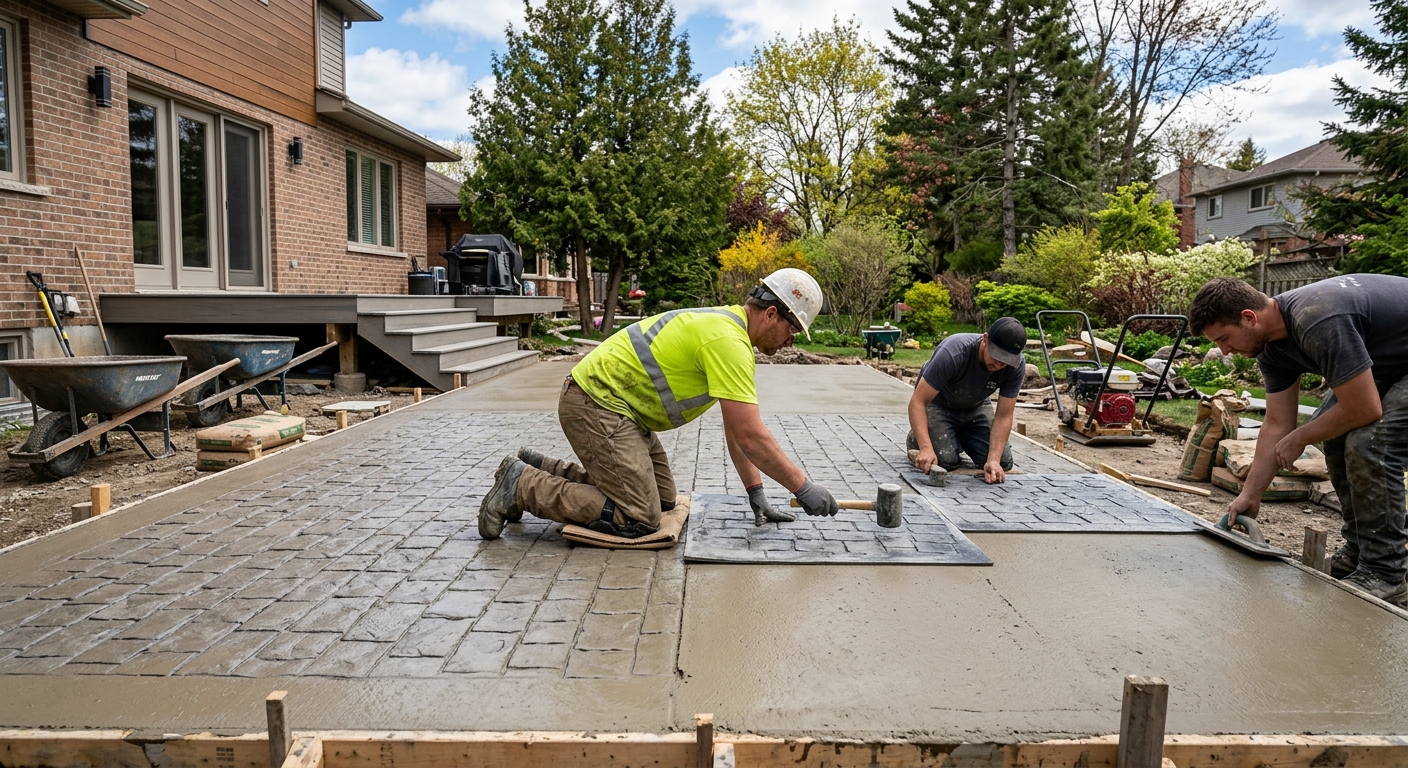
Concrete work options and costs in Kennedy Park
Kennedy Park, Ontario is a neighbourhood where homeowners tend to invest early in durable exterior flatwork—driveways, patios and walkways—because Toronto’s winters push concrete through repeated freeze–thaw cycles. With Kennedy Park’s population at 17,123 (Statistics Canada, 2021 Census), there’s steady demand for contractors who can plan pours around weather, scheduling and curing protection. That matters, because the Toronto area typically sees many families living in single-detached and low-rise homes, which often means more exterior concrete per property for owners who maintain landscaping and access. In practice, the local market is also very active along the Bayview Ave and Sheppard Ave corridor edges, where vehicle access and replacement driveway work are common.
Concrete pricing in the Toronto economic region isn’t just about square metres—it’s about frost depth requirements, base preparation, and the mix design used to resist spalling. Ontario typically requires most structural footings to extend to at least 1.2 m (about 4 ft) below grade, and exterior slabs rely on air-entrained concrete plus adequate thickness and control joints to manage cracking. Pours are commonly concentrated in warmer months to support proper curing, but humid, wet shoulder seasons still complicate grading, drainage, and finishing.
Below is a homeowner-friendly comparison of the most common concrete options and what you can expect to pay in Kennedy Park. Use this as your baseline, then tighten the numbers with itemized quotes for excavation depth, reinforcement, thickness, and finish details.
| Application |
Typical Size |
Key Spec |
Finish Option |
Price Range |
| Concrete driveway (standard broom finish) |
400 sq. ft. (approx. 12 m × 3.7 m) |
Air-entrained exterior mix; compacted granular base; control joints |
Broom finish, sealed (optional) |
$7,200–$11,200 |
| Exposed aggregate driveway |
400 sq. ft. (approx. 12 m × 3.7 m) |
Air-entrained mix; higher cementitious content; proper cure and wash |
Exposed aggregate finish |
$9,000–$14,800 |
| Stamped concrete driveway or patio |
300 sq. ft. (approx. 10 m × 3 m) |
Air-entrained mix; decorative colouring; reinforcement as specified |
Stamped pattern with release and colour hardener |
$7,200–$12,000 |
| Plain concrete patio or walkway |
200 sq. ft. (approx. 10 m × 2 m) |
Well-drained base; air-entrained mix; edge forms; control joints |
Float and broom finish |
$3,200–$5,200 |
| Garage floor (interior slab) |
300 sq. ft. (approx. 10 m × 3 m) |
Vapour barrier (if required); compacted base; proper thickness |
Power trowel (smooth) or broom (light texture) |
$5,400–$8,400 |
| Foundation footings (structural, below frost) |
Typical single house: 1,000–2,000 sq. ft. of footing lineal area |
Engineered footing size; rebar cage; below-frost excavation and inspection |
Structural concrete only (no finish) |
$180–$300 |
Prices are estimates only and vary by project scope, site access and material selection.
What affects the price of concrete work in Kennedy Park
In Kennedy Park and the broader Toronto area, two contractors can quote the “same” concrete job and still land 30–50% apart. The difference is usually in the unseen items: how deep they excavate, whether they build the correct compacted granular base, what reinforcement is included, and what mix design (especially air-entrainment) they specify for exterior durability. Because concrete pricing here is influenced by frost depth and freeze–thaw cycles, structural work like footings and exterior flatwork aren’t interchangeable—each layer has to be built to resist winter movement.
Toronto’s climate-driven requirements shape nearly every spec. Most structural footings must extend at least 1.2 m below grade in Ontario to reduce frost heave risk, and exterior slabs generally use air-entrained concrete so water trapped in pores can expand and contract without damaging the surface. When temperatures drop toward 10 °C or below, cold-weather curing precautions (insulating blankets, added protection, or heating depending on conditions) may be needed to protect early-age strength gain. On top of that, de-icing salt accelerates surface wear and spalling if the concrete mix and finishing aren’t right, which is why sealing and proper curing are commonly recommended.
Cost can move up or down quickly in Kennedy Park. For example, adding decorative stamping typically shifts driveways toward the $24–$40 decorative band per square foot, while a plain broom-finished patio usually stays in the more predictable $16–$26 range. Likewise, a sloped yard that needs regrading and thicker granular import can add thousands even if the final slab looks “the same” on paper.
Housing stock here includes older lots and established landscapes, so demolition, removal of old concrete, and drainage adjustments can become major line items—especially where the driveway meets the garage apron or where downspouts discharge near the slab.
| Price Factor |
Why It Matters |
Cost Impact |
| Frost line depth |
Footings must extend below design frost depth to prevent heave and differential movement. |
Higher excavation/formwork can add significant labour and material cost. |
| Site preparation |
Excavation, grading, and compacted granular base control settlement and water movement. |
Poor base prep often leads to early cracking—good prep usually raises upfront cost but protects the slab. |
| Reinforcement |
Rebar or wire mesh helps manage shrinkage and structural demands where required. |
Adding steel can increase cost, but skipping it increases failure risk. |
| Mix design |
Air-entrainment and target compressive strength improve freeze–thaw resistance. |
Correct exterior mix costs slightly more, but reduces spalling and early scaling. |
| Finish type |
Broom is simple; exposed aggregate and stamping require specialized materials and labour. |
Decorative options often push you from plain patio/driveway bands into stamped/exposed bands. |
| Pour size and concrete truck access to site |
Long hose runs or limited access can slow production and add labour. |
Access constraints can increase pump/placement time and crew hours. |
| Cold-weather curing precautions |
Insulation/heating may be needed to protect early-age strength and curing. |
Extra protection can add measurable cost when pours extend into colder temperatures. |
| Control joint pattern and sealing cost |
Joints control cracking location; sealing helps repel salt and moisture. |
Both are relatively small-line items but can extend service life. |
Permits & regulations in Ontario
In Ontario, structural concrete work generally needs a building permit and often engineered drawings. That includes foundation walls, grade beams, structural footings, underpinning, and any concrete tied to the structural integrity of the home. Concrete flatwork—like patios, walkways, and most driveways—usually does not require a permit unless it affects lot grading, interferes with stormwater management, changes impervious surface coverage limits, or impacts municipal right-of-way conditions. Even when a permit isn’t required, your contractor should still confirm setbacks, drainage direction, and any required approvals before breaking ground.
For Kennedy Park homeowners, the best practical approach is to verify three items before work starts: (1) licence/registration details where applicable for the contractor, (2) liability insurance, and (3) WSIB/WCB coverage. Step-by-step: first, ask the contractor for their certificate of insurance showing current general liability and the project address; confirm the coverage dates match your job window. Next, request proof of WSIB/WCB clearance or equivalent coverage documentation—don’t accept a verbal assurance. Finally, ask whether a permit will be pulled for structural items like footings or foundation walls, and confirm who is responsible for submitting drawings or responding to municipal comments. If your contractor is reluctant to provide documentation, that’s a red flag—especially for structural work.
Where possible, also request references on similar-scale projects in Ontario so you can confirm their track record with inspections and concrete placements under local freeze–thaw conditions.
Getting concrete right in Kennedy Park's freeze-thaw climate
Concrete failures in Kennedy Park usually trace back to water management and winter durability. When slabs are built on poorly compacted granular base or when drainage pushes water toward the concrete, you’ll see freeze–thaw damage accelerate. The most common visible issue is spalling: surface scaling and flaking caused by water entering the concrete and the lack of sufficient air-entrainment or inadequate curing. Cracking also happens when control joints aren’t installed where shrinkage wants to relieve stress—leading to random cracks that let more moisture in.
To spec concrete correctly for the Toronto market, focus on five areas. (1) Base preparation: use a compacted granular sub-base to the correct depth for local soil and frost movement risk; ensure drainage falls away from the house. (2) Mix design: specify air-entrainment appropriate for exterior flatwork—commonly 5–7% air content—and minimum compressive strength (often 32 MPa for typical exterior applications when designed to code). (3) Control joints: plan joint layout to control where cracks form, and keep joint cuts on schedule. (4) Curing: protect concrete for at least 7 days under proper conditions, especially when pours are near cooler temperatures in fall or early spring. (5) Sealing: apply a penetrating sealer after curing, typically 28 days post-pour, so de-icing salts and moisture are less able to attack the surface.
Here’s a real-life pricing logic for homeowners: a plain broom-finished driveway in the $18–$28 per-square-foot band is usually less expensive than stamped or exposed options. The extra cost for stamping or exposed aggregate (often driven by the $24–$40 band) can be justified when you want visual impact and are also willing to invest in the same winter-durability specs—air entrainment, base prep, thickness, and joints—rather than cutting corners.
| Spec |
Why It Matters in Kennedy Park |
What to Ask For |
Impact if Skipped |
| Compacted granular base (depth?) |
Prevents settlement and reduces trapped water that fuels freeze–thaw damage. |
State the target base depth and compaction method; confirm drainage slope. |
Early cracking, uneven slab, and faster deterioration. |
| Air-entrained concrete mix (target air %?) |
Air pockets give freeze–thaw room to expand safely in Ontario winters. |
Ask for target air content for exterior flatwork (commonly 5–7%). |
Higher risk of spalling and scaling on the surface. |
| Compressive strength (MPa rating) |
Strength development supports durability and load performance. |
Confirm minimum 32 MPa design strength (or project-specific rating). |
Reduced surface hardness and potential early wear. |
| Control joints (spacing per ACI guidelines) |
Directs cracking to predictable locations and limits random cracking paths. |
Request joint spacing, saw-cut timing, and layout plan. |
Random cracks that open, letting moisture into the slab. |
| Minimum 7-day curing period |
Proper early-age strength gain reduces shrinkage cracking and surface weakness. |
Confirm curing approach and protection if temps drop; plan for cold nights. |
Weaker, more permeable concrete prone to early damage. |
| Penetrating sealer (when applied after cure) |
Repels de-icing salt and moisture so freeze–thaw is less damaging. |
Ask for penetrating sealer application after curing (commonly 28 days post-pour). |
Faster surface wear and higher chance of spalling over winters. |
How to choose a concrete work contractor in Kennedy Park
Choosing the right concrete contractor in Kennedy Park means checking more than “years in business.” Start with Ontario coverage verification: request a current certificate of insurance showing general liability for your project and ask for proof of WSIB/WCB coverage (or clearance where applicable). How to check each is simple—verify the dates are current, ensure the address is listed or the policy supports work at your location, and confirm the coverage status isn’t expired before the first pour. If the contractor can’t provide documents promptly, don’t proceed.
Next, get 2–3 itemised written quotes. Ideally, you want a breakdown that separates excavation/demolition, base material and compaction, reinforcement, concrete supply, finishing, saw-cut joints, and sealing. Avoid lump sums with vague allowances. Ask whether the quote includes the permit pull if structural concrete work is involved, whether disposal is included for removed concrete, and what happens if the sub-base conditions uncover poor soil or unexpected rock.
For warranty, look for a clear workmanship warranty length and whether the manufacturer warranty for any system (like sealing materials) is included. Also ask if warranties are transferable to future owners—often a deciding factor in neighbourhood resale.
On payment schedule, keep it practical: don’t pay more than 10–15% upfront. Hold back a portion until the job is complete and cleanup, joint finishing, and sealing (if included) are done. Finally, request a start date and completion timeline in writing—cold-weather protection can impact schedules when temperatures drop toward 10 °C or below.
- Provide COI (certificate of insurance) with your Kennedy Park address or project description.
- Provide WSIB/WCB clearance or proof of coverage in writing before any work starts.
- Give itemised labour/material quotes (no “all-in” pricing without breakdowns).
- List concrete thickness, base depth, and reinforcement details (rebar mesh size/placement).
- Specify air-entrainment for exterior work and a minimum compressive strength.
- Confirm control joint spacing and when saw cuts will be made.
- Clarify curing plan (blankets/heating if temperatures drop) for scheduled pour dates.
- Include drainage details: slope away from the house and tie-ins to existing grading.
- Confirm disposal/hauling of demolished concrete is included (or state separate fees).
- Ask whether sealing is included and the expected sealer type (penetrating vs film-forming).
- Review warranty: workmanship coverage period, what’s excluded, and claim process.
- Payment terms: limit upfront deposit to 10–15% and hold back until final walk-through.
Concrete red flags in Kennedy Park include: quoting decorative work without specifying air-entrained mix, promising “no need for joints,” skipping base compaction detail, using generic reinforcement language (e.g., “mesh will be used” with no spec), and requesting a large upfront payment before site conditions and measurements are confirmed.
Frequently asked questions — concrete work in Kennedy Park
What is rebar and when is it required in Ontario?
Rebar is steel reinforcement embedded in concrete to help it carry tensile forces, control cracking, and improve structural performance. In Ontario, rebar requirements are driven by the engineered design for structural elements such as foundation footings, foundation walls, and grade beams—those are the items most likely to require permits and engineering drawings. For typical exterior flatwork like patios and driveways, reinforcement may be recommended depending on slab thickness, soil conditions, and loading, but the concrete mix and base are still the primary durability factors in Toronto’s freeze–thaw climate. If you’re budgeting, structural footing work is often quoted on a unit basis and can land in the $180–$300 per footing item band, with rebar being one component of the engineered package. Always ask your contractor for the specific rebar size, spacing, and placement (top/middle/bottom) rather than a general “we’ll add steel.”
How long does a concrete project take in Kennedy Park?
Most concrete flatwork projects in Kennedy Park can be completed quickly at the “active” work stage, but the schedule is shaped by curing and weather. A typical patio or walkway pour is often one day for forming and placing concrete, followed by finishing and protection. However, the concrete needs proper curing for at least 7 days before you should treat it like a fully finished, fully durable surface, and sealing (if included) is usually planned after curing—commonly around 28 days. Driveway work can take longer due to demolition, excavation, granular base compaction, reinforcement, and traffic planning. In Toronto’s shoulder seasons, pours may need extra protection if temperatures drop toward 10 °C or below, which can add time for heating/blankets. If your contractor is too optimistic about “pour today, done tomorrow,” ask what curing and protection steps are included in their quote.
What is a concrete overlay and is it suited to Kennedy Park?
A concrete overlay is a thin bonded layer placed over existing concrete to restore appearance and add a wear surface without fully removing the original slab. In Kennedy Park and the GTA, overlays can be viable when the existing slab is structurally sound—no major settlement, deep spalling, or widespread cracking—because you need a stable base for adhesion and performance. If the original concrete already has freeze–thaw damage or has shifted due to drainage issues, an overlay may crack again or delaminate because it can’t fix the root problem: water and movement beneath the slab. If you’re considering an overlay, ask your contractor how they prep the surface (mechanical cleaning/profiling), whether they address drainage and joint sealing, and what system they use. Compare costs to a full replacement: while overlays can sometimes be cheaper initially, the long-term durability in Ontario’s freeze–thaw climate depends on whether the existing concrete’s failures are localized or widespread.
How do I seal concrete to protect it in Kennedy Park?
Sealing helps protect concrete from moisture and de-icing salt, which is a big deal in Ontario winters when salt exposure can lead to surface scaling and spalling. The key is timing and product type. In Kennedy Park, plan to apply a penetrating sealer after proper curing—commonly around 28 days post-pour—so the concrete has dried and reached the strength needed to accept the coating properly. Before sealing, the surface should be clean and dry; any trapped moisture or construction residue can reduce effectiveness. Ask your contractor which sealer they use (penetrating vs film-forming), the coverage rate, and whether it’s included in the price. If your driveway is in the standard $18–$28 band, sealing may be an add-on or bundled depending on the contractor; if you’re spending in the decorative range like $24–$40, make sure sealing is still part of the durability plan, not just a colour/finish promise.
What is the difference between concrete and cement?
Concrete is the final building material you see—made from cement plus aggregates (sand and gravel), water, and often admixtures like air-entrainers. Cement is only one component within concrete (the binder that reacts with water to form strength). In everyday contractor talk, people sometimes say “cement” when they mean the full concrete mix, but the mix design matters for performance in Kennedy Park’s freeze–thaw conditions. For exterior flatwork, the important part is the concrete mix properties—especially air-entrainment and target compressive strength—because those directly affect durability against winter moisture and salt. When you get quotes, focus on what the contractor specifies about the concrete mix (air content, strength rating, and curing/protection) rather than whether they mention cement versus concrete. That’s the difference that determines whether your slab stays serviceable for years.
How much does concrete work cost in Kennedy Park?
Concrete cost in Kennedy Park generally follows Toronto-region pricing bands based on application, finish, and how much site prep and durability work is needed. For driveways and slabs, typical pricing sits around $18–$28 for concrete driveway/flatwork and $16–$26 for patios and walkways, while decorative stamped or exposed work often lands in the $24–$40 range due to extra materials and labour. Foundation footings are usually quoted separately and can fall in the $180–$300 range depending on the engineered scope and below-frost excavation requirements. The biggest cost swings usually come from demolition and haul-away, base depth/compaction, reinforcement needs, and whether the contractor has to use cold-weather curing protection to protect early-age strength. Always compare quotes on thickness, base prep, and mix specs—not just total dollars.