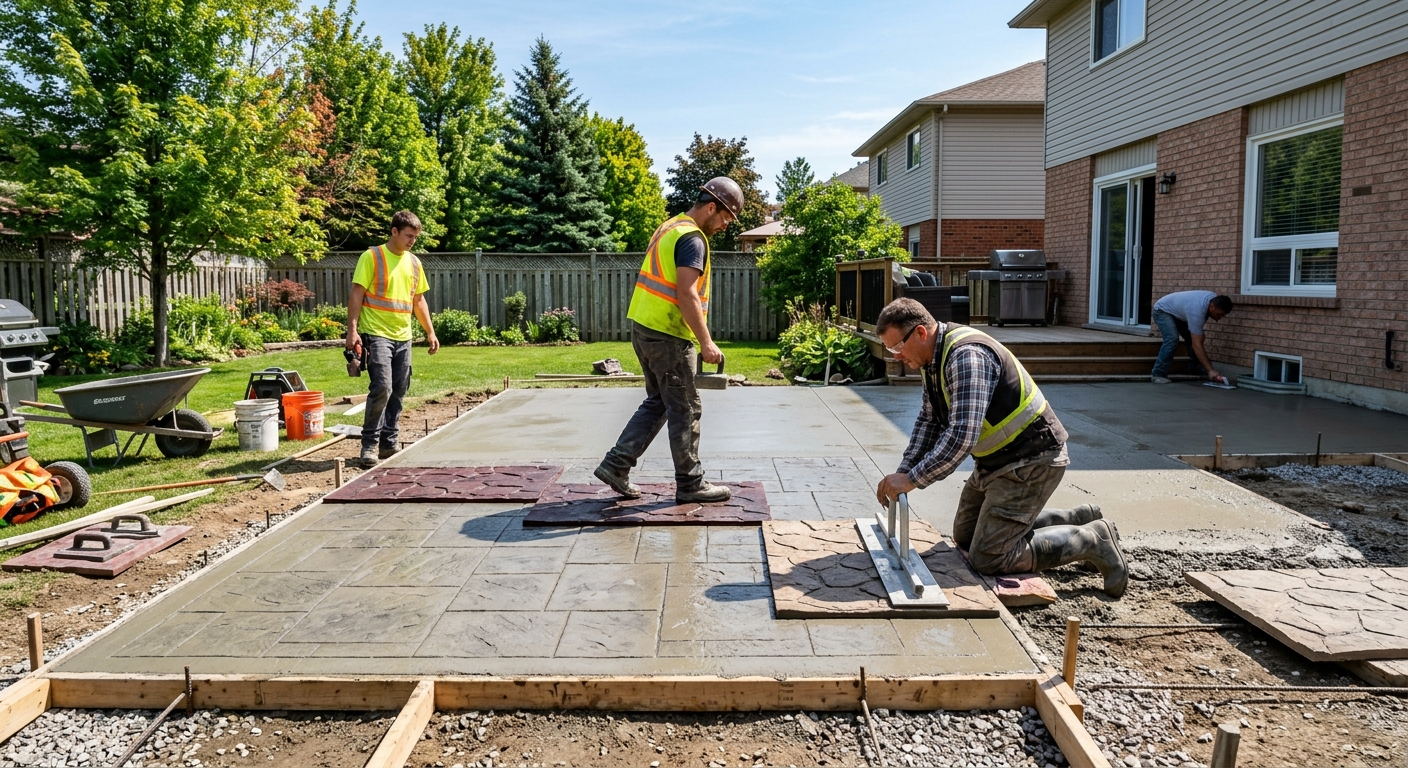
Concrete work options and costs in The Glebe
The Glebe is a beautiful, established neighbourhood, and it’s also one where concrete work is in constant demand for driveways, patios and walkways. With a population of 13,055 (Statistics Canada, 2021 Census), local trades stay busy serving a mix of older homes and newer builds. Many properties here are single-detached or semi-detached, which tends to translate into frequent requests for exterior flatwork—especially where front-steps, garage entries and side yards need durable, low-maintenance surfaces.
In the Toronto economic region, pricing is tightly linked to frost depth and freeze–thaw cycles. Local specs typically require structural footings to extend at least 1.2 m (about 4 ft) below grade, and exterior slabs rely on air-entrained mixes, good drainage, and properly spaced control joints to manage cracking. In practice, contractors concentrate most exterior pours in warmer months to protect curing. When temperatures drop toward 10 °C or below, concrete needs more protection (insulating blankets/heating) so it can reach strength without surface defects.
In The Glebe, that weather reality is especially noticeable in the shoulder seasons—wet fall and spring can make base preparation and curing scheduling more labour-intensive. Areas around major corridors like Bank Street and near the downtown-adjacent lanes often see repeated concrete repairs because walkways and driveway edges take a beating from snow clearing and de-icing.
Below is a practical way to compare common concrete options and realistic cost ranges, so you can line up quotes apples-to-apples before deciding on finish and site conditions.
| Application |
Typical Size |
Key Spec |
Finish Option |
Price Range |
| Concrete driveway (standard broom finish) |
16 ft x 20 ft (320 sq ft) |
Air-entrained, compacted granular base |
Broom finish |
$5,760 – $8,960 |
| Exposed aggregate driveway |
16 ft x 20 ft (320 sq ft) |
Air-entrained; careful curing and washing |
Exposed aggregate |
$8,000 – $12,800 |
| Stamped concrete driveway or patio |
12 ft x 18 ft (216 sq ft) |
Air-entrained; proper curing and release |
Stamped pattern |
$5,184 – $8,640 |
| Plain concrete patio or walkway |
10 ft x 15 ft (150 sq ft) |
Well-drained base; control joints |
Float/smooth with light broom |
$2,400 – $3,900 |
| Garage floor (interior slab) |
20 ft x 20 ft (400 sq ft) |
Vapour/insulation strategy as needed; compacted base |
Standard broom or trowel finish |
$7,200 – $11,200 |
| Foundation footings (structural, below frost) |
Typical house perimeter run |
Below frost depth; formed/placed to plan |
Structural concrete |
$180 – $300 |
Prices are estimates only and vary by project scope, site access and material selection.
What affects the price of concrete work in The Glebe
In The Glebe and across the Toronto area, you can see the same general concrete project come in 30–50% apart depending on how the quote is built. The biggest driver isn’t “concrete” alone—it’s the details around excavation, base prep, mix design, reinforcement, finishing, and how the contractor protects curing during Ontario’s freeze–thaw swings.
Frost depth and repeated freeze–thaw cycles dictate specs in the GTA. Structural footings generally must extend below design frost depth (Ontario commonly lands in the 1.5–2.4 m range, depending on location and soil conditions) to prevent frost heave and differential movement. Exterior slabs and flatwork then need air-entrained concrete mixes to survive repeated wetting and freezing, plus proper drainage so saturated soils don’t expand and contract against the slab every winter. When temperatures fall toward 10 °C or below, the pour season gets shorter and cold-weather curing precautions (heating, insulated blankets, longer protection time) add labour and equipment costs.
De-icing salt is another Ontario-specific cost pressure. It accelerates surface spalling if the mix, curing, and sealing plan aren’t right—so sealing becomes more than an “upgrade” for exterior work in The Glebe.
Two examples from local jobs: (1) A driveway upgrade from broom-finish standard to exposed aggregate may cost more, but it’s often justified where you want improved surface texture for traction and better long-term appearance; (2) A plain patio poured over poorly compacted fill can look fine initially, then heave or crack sooner—cutting corners there is where homeowners get hit twice. If you’re comparing a $5,760 – $8,960 standard driveway range to an $8,000 – $12,800 exposed aggregate plan, the difference usually reflects thicker/stronger prep work, better finish execution, and more robust curing and jointing.
| Price Factor |
Why It Matters |
Cost Impact |
| Frost line depth — determines footing depth and form height |
Deeper footings reduce frost heave and settlement risk |
Higher excavation/forming labour; can add significant cost on structural work |
| Site preparation — excavation, grading, compacted granular base |
Bad base prep leads to cracking, unevenness and drainage failures |
Can swing costs widely depending on soil, haul distance, and accessibility |
| Reinforcement — rebar or wire mesh requirement |
Helps control cracking and supports loads |
Material and placement labour; more steel/mesh generally increases price |
| Mix design — air-entrainment and compressive strength spec |
Protects concrete through freeze–thaw cycles and provides strength |
Often modest material cost, but essential for exterior durability |
| Finish type — broom vs. stamped vs. exposed aggregate |
Finish affects materials, labour, and surface performance |
Stamped and exposed finishes usually add the most cost per sq ft |
| Pour size and concrete truck access to site |
Narrow lanes and limited access can increase labour and placement time |
Extra equipment/crew time; possible redesign for traffic management |
| Cold-weather curing precautions — heating and blankets |
Ensures concrete reaches strength without defects |
Raises labour and materials; may shift schedule to warmer windows |
| Control joint pattern and sealing cost |
Joints manage cracking; sealing helps repel salt and moisture |
Often a small line item but reduces future repair risk |
Permits & regulations in Ontario
In Ontario, structural concrete work typically requires a building permit. That includes footings, foundation walls, grade beams, and any concrete elements that are part of the structural system. Often, engineered drawings are reviewed by the municipality before work proceeds, particularly where there are changes to loads, spans, or foundation design.
Concrete flatwork (like patios, walkways, driveways and sidewalks) usually does not require a permit, unless it affects lot grading, intersects with drainage plans, or triggers municipal rules around impervious surface coverage or work within a municipal right-of-way. Even when a permit isn’t required, permits can still come up for removals, ties into eaves/drainage, or if the work changes how water flows away from the house. In The Glebe, it’s smart to confirm with the local authority before you break ground—especially if your plan includes lowering/raising slopes or rebuilding near the curb.
Homeowners should verify three things before signing: (1) licensing/registration where applicable (ask for the contractor’s business details and current standing), (2) liability insurance (obtain a current certificate of insurance naming you as an additional insured if possible), and (3) WSIB/WCB coverage where required. A reliable process is: request the contractor’s insurance certificate, ask for WSIB/WCB clearance/coverage details, and then confirm any stated registrations/credentials through the appropriate online registry sources. Also ask for references on similar-scale Toronto-area exterior concrete projects so you can see their workmanship through multiple seasons.
Getting concrete right in The Glebe's freeze-thaw climate
The Glebe’s freeze–thaw reality is what makes “good concrete” different from “pretty concrete.” Most failures here come from water and salt getting into vulnerable surfaces, then expanding as it freezes. If the base isn’t prepared correctly, or if the mix isn’t air-entrained and properly cured, you’ll often see early scaling/spalling on exterior slabs even when the colour and finishing look fine at first.
To spec the job correctly, start with (1) base preparation: a properly graded, compacted granular sub-base sized to handle your local soil and keep water from pooling. (2) mix design: exterior flatwork should use air-entrained concrete (commonly in the 5–7% air content range for durability outdoors) and a minimum compressive strength such as 32 MPa. (3) control joints: spacing and layout that guide where cracks will happen instead of allowing random cracking. (4) curing: concrete needs time and protection—plan for a minimum 7-day curing period under proper conditions; cold weather demands heating/blankets so the slab doesn’t freeze before it reaches adequate strength. (5) sealing: apply a penetrating sealer after curing (typically 28 days post-pour) to help repel de-icing salts and moisture.
When you ask contractors for these specifics, you’ll quickly find out who understands Ontario durability. For example, moving from a budget broom-finish driveway to a properly specified, air-entrained standard broom job can be a better value than “saving” on mix/air content—because spalling repairs cost far more than the small materials difference up front. That’s how you protect the appearance and reduce future work on the roads and sidewalks you rely on every day.
| Spec |
Why It Matters in The Glebe |
What to Ask For |
Impact if Skipped |
| Compacted granular base (depth?) |
Prevents pumping, uneven settlement and water retention through winter |
Granular base type and compacted thickness; drainage plan |
Early cracking, uneven surface, and poor long-term performance |
| Air-entrained concrete mix (target air %?) |
Resists freeze–thaw damage and reduces scaling/spalling risk |
Air content target (commonly 5–7% for exterior flatwork) |
Higher risk of spalling and surface scaling after freeze–thaw cycles |
| Compressive strength (MPa rating) |
Ensures the slab reaches durability and load capacity |
Minimum 32 MPa (or project-specific requirement) |
Weaker concrete that can fail prematurely under normal use |
| Control joints (spacing per ACI guidelines) |
Controls where cracks form to keep them tight and predictable |
Joint layout drawing or spacing plan before pour |
Random cracking that can allow water infiltration |
| Minimum 7-day curing period |
Builds strength and improves durability before the next freeze |
How curing will be protected; timeline for cold weather pours |
Surface defects, reduced strength gain, and premature deterioration |
| Penetrating sealer (when applied after cure) |
Helps repel de-icing salts and moisture from the surface |
Sealer type and application after curing (commonly around 28 days) |
Accelerated salt damage and increased spalling risk |
How to choose a concrete work contractor in The Glebe
Choosing the right contractor in The Glebe starts with verification, not a quick phone call. In Ontario, you should ask for (1) current liability insurance—request the certificate of insurance and confirm it matches the work scope and dates of coverage; (2) WSIB/WCB coverage details—ask for evidence/clearance and make sure it’s active for the crew who will be on site; and (3) proof that they are properly set up to do the work they’re quoting. If you’re told coverage is “handled” but you can’t get paperwork, that’s a red flag.
Next, get 2–3 itemised written quotes where labour and materials are broken out. A trustworthy quote lists excavation/grading, base materials and compaction, reinforcement (if required), concrete mix details (including air-entrainment for exterior), finishing method (broom vs stamped vs exposed aggregate), jointing and sealing, and concrete truck access conditions. Avoid lump-sum quotes that don’t state what’s included.
Read the scope carefully for what’s excluded: permit pull included or not (where required), disposal of excavated material, saw-cut timing for control joints, and how the contractor will protect curing during cooler nights. Ask about workmanship warranty length, product/manufacturer warranties for any sealers or systems, and whether any warranty is transferable if you sell your home. For payment, a common healthy structure is no more than 10–15% upfront, with holdback until the final finish, joints, and any sealing steps are completed. Confirm timeline milestones in writing: start date, expected curing/protection window, and final completion date.
- Ask for insurance certificate and WSIB/WCB proof before signing.
- Get itemised labour vs materials breakdown (not only a total price).
- Confirm air-entrained mix specification for any exterior flatwork.
- Ask about granular base thickness and compaction method.
- Require joint layout (spacing and where joints will be cut/sawed).
- Clarify if sealing is included and when it will be applied (after curing).
- Check whether disposal/hauling is included for excavation and removals.
- Confirm concrete truck access plan and whether they allow for limited access charges.
- Ask who completes finishing and jointing on the crew (experience matters).
- Request a workmanship warranty in writing and what it covers.
- Avoid paying more than 10–15% upfront; hold back until completion.
- Get a written schedule that includes curing/protection conditions.
Concrete contractor red flags in The Glebe: vague scopes that don’t mention air-entrainment or jointing, promises to pour “no matter what” without cold-weather curing precautions, reluctance to provide insurance/WSIB/WCB paperwork, quotes that exclude sealing while recommending it later, and frequent changes based on “field adjustments” without documenting them.
Frequently asked questions — concrete work in The Glebe
Concrete vs pavers for a patio in The Glebe?
For many The Glebe homeowners, concrete is the simpler long-term choice when you want a smooth, uniform finish with fewer joints to manage. Properly installed concrete patio slabs—built on compacted granular base, with air-entrained exterior mix, and control joints—can hold up well through Toronto’s freeze–thaw seasons. Pavers can also perform very well, but the look and longevity depend heavily on edge restraints, base depth, and joint sand maintenance. If you’re getting de-icing salt nearby (common with walkways), concrete benefits from proper sealing applied after curing. As a rough planning reference, a plain concrete patio often falls in the $16 – $26 per sq ft band depending on thickness, base prep and finish approach. If you want custom patterns and a higher-end look, stamped concrete is often priced higher, but pavers can still be comparable once excavation and re-laying labour is included.
How long does a concrete driveway last?
A well-built concrete driveway in Ontario commonly lasts decades, but the “how long” depends on details that directly relate to our climate and surface exposure in The Glebe. The biggest determinants are air-entrainment, proper base preparation and drainage, correct thickness, joint spacing, curing conditions, and whether sealing is done after the pour. Salt and winter moisture are hard on surfaces—so sealing and good drainage matter. If a driveway is poured over poorly compacted fill or without the right mix for freeze–thaw, you might see surface scaling and spalling much earlier than expected. For planning, typical driveway pricing often lands in the $18 – $28 per sq ft range in the Toronto market when the contractor includes appropriate exterior specifications and a durable finish. A premium finish (like exposed aggregate) usually costs more but can better hide minor surface weathering, especially around driveway edges where ploughing and traction products are frequent.
What is air-entrained concrete and why does it matter here?
Air-entrained concrete is designed to survive freeze–thaw cycles by creating tiny air bubbles in the mix. Those microscopic “air voids” give water space to expand when it freezes, which reduces cracking and surface spalling. In The Glebe and across the Toronto region, freeze–thaw is a persistent stressor—especially when de-icing salt and moisture get into the slab surface. Exterior flatwork should therefore use an air-entrained mix and appropriate curing so the concrete reaches strength before colder nights and moisture exposure. If the mix isn’t air-entrained (or the air content is wrong), the most common failure you’ll see is scaling and spalling after winter. This is one reason quotes can vary significantly: the concrete mix spec and curing protection are often where the real value (and cost control) sits, not in the basic finishing look. When comparing bids, ask for the mix design and confirmation that it’s air-entrained for exterior exposure.
How do I prepare the base for a concrete slab?
Base prep is where concrete jobs in Ontario are won or lost. For The Glebe patios, walkways, and driveways, contractors typically excavate to remove topsoil/loose materials, then build up a well-graded compacted granular sub-base. The goal is to create stable support at the correct depth, with drainage that prevents water from pooling under the slab. Proper compaction matters because it reduces movement during freeze–thaw. If soil conditions are variable or saturated, the base prep often takes longer and may require additional granular layers or drainage adjustments. Homeowners don’t usually do base prep directly, but you should ask your contractor to specify base thickness, granular material type, compaction approach, and how they’ll handle drainage at the edges. A premium finish won’t protect a slab that’s built over unstable base, so make base prep part of your written scope.
How do I compare concrete quotes?
To compare concrete quotes in The Glebe, avoid judging by the lowest total price alone. Ask for itemised quotes showing excavation/grading, base materials and compaction, reinforcement (if required), concrete mix spec (including air-entrainment for exterior), thickness, finishing method, jointing plan, sealing (if applicable) and disposal. Confirm whether the contractor includes cold-weather curing precautions (heating/blankets) if the pour date falls near colder conditions. Quotes can differ by 30–50% because one contractor may be bundling higher-spec durability items while another is using a thinner slab, omitting reinforcement, or leaving out sealing. Use the Toronto market price bands as a sanity check: for example, standard exterior driveway work often falls within $18 – $28 per sq ft, while stamped finishes may land around $24 – $40 per sq ft depending on complexity and base prep. If one quote is far below the band, it’s usually missing key scope items.
Can concrete be poured in cold weather in The Glebe?
Yes, concrete can sometimes be poured in cold weather in The Glebe, but it must be done correctly. Toronto-area crews manage cold pours using protections like insulating blankets, heated enclosures/temporary heat, and curing plans that prevent early freezing. The key is whether the contractor can protect the concrete long enough for it to gain strength safely. In local practice, schedules often shift when temperatures drop toward 10 °C or below because curing becomes harder and more protection is needed. If the job is rushed without adequate curing management, you risk surface defects and reduced long-term durability—exactly the issues Ontario homeowners see after freeze–thaw. When comparing bids for late-season pours, ask what cold-weather plan they’ll use, how long they’ll keep protection in place, and whether the mix design includes any adjustments. A responsible contractor will also explain how this affects timeline and why it changes labour and equipment cost.