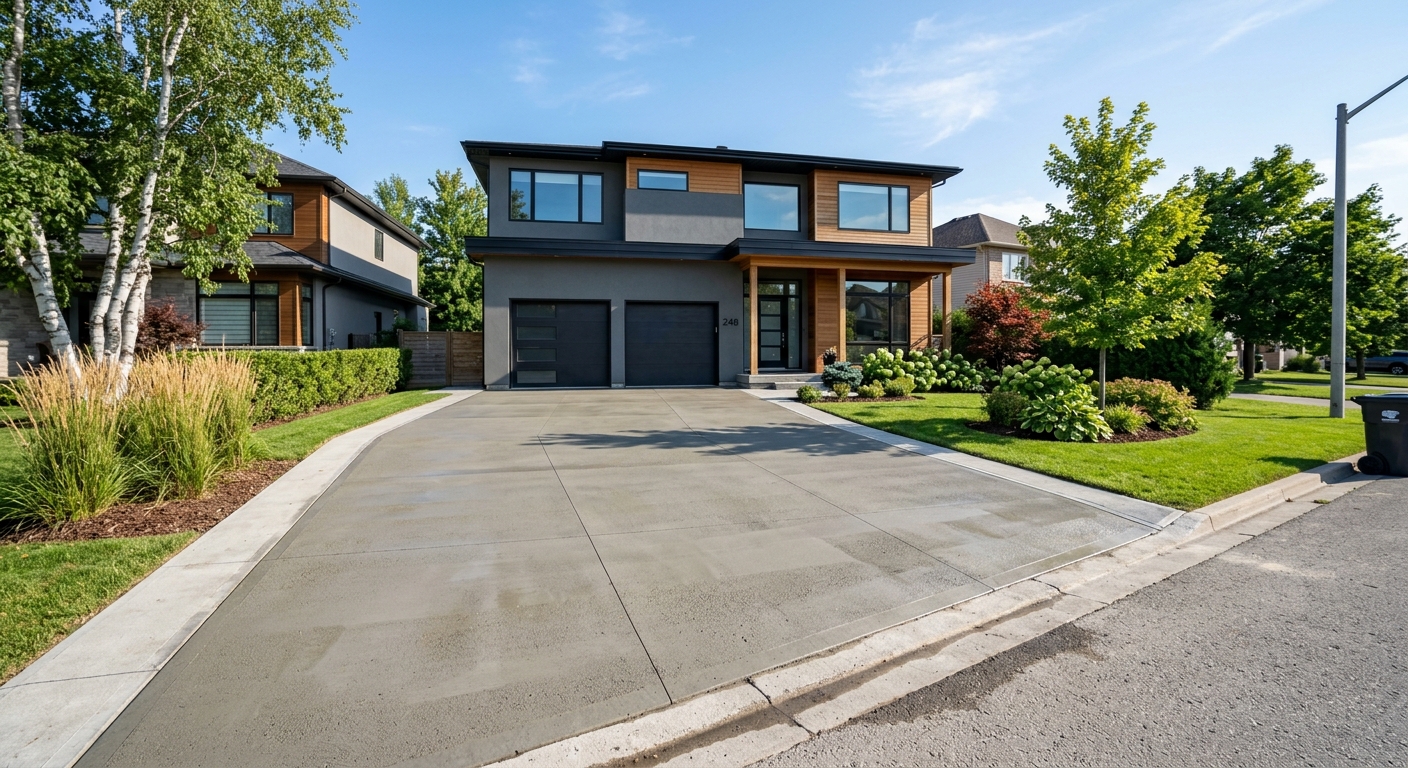
Concrete work options and costs in Longlac
Concrete work in Longlac is typically driven by the same factors you see across the Toronto economic region: freeze–thaw cycling, frost-depth requirements, and the limited window for reliable outdoor curing. With Longlac’s population at 1,316 (Statistics Canada, 2021 Census), the local trades market is smaller than the GTA core, so appointment availability can affect scheduling—and that can influence labour and protection measures for cold snaps. Housing demand also leans heavily toward owner-occupied properties, which is where driveways, patios, and walkways are most commonly updated to improve curb appeal and day-to-day access. In practical terms, that means you’ll often see concrete flatwork designed for drainage and crack control from the start, rather than “fix-it later” patching.
In this region, most structural footings need to sit below the design frost depth (Ontario commonly around 1.2 m or more below grade) to reduce frost heave and settlement-related cracking. Exterior slabs also need air-entrained concrete to survive repeated winter freeze–thaw. When temperatures dip toward about 10 °C or below, contractors often pause, insulate, or protect the pour for curing quality, which adds cost. Even the humid, wet shoulder seasons can delay base prep and proper curing if the site stays saturated.
If you’re around the core serviced areas and near the main residential lanes, concrete contractors tend to see steady demand for driveway replacements and small front-steps tied into landscaping updates—especially where homeowners want a neat broom finish or upgrade to exposed aggregate for a longer-looking surface. Below is a comparison of typical options so you can benchmark your quote before you pick a finish.
| Application |
Typical Size |
Key Spec |
Finish Option |
Price Range |
| Concrete driveway (standard broom finish) |
16 ft × 30 ft (about 480 sq. ft.) |
Air-entrained exterior mix, reinforced as needed, compacted granular base |
Broomed surface; control joints |
$8,640 – $13,440 |
| Exposed aggregate driveway |
16 ft × 30 ft (about 480 sq. ft.) |
Air-entrained exterior mix; proper curing and retarder/ wash-off control |
Exposed aggregate with sealer |
$10,560 – $17,280 |
| Stamped concrete driveway or patio |
12 ft × 24 ft (about 288 sq. ft.) |
Air-entrained mix; integral colour or overlay colour; joints planned for pattern |
Stamp pattern; optional border |
$6,912 – $11,520 |
| Plain concrete patio or walkway |
10 ft × 16 ft (about 160 sq. ft.) |
Compacted base, drainage pitch, air-entrained mix for exterior durability |
Float-and-broom or light broom finish |
$2,560 – $4,160 |
| Garage floor (interior slab) |
20 ft × 22 ft (about 440 sq. ft.) |
Vapour barrier as applicable, reinforced slab, proper subgrade compaction |
Light broom or smooth-float (for finish coatings) |
$7,920 – $12,320 |
| Foundation footings (structural, below frost) |
Typical small foundation: 20 linear ft (varies by design) |
Engineered footing spec; excavation, forms, steel, and concrete placement |
Structural concrete only (no decorative finish) |
$3,600 – $6,000 |
Prices are estimates only and vary by project scope, site access and material selection.
What affects the price of concrete work in Longlac
In Longlac, you can see wide differences between quotes for what seems like the same concrete job—often 30–50%—because concrete pricing isn’t just about volume. It’s about what needs to be done to make it last through Toronto-region winters: excavation depth, how much granular base is required, steel quantity, truck access, and how the contractor manages curing when temperatures slide. In a small local market, scheduling also matters; if a crew has to mobilize twice because the site isn’t ready, labour and protective measures can stack up.
For every exterior pour, frost-depth and freeze–thaw cycles dictate the spec. Structural footings must extend below the design frost depth (Ontario commonly around 1.2 m or deeper) to reduce frost heave and differential movement. For driveways, patios, and walkways, contractors typically use air-entrained concrete so the surface doesn’t scale and spall under repeated freezing and thawing. When cold nights arrive, cold-weather curing precautions—insulating blankets, additional labour time for temperature control, and sometimes delaying the pour—add cost. De-icing salt in winter is another driver; it accelerates surface deterioration, so sealing is often recommended, especially for broom finishes.
Two examples from Longlac that change costs quickly: (1) if your soil is soft or saturated, excavation and granular base thickness may increase, raising costs toward the upper end of the $18,000 – $28,000 driveway band-equivalents; (2) if truck access is tight and forms/reinforcement work is slower, you may pay more even when the square footage is the same—particularly for stamped work in the $24 – $40 per-sq.-ft decorative tier. Also, if your project is in an older housing area where existing subgrade was backfilled decades ago, extra preparation and regrading can be necessary, and that preparation is often where the “quote gap” hides.
| Price Factor |
Why It Matters |
Cost Impact |
| Frost line depth |
Determines footing depth and form height |
Higher excavation and more concrete; larger foundation scope can add several thousand dollars |
| Site preparation |
Excavation, grading, compacted granular base |
Wet/unstable soil can force deeper base and more material haul |
| Reinforcement |
Rebar or wire mesh requirement |
More steel labour and material increases cost, especially for thicker slabs |
| Mix design |
Air-entrainment and compressive strength spec |
Exterior-grade air content and strength can be slightly higher, but it reduces failure risk |
| Finish type |
Broom vs. stamped vs. exposed aggregate |
Decorative systems (stamps, retarder processes, polish/wash) add labour and consumables |
| Pour size and concrete truck access to site |
Placement speed and number of loads |
Poor access can require smaller loads or extra handling, increasing labour time |
| Cold-weather curing precautions |
Heating and blankets |
Protection can add daily labour costs and materials if the schedule runs late |
| Control joint pattern and sealing cost |
Controls cracking and protects against de-icing salt |
Proper joints and sealing add line items, but reduce long-term surface repairs |
Permits & regulations in Ontario
In Ontario, structural concrete work typically requires a building permit and, in many cases, engineered drawings reviewed by the municipality. This includes things like foundation walls, footings, grade beams, and other structural elements that affect load paths. For concrete flatwork—such as patios, walkways, driveways, and exterior steps—permits usually are not required by default, but they can come up if the work affects lot grading, changes drainage patterns, or triggers municipal rules related to impervious surface coverage or work within/near municipal right-of-way. Because rules can vary based on the lot and the proposed footprint, it’s smart to confirm with the local authority before excavation begins.
For contractor accountability in Longlac, don’t rely on verbal assurances. First, request a current certificate of insurance showing liability coverage and verify it matches the legal name of the business on the quote. Second, confirm the contractor is registered for WSIB/WCB coverage (or provides the appropriate clearance letter where applicable). Third, for structural work, ensure they’re comfortable with the permit process and that engineered documentation—if required—is addressed.
Step-by-step verification for homeowners: (1) check the contractor’s Ontario business information and trade eligibility via the relevant online registry listings; (2) ask for the certificate of insurance and WSIB/WCB clearance/correspondence; (3) verify the insurance dates cover your planned start date; (4) request 2–3 references on similar-scale jobs; and (5) ensure the permit scope (if needed) is clearly stated in the contract before you sign.
Getting concrete right in Longlac's freeze-thaw climate
Concrete failure in Longlac typically comes down to three problems: water, weak base preparation, and freeze–thaw damage that expands and contracts at the surface. The fix isn’t just “pour more thickness”—it’s specifying the right base, the right mix, and a realistic curing and joint plan that matches Toronto-region weather. Start with base preparation: you want a properly compacted granular sub-base to the correct depth so the slab doesn’t pump water or settle unevenly during spring thaws. Next, mix design: exterior flatwork should be air-entrained to target about 5–7% air content to manage internal ice expansion. Pair that with a minimum 32 MPa compressive strength for typical exterior exposure.
Control joints are essential in freeze–thaw areas. They intentionally create weak points so cracking happens in straight, planned locations—not randomly across driveways and walkways. Curing matters too: allow a minimum 7-day curing period under appropriate conditions, and when the air cools, plan protection so the surface doesn’t freeze or cure unevenly. Finally, sealing helps repel moisture and de-icing salt; a penetrating sealer is commonly applied about 28 days after the pour, once the slab has matured.
If you’re comparing finishes, it’s worth spending where it protects the system. For example, for a stamped patio, the decorative upgrade may land you in the $6,912 – $11,520 range for a typical small patio size, but if joints, base thickness, and air-entrainment aren’t handled correctly, you can still end up with spalling and patchy deterioration. Paying for the underlying durability spec first is what makes decorative concrete look good longer.
| Spec |
Why It Matters in Longlac |
What to Ask For |
Impact if Skipped |
| Compacted granular base (depth?) |
Reduces pumping and settlement during spring thaw |
Granular base depth based on soil and frost considerations; proof of compaction method |
Uneven settling, cracking, and water retention under the slab |
| Air-entrained concrete mix (target air %?) |
Manages ice expansion through freeze–thaw cycles |
Air content targeted to about 5–7% for exterior flatwork; exposure-appropriate mix |
Surface scaling/spalling, especially after winters with de-icing salts |
| Compressive strength (MPa rating) |
Supports durability and resists early damage |
Minimum 32 MPa specified for the placement |
Lower wear resistance and increased risk of surface breakdown |
| Control joints (spacing per ACI guidelines) |
Keeps cracking controlled during thermal movement |
Planned joint layout with spacing aligned to design and slab dimensions |
Random cracking and frequent trip hazards at the worst spots |
| Minimum 7-day curing period |
Ensures strength gain before weather stresses it |
Protection plan and curing timeline that accounts for cold nights |
Surface weakness, curling, and premature deterioration |
| Penetrating sealer (when applied after cure) |
Improves resistance to moisture and de-icing salt exposure |
Penetrating sealer application after cure (commonly after 28 days) |
Faster spalling and darker staining from water migration |
How to choose a concrete work contractor in Longlac
Start by verifying the basics that protect you in Ontario: liability insurance and WSIB/WCB coverage. Ask for a current certificate of insurance and confirm the coverage dates line up with your project start and completion. For WSIB/WCB, request a clearance letter or proof of registration showing they’re compliant for the workers who will be on your site. If you’re hiring for structural concrete in Longlac, insist they can coordinate any permit steps and engineered requirements that apply to footings or foundation walls.
Next, get 2–3 itemised written quotes. You want a labour-and-materials breakdown rather than a single lump sum so you can compare whether one contractor is under-specifying base prep, reinforcement, or curing protection. Ask what’s included for cleanup and disposal, whether permit pull (if needed) is part of their scope, and how they handle existing concrete removal and hauling. Compare finish details too—standard broom versus stamped or exposed aggregate—because decorative work changes labour and consumables.
Warranty should be clear: workmanship warranty length and what it covers (cracks due to shrinkage vs. structural movement), and whether product/manufacturer warranties apply to additives, sealers, or decorative systems. For payment, keep it controlled: never pay more than 10–15% upfront; use a holdback until completion and walk-through sign-off. Finally, insist on a written timeline with a start date and completion estimate, and confirm how weather delays will be managed.
- Written, itemised quotes (labour, materials, base prep, reinforcement, finishing)
- Proof of liability insurance with matching legal business name
- WSIB/WCB clearance or proof of coverage for workers
- Clear scope of disposal: concrete removal and debris hauling included or not
- Site access plan (truck approach, staging, and how they’ll avoid damaging landscaping)
- Concrete spec sheet: air-entrainment and compressive strength mentioned in writing
- Base prep depth and compaction method stated (and who confirms compaction)
- Reinforcement details (mesh vs. rebar, thickness, chairs/spacers if applicable)
- Control joint pattern and spacing plan included before ordering concrete
- Curing and cold-weather protection plan, especially if nights run cool
- Sealer included where appropriate, with application timing (after cure)
- Warranty terms in writing and a payment schedule tied to milestones
Concrete red flags in Longlac include: promises to “pour no matter the temperature” without curing protection, vague specs like “regular concrete” (no air-entrainment/strength stated), skipping compacted granular base depth, refusing to discuss joint spacing and sealing, or requesting large upfront payments with no contract milestones for holdback.
Frequently asked questions — concrete work in Longlac
When is the best time to pour concrete in Longlac?
The best time in Longlac (Ontario) is typically late spring through early fall, when you can maintain stable curing temperatures. In the Toronto economic region, freeze–thaw cycling is the enemy of exterior flatwork, so contractors generally avoid pouring right before cold snaps or long stretches of damp, near-freezing conditions. That’s why many crews focus on a warmer window where the slab can gain strength properly. If you’re doing structural footings, the work can be scheduled differently, but exterior slabs still need dependable curing. If your project timeline is late-season, ask the contractor what cold-weather curing approach they’ll use (insulating blankets, heating plan, and how they’ll protect the surface). As a homeowner, planning around weather is often the most cost-effective way to avoid protective add-ons that can push your quote toward the higher end of exterior pricing.
How long does concrete take to cure?
Concrete needs time to reach usable strength, but “cure time” depends on temperature and the element being poured. For most exterior flatwork in Ontario, crews plan at least 7 days of proper curing before heavy stress and ongoing exposure. Decorative work and any sealing schedule are usually timed based on full curing; a penetrating sealer is commonly applied about 28 days post-pour to repel moisture and de-icing salt. Cold nights can slow strength gain, so contractors may extend protection time. In Longlac, the freeze–thaw cycle makes early exposure riskier—especially if water finds cracks and expands during freeze. If you want long-term durability, ask your contractor to specify curing protection and confirm the expected timeline before you sign.
Do I need a permit for concrete work in Ontario?
In Ontario, the rule of thumb is: structural concrete such as footings, foundation walls, and grade beams usually requires a building permit and often engineered drawings reviewed by the municipality. For typical flatwork like driveways, patios, and walkways, a permit is often not required unless the work affects lot grading, drainage, impervious surface limits, or involves municipal right-of-way changes. Because Longlac properties can vary by lot and drainage situation, the safest move is to ask your contractor to confirm what applies to your project scope before excavation. Also, for your contractor’s protection, verify they carry liability insurance and have WSIB/WCB coverage. You can ask for their clearance letter and certificate of insurance, and ensure the documentation covers the period of your start date.
Concrete vs pavers for a patio in Longlac?
For a patio in Longlac, both concrete and pavers can look great, but concrete usually wins on longevity and ease of maintenance when it’s built to handle freeze–thaw. With concrete, the critical durability factors are base preparation, air-entrainment, control joints, and curing quality—because Ontario winters punish slabs that trap water. Pavers can perform well too, but they depend heavily on a properly graded and compacted base; if base is off, weed growth and shifting become common. Cost-wise, a plain concrete patio often fits within the $16 – $26 per-sq.-ft band for typical projects, while stamped or decorative options move higher. If you want a traditional, low-maintenance surface and you’re prepared to pay for correct base and joints, concrete is often the more predictable option in freeze–thaw conditions.
How long does a concrete driveway last?
A well-built concrete driveway in Ontario commonly lasts 20–30 years, sometimes longer, but the outcome depends on base prep, air-entrainment, thickness, joint layout, and how the homeowner manages winter salt and water. In the Toronto economic region, freeze–thaw and de-icing salt are major wear drivers, so sealing and proper drainage matter. If the base is under-compacted or the slab was poured without adequate granular thickness, you’ll often see early cracking or uneven settlement. If joints are missing or poorly spaced, random cracking can worsen. From a cost perspective, homeowners often compare standard broom concrete versus upgrades like exposed aggregate or stamped finishes; the decorative systems can cost more, but they don’t replace the need for correct sub-base and a durable mix. Ask your contractor to detail their air content and joint plan—those are the real predictors of lifespan.
What is air-entrained concrete and why does it matter here?
Air-entrained concrete is mixed with microscopic air bubbles designed to give expanding freeze water somewhere to go during winter freeze–thaw cycles. Without that engineered air, the pressure from ice formation can break the cement paste and cause scaling or spalling—common exterior problems in Ontario. In Longlac, where you’ll experience repeated seasonal freezing and thawing, air-entrainment is one of the most important specs for driveways, patios, and walkways. That’s why reputable contractors specify an exterior-grade air content (commonly targeting about 5–7% air for these flatwork applications) and pair it with a suitable strength requirement. If you’re comparing quotes in the $18 – $28 driveway pricing band, ask what mix they’re using and whether it’s truly air-entrained for freeze–thaw exposure. A cheaper quote that skips this detail may look attractive but can lead to earlier surface damage.