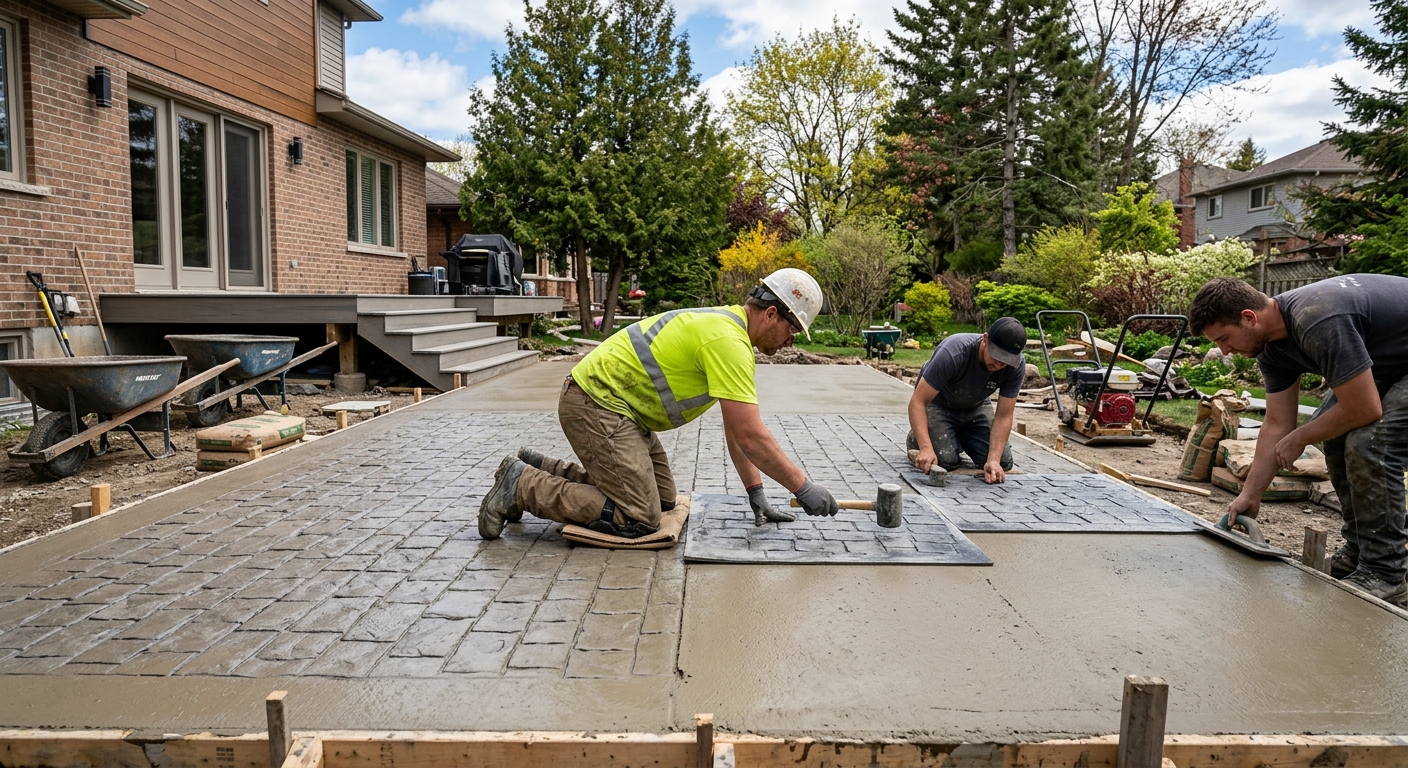
Concrete work options and costs in Lang's Farm
In Lang's Farm, concrete work is one of those “do it once, do it right” trades—because freeze–thaw cycles punish sloppy base prep and weak mix design. With a population of 5,347 (Statistics Canada, 2021 Census), the area draws steady demand from homeowners planning driveways, patios, and walkways around established residential streets and newer builds. Lang’s Farm is also part of the broader Toronto economic region, where crews tend to be busiest during the spring and early summer window as contractors line up exterior pours before temperatures drop. For many local homeowners, the most common projects fall under exterior flatwork (driveways, patios, and walkway slabs) and they’re priced differently depending on how much protection the concrete needs against Ontario winter conditions.
Toronto-region pricing is heavily shaped by frost depth and the need to manage cracking and surface wear. Municipal expectations and Ontario Building Code practice generally mean structural footings extend about 1.2 m (roughly 4 ft) below grade to reduce frost heave and differential movement, which directly raises foundation costs. On exterior slabs, Toronto contractors commonly specify air-entrained concrete, adequate thickness, and well-planned control joints, especially where de-icing salt hits the surface. If you’re in demand areas like the established residential pockets near local lanes and drive-in homes where access for formwork and concrete trucks is straightforward, turnaround is often quicker—yet the actual mix and base spec still drive the final numbers.
Below is a practical comparison of options and typical installed costs in Lang’s Farm so you can align expectations with the specs that matter most in a freeze–thaw climate.
| Application |
Typical Size |
Key Spec |
Finish Option |
Price Range |
| Concrete driveway (standard broom finish) |
10 m x 3 m (approx. 30 m²), 100 mm thick |
Compacted granular base, rebar or wire mesh as specified, control joints |
Broom finish + sealer |
$18,000–$28,000 |
| Exposed aggregate driveway |
10 m x 3 m (approx. 30 m²), 100–125 mm thick |
Air-entrained mix, proper thickness, curing and jointing |
Exposed aggregate (surface wash) |
$22,000–$34,000 |
| Stamped concrete driveway or patio |
Varies; common 6 m x 3 m (approx. 18 m²) or part of driveway |
Air-entrained mix, integral color, forms and base compaction |
Stamp + color + release |
$26,000–$45,000 |
| Plain concrete patio or walkway |
3 m x 4 m (approx. 12 m²), 100 mm thick |
Granular base, correct slope/drainage, joints |
Steel trowel or broomed edge |
$2,000–$5,500 |
| Garage floor (interior slab) |
6 m x 7 m (approx. 42 m²), 100 mm thick |
Vapour barrier where required, thickness spec, jointing |
Plain finish (broomed) or light trowel |
$3,000–$8,500 |
| Foundation footings (structural, below frost) |
Typical detached home footing package |
Concrete to frost depth, rebar cage as per engineer, formwork and excavation |
Structural concrete (no decorative finish) |
$180,000–$300,000 |
Prices are estimates only and vary by project scope, site access and material selection.
What affects the price of concrete work in Lang's Farm
In Lang’s Farm and across the Toronto economic region, two quotes for the “same” concrete job can land 30–50% apart because contractors price the unseen parts: excavation depth, base thickness, how they reinforce, and how they manage Toronto’s freeze–thaw climate. Frost depth and repeated freezing cycles dictate specs for every exterior detail—structural footings generally must extend below the local design frost depth (about 1.2 m in typical Ontario practice) to prevent frost heave and differential movement. For patios, walkways and driveways, exterior slabs are commonly built with air-entrained concrete and enough thickness to handle seasonal movement and traffic loads. When temperatures drop toward 10 °C or below, crews also need cold-weather curing precautions (insulating blankets, sun/heat management, and careful scheduling) that can add real labour and equipment time.
Local Toronto conditions also mean humidity and wet fall/spring weather are common, which influences curing protection and surface longevity. De-icing salt in winter accelerates surface spalling if the concrete mix isn’t air-entrained and the surface isn’t sealed. You’ll often see that difference reflected in the cost band: a standard broom-finished driveway typically lines up with the $18–$28 range per job scope, while more durable or labour-intensive finishes like stamped concrete or exposed aggregate move toward the higher end (and sometimes beyond) because the work includes extra materials, forming time, and surface prep.
Two concrete examples from local-style projects: (1) If a driveway subgrade is soft or poorly drained, contractors must excavate deeper and rebuild a properly compacted granular base—often pushing an otherwise “standard” broom job upward. (2) If a stamped patio requires tighter control joint planning and decorative finishing around drains or steps, the labour time climbs, but you’re paying for fewer weak points that lead to early edge cracking. For many homeowners with older housing stock in established pockets, correcting drainage and base issues can add thousands, but it prevents the “cheap now, replace later” cycle.
| Price Factor |
Why It Matters |
Cost Impact |
| Frost line depth — determines footing depth and form height |
Footings must be below design frost to limit frost heave and movement. |
Higher excavation/formwork can add large scope cost on foundations and footings. |
| Site preparation — excavation, grading, compacted granular base |
Bad base leads to settlement, pumping and cracking during freeze–thaw cycles. |
Can shift a driveway/slab by roughly $3,000–$10,000+ depending on soil removal and rebuild. |
| Reinforcement — rebar or wire mesh requirement |
Reinforcement improves crack control, especially on driveways and thicker slabs. |
Material plus labour often adds several hundred to a few thousand dollars. |
| Mix design — air-entrainment and compressive strength spec |
Air-entrainment helps the concrete survive freeze–thaw and reduces spalling risk. |
Small per-cubic-yard difference, but big durability value; skipping it can save upfront but fail early. |
| Finish type — broom vs. stamped vs. exposed aggregate |
Decorative finishes require extra steps, materials and longer finishing time. |
Stamped/exposed generally pushes you toward the higher end of driveway/patio pricing bands. |
| Pour size and concrete truck access to site |
Access constraints increase labour for pumping, wheelbarrows, or additional staging. |
Restrictive access can add labour costs and time; larger pours may need multiple trucks. |
| Cold-weather curing precautions — heating and blankets |
Proper curing matters when temps fall; it protects strength gain and surface integrity. |
Often adds cost for equipment, coverage materials, and careful scheduling. |
| Control joint pattern and sealing cost |
Jointing manages cracking; sealing protects against moisture and de-icing salts. |
Sealing plus a correct joint plan adds modest cost but can extend service life. |
Permits & regulations in Ontario
In Ontario, the rule of thumb is that structural concrete work needs a building permit, while most simple exterior flatwork typically does not. In practice, concrete that is part of the building’s structure—footings, foundation walls, grade beams, and other load-bearing elements—usually requires a permit and often engineered drawings reviewed by the municipality. That means engineered foundation details, rebar placement, and inspection sign-offs aren’t just paperwork; they’re tied to safety and structural performance in freeze–thaw ground conditions. For concrete flatwork like patios, walkways and driveways, permits are often not required unless the work affects lot grading, impervious surface coverage limits, drainage patterns, or the municipal right-of-way.
For a Lang’s Farm homeowner, verify a contractor in a methodical way before you authorize any excavation. First, ask what permit (if any) is required for your scope and whether the contractor will handle it. Next, confirm the contractor is licensed/registered where applicable for contracting activity and that they carry liability insurance; request a certificate of insurance that names you/your property as applicable (or confirms coverage amount and dates). Then confirm workers coverage—Ontario contractors typically must provide WSIB clearance (or demonstrate equivalent coverage where the law applies). Finally, request references on similar-scale concrete work (driveways/patios and, if applicable, foundation packages) and ask about change orders and protection measures during cold snaps.
Getting concrete right in Lang's Farm's freeze-thaw climate
Concrete failures in Lang’s Farm most often come down to three things: water movement through weak base layers, inadequate air-entrainment, and poor curing protection during temperature swings. Freeze–thaw cycles expand and contract the moisture inside concrete and the soil beneath it; if the slab or footing can’t tolerate that movement, you’ll see cracking, spalling and edge deterioration—especially where de-icing salts are used.
To spec the job correctly, start with base preparation: use a compacted granular sub-base to the correct depth for local soil and frost conditions, with proper grading and drainage so saturated soils don’t expand against the slab. Next, require air-entrained concrete for exterior flatwork; target air content is commonly in the 5–7% range for well-performing exterior mixes. Pair that with a minimum 32 MPa compressive strength so the concrete achieves strength gain appropriate for service demands. Then control cracking with a joint plan: place control joints at spacing that limits random cracking and cut/finish them so they don’t become uncontrolled “stress paths.”
Curing is non-negotiable. In Ontario, minimum 7-day curing under proper conditions is typical for strength development, and it matters even more when you’re pouring near cooler periods—temps dropping toward 10 °C can slow curing. Finally, plan for sealing: a penetrating sealer applied 28 days post-pour helps repel moisture and de-icing salts.
A quick dollar example: if you’re comparing a plain broom-finished patio in the $16–$26 band versus a decorative stamped option, the higher cost can be justified when the contractor also includes stronger base prep, correct joints, and proper sealing. Those durability items don’t always “show” visually, but they’re what keeps a patio from needing premature repairs after a tough winter.
| Spec |
Why It Matters in Lang's Farm |
What to Ask For |
Impact if Skipped |
| Compacted granular base (depth?) |
Frozen/soft subgrade movement transfers into the slab during freeze–thaw. |
Granular base depth, compaction method, and drainage slope details |
Settlement, pumping, and early cracking/edge failures |
| Air-entrained concrete mix (target air %?) |
Air bubbles give room for freeze expansion, reducing spalling risk. |
Air content target (commonly 5–7% for exterior flatwork) |
Surface scaling/spalling and reduced lifespan in Ontario winters |
| Compressive strength (MPa rating) |
Adequate strength helps the slab resist wear and winter stress. |
Minimum 32 MPa compressive strength (or higher if specified) |
Lower durability and increased cracking under loads |
| Control joints (spacing per ACI guidelines) |
Joints manage shrinkage and thermal movement, preventing random cracking. |
Joint layout plan and sawing depth/timing |
Random cracks, water infiltration, and faster deterioration |
| Minimum 7-day curing period |
Curing supports strength gain and surface integrity in changing temps. |
Curing method, curing blankets/plans for cooler nights |
Reduced strength, surface weakness, and scaling |
| Penetrating sealer (when applied after cure) |
Repels moisture and helps protect against de-icing salt effects. |
Sealer type and confirmation of application after cure (often 28 days) |
More moisture uptake, faster staining and surface wear |
How to choose a concrete work contractor in Lang's Farm
Choosing the right contractor is where you protect both your budget and the lifespan of the slab. Start by verifying Ontario requirements and coverage. Ask for their proof of liability insurance (certificate of insurance) and confirm coverage limits are appropriate for your project size. Then verify workers’ compensation coverage—Ontario contractors should provide WSIB/WCB information and clearance where applicable. If you can’t get clear documentation promptly, treat it as a red flag.
Next, get 2–3 itemised written quotes, not just lump sums. You want a breakdown that separates excavation and base prep, concrete supply/mix spec (including air-entrainment), reinforcement, formwork, finishing, jointing, sealing, and disposal. Read the scope carefully for what’s excluded: for example, tree/root removal, haul-away, permit fees (if needed), and any reinstatement (topsoil, sod, or gravel backfill). A quote that doesn’t clearly list these items can hide cost swings later.
Warranty should be spelled out. Ask about workmanship warranty length and what it covers (cracks due to shrinkage vs. issues from inadequate base, for example), plus the product/manufacturer warranty on sealers or decorative systems. Ask whether the warranty is transferable if you sell the property.
For payment, never agree to pay more than about 10–15% upfront. Hold back a portion until completion and final cleanup. Finally, demand a written timeline with start date and completion estimate—Toronto-area pours are scheduled tightly around weather, so clarity protects you from delays.
- Verify insurance: request a certificate of liability coverage before signing.
- Confirm WSIB/WCB coverage and ask for clearance documentation.
- Ask what concrete mix spec they use (air-entrainment for exterior is non-negotiable).
- Require base preparation details: granular depth, grading, compaction and drainage.
- Check whether reinforcement is included (mesh vs. rebar) for your thickness and use.
- Confirm joint plan: spacing, saw-cut timing, and where joints land near edges.
- Ask about curing: how they protect the slab during cooler nights.
- Make sure sealing is included if you’re in an exterior de-icing zone; confirm schedule (after cure).
- Request disposal/haul-away inclusion (spoils, excess soil, and forms).
- Ensure access constraints are addressed (pumping plan if trucks can’t reach).
- Get a written start/completion date and weather-day communication plan.
- Review the contract for change-order triggers and confirm unit pricing for extras.
Concrete red flags in Lang’s Farm: (1) they refuse to discuss air-entrainment for exterior flatwork; (2) they give vague scope like “we’ll level it” without granular base depth and compaction; (3) they don’t include joint layout and curing protection in writing; (4) they ask for large upfront deposits; and (5) they won’t provide insurance/WSIB documentation or references for similar jobs.
Frequently asked questions — concrete work in Lang's Farm
When is the best time to pour concrete in Lang's Farm?
In Lang’s Farm and the broader Toronto region, the “best” time is typically late spring through early fall when daytime temperatures stay favourable and crews can protect curing. Concrete work is strongly influenced by freeze–thaw conditions, so contractors try to schedule exterior pours before temperatures start repeatedly dropping into the colder range. That doesn’t mean winter is impossible, but it does usually require extra cold-weather curing measures (blankets, heating plans, and tighter scheduling). If you’re planning anything exterior—like a driveway or walkway—aim for a period when the contractor can maintain proper curing conditions for at least a week. For budgets, summer timing often helps availability, which can keep quote variability from creeping higher during peak months. If you’re comparing options, a standard driveway quote often lands in the $18–$28 range, while decorative work can be priced higher due to scheduling and finishing steps.
How long does concrete take to cure?
Concrete curing has two time concepts: initial curing and full strength development. For most exterior flatwork in Ontario, you should plan for at least 7 days of proper curing conditions before you treat the surface as reliably set—especially in a freeze–thaw climate where early weakness can lead to scaling or cracking. Full long-term performance continues beyond that, but the minimum curing window is what many contractors use for safe handling and follow-up work like sealing. If colder nights are expected, a contractor should include curing protection in their plan; otherwise, the concrete may not gain strength as intended. Sealing is usually scheduled after adequate cure—often around 28 days—so the sealer can penetrate and repel moisture and salt effectively. If you’re working around winter de-icing, curing and sealing timing matter as much as the decorative finish choice on the day of the pour.
Do I need a permit for concrete work in Ontario?
In Ontario, structural concrete work usually requires a building permit. That includes footings, foundation walls and grade beams—any concrete that supports the structure. Concrete flatwork like patios, walkways and driveways often does not require a permit unless it changes lot grading, affects impervious surface coverage rules, or interacts with municipal right-of-way/drainage requirements. In Lang’s Farm, the safe approach is to ask your contractor what they’re including and whether your specific scope triggers a permit. Before breaking ground, confirm with the local authority whether a permit is required and whether inspections are needed. A reputable contractor should be comfortable answering this clearly in writing. Also verify they carry liability insurance and provide workers’ compensation coverage information (typically WSIB/WCB clearance where applicable). These items are separate from permits, but together they reduce your risk during excavation and pours.
Concrete vs pavers for a patio in Lang's Farm?
Concrete and pavers can both be good in Lang’s Farm, but freeze–thaw performance depends on base and water management more than the material alone. Pavers can be easier to repair section-by-section if a localized area shifts, while concrete offers a continuous surface that—when built with air-entrainment and proper joints—typically performs very well. Concrete patios also tend to be more predictable in labour scheduling once the base is prepared correctly. Pavers, however, require meticulous bedding sand, edge restraint, and drainage—if those aren’t right, you can still get heaving and uneven settlement. Pricing varies: plain concrete patios and walkways commonly fall in the $16–$26 band for the tier, while decorative concrete can be higher due to additional finishing steps. If your priority is low maintenance and fewer surface joints, concrete often makes sense; if you value modular repairs, pavers can be attractive—just ensure the base and drainage plan are tight.
How long does a concrete driveway last?
With good base preparation, proper mix design (including air-entrainment for exterior), and an effective jointing and sealing plan, many concrete driveways can last for decades in Ontario’s freeze–thaw environment. The reality is that Toronto-region conditions—wet springs, winter salt, and repeated freeze–thaw—treat weaknesses harshly. If a contractor skips granular base depth/compaction, uses an exterior mix without air-entrainment, or fails to plan control joints, you’ll often see cracking or spalling much earlier. Sealing applied after the concrete cures (commonly around 28 days) helps repel moisture and salt, which supports longer service life. In terms of budgeting, a standard broom-finished driveway often lands within the $18–$28 range depending on size and access; paying for proper specs inside that band is what drives longevity. If a quote is low but doesn’t clearly include base prep, joints, and curing/sealing, you’re more likely to face premature repairs.
What is air-entrained concrete and why does it matter here?
Air-entrained concrete is mixed with tiny, evenly distributed air bubbles that give water inside the concrete room to expand when temperatures freeze. In Lang’s Farm and the Toronto area, freeze–thaw cycles and winter de-icing salts can quickly damage concrete surfaces if the mix isn’t designed for exterior exposure. That’s why Ontario contractors commonly specify air-entrainment for driveways, patios, and walkways. A typical target for exterior flatwork is in the 5–7% air range, paired with adequate thickness, control joints, and proper curing. The difference shows up as improved durability—less scaling and spalling over time—so your driveway or patio keeps its surface quality through many winters. When you compare quotes in the $18–$28 driveway band or the $16–$26 patio band, ask each contractor what air-entrainment and curing plan they use. If it isn’t clearly addressed, you’re taking on avoidable risk in Ontario’s winter climate.