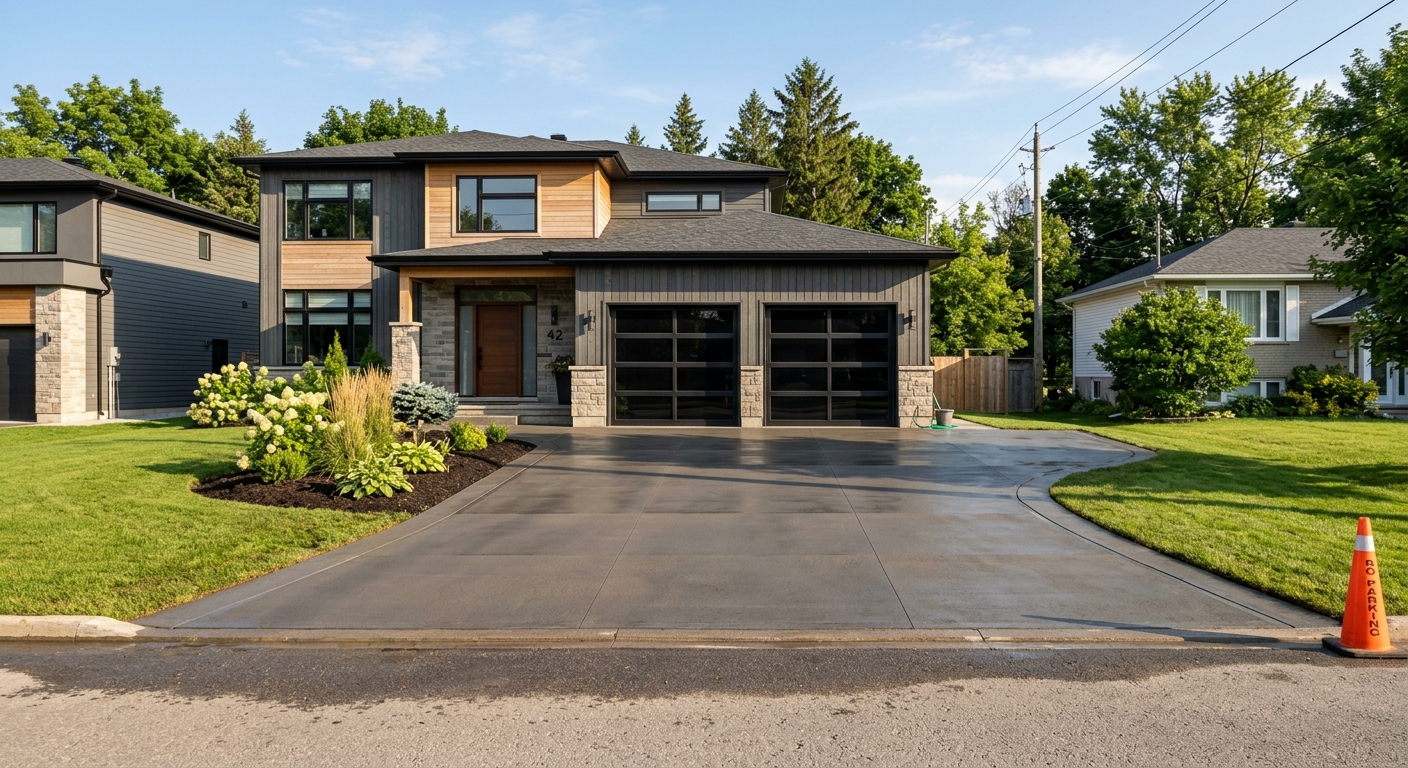
Concrete work options and costs in Sioux Lookout
Sioux Lookout is a northern Ontario community where most homeowners rely on solid concrete flatwork—driveways, patios and walkways—to handle deep frost and the repeated freeze–thaw cycles that show up year after year. With 67.9% of dwellings being single-detached homes and about 66.7% of households owning their home (Statistics Canada, 2021 Census), there’s steady demand for exterior concrete upgrades that improve durability and curb appeal. Roughly half of the local housing stock is older (49.6% built before 1981), so many projects are “replacement-and-repair” jobs where existing slabs are removed and reworked to correct drainage and base issues.
In the Northwest, concrete pricing is influenced by longer, colder shoulder seasons and the logistics of getting materials and crews on-site during a narrow pour window. Frost penetration can approach or exceed 5–6 ft in parts of the region, so exterior slabs and structural footings must be built with the right depth and granular base to reduce the risk of heave and cracking. Contractors also use air-entrained concrete mixes for exterior work because freeze–thaw scaling is a common failure mode when the air content and finishing timing are off. In areas around Lakeside and the downtown core where infill and upgrades are frequent, you’ll often see quicker turnover for driveway and sidewalk work.
Below are typical sizes and the most common finish options you can expect when comparing quotes from local crews—then we’ll break down what drives the final numbers.
| Application |
Typical Size |
Key Spec |
Finish Option |
Price Range |
| Concrete driveway (standard broom finish) |
24 ft × 10 ft (240 sq ft) |
Air-entrained exterior mix; compacted granular base |
Broom finish + control joints |
$3,360 – $5,280 |
| Exposed aggregate driveway |
24 ft × 10 ft (240 sq ft) |
Air-entrained mix; proper curing to support wash |
Exposed aggregate with sealer |
$4,320 – $6,720 |
| Stamped concrete driveway or patio |
20 ft × 12 ft (240 sq ft) |
Air-entrained exterior mix; integral color; release agent |
Stamp patterns + light broom/textured finish |
$5,280 – $7,680 |
| Plain concrete patio or walkway |
12 ft × 16 ft (192 sq ft) |
Air-entrained mix; drainage slope |
Light broom + control joints |
$2,304 – $3,840 |
| Garage floor (interior slab) |
22 ft × 22 ft (484 sq ft) |
Vapour barrier; reinforced slab |
Plain trowel/float with joints |
$3,400 – $5,450 |
| Foundation footings (structural, below frost) |
Per linear foot (typical small home) |
Excavate to frost depth; rebar; inspected placement |
Structural concrete with proper consolidation |
$180 – $260 |
Prices are estimates only and vary by project scope, site access and material selection.
What affects the price of concrete work in Sioux Lookout
In Sioux Lookout and across Northwestern Ontario, you can see the same basic concrete job come in with a 30–50% difference between quotes. The big reasons are (1) the frost-protection depth and base build-up required for long-term performance and (2) how much time crews spend on prep, reinforcement, and curing in cold or wet conditions. In practice, two contractors can quote the “same” driveway square footage, but one may include better granular base and correct reinforcement while the other assumes easier soil conditions—those choices move pricing quickly.
Frost line depth and freeze–thaw cycles dictate nearly every spec in this region. Footings must extend below design frost depth to prevent frost heave, and exterior slabs need air-entrained concrete mixes to survive repeated expansion and contraction. Cold weather also compresses the pour season, which affects crew availability and may require heating or insulated blankets to reach reliable strength gain—both add cost. Finally, de-icing salts accelerate surface deterioration if you don’t seal and properly finish to limit scaling.
Concrete choices also change the “final look” price. A standard broom-finished driveway often lands in the $14–$22 per sq ft band, while stamped & decorative concrete typically runs $20–$32 per sq ft because of integral color, release agents, and extra labour for form/tamp/release/finishing. A real example: if you swap from a plain patio in the $12–$20 per sq ft range to stamped concrete, the upgrade can be worth it when you want a longer-lasting finish and are willing to pay for correct curing—otherwise decorative surfaces can show premature wear in salty, wet winter conditions.
Local housing age matters too. For homes built before 1981 (49.6% locally, Statistics Canada, 2021 Census), older drainage patterns often mean extra excavation and base rebuild to get the slope right and keep water from undermining the slab—usually adding labour and material beyond “straight replacement.”
| Price Factor |
Why It Matters |
Cost Impact |
| Frost line depth — determines footing depth and form height |
Deeper frost protection reduces heave and settlement over time. |
Higher excavation and formwork can add material/labour; typically among the biggest cost drivers for foundations. |
| Site preparation — excavation, grading, compacted granular base |
Proper base and drainage prevent pumping, voids, and slab cracking. |
More granular, hauling, and compaction time can materially increase the quote. |
| Reinforcement — rebar or wire mesh requirement |
Reinforcement helps control cracking and improves load resistance. |
Additional steel, cutting, chairs, and labour; often increases cost but can reduce future repairs. |
| Mix design — air-entrainment and compressive strength spec |
Air entrainment is key for freeze–thaw scaling resistance. |
Upgraded mix and spec can add dollars per yard and affect schedule readiness. |
| Finish type — broom vs. stamped vs. exposed aggregate |
Higher-end finishes require more steps and tighter timing. |
Stamped/exposed aggregate generally costs more per sq ft than plain finishes. |
| Pour size and concrete truck access to site |
Smaller pours, curb lines, or limited access increase labour and pumping needs. |
Can add equipment time or require alternate placement methods. |
| Cold-weather curing precautions — heating and blankets |
Cold slows strength gain and can increase early-age cracking. |
Heated enclosure/blankets can raise costs, especially shoulder season. |
| Control joint pattern and sealing cost |
Correct jointing manages shrinkage; sealing reduces salt-driven surface damage. |
Premium comes from saw-cut planning and later sealer application. |
Permits & regulations in Ontario
In Ontario, structural concrete work typically requires a building permit. That generally includes concrete that forms part of the structural system—such as footings, foundation walls, and grade beams. In many cases, municipalities will also expect engineered drawings for structural concrete components (especially where there are changes to loads or foundation geometry). For concrete flatwork like patios, walkways and driveways, permits are usually not required on their own, unless the work affects lot grading, drainage, stormwater management, impervious surface coverage limits, or a municipal right-of-way. Because Sioux Lookout can have site-specific grading and drainage considerations, it’s smart to confirm requirements with the local authority before you remove topsoil or break asphalt/sidewalk.
For contractor compliance, start with the basics: request evidence of liability insurance and WSIB/WCB coverage (coverage requirements vary by coverage class, but reputable contractors can provide the clearance documentation you need). Step-by-step, homeowners should: (1) ask the contractor for their certificate of insurance (COI) and verify the coverage is active and matches your project address; (2) request proof of WSIB/WCB clearance; (3) confirm the contractor is properly licensed/registered for the work they’re doing in Ontario; and (4) ask for references on similar driveway/foundation projects in northern conditions. If the contractor can’t provide these documents promptly, treat it as a red flag and move on.
Getting concrete right in Sioux Lookout's freeze-thaw climate
The biggest concrete failures in Sioux Lookout aren’t “mystery issues”—they’re usually predictable: inadequate air entrainment, poor drainage/base preparation, or curing that’s too cold too soon. With freeze–thaw cycles and de-icing salt exposure, exterior surfaces can spall (flake/scale) if the air content is wrong or the mix isn’t properly consolidated. A correct spec starts at the bottom: (1) base preparation should use well-compacted granular to the right depth for local soils and to support the slab without voids; (2) the mix design should be air-entrained with a typical target of 5–7% air for exterior flatwork, plus a minimum 32 MPa compressive strength; (3) control joints must be planned so shrinkage cracks form where they’re meant to, not randomly; (4) curing should be at least 7 days under suitable conditions—cold weather delays strength gain, so blankets or heated enclosures may be necessary; and (5) sealing with a penetrating sealer is typically applied after the cure (often around 28 days) to help repel de-icing salt and moisture.
To avoid spalling, ask directly whether they’ll use air-entrained concrete and how they will protect curing from freezing. You can also justify cost differences with real outcomes. For example, a standard broom-finished driveway may be in the $14–$22 per sq ft band, but if you’re paying for proper base rebuild and cold-weather curing precautions, that increased upfront cost is often what prevents a repeat pour within a few years—especially on older lots where drainage wasn’t originally designed for modern freeze-thaw stress.
Use these questions to compare bids fairly: the “cheapest” quote is often the one with less granular, fewer protection measures, or a finish plan that doesn’t match Sioux Lookout’s winter conditions.
| Spec |
Why It Matters in Sioux Lookout |
What to Ask For |
Impact if Skipped |
| Compacted granular base (depth?) |
Sioux Lookout requires stable support to resist heave during deep freeze and thaw. |
Ask for granular type, lift thickness, compaction method, and target depth below finished grade. |
Void formation leads to uneven settlement, cracking, and early slab failure. |
| Air-entrained concrete mix (target air %?) |
Freeze–thaw scaling resistance depends on correct air entrainment in cold climates. |
Ask for target air content (commonly 5–7% for exterior flatwork) and confirmation it’s air-entrained. |
Spalling and scaling, especially where de-icing salts land on the surface. |
| Compressive strength (MPa rating) |
Strength gain affects durability and resistance to early-age damage. |
Ask for minimum 32 MPa (and how cold weather will protect curing to reach strength). |
Surface damage, increased cracking, and reduced long-term performance. |
| Control joints (spacing per ACI guidelines) |
Jointing controls where shrinkage cracks appear under freeze–thaw movement. |
Ask for joint spacing and timing of saw-cut (on time to manage shrinkage). |
Random cracking and wider deterioration paths through moisture exposure. |
| Minimum 7-day curing period |
Cold conditions require more attention to early-age curing for strength development. |
Ask how they’ll keep concrete above freezing and protected during curing. |
Weak early structure and higher likelihood of surface defects. |
| Penetrating sealer (when applied after cure) |
Salt and moisture cycling accelerate surface wear in northern Ontario. |
Ask when sealer will be applied (often around 28 days post-pour) and which product they’ll use. |
Faster scaling and water ingress that accelerates freeze–thaw damage. |
How to choose a concrete work contractor in Sioux Lookout
Choosing the right concrete contractor in Sioux Lookout is about verifying compliance, comparing quotes on the same scope, and making sure the crew understands northern freeze–thaw performance. In Ontario, start by confirming the contractor carries current liability insurance and provides proof of WSIB/WCB coverage or clearance. How to check: (1) ask for a current certificate of insurance (COI) listing the appropriate policy dates and coverage; (2) request WSIB/WCB clearance documentation; and (3) verify the contractor’s Ontario licensing/registration for the specific concrete work they’re proposing. You’re looking for documents that match your project timeline and address—not generic certificates that don’t align with your job.
Get 2–3 written, itemised quotes instead of one lump sum. A solid quote breaks out labour and materials (excavation/granular, reinforcement, concrete supply, finishing/sealing, saw-cutting, disposal, and any heating/blankets). Carefully review exclusions: Is the permit pull included if it’s required for the structural portion? Is removal and disposal of old concrete included? Are forms and reinforcement specified, or “allowance” items?
Warranty matters too. Ask for a workmanship warranty length and what it covers (and doesn’t), plus whether the product/manufacturer warranty is separate and transferable. For payment, never pay more than 10–15% upfront. Use a holdback (often until finish work and any required sealing/jointing are completed). Finally, insist on a start date and completion estimate in writing—cold-weather curing and short pour windows can affect scheduling.
- Ask whether they’ll use air-entrained concrete for exterior work.
- Confirm they’ll build a compacted granular base to a specified depth and compaction standard.
- Require joint spacing and saw-cut timing details in the scope.
- Get sealer included (and confirm when it will be applied after cure).
- Verify liability insurance is active for your project dates.
- Provide WSIB/WCB clearance proof before work starts.
- Request an itemised labour/materials quote (no vague “allowances”).
- Clarify disposal: hauling away old concrete and spoils included or extra?
- Check that truck access/pump requirements are reviewed at the site walk.
- Ask how they handle cold snaps (blankets/heating, temperature monitoring).
- Confirm the warranty terms for workmanship and any product warranties.
- Use staged payments with a meaningful holdback until completion and cleanup.
Concrete contractor red flags in Sioux Lookout: (1) they refuse to discuss air entrainment and curing methods, (2) they quote “one price” without explaining base preparation and reinforcement, (3) they ask for large upfront payments, (4) their quote excludes disposal or sealing without telling you, and (5) they can’t provide insurance/WSIB documentation or recent references for similar northern conditions.
Frequently asked questions — concrete work in Sioux Lookout
How long does concrete take to cure?
In Sioux Lookout, cure time depends on temperature and how the contractor protects the pour. For typical slabs and flatwork, you should plan on at least 7 days of curing before treating the surface as “ready for normal use,” with full durability improving over longer time. If it’s a shoulder-season pour, contractors may use curing blankets or heated enclosures to keep the concrete from freezing while it builds strength. Even after the slab is walkable, surface performance keeps improving as moisture and hydration progress. For exterior durability—especially with de-icing salts—sealers and long-term protection are usually scheduled after the cure period (commonly around 28 days). If a contractor pressures you to open the driveway quickly in cold weather, that’s a risk factor.
Do I need a permit for concrete work in Ontario?
In Ontario, structural concrete work—like footings, foundation walls, and grade beams—usually needs a building permit and often engineered drawings reviewed through the municipal process. For concrete flatwork such as patios, walkways, and driveways, permits are typically not required by default, unless the work changes lot grading, drainage, or affects impervious surface coverage rules, or impacts a municipal right-of-way. In Sioux Lookout, the safest approach is to confirm with the local authority before breaking ground, particularly for projects that change elevations or direct runoff. Also, make sure your contractor provides proof of liability insurance and WSIB/WCB coverage. If your quote is for a driveway in the $14–$22 per sq ft band, ensure it still clarifies what’s included (removal, base prep, and any drainage corrections) rather than assuming a permit is “never” needed.
Concrete vs pavers for a patio in Sioux Lookout?
Both can work, but in Sioux Lookout’s freeze–thaw climate concrete often has an advantage for long-term slab continuity when joints and base prep are done properly. Concrete patios are usually built with a compacted granular base and correct slope, and air-entrained mix reduces freeze–thaw scaling risk. Pavers can perform well too, but they rely on consistent bedding and drainage; if water gets trapped beneath, heaving can occur and individual units may shift. Pricing depends on finish choice: plain concrete patios often fall in the $12–$20 per sq ft band, while decorative options can move toward $20–$32 per sq ft. If you want a quick comparison, ask contractors to compare: (1) base thickness and compaction, (2) drainage detailing, (3) jointing plan for concrete, or edging/locking for pavers, and (4) what sealer or protective steps are included for the concrete.
How long does a concrete driveway last?
A well-built concrete driveway in Ontario commonly lasts decades, but the real answer depends on how it’s constructed for freeze–thaw and salt exposure. In Sioux Lookout, the drivers are base stability, air-entrained concrete, correct joint spacing, and proper curing. When the base is compacted to the right depth and the slab is designed to manage movement, it can handle seasonal expansion without excessive cracking. If joints are poorly planned, the slab tends to crack randomly; if air entrainment is missing, scaling and spalling can appear sooner, especially in winter where de-icing salt sits on the surface. If you’re comparing quotes, a standard driveway in the $14–$22 per sq ft range can be a durable option, but the cheaper price shouldn’t come from skipping base rebuild, reinforcement, or curing protections. Ask what’s included and whether sealer is planned after the cure.
What is air-entrained concrete and why does it matter here?
Air-entrained concrete contains tiny, evenly distributed air bubbles intentionally created during mixing. In Sioux Lookout, those bubbles give water a place to expand when it freezes, which helps prevent internal pressure and reduces freeze–thaw scaling and spalling on exterior surfaces. This is one of the most important specs for patios, walkways, driveways, and any portion exposed to de-icing salts. Contractors typically target about 5–7% air content for exterior flatwork, and they’ll pair that with minimum compressive strength (often 32 MPa) and good finishing and curing practices. If air entrainment is left out, the surface can deteriorate faster with repeated cold cycles. When you review bids in Ontario, don’t just look at the per-sq-ft number—ask how they’ll ensure the mix is air-entrained and how they’ll protect curing during cold weather.
How do I prepare the base for a concrete slab?
Base preparation is where most “future problems” begin, so it’s worth being specific in your quote. For Sioux Lookout projects, the contractor should excavate to the required depth, then place a well-compacted granular sub-base (often in lifts) and ensure drainage and slope are correct before any concrete is poured. The goal is a stable foundation with minimal voids so the slab doesn’t settle unevenly during freeze–thaw cycles. You should ask for: granular type and lift thickness, compaction expectations, confirmation of frost protection depth, and whether reinforcement will be installed on chairs/tickets at the correct elevation. If a contractor offers a lower price for a patio or driveway, ask whether that saving comes from reducing granular/base depth or reinforcement—those are common places where performance gets compromised. For reference, plain patios often fall within the $12–$20 per sq ft band depending on scope, but better base work can be what keeps the slab lasting.