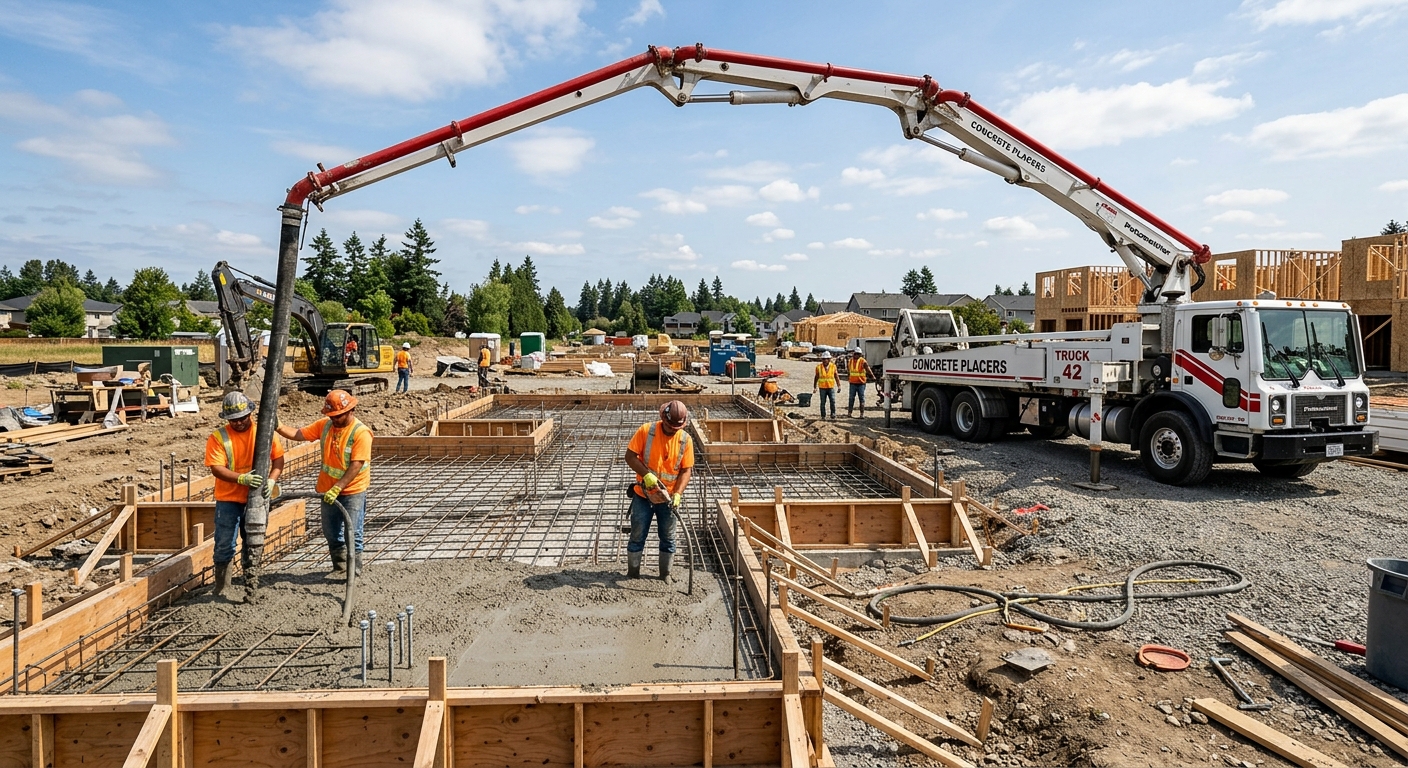
Concrete work options and costs in Beeton
Concrete is a common choice in Beeton for driveways, patios, walkways and garage floors, especially for the many homeowners in the area who want a surface that looks clean and handles winter traffic. Beeton’s housing stock is fairly small-town in scale—about 4,151 people live in the community (Statistics Canada, 2021 Census)—and demand is steady for contractor crews that can work efficiently through the short, reliable pour window in the Toronto area. In the GTA, we see a lot of concrete work tied to single-family properties and low-rise neighbourhoods, with flatwork often getting renewed as older driveways and steps start cracking, staining or spalling after repeated freeze–thaw.
Toronto’s climate drives the specs that impact cost. Exterior concrete needs air-entrained mixes, proper thickness, and well-planned control joints to manage cracking, and all exterior flatwork must be set on well-compacted granular base so saturated soils don’t expand and contract against the slab every winter. Municipal expectations also push structural work deeper: most structural footings extend at least about 1.2 m below grade, which is below the regional frost depth, to limit frost heave and differential movement. That deeper excavation and extra rebar/formwork is why foundation footings price differently than patios or driveways.
In Beeton, trade demand is especially noticeable around the town’s busier residential corridor near Simcoe County Road 9 and the broader area residents use for commuting and local services—lots of homeowners are refreshing entry walkways, front steps and driveways before weather turns. Use the table below to compare common options and realistic budget ranges for your project.
| Application |
Typical Size |
Key Spec |
Finish Option |
Price Range |
| Concrete driveway (standard broom finish) |
10 ft x 20 ft (200 sq ft) |
Air-entrained exterior mix, compacted granular base |
Broomed surface with simple jointing |
$3,600 – $5,600 |
| Exposed aggregate driveway |
10 ft x 20 ft (200 sq ft) |
Air-entrained exterior mix, proper cure and wash |
Exposed stone finish with sealed topcoat |
$4,200 – $6,400 |
| Stamped concrete driveway or patio |
10 ft x 20 ft (200 sq ft) |
Air-entrained exterior mix, adequate thickness and joints |
Stamp pattern with release agent and colouring |
$5,000 – $8,000 |
| Plain concrete patio or walkway |
12 ft x 16 ft (192 sq ft) or 4 ft x 20 ft (80 sq ft) |
Well-compacted base, air-entrained exterior mix |
Broom finish for slip resistance |
$1,300 – $5,000 |
| Garage floor (interior slab) |
20 ft x 22 ft (440 sq ft) |
Vapour barrier (as needed), proper thickness |
Light trowel or broom finish |
$6,000 – $9,500 |
| Foundation footings (structural, below frost) |
Typical new build footing lineal ft |
Excavation to design depth, rebar, forms, below-frost bearing |
Structural concrete with engineered layout |
$180 – $300 |
Prices are estimates only and vary by project scope, site access and material selection.
What affects the price of concrete work in Beeton
If you get two quotes for the “same” concrete job in the Toronto economic region, it’s common to see a 30–50% spread. The difference is usually in the details: how deep the excavation goes, how well the base is prepared, whether the mix is air-entrained for freeze–thaw durability, what reinforcement is installed, and how the contractor manages curing when temperatures drop toward 10 °C or below. Those choices are not cosmetic—on exterior flatwork they’re what determine whether you’ll see early cracking, scaling or spalling after your first winters.
Every exterior concrete job is shaped by frost depth and freeze–thaw cycles. In Ontario, structural footings generally must extend below the design frost depth (often in the 1.5–2.4 m range depending on conditions), and exterior slabs need air-entrained concrete so the paste can better handle expansion and contraction. Toronto-area crews also concentrate pours in the warmer months to keep curing consistent, and they may add cold-weather protection (insulating blankets and sometimes heat) when conditions shift. Add de-icing salt, and sealing becomes a practical durability line item rather than an optional upgrade.
Concrete options also change labour and material intensity. For example, moving from a plain broom-finish driveway (often budgeted around the $18–$28 per sq ft band locally) to stamped concrete (the $24–$40 band) can cost more because of formwork, stamp labour and careful joint planning. Meanwhile, a foundation footing line item typically runs in the $180–$300 per unit band because excavation and steel/forms are the heavy costs—not just “more concrete.” In Beeton, older properties with established grades, mature trees and limited equipment access can add excavation/disposal and therefore increase your overall budget even if the slab size stays the same.
| Price Factor |
Why It Matters |
Cost Impact |
| Frost line depth — determines footing depth and form height |
Deeper footings reduce frost heave risk and differential movement |
Higher excavation and more rebar/forms; can add substantial cost on footings |
| Site preparation — excavation, grading, compacted granular base |
Proper base prevents pumping and slab settlement |
More base material and trucking; often the biggest difference between quotes |
| Reinforcement — rebar or wire mesh requirement |
Helps control cracking and supports loads |
Steel weight, chair supports and labour can increase the price |
| Mix design — air-entrainment and compressive strength spec |
Air-entrainment improves freeze–thaw durability on exterior work |
Specialty mix and batching accuracy; typically modest per-sq-ft increase with major benefits |
| Finish type — broom vs. stamped vs. exposed aggregate |
Complex finishes require extra labour and more careful curing timing |
Stamped/exposed can shift you from $18–$28 into the $24–$40 bands |
| Pour size and concrete truck access to site |
Smaller access can mean more labour or pump/short truck scheduling |
Extra crew time, pump fees, or multiple loads |
| Cold-weather curing precautions — heating and blankets |
Maintains strength gain when temperatures drop |
Adds materials and time; can matter near shoulder seasons |
| Control joint pattern and sealing cost |
Controls random cracking and protects surface from de-icing salt |
Sealer and tooling time; often small compared with repair costs |
Permits & regulations in Ontario
In Ontario, structural concrete work—such as concrete footings, foundation walls, and grade beams—typically requires a building permit, and it’s very common for the municipality to review engineered drawings for structural details. If you’re building or significantly altering a foundation, expect permit requirements to be part of the process well before the first shovel of concrete goes in. Concrete flatwork (patios, walkways and driveways) usually does not require a permit by itself, but it can become a permit or approval issue when it affects lot grading, drainage, or impervious surface coverage limits, or when work is close to municipal right-of-way requirements. Always confirm with the local authority before breaking ground so you don’t get hit with stop-work or rework later.
For contractor readiness in Beeton, verify three things before any work begins: (1) the proper permit/municipal clearance handled for structural scope (if required), (2) liability insurance, and (3) WSIB/WCB coverage (or the applicable worker coverage status). A reputable contractor should provide documentation early without hesitation.
To verify Ontario licence status, use the contractor’s business information and confirm they’re in good standing through the appropriate Ontario consumer protection/contractor registry where applicable. For insurance, request a certificate of insurance showing liability limits and the effective dates. For coverage, ask for WSIB/WCB clearance documentation. Then cross-check that these dates cover the entire planned work window and any subcontractors scheduled to be on site.
Getting concrete right in Beeton's freeze-thaw climate
Concrete failures in Beeton almost always trace back to the same few weak links: insufficient base preparation, improper mix design (especially air-entrainment), weak curing practices, and joint/sealing plans that don’t match our freeze–thaw routine. Exterior flatwork is exposed to wet fall and spring conditions, and then winter freezing cycles. If the concrete is not air-entrained or if curing is rushed when temperatures drop toward 10 °C or lower, the surface can start scaling and spalling—often visible as rough, flaky patches—within a few seasons.
To spec the job correctly in Beeton, start with base preparation: excavate to the planned depth and install a compacted granular sub-base so drainage is controlled and the slab doesn’t “float” on unstable soils. For the mix, request an air-entrained concrete mix with air content typically in the 5–7% range for exterior flatwork, and a minimum 32 MPa compressive strength (or the project’s engineered requirement). Add control joints at a spacing that limits random cracking and plan the joint pattern so cracks occur in predictable locations, not across walkways and driveway lanes. For curing, plan for minimum 7 days under proper conditions; when cold weather threatens, ask how they’ll protect the pour with heating/blankets so strength gain is consistent. Finally, for durability against de-icing salt, a penetrating sealer is typically applied after cure—commonly around 28 days—so water and salts don’t penetrate as easily.
Here’s a practical dollar example: upgrading from plain broom-finish to stamped concrete can move you from the $18–$28 band toward the $24–$40 band, which is justified because finishing requires additional labour and more careful joint/curing sequencing. But you shouldn’t sacrifice air-entrainment or base prep to “save” money on the finish—those are the real freeze–thaw protection layers.
| Spec |
Why It Matters in Beeton |
What to Ask For |
Impact if Skipped |
| Compacted granular base (depth?) |
Stable support prevents settlement and cracking during freeze–thaw |
Specify excavated depth, granular type and compacted thickness; confirm compaction testing method |
Cracking, rocking slab, drainage issues and early failure |
| Air-entrained concrete mix (target air %?) |
Air bubbles relieve freeze–thaw pressure in exterior concrete |
Request 5–7% air content for exterior flatwork and confirm with mix tickets |
Spalling/scaling, surface pop-outs and rapid deterioration |
| Compressive strength (MPa rating) |
Ensures strength gain for load and durability in Ontario seasons |
Minimum 32 MPa (or engineered requirement for the scope) |
Weak concrete, surface damage under traffic and handling |
| Control joints (spacing per ACI guidelines) |
Controls crack locations to reduce random cracking |
Ask for joint spacing and cut timing plan so joints form before random cracking |
Uncontrolled cracks, water intrusion and faster deterioration |
| Minimum 7-day curing period |
Strength develops reliably for exterior performance |
Confirm cure protection plan if temps drop; ask how curing will be monitored |
Surface weakness, increased shrinkage cracking and durability loss |
| Penetrating sealer (when applied after cure) |
Repels water and de-icing salts common in Ontario winters |
Plan for application after cure (commonly around 28 days) and ask for product details |
Higher salt intrusion, staining and accelerated scaling in future winters |
How to choose a concrete work contractor in Beeton
Picking the right concrete contractor in Beeton is less about the lowest number on page one and more about who will deliver the specs that survive freeze–thaw. Start with Ontario coverage checks. Ask for a current certificate of liability insurance (showing general liability limits) and request documentation for WSIB/WCB worker coverage for anyone who will be on site. Then confirm they can demonstrate relevant experience for your exact scope—driveways and slabs are different from structural footings, and exterior finishes need a crew that understands timing, curing and jointing.
Next, get 2–3 itemised written quotes instead of lump sums. You want a breakdown that separates excavation and disposal, granular base and compaction, reinforcement, concrete supply (and mix design), forms, finishing, saw cutting/control joints, and sealing (if included). Verify whether permits are included for structural work and whether the contractor handles scheduling inspections. Confirm what’s excluded: removals, snow clearing access, hauling, regrading, or landscape repairs can become “surprise” costs.
For warranty, ask for both workmanship coverage and any manufacturer/product warranty. Clarify the length, what it covers (cracks? scaling? surface delamination?), and whether the warranty transfers if you sell your home. For payment, use a schedule where you never pay more than 10–15% upfront and keep a holdback until forms are removed, joints are cut, and the surface cure/protection requirements are met. Finally, demand a written start date and completion estimate that matches the GTA schedule—concrete work quality depends on weather windows, especially when night temperatures move toward 10 °C.
- Provide certificate of liability insurance with active dates covering your project.
- Provide WSIB/WCB clearance/status documentation for covered workers.
- Show experience with similar exterior flatwork in the Toronto region.
- Use itemised quotes: base prep, reinforcement, concrete supply, finishing, joints, sealing.
- Confirm mix design includes air-entrainment for exterior work (5–7% target).
- Confirm footing depth and engineered requirements for any structural scope.
- Ask for a control joint plan (spacing and timing) and who is responsible for saw cutting.
- Ask what curing protection they provide if temperatures drop.
- Confirm disposal included for removed concrete/soil or identify it separately.
- Check whether sealing is included and when it will be applied after cure.
- Verify warranty length, exclusions, and whether it transfers to future homeowners.
- Keep holdback until final cleanup, curing/sealer steps and punch-list items are done.
Red flags in Beeton include: “we always pour anytime” without cold-weather curing protection, no written breakdown (just a one-line lump sum), refusing to show mix ticket/method details, no insurance/WSIB paperwork, and warranties that cover only “material defects” while labour is excluded.
Frequently asked questions — concrete work in Beeton
Concrete vs pavers for a patio in Beeton?
In Beeton, both concrete and pavers can work well, but the decision usually comes down to maintenance and how your patio is detailed for drainage. Concrete patios can be more affordable per square foot than highly finished stone systems, and a properly built concrete slab with air-entrained mix and control joints is designed to handle freeze–thaw cycles. For many Beeton homeowners, plain concrete patios land around the $16–$26 band, while decorative options like stamped concrete are typically higher within the $24–$40 range. Pavers can offer easier spot repairs if individual units shift, but they still need a well-compacted base and correct bedding thickness so water doesn’t undermine the surface. If you expect a lot of de-icing salt or you have marginal drainage, concrete with the right base prep and sealing is often the simpler long-term choice—just confirm joints and sealing are included in the quote.
How long does a concrete driveway last?
A well-built concrete driveway in Ontario commonly lasts 20–30 years, and sometimes longer, but the “how” matters more than the material name. In Beeton’s freeze–thaw climate, failures usually begin with inadequate air-entrainment, weak base preparation, or poor joint planning—then water and de-icing salts work into cracks and accelerate spalling. A standard broom-finish driveway can fit budgets often referenced around the $18–$28 band, but cutting corners to save on base depth, drainage, or mix design is what shortens lifespan. If joints are cut at the right time, the slab is properly cured (minimum 7 days under good conditions), and a penetrating sealer is applied after cure (often around 28 days), you’re far more likely to get the service life you paid for. If you’re comparing quotes, ask each contractor what exactly is included: granular base depth, air-entrained mix confirmation, reinforcement, and joint/sealing plan.
What is air-entrained concrete and why does it matter here?
Air-entrained concrete is a mix designed with tiny air bubbles that help the concrete withstand freeze–thaw cycles by giving expansion pressure somewhere to go. In the Beeton and wider Toronto area, exterior concrete is exposed to wet conditions in fall/spring and repeated winter freezing, so air-entrainment is one of the most important durability specs for preventing surface scaling and spalling. Many homeowners only think about appearance—colour or broom finish—but air-entrainment is about performance. A contractor should be able to confirm the air content target (typically 5–7% for exterior flatwork) and provide mix ticket information. It’s also tied to correct curing and temperature protection when pours are near colder periods. If a quote is much cheaper than others, and the contractor can’t clearly explain the mix design or air-entrainment, that cost difference is often hidden risk you’ll pay for later with repairs.
How do I prepare the base for a concrete slab?
Proper base prep is the foundation of a long-lasting slab in Beeton. Start with excavation to the planned depth, then install a compacted granular sub-base designed for drainage and stability. The granular layer should be compacted in lifts to reach the required density (a good contractor will explain their compaction method and what they’re targeting). You also want to address existing soil that may be soft, saturated or near-surface—Toronto-region freeze–thaw can magnify small drainage problems. A robust base supports the concrete so it doesn’t rock or settle unevenly. For exterior work, the aim is to keep water from being trapped under the slab and to reduce frost heave potential. When comparing quotes, ask for granular type, compacted thickness/depth, and whether disposal/haul-away is included if they’re removing unsuitable material. For interior garage floors, base prep still matters, but vapour barrier decisions and thickness requirements often differ from exterior slabs.
How do I compare concrete quotes?
To compare concrete quotes in Beeton, insist on like-for-like scope and specifications. First, request itemised quotes that separate excavation and disposal, granular base and compaction, reinforcement, concrete supply (including mix design), forms, finishing, saw cutting/control joints, and sealing if included. A huge reason quotes vary across the Toronto economic region is that one contractor may include air-entrained exterior mix and proper base preparation, while another may not clearly specify them. Second, compare finish type: a standard broom driveway often sits near the $18–$28 band, while stamped concrete typically falls into the $24–$40 band because it involves more labour and timing-critical finishing. Third, ask about curing protection if the weather turns cold and how long they will protect the pour. Finally, verify warranty terms, payment schedule, and whether permits are included where required. If one quote is significantly lower without explaining the spec differences, treat that as a warning sign rather than a bargain.
Can concrete be poured in cold weather in Beeton?
Yes, concrete can be poured in cold weather in Beeton, but it should be done with the right cold-weather procedures, not “business as usual.” As temperatures approach and drop toward around 10 °C, curing slows and the risk of poor surface performance increases if contractors don’t add protection. A competent contractor will use cold-weather curing precautions such as insulating blankets and/or temporary heating, and they’ll protect the pour long enough to achieve proper strength gain. They should also plan the schedule so finishing and curing steps happen within the correct temperature window for the mix. Even with proper measures, winter work can still cost more due to extra labour, materials and slower timelines, which is why many GTA crews concentrate exterior pours in warmer months. When comparing quotes, ask what they’ll do if night temps fall, how they’ll monitor curing conditions, and whether they’ll adjust your build to control joints and curing requirements.