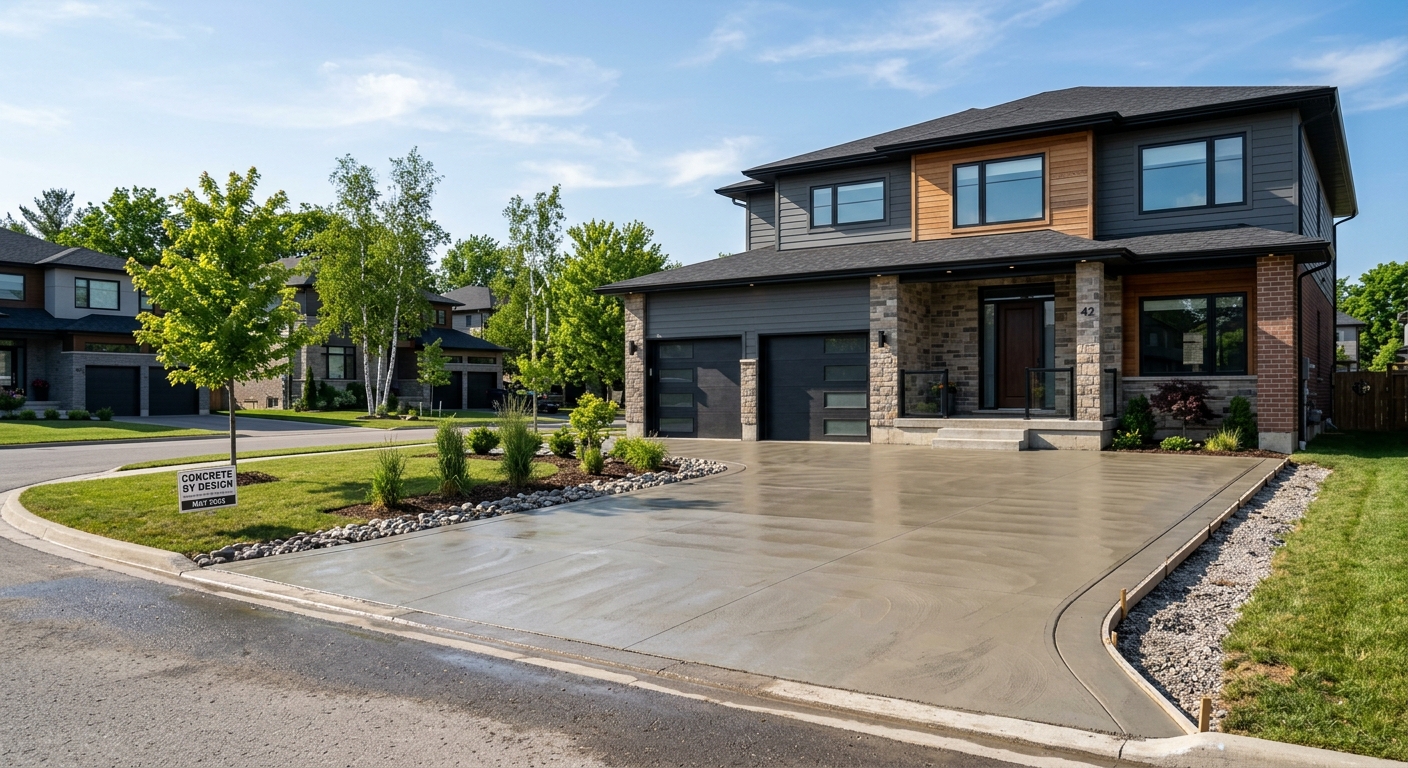
Concrete work options and costs in Edenbridge-Humber Valley
Edenbridge-Humber Valley, Ontario is a well-established residential area with 15,535 residents (Statistics Canada, 2021 Census), and it’s the kind of neighbourhood where curb appeal matters. Most concrete flatwork—driveways, patios and walkways—goes hand-in-hand with the area’s long-running detached home stock, especially around busier pockets like the Humber Valley side streets, where owners often refresh surfaces at the same time they update landscaping and grading.
In the Toronto economic region, concrete pricing isn’t just about material—your quote is shaped by frost depth, freeze–thaw cycles, and how the contractor plans the pour season. Exterior work is commonly scheduled for the warmer months because curing gets less reliable when temperatures trend toward 10 °C or below. Wet fall and spring conditions also increase the importance of proper base preparation and drainage, since saturated soils can expand and contract against the slab every winter.
That’s why two projects that “look the same” (for example, two broom-finished driveways) can differ once you factor in foundation-bearing requirements, granular base depth, air-entrained concrete, and joint layout. If you’re considering a simple upgrade, plain concrete can be the most budget-friendly choice; if you want a longer-term curb-appeal payoff, decorative options like stamped concrete or exposed aggregate are where the money goes.
Below is a practical cost comparison for common projects in Edenbridge-Humber Valley, including the key specs that drive labour and material totals.
| Application |
Typical Size |
Key Spec |
Finish Option |
Price Range |
| Concrete driveway (standard broom finish) |
400–600 sq. ft. |
Air-entrained mix, compacted base, control joints |
Broom finish |
$18,000–$28,000 |
| Exposed aggregate driveway |
400–600 sq. ft. |
Proper aggregate blend, air-entrained mix, bonding/polishing plan |
Exposed aggregate |
$22,000–$34,000 |
| Stamped concrete driveway or patio |
300–550 sq. ft. |
Air-entrained mix, stamped border/detailing, release agent and sealer |
Stamped patterns (e.g., slate/fieldstone look) |
$24,000–$44,000 |
| Plain concrete patio or walkway |
200–450 sq. ft. |
Compacted granular base, drainage grading, control joints |
Float/trowel with light broom or broom finish |
$16,000–$26,000 |
| Garage floor (interior slab) |
300–600 sq. ft. |
Vapour barrier (if specified), mesh or rebar (project dependent) |
Plain/steel-trowel finish |
$20,000–$36,000 |
| Foundation footings (structural, below frost) |
Varies by footprint |
Engineered design, rebar, concrete below design frost depth |
Unfinished structural concrete |
$180–$300 |
Prices are estimates only and vary by project scope, site access and material selection.
What affects the price of concrete work in Edenbridge-Humber Valley
If you get multiple quotes for what seems like the “same job” in Edenbridge-Humber Valley, it’s not unusual to see differences in the 30–50% range across the Toronto area. The reason is that concrete costs are bundled into site conditions and durability specifications that aren’t obvious from a photo. One contractor may include the deeper granular base and better drainage that Toronto subsoils often require, while another may price to a lighter prep spec—then you pay later through early cracking, settlement, or surface scaling.
In the Toronto economic region, frost depth and freeze–thaw cycles drive nearly every structural decision. Structural footings must extend below the design frost depth (Ontario typically calls for about 1.2 m or deeper below grade) to prevent frost heave and differential movement. For exterior flatwork, contractors typically specify air-entrained concrete so the slab can handle repeated freeze–thaw cycles. If you pour closer to the cool end of the season, you also need cold-weather curing precautions (insulation blankets, maintaining temperature, and longer protection time), which adds both labour and materials.
De-icing salt in winter further accelerates surface spalling if the mix and surface curing weren’t done correctly, so sealing becomes more than an aesthetic add-on. In practice, that means a plain patio in the lower end of the band (around $16–$26 per sq. ft. equivalent pricing) may jump toward the higher end when you add thicker slab design, better base prep, and sealing. A stamped driveway or patio, commonly in the higher band (around $24–$40), is often justified where homeowners want premium appearance but still expect the same freeze–thaw durability measures.
Local conditions can move your price quickly: sloped lots near Humber Valley can require more grading and re-forms, while older properties with more mature tree roots can increase excavation effort. On top of that, if your home was built decades ago, you may have existing buried services that force careful concrete staging, which affects truck access and labour time.
| Price Factor |
Why It Matters |
Cost Impact |
| Frost line depth |
Determines footing depth and form height |
Higher depth increases excavation, rebar, and concrete volume |
| Site preparation |
Excavation, grading, compacted granular base |
Poor prep leads to failure; correct prep is labour-heavy but cheaper than repairs |
| Reinforcement |
Rebar or wire mesh requirement |
Material + placement time can add significant cost on thicker slabs |
| Mix design |
Air-entrainment and compressive strength spec |
Premium mix and spec compliance can raise unit costs, especially exterior work |
| Finish type |
Broom vs. stamped vs. exposed aggregate |
Decorative work uses more labour per sq. ft. and extra materials (release, sealer) |
| Pour size and concrete truck access to site |
Access affects crew productivity and pumping/extra handling |
Pumping or hand-placement adds labour and equipment charges |
| Cold-weather curing precautions |
Heating and blankets |
More staging and protection cost during late/early-season pours |
| Control joint pattern and sealing cost |
Limits cracking and protects against de-icing salt damage |
Good jointing reduces callbacks; sealer adds a material line item |
Permits & regulations in Ontario
In Ontario, structural concrete work generally needs municipal oversight. In Edenbridge-Humber Valley, that typically means a building permit for structural items like footings, foundation walls, and grade beams. In many cases, the municipality expects engineered drawings for these foundation components before work proceeds. For concrete flatwork—patios, walkways, and driveways—the work often does not require a permit by default, but it can if it affects lot grading, impervious surface coverage limits, drainage patterns, or the municipal right-of-way. The best approach is to confirm requirements with your local authority before breaking ground.
Before you hire anyone, verify the contractor is properly set up to do Ontario work safely and legally. Ask for proof of liability insurance (so you’re protected if there’s property damage), and request confirmation of WSIB/WCB coverage (so workers are covered if injured). Also, ask for references for projects of a similar scale—driveway and patio jobs are mostly about base prep and finishing control, while structural jobs are much more regulated and engineering-driven.
Here’s a homeowner-friendly checklist to verify a contractor in Ontario: (1) check the contractor’s Ontario licence/registration details on the relevant online registry for the trade or category they’re working under; (2) ask for an up-to-date certificate of insurance and confirm your property address is covered; (3) request evidence of WSIB/WCB clearance or account coverage; (4) confirm the scope in writing matches what they’re insured for; and (5) make sure their insurance dates are current before any excavation begins.
Getting concrete right in Edenbridge-Humber Valley's freeze-thaw climate
Concrete tends to fail in Edenbridge-Humber Valley when the slab or footing can move with moisture and freeze–thaw. The most common exterior problems here are scaling/spalling at the surface, cracking that shows up “too soon,” and uneven settlement—usually traced back to inadequate base prep, the wrong mix, or skipping key curing and sealing steps. Toronto-area freeze–thaw cycles are hard on exterior flatwork, so the spec has to be built around durability, not just appearance.
Start with base preparation: excavate to the correct depth for your soil and frost requirements, then place compacted granular sub-base in lifts and verify grade/drainage. Next is mix design: exterior slabs should use air-entrainment (commonly 5–7% target air content for exposure conditions) and a minimum 32 MPa compressive strength so the paste can withstand repeated freezing. Control joints matter because joints are how you “tell” the concrete where to crack; without a planned spacing pattern and clean jointing, you often get random cracking.
Curing is where late pours can get expensive. Even if concrete sets, it must cure properly—aim for a minimum 7-day curing period under proper conditions. When temperatures dip, crews may need insulation blankets or other cold-weather protection to maintain curing conditions. Finally, sealing: apply a penetrating sealer after the slab has properly cured (commonly 28 days post-pour) to help repel de-icing salt and reduce moisture ingress.
When you ask the right technical questions, you reduce the risk of spalling caused by inadequate air-entrainment. For example, if a contractor offers a “cheaper” driveway option that doesn’t include the correct air-entrained mix and sealing, you might save a few thousand up front (staying closer to the lower end of the $18–$28 driveway band), but you’re more likely to be back for repairs—often costing more than the difference in the first place.
| Spec |
Why It Matters in Edenbridge-Humber Valley |
What to Ask For |
Impact if Skipped |
| Compacted granular base (depth?) |
Base stability prevents movement during freeze–thaw |
State base depth, compaction method, and drainage grading |
Settlement, cracking, and premature surface deterioration |
| Air-entrained concrete mix (target air %?) |
Helps concrete resist freeze–thaw scaling |
Ask for the target air content (commonly 5–7% for exterior) |
Higher spalling risk, especially with winter de-icing salts |
| Compressive strength (MPa rating) |
Strength ensures durability under load and weathering |
Confirm minimum 32 MPa compressive strength spec |
Reduced wear resistance and faster cracking |
| Control joints (spacing per ACI guidelines) |
Controls crack locations to manage thermal movement |
Ask for the joint spacing plan and timing of joint cutting |
Random cracking and visible, uneven crack patterns |
| Minimum 7-day curing period |
Proper cure builds strength for winter exposure |
Confirm curing protection plan during cool or wet conditions |
Weaker surface, higher shrinkage cracking and scaling |
| Penetrating sealer (when applied after cure) |
Repels salt and limits moisture ingress |
Ask for sealer type and application timing (commonly after 28 days) |
More salt damage and faster surface wear |
How to choose a concrete work contractor in Edenbridge-Humber Valley
Choosing the right concrete contractor in Edenbridge-Humber Valley comes down to proof and process. First, verify Ontario licensing/registration for the trade category they’re working under, then confirm liability insurance. Ask for a current certificate of insurance and ensure the coverage is active before work starts. Next, check WSIB/WCB coverage: request documentation or a clearance letter showing active coverage or compliance. Don’t rely on “we’re covered” unless you can see the paperwork.
Second, get 2–3 itemised written quotes, not lump sums. A good quote separates labour and materials (concrete supply, granular base, reinforcement, forms, finishing and sealing) and lists any exclusions clearly. Ask whether permit pull is included (for structural work it usually is coordinated, but you should see who is responsible), and whether excavation spoils disposal is included. If they’re vague, you can end up paying change orders for work you thought was part of the plan.
Third, look at warranty terms. A workmanship warranty should state the length and what it covers (and what it doesn’t). Also ask whether product/manufacturer warranties apply to sealers or admixtures and whether they transfer if you sell your home.
Fourth, payment schedule matters. Don’t pay more than about 10–15% upfront, and agree on a holdback until completion and cleanup. Finally, insist on a written timeline: start date, pour date (weather-dependent), and completion estimate.
- Ask for project references within the last 12–24 months in the GTA.
- Confirm air-entrained mix and exterior durability specs are included in writing.
- Verify who supplies and places the granular base and how compaction is handled.
- Request joint layout details (spacing, edge finishing, and timing).
- Confirm curing/curing protection plan for cool or rainy forecasts.
- Ask whether sealing is included and when it will be applied.
- Check insurance certificate dates and liability limits.
- Confirm WSIB/WCB clearance evidence before excavation begins.
- Ensure their quote lists disposal/removal of excavated material.
- Clarify truck access, pumping needs, and how they’ll protect landscaping.
- Get a written warranty statement and coverage exclusions.
- Use a payment schedule tied to milestones, with a holdback after completion.
Concrete red flags in Edenbridge-Humber Valley: (1) quotes that don’t mention air-entrainment or sealing for exterior flatwork; (2) “one-size-fits-all” base thickness with no drainage plan; (3) no written joint spacing or curing timeline; (4) asking for large deposits upfront; and (5) contractors who won’t provide insurance/WSIB proof or recent comparable photos.
Frequently asked questions — concrete work in Edenbridge-Humber Valley
When is the best time to pour concrete in Edenbridge-Humber Valley?
The best window in Edenbridge-Humber Valley is late spring through early fall, when crews can maintain proper curing conditions. In the Toronto area, weather swings and humidity can be tough in April/May and again in late September/October, and that’s when contractors start adding cold-weather protection or scheduling changes. If temperatures trend toward 10 °C or below, concrete curing needs extra protection (insulation blankets or other measures) to avoid weak surfaces and early deterioration. That’s one reason exterior projects are often concentrated in warmer months—especially driveways and patios that must handle winter freeze–thaw and de-icing salt. If you’re budgeting, decorative concrete like stamped work typically prices closer to the higher end of the band, but timing still matters as much as the finish.
How long does concrete take to cure?
Concrete “sets” in hours, but durable curing takes longer. For most exterior slab work in Ontario, plan on at least a minimum 7-day curing period under proper conditions before you treat it as fully stable for regular exposure. Strength continues developing beyond that, and for durability treatments—like penetrating sealer—timing is typically keyed to full cure. A common practice is to apply penetrating sealer around 28 days post-pour, after the concrete has developed the needed strength and moisture has reduced. If the forecast is cool or wet, experienced GTA crews adjust protection to keep curing conditions stable. Skipping curing or pushing work too early is a common path to surface scaling and cracking that homeowners notice after the first winter cycle.
Do I need a permit for concrete work in Ontario?
In Ontario, structural concrete work usually needs a building permit, especially for footings, foundation walls, and grade beams. For concrete flatwork—driveways, patios and walkways—permits are often not required, but it can depend on whether the work affects lot grading, drainage, impervious surface coverage rules, or anything related to the municipal right-of-way. Since requirements can vary by scope, Edenbridge-Humber Valley homeowners should confirm with the local authority before starting excavation. When you hire a contractor, ask whether they coordinate the permit (if it’s needed) and who is responsible for submission. Regardless of permit needs, verify they carry liability insurance and WSIB/WCB coverage so you’re protected if something goes wrong.
Concrete vs pavers for a patio in Edenbridge-Humber Valley?
Concrete and pavers both work well, but freeze–thaw durability is where the decision gets practical. A well-built concrete patio with air-entrained mix, proper base compaction, control joints, and sealing tends to hold up well through Ontario winters and de-icing salt exposure. Pavers can also perform very well, and they offer easier section replacement if a unit fails—but installation quality is still everything, especially around edging and drainage. Pricing often overlaps: a plain concrete patio is commonly in the $16–$26 band depending on size and prep, while decorative finishes (like stamped concrete) move you closer to the higher end (about $24–$40). If you want the most consistent, low-maintenance surface, well-specified concrete is usually the safer bet.
How long does a concrete driveway last?
A properly built concrete driveway in Edenbridge-Humber Valley can last many years—often decades—if the base prep, mix design, joints, curing, and sealing are done for Toronto’s freeze–thaw cycles. The big risks are early scaling/spalling from insufficient air-entrainment, poor drainage that saturates the base, and random cracking caused by missing or incorrect control joints. Driveways also see frequent de-icing salt use, which is why sealing after cure (commonly around 28 days) is often recommended to repel moisture and salts. If you’re comparing quotes, don’t just compare the driveway’s position in the $18–$28 estimate range; confirm the durability specs that protect it through winter. You’ll usually get a longer service life when the contractor includes those details up front.
What is air-entrained concrete and why does it matter here?
Air-entrained concrete is designed with tiny, evenly distributed air bubbles in the mix. In Ontario’s freeze–thaw climate, that air helps relieve pressure inside the concrete when water freezes, which reduces scaling and spalling on exterior surfaces. This matters in Edenbridge-Humber Valley because exterior slabs and driveways are exposed to winter moisture, then thaw and refreeze repeatedly, stressing the surface every season. For exterior flatwork, contractors typically target an air content around 5–7% and use the right curing and protection plan during cool weather. If a quote doesn’t mention air-entrained concrete for an outdoor pour, that’s a serious durability gap—often leading to early surface damage even when the initial finish looks good. For homeowners, the best way to avoid failures is to ask for the mix spec in writing.