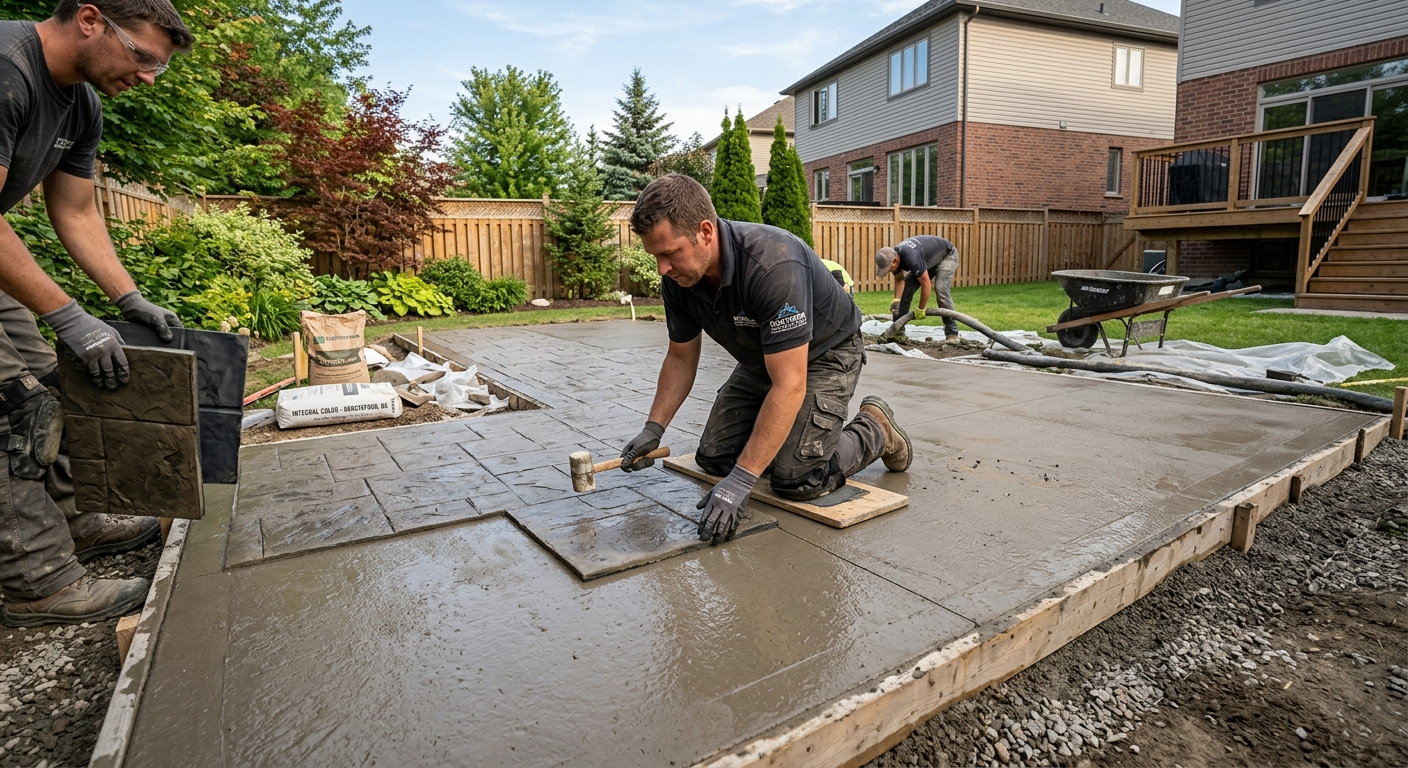
Concrete work options and costs in Wendover
Concrete work in Wendover starts with matching the right option to how your property is used and how the soil and winters behave. With a population of 1,302 in 2021 (Statistics Canada, 2021 Census), the town has a smaller pool of trades, so availability can tighten when multiple crews are booked for the same spring and early-summer concrete window. Most homeowners here are maintaining or upgrading family homes common to the wider Toronto region, where driveways, patios, and walkways see heavy seasonal stress from snowmelt and repeated freeze–thaw. That combination is exactly why pricing differs from job to job—even when two projects look similar on paper.
In the Toronto economic region, structural specs are driven by frost depth and movement risk: footings for most structural concrete are typically required to extend about 1.2 m (around 4 ft) below grade to reduce frost heave and differential settlement. For exterior flatwork, crews usually use air-entrained mixes and build a well-compacted granular base with drainage so saturated soils don’t “pump” against the slab each winter. Pours also tend to be scheduled in the warmer months for reliable curing; as temperatures drop toward about 10 °C, contractors must add protection (insulation blankets and sometimes temporary heat), which can raise labour and material costs. If you’re in the more active renovation corridors near the Ottawa–Gatineau commute route, trades often see above-average demand for driveway and walkway replacements tied to curb accessibility and winter sanding needs.
Below is a practical comparison of the main options you’ll see in Wendover. Use it to sanity-check quotes, then confirm details like footing depth, base thickness, joint layout, and sealing timing.
| Application |
Typical Size |
Key Spec |
Finish Option |
Price Range |
| Concrete driveway (standard broom finish) |
400–500 sq. ft. |
4 in. slab on compacted granular base; air-entrained |
Broom finish + control joints |
$7,200 – $12,500 |
| Exposed aggregate driveway |
400–500 sq. ft. |
4 in. slab with consistent wash/retarder process; air-entrained |
Exposed aggregate with edging |
$9,800 – $16,800 |
| Stamped concrete driveway or patio |
300–450 sq. ft. |
4 in. slab; integral colour; air-entrained; joints planned |
Stamped pattern + sealer |
$10,500 – $18,000 |
| Plain concrete patio or walkway |
200–350 sq. ft. |
4 in. slab on granular base; air-entrained |
Broom or light broom finish |
$3,200 – $8,100 |
| Garage floor (interior slab) |
500–600 sq. ft. |
4 in. slab; vapour barrier and reinforced mesh (typical) |
Steel-trowel finish + seal/coat (optional) |
$8,800 – $14,500 |
| Foundation footings (structural, below frost) |
Per linear metre (varies) |
Excavation + formwork; rebar; pour to required depth |
Structural concrete only (engineered) |
$180 – $300 |
Prices are estimates only and vary by project scope, site access and material selection.
What affects the price of concrete work in Wendover
In the Toronto economic region, it’s common to see the same type of concrete job land 30–50% apart when comparing quotes. The difference usually isn’t just the concrete—it’s how each contractor handles frost-related excavation depth, base preparation, reinforcement, and protection during curing. Even for flatwork, GTA crews typically price in the realities of freeze–thaw: they specify air-entrained mixes, build thicker or better-compacted granular bases, and include a control-joint strategy to limit random cracking. If a quote looks cheaper, it’s often because key items—like correct footing depth, air-entrainment, proper drainage, or sealing—are missing or assumed.
For Ontario structural work, footings and foundation elements must be designed to extend below the design frost depth to reduce frost heave risk and differential movement. Exterior slabs also need air-entrained concrete to survive repeated freeze–thaw cycles. Cold-weather curing can add labour and materials: when night temperatures drop near 10 °C or below, contractors may need insulating blankets or temporary heating and they must track cure time more carefully. De-icing salt accelerates surface deterioration, so many exterior jobs benefit from sealing, especially on driveways and patios that see winter traffic.
In Wendover specifically, costs can rise if your site has heavier clay or saturated areas that require more granular base and drainage corrections. Prices can also drop when demolition is minimal and truck access is straightforward—no long wheelbarrow distances or complicated staging. As a quick anchor, standard broom-finished driveway work often aligns closer to the lower end of the $18–$28 per sq. ft. band, while stamped or exposed aggregate usually pushes toward the higher end of the decorative ranges when you add curing and finishing labour. For patios/walkways, small grade changes and drainage improvements can be the difference between a basic $16–$26 per sq. ft. look and a longer-lasting installation.
| Price Factor |
Why It Matters |
Cost Impact |
| Frost line depth — determines footing depth and form height |
Deeper excavation reduces frost heave and settlement risk |
Major impact: can change the scope substantially |
| Site preparation — excavation, grading, compacted granular base |
Proper base prevents pumping and improves drainage |
Often medium to major depending on soil conditions |
| Reinforcement — rebar or wire mesh requirement |
Controls cracking in slabs and improves structural capacity |
Medium; depends on slab thickness and use |
| Mix design — air-entrainment and compressive strength spec |
Air entrainment is key for freeze–thaw durability |
Low to medium, but critical for longevity |
| Finish type — broom vs. stamped vs. exposed aggregate |
Labour and materials (forms/colour/sealer) add cost |
Medium to major for decorative finishes |
| Pour size and concrete truck access to site |
Access affects pumping, labour time, and scheduling |
Can be high if crane/pump or long carry is needed |
| Cold-weather curing precautions — heating and blankets |
Ensures strength gain and reduces surface defects |
Medium; more common late season |
| Control joint pattern and sealing cost |
Joints manage shrinkage cracking; sealing resists salt damage |
Low to medium for basic sealing, higher for premium packages |
Permits & regulations in Ontario
In Ontario, the rule of thumb is: if the concrete is structural, you should expect a permit and often engineered drawings. Structural concrete work—such as foundation footings, foundation walls, grade beams, and other components that carry load—generally requires a building permit and municipal review. Concrete flatwork (patios, walkways, and most driveways) typically does not require a permit on its own unless it affects lot grading, interferes with drainage requirements, changes impervious surface coverage rules, or impacts municipal right-of-way areas (for example, near a driveway apron or curb/sidewalk relationship). Even when a permit isn’t required, good contractors still confirm whether any local approvals apply before excavation.
For your Wendover project, verify three things before anything starts: (1) contractor licensing/registration as required for the work they’re doing, (2) liability insurance, and (3) WSIB/WCB coverage. Step-by-step, you can do this by: requesting the contractor’s certificate of insurance showing they carry current liability coverage; asking for their WSIB/WCB clearance letter or account evidence; and checking their business details and registration status using Ontario’s online business and contractor-related resources. Then ask for references and photo examples of similar jobs done on comparable soil conditions and winter-service expectations.
If your scope includes structural foundation work, insist the permit application and inspection plan are explicitly covered in the quote—don’t assume the municipality will “figure it out” later.
Getting concrete right in Wendover's freeze-thaw climate
Concrete fails in Wendover when freeze–thaw action gets the chance to break apart the surface—usually through inadequate base prep, weak or improperly designed mixes, poor curing, or skipped sealing. The fix is to spec the job like a durable outdoor system: (1) base preparation with a compacted granular sub-base to the proper depth for local soil and frost conditions, (2) a freeze–thaw-tough air-entrained mix, (3) a control-joint layout that gives shrinkage cracks a planned location, (4) curing long enough under suitable protection, and (5) sealing to reduce salt and moisture penetration. With Ontario’s humid seasonal swings and winter de-icing exposure, the most common failure I see is spalling and scaling when air-entrainment isn’t correct or when the slab is poured and finished without adequate protection during cold snaps.
For exterior flatwork, a typical target is 5–7% air content in the mix and a minimum 32 MPa compressive strength spec (exact targets vary by exposure class and design). Contractors should plan joints so spacing limits random cracking and ensure at least 7 days of curing under proper conditions. Sealing is typically applied after the slab has cured—commonly around 28 days post-pour—so you’re not trapping moisture in the concrete.
Here’s where money is justified: if you’re comparing a basic broom-finish patio versus a stamped decorative option, the stamped bid may run toward the higher end of the decorative band (often $24–$40 per sq. ft. in the Toronto-tier for stamp/colour systems). That extra cost is warranted if the contractor also nails the base, joints, and curing; otherwise, decorative surfaces only make problems more obvious. Conversely, for plain patios and walkways, good drainage and correct base depth can deliver a near “value” outcome within the $16–$26 per sq. ft. band.
| Spec |
Why It Matters in Wendover |
What to Ask For |
Impact if Skipped |
| Compacted granular base (depth?) |
Correct thickness and compaction prevent pumping and slab movement in freeze–thaw |
Base depth, soil condition notes, compaction method, drainage plan |
Settlement, cracking, uneven slabs, premature failure |
| Air-entrained concrete mix (target air %?) |
Air bubbles provide room for freeze expansion and reduce spalling risk |
Verify air-entrainment target (commonly 5–7% for exterior flatwork) |
Scaling/spalling during winters with de-icing exposure |
| Compressive strength (MPa rating) |
Strength gain ensures durability and supports load and traffic |
Minimum 32 MPa spec (confirm with contractor and mix design) |
Surface wear, chipping, reduced long-term performance |
| Control joints (spacing per ACI guidelines) |
Joints manage shrinkage and thermal movement |
Joint spacing plan and sawcut timing |
Random cracking and more frequent repairs |
| Minimum 7-day curing period |
Cold nights and humidity can slow strength development |
Curing method details; protection if temps drop |
Weakened concrete and higher risk of surface defects |
| Penetrating sealer (when applied after cure) |
Repels moisture and helps reduce salt-related deterioration |
Sealer type and application window (often around 28 days post-pour) |
Faster moisture ingress, scaling, and shorter service life |
How to choose a concrete work contractor in Wendover
Choosing the right concrete contractor in Wendover comes down to verification, clarity, and proof. Start by confirming Ontario-appropriate licensing/registration for the type of work they’re doing (especially structural work), and request current certificate of insurance showing liability coverage. Next, verify WSIB/WCB coverage by asking for a clearance letter or evidence tied to their account status—don’t accept “we’re covered” without documents. This protects you if someone is injured on your property.
Then get 2–3 itemised written quotes. Ask for a labour and materials breakdown rather than a lump sum, and ensure the quote spells out what’s included: excavation and haul-away, granular base thickness and compaction, reinforcement type, concrete mix design (air-entrained), joint pattern and sawcut timing, curing protection, and sealing. Confirm permit pull responsibility (if needed) and whether disposal, forms removal, and cleanup are part of the price.
Warranty matters: ask for the workmanship warranty length and what it covers (cracks due to shrinkage vs. workmanship errors), plus whether any product/manufacturer warranty is included and if it’s transferable to you as the homeowner. Finally, discuss payment schedule—never more than about 10–15% upfront, and hold back payment until the job is complete and walk-through items are done. Get a specific start date and estimated completion timeline in writing so weather-related delays and cure protection expectations are transparent.
- Proof of liability insurance (certificate requested before work starts)
- WSIB/WCB clearance letter/evidence provided in writing
- Concrete mix details: air-entrainment target and strength spec (for exterior)
- Base prep scope stated: excavation depth, granular type, and compaction
- Reinforcement plan listed (mesh vs. rebar, thickness notes)
- Control joint layout explained (where joints go and when they’re cut)
- Drainage addressed (grade, swales, and water shedding away from structures)
- Curing/protection plan for cold nights and how they’ll meet cure expectations
- Sealer included or clearly excluded, with application timing stated
- Site access plan (no “mystery costs” for long carry or pump requirements)
- Written disposal/haul-away confirmation for demo and excess materials
- Clear warranty terms on workmanship and what voids coverage
Concrete contractor red flags I see in Wendover: quotes that don’t mention air-entrained concrete for exterior slabs; vague “we’ll do the base” language with no depth/compaction details; missing joint or sealing steps (especially on driveways and patios exposed to salt); refusal to provide insurance/WSIB/WCB documentation; and payment schedules that ask for large upfront deposits without an agreed start date and schedule.
Frequently asked questions — concrete work in Wendover
Concrete vs pavers for a patio in Wendover?
For patios in Wendover, both concrete and pavers can work, but your choice depends on maintenance tolerance and how you want the surface to handle Ontario freeze–thaw. A properly built plain concrete patio (often in the $16–$26 band for many Toronto-tier small patio scopes) can be very durable when the base is compacted correctly, the mix is air-entrained, and control joints are planned. Pavers can be easier to repair area-by-area if one section shifts, but they still require excellent base prep and joint sand management, and they can settle if drainage is off. If you expect heavy winter de-icing and foot traffic over time, ask both contractors how they’ll handle drainage and what they use for frost-resistant base thickness.
How long does a concrete driveway last?
A well-built concrete driveway in Ontario commonly lasts 20+ years, but the real-life range is mostly controlled by freeze–thaw durability details: air-entrainment, correct base prep, joint placement, and sealing decisions. In the Toronto region, the recurring problem isn’t just cracking—it’s spalling and scaling when moisture and salt get into the surface and the concrete can’t tolerate expansion. Driveways priced near the lower end of the $18–$28 per sq. ft. band can last if the contractor still includes air-entrained mix, proper drainage, and correct joint strategy. Decorative options cost more (stamped/exposed often higher), but longevity still comes back to the same core specs rather than the look.
What is air-entrained concrete and why does it matter here?
Air-entrained concrete is designed with tiny, evenly distributed air bubbles that give water inside the cement paste space to expand when it freezes. In Wendover and across Ontario’s freeze–thaw seasons, that directly reduces scaling and spalling—surface damage that can happen when the concrete is repeatedly wetted, frozen, and thawed. Contractors typically specify air-entrainment for exterior slabs (driveways, patios, walkways) because exterior exposure is harsh and de-icing salts increase deterioration. If a quote for an exterior job doesn’t explicitly mention air-entrainment and outdoor-ready mix design, that’s a major technical gap. Ask what air content target they use and confirm it’s for exterior exposure.
How do I prepare the base for a concrete slab?
The base is where many concrete jobs succeed or fail in Wendover. Preparation usually starts with proper excavation and subgrade inspection, then placement of a compacted granular sub-base to the correct depth for local soil and frost considerations. The contractor should remove topsoil/soft material, build the granular layer in lifts, and compact to a target level (not “lightly tamped”). Drainage matters too: the slab needs grade that sheds water away from the house and reduces standing water against the concrete. If you’re comparing quotes, demand the exact base depth, the granular material type, compaction approach, and whether they’re correcting poor drainage before pouring.
How do I compare concrete quotes?
Comparing concrete quotes in Ontario is easiest when you force apples-to-apples scope. Ask each contractor to provide itemised pricing: excavation and disposal, granular base type and depth with compaction notes, reinforcement (mesh vs. rebar and slab thickness), concrete mix design (especially air-entrainment for exterior), finish type, joint pattern, curing protection, and sealer timing if applicable. Pay attention to accessibility—truck access, pump requirements, and long carry distances can swing labour costs. Also compare what’s excluded: for example, permit handling (if structural), removal of old concrete, and landscaping restoration. As a sanity check, if a driveway quote lands far below the typical $18–$28 per sq. ft. range for your tier, it may be skipping critical durability items.
Can concrete be poured in cold weather in Wendover?
Concrete can be poured in cold weather in Wendover, but the conditions determine whether it’s a good idea. The key issue is strength gain and curing: when temperatures drop toward around 10 °C or below, concrete can cure too slowly unless the contractor uses cold-weather precautions such as insulating blankets, protection from wind/chill, and sometimes temporary heating. Even if the pour “sets,” you can lose durability if curing isn’t managed—leading to increased cracking risk later. Ask the contractor how they’ll protect the slab during curing and for the minimum curing period they commit to. If you’re aiming for a driveway or patio, it’s often cheaper overall to schedule in the warmer season unless conditions and protection methods are clearly planned in the quote.