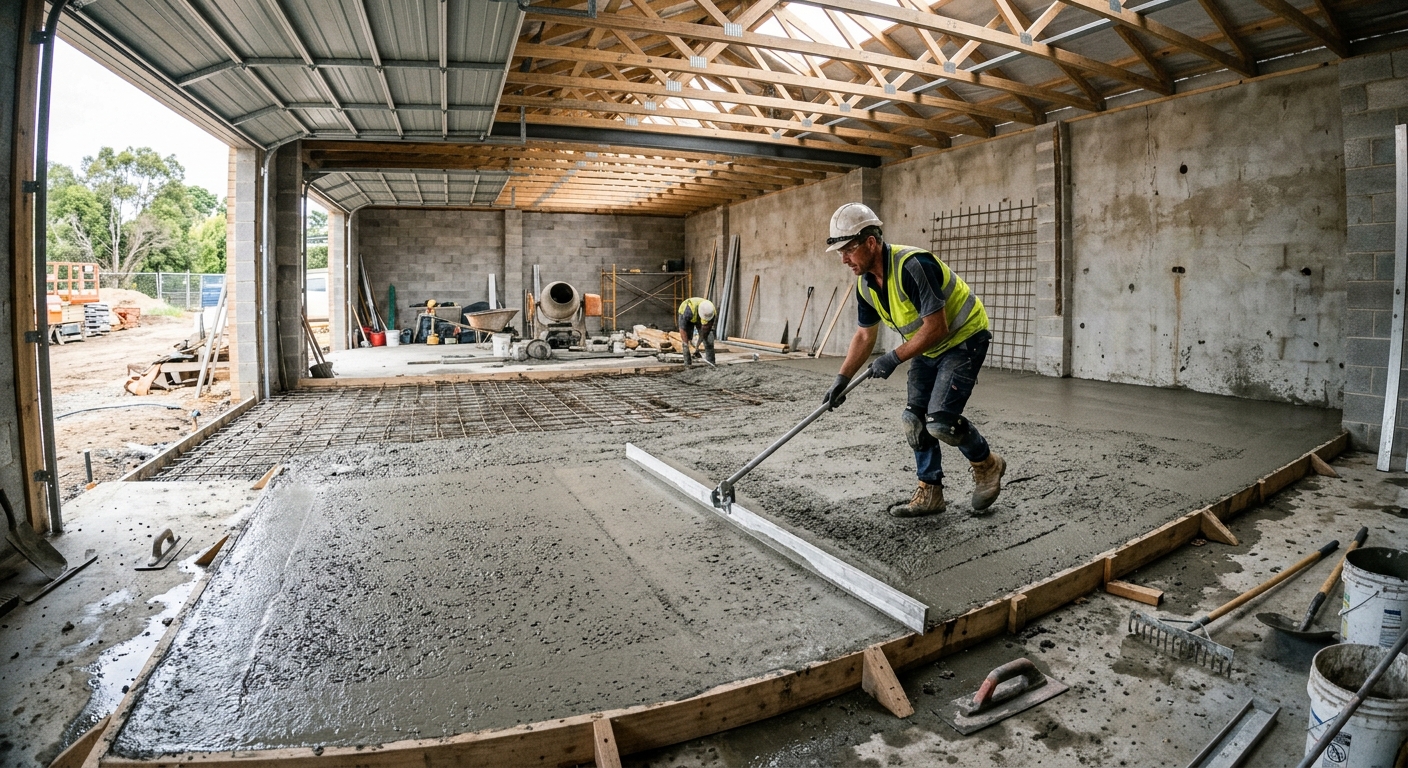
Concrete work options and costs in Petrolia
Petrolia homeowners usually choose concrete because it fits the town’s typical housing style and long winters—especially when you’re dealing with flatwork that has to survive frost, moisture, and freeze–thaw cycles. In Petrolia, single-detached homes make up 82.3% of dwellings (Statistics Canada, 2021 Census), and those houses are where we see most driveways, patios, walkways, and garage slab upgrades. The area also has a mature housing stock, with 55.1% of homes built before 1981 (Statistics Canada, 2021 Census), which means many projects start with repairs or replacements after years of joint movement and minor base drainage issues.
In the Windsor–Sarnia region, pricing is influenced by the cold, lake-influenced climate. Contractors commonly keep footings below the frost line, which increases excavation depth and rebar/material needs on foundation work. For exterior slabs, we also specify air-entrained concrete and build a well-compacted granular base so water can’t sit under the slab and fuel freeze–thaw damage. In practice, that translates into more labour for formwork, saw-cut control joints on time, and careful curing—especially during shoulder-season pours when heaters, blankets, or admixtures may be needed to protect the first days of set.
Trade demand is steady in established pockets such as the downtown and residential streets near the former railway corridor, where older sidewalks and driveway approaches get replaced during spring melt and summer access. From there, the best next step is comparing what you’re actually getting—use the pricing ranges below as a starting point before you request itemised quotes.
| Application |
Typical Size |
Key Spec |
Finish Option |
Price Range |
| Concrete driveway (standard broom finish) |
16 ft x 30 ft (480 sq. ft.) |
Air-entrained mix; compacted granular base; control joints |
Broom finish |
$5,500–$15,000 |
| Exposed aggregate driveway |
16 ft x 30 ft (480 sq. ft.) |
Air-entrained mix; proper base drainage; sealer recommended |
Washed/exposed aggregate |
$8,500–$18,500 |
| Stamped concrete driveway or patio |
12 ft x 24 ft (288 sq. ft.) |
Air-entrained mix; integral colour; joints planned for pattern |
Stamped (e.g., slate/stone texture) |
$7,500–$22,000 |
| Plain concrete patio or walkway |
10 ft x 16 ft (160 sq. ft.) |
Air-entrained mix; compacted base; correct slope |
Float/screed with light broom |
$3,500–$9,000 |
| Garage floor (interior slab) |
20 ft x 22 ft (440 sq. ft.) |
Moisture-aware base; vapour considerations; reinforcement as required |
Light broom or smooth trowel (finish dependent) |
$6,000–$14,000 |
| Foundation footings (structural, below frost) |
Typical perimeter for a small home addition |
Below frost-line excavation; rebar as engineered; concrete strength spec |
Structural concrete (not decorative) |
$12,000–$35,000 |
Prices are estimates only and vary by project scope, site access and material selection.
What affects the price of concrete work in Petrolia
In Petrolia and across Southwestern Ontario, it’s common to see quotes for the “same” concrete job come in 30–50% apart. The biggest reasons aren’t usually the concrete itself—it’s what’s underneath and around it. For example, if one contractor is pricing a drive as though it’s a simple pour, while another is allowing for deeper excavation, a thicker granular base, and extra rebar because of frost and soil conditions, the difference shows up fast.
In Windsor–Sarnia’s cold, lake-influenced climate, frost depth and freeze–thaw cycles dictate nearly every spec: footings must extend below the design frost depth to prevent frost heave. Exterior slabs are typically built with air-entrained mixes so the concrete can survive repeated expansion and contraction from moisture and temperature swings. Cold-weather placement also matters: spring and fall pours may require heaters, insulating blankets, or admixtures to protect early hydration, and proper curing becomes a line item rather than a footnote.
Two examples from Petrolia that change the budget: (1) replacing a driveway over a soft, pumping-prone subgrade often increases excavation and granular thickness—this can push a basic driveway toward the upper end of the local range (think “closer to” $5,500–$15,000 rather than the low end). (2) A stamped or exposed finish may cost more, but the premium is justified when the base, joint layout, and curing are done right—otherwise decorative work can still crack. In many cases, a patio that’s planned as $3,500–$9,000 becomes more expensive if drainage and joint control aren’t treated as part of the foundation of the finished surface.
| Price Factor |
Why It Matters |
Cost Impact |
| Frost line depth — determines footing depth and form height |
Controls excavation depth to prevent frost heave and movement |
Can add significant labour and concrete volume on structural work |
| Site preparation — excavation, grading, compacted granular base |
Prevents water retention and reduces slab settlement |
Thicker base and more disposal/hauling increases totals |
| Reinforcement — rebar or wire mesh requirement |
Helps control cracking and supports load paths |
Material and labour increase; skipped reinforcement can lead to early failure |
| Mix design — air-entrainment and compressive strength spec |
Air content and strength protect against freeze–thaw damage |
Often the difference between “cheap” and “survives winters” pricing |
| Finish type — broom vs. stamped vs. exposed aggregate |
More steps, timing control, and finishing labour |
Higher finish labour and materials can move projects toward decorative bands |
| Pour size and concrete truck access to site |
Access affects pumping/placement time and crew size |
Limited access can add equipment and labour premiums |
| Cold-weather curing precautions — heating and blankets |
Maintains hydration and strength gain in cooler periods |
Heaters/blankets and extended curing supervision add cost |
| Control joint pattern and sealing cost |
Manages shrinkage cracking and protects against water intrusion |
Saw-cut timing and sealers add labour/materials |
Permits & regulations in Ontario
In Ontario, many concrete projects are straightforward—but the rules depend on what you’re building. Structural concrete work such as footings, foundation walls, and grade beams generally requires a building permit, and engineered drawings are often reviewed by the municipality. Concrete flatwork—driveways, patios, and walkways—usually does not require a permit by default, unless the work affects lot grading, impervious surface coverage limits, or the municipal right-of-way (for example, curb-related or drainage-affecting tie-ins). Because bylaws can differ and site conditions vary, confirm with the local authority before you break ground in Petrolia.
Whatever the permit outcome, verify contractor basics. Ask for proof of liability insurance and WSIB/WCB coverage before signing. Also request references from similar-scale concrete work—driveways, garage floors, and foundation-related excavations—so you can judge workmanship on joints, finish uniformity, and how they handled drainage.
How to check as a homeowner (step-by-step): (1) look up the contractor’s licensing/registration status through the province’s online service where applicable; (2) request a current certificate of insurance and confirm it’s active for the project period; (3) ask for WSIB/WCB proof or clearance documentation; (4) compare what’s included in the quote (permit pull responsibilities, disposal/haul-away, and curing protection measures). If any of those items aren’t provided promptly, it’s a warning sign—especially in a freeze–thaw area where workmanship and documentation both matter.
Getting concrete right in Petrolia's freeze-thaw climate
Concrete can fail in Petrolia when water gets under a slab, air gaps let freeze–thaw cycles expand damage, and joints aren’t cut and sealed on the right schedule. In our cold, lake-influenced Southwestern Ontario weather, the most common complaint we see is surface scaling or cracking that begins at edges and around joints—often linked to inadequate base prep, insufficient air-entrainment, or shortcuts on curing. The fix is to spec the job with the right layers and the right timing.
First, base preparation: use a compacted granular sub-base to the design depth and profile for drainage and frost protection. Next, mix design: for exterior flatwork, specify air-entrainment (typically 5–7% air content) and a minimum 32 MPa compressive strength so the concrete survives repeated freeze–thaw expansion. Third, control joints: plan spacing to reduce random cracking, then cut on time (not days late) so cracks occur at the intended lines. Fourth, curing: plan for at least 7 days of curing under suitable conditions—this is critical if you’re pouring during cool spring or fall periods. Fifth, sealing: apply a penetrating sealer after the cure (commonly around 28 days) to help repel de-icing salts and reduce surface deterioration.
If you’re comparing options, a stamped patio may sound like “just an appearance upgrade,” but the real justification is only there if the contractor still builds a proper base, uses air-entrained concrete, and manages joints correctly. For example, a plain patio/walkway often falls in the $3,500–$9,000 band, while stamped work commonly lands higher in the $7,500–$22,000 range. If the lower quote skips curing blankets or under-specifies air, you don’t want to pay twice later—spalling and repairs cost far more than the difference in materials and time.
| Spec |
Why It Matters in Petrolia |
What to Ask For |
Impact if Skipped |
| Compacted granular base (depth?) |
Stabilizes the slab and controls moisture under freeze–thaw cycles |
Minimum prepared base depth and compaction testing method |
Settlement, edge cracking, and premature deterioration |
| Air-entrained concrete mix (target air %?) |
Protects against freeze–thaw scaling in Ontario winters |
Air content target (typically 5–7% for exterior flatwork) on the ticket/spec |
Higher risk of spalling and surface pop-outs |
| Compressive strength (MPa rating) |
Supports durability and strength gain through seasonal swings |
Minimum 32 MPa (or higher if engineered), with documentation |
Soft/weak concrete, faster cracking and surface wear |
| Control joints (spacing per ACI guidelines) |
Creates planned crack locations during shrinkage |
Joint layout, saw-cut timing, and width/depth targets |
Random cracking across finished surfaces |
| Minimum 7-day curing period |
Ensures proper hydration and reduces early-age damage |
Curing plan for your pour date (including cold-weather blankets/heaters if needed) |
Lower durability, curling, and early scaling |
| Penetrating sealer (when applied after cure) |
Helps repel salts used on winter sidewalks/driveways |
Application timing (commonly around 28 days post-pour) and sealer type |
More salt-related surface breakdown and faster staining |
How to choose a concrete work contractor in Petrolia
Choosing the right concrete contractor in Petrolia is mostly about verification and clarity. Start with Ontario licensing/registration where applicable, then confirm liability insurance before any excavation begins. For workers on site, ask for WSIB/WCB coverage proof (or clearance documentation). Don’t accept verbal confirmation—request the certificate(s) and ensure coverage is active for the project dates.
Next, get 2–3 itemised written quotes, not one lump number. You want labour and materials broken out: excavation and disposal, granular base and compaction, rebar/wire mesh, formwork, concrete supply, saw-cutting and finishing labour, and curing protection. Ask whether the contractor is pulling any required permit (for example, structural work like footings/foundation walls), and what’s excluded (tree/rock removal, pumping, off-haul distance, patching existing surfaces, or sealers).
Warranty should be in plain language. Ask for a workmanship warranty length, what it covers, and whether it’s backed by the contractor or manufacturer. Product/manufacturer warranties for concrete-related items are less common for slabs themselves, but sealer and certain specialty components may carry coverage.
On payment, never pay more than 10–15% upfront. Hold a portion until the job is complete and final finishing, joint sealing, and cleanup are done. Finally, get a start date and completion estimate in writing, including what happens if weather forces a reschedule in Petrolia’s freeze–thaw shoulder seasons.
- Confirm liability insurance is current and covers the full job period.
- Provide WSIB/WCB clearance or coverage proof for the crew.
- Ask who is responsible for permits if structural concrete is involved (footings/foundation walls).
- Demand an itemised quote: excavation, base, reinforcement, concrete, finishing, curing, sealing.
- Check whether control joints are included and whether they’ll be cut on time.
- Verify air-entrained mix for exterior flatwork (ask for air content target).
- Ask about minimum curing time and curing protection during cold snaps.
- Clarify disposal/hauling: distance limits and whether extra loads cost more.
- Ask how they handle water management (slopes, ties to existing drainage).
- Confirm whether rebar is included where needed (especially structural and larger slabs).
- Review the warranty terms in writing before signing.
- Keep payment terms conservative: 10–15% max deposit; holdback until completion.
Concrete contractor red flags in Petrolia: refusing to show insurance/WSIB coverage, quoting decorative work without detailing base thickness and joint plan, offering a “one-price” lump sum without specifying air-entrainment or curing, delaying joint cutting and not mentioning sealing, or asking for large upfront deposits with no signed scope.
Frequently asked questions — concrete work in Petrolia
How do I prepare the base for a concrete slab?
In Petrolia (and across Southwestern Ontario), base prep is where slab durability is won or lost. A proper granular sub-base should be excavated to the required depth, graded for drainage, and compacted in lifts so it doesn’t settle under the slab during freeze–thaw. Contractors typically place crushed aggregate rather than relying on native soil, and they finish with correct slope toward drainage rather than letting water pool. Ask your contractor what granular depth they’re allowing, how they compact (and whether they measure it), and how they handle soft spots or pumping subgrade. Even for a driveway in the $5,500–$15,000 band, a thin/poorly compacted base is what leads to edge cracking and scaling. Preparation also determines how much concrete and reinforcement you’ll really need.
How do I compare concrete quotes?
When comparing quotes in Ontario, don’t compare only the final number—compare what’s included. In Petrolia, the biggest hidden differences are excavation depth, granular base thickness, reinforcement (rebar or mesh), and the concrete mix spec (especially air-entrainment for exterior work). Ask each contractor to provide an itemised breakdown: concrete volume (and strength), base and compaction provisions, formwork, finishing, saw-cut timing, and sealing. Make sure the same dimensions and finish are being quoted (for example, broom-finished versus stamped). A stamped driveway or patio usually sits in the higher $7,500–$22,000 range, but it should only cost that if the base, joint layout, and curing plan are equally robust. If one quote is far cheaper, it often means they’re skipping critical steps like curing protection or proper joint control.
Can concrete be poured in cold weather in Petrolia?
Yes, concrete can be poured in cold weather in Petrolia, but it must be done with proper cold-weather procedures. The risk isn’t just “getting cold”—it’s slowing hydration and leaving early-age concrete vulnerable, especially through freeze–thaw transitions. Reputable contractors plan for heating, insulating blankets, and sometimes admixtures so the concrete reaches strength safely while protecting the curing window. Ask for their specific curing plan for your pour date, including how they maintain temperature and how long they’ll keep protection on. For exterior flatwork, you also still need an air-entrained mix to survive Ontario freeze–thaw cycles. If someone promises a pour without a curing protection plan during cool seasons, that’s a major concern. Pricing may rise slightly because heaters and extra supervision are labour and equipment costs—so it can affect where your project lands within the local bands.
How do I maintain concrete in Petrolia's freeze-thaw climate?
Maintenance in Petrolia is mostly about water and salts. Start by sealing the slab after it’s properly cured—many contractors apply a penetrating sealer around 28 days post-pour—then maintain that protection as recommended by the sealer manufacturer. Use de-icing practices that minimize salt saturation and avoid heavy impact from shovels at edges and joints. Keep the area around the slab clear so water can’t run back onto the concrete. If you notice small joint failures, don’t wait; repair and sealing of joints helps prevent water migration under the slab, which is what accelerates freeze–thaw deterioration. For exterior concrete, correct slope and drainage at install time reduce long-term maintenance burden. Even with a driveway in the $5,500–$15,000 range, good maintenance protects the investment from the region’s repeated winter cycles.
What causes concrete to spall in Petrolia winters?
Spalling in Petrolia is most commonly caused by inadequate air-entrainment combined with moisture exposure during freeze–thaw cycles. When water enters paste or near-surface zones and freezes, it can break off surface material, especially if the concrete mix wasn’t designed for exterior durability. Another contributor is poor base drainage—if water sits under or against the slab, freezing damage accelerates at edges and around joints. Improper curing (especially in cool spring/fall pours) can also reduce durability and increase early surface scaling. Control joints and sealing matter too: cracks that open and stay wet provide a pathway for water intrusion. If your contractor didn’t plan saw-cut timing and joint sealing, surface failure often shows up first. If you’re evaluating replacement, ask specifically for an air-entrained mix target and confirmation of the compressive strength and curing steps.
What is rebar and when is it required in Ontario?
Rebar (reinforcing steel) is used to strengthen concrete by controlling cracking and supporting structural load paths. In Ontario, whether rebar is required depends on the engineered design, slab type, thickness, and load conditions. For structural work—like footings and foundation elements—rebar is typically required and should be installed according to engineered drawings and applicable building permits. For residential flatwork such as patios, some slabs use wire mesh or reinforcement ties in specific scenarios, but not every thin slab needs full rebar. The key is that the spec must match the use and soil/frost conditions. In Petrolia’s freeze–thaw climate, reinforcement decisions often connect to base preparation and slab thickness, because frost movement and moisture exposure can worsen cracking. When getting a quote, ask what reinforcement they include, what’s omitted, and whether the plan matches the load and thickness you’re building.