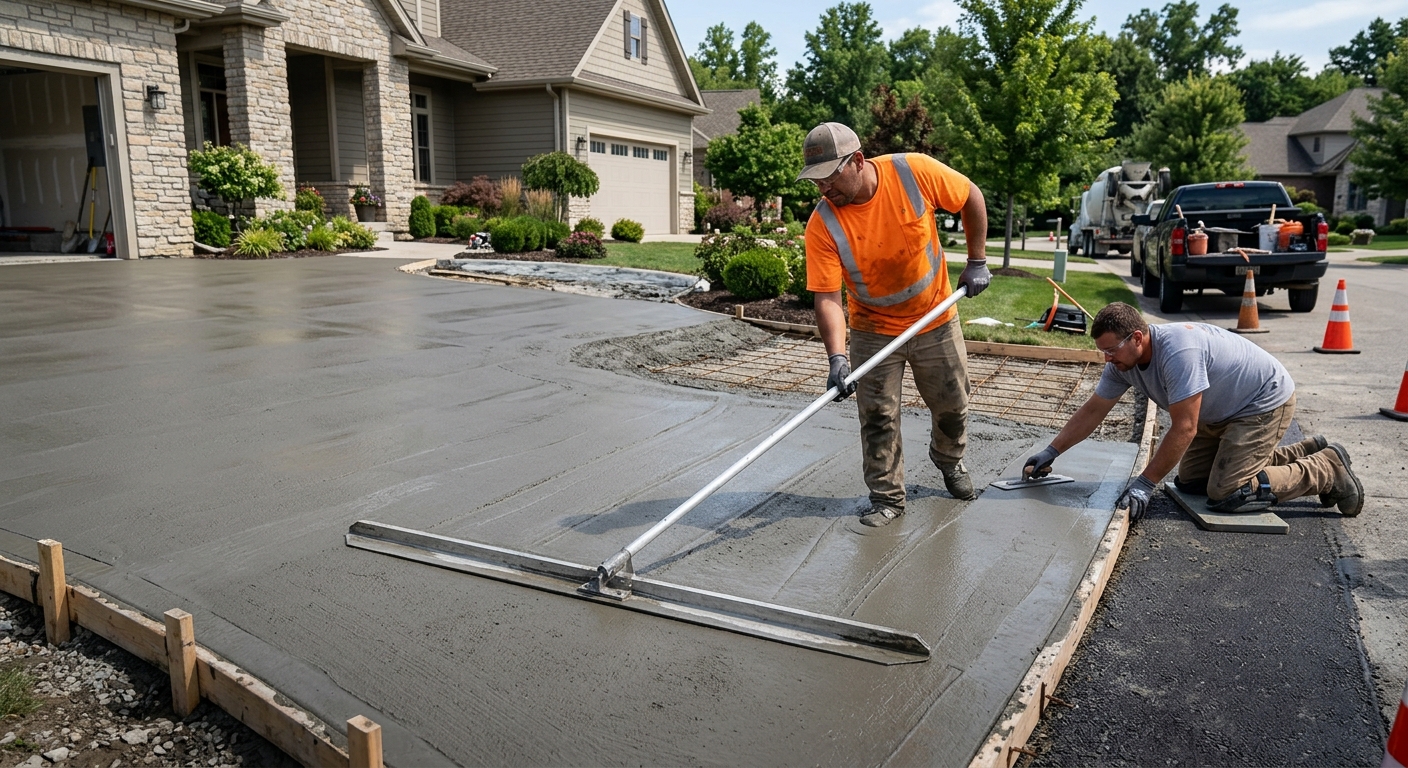
Concrete work options and costs in Hamilton
Hamilton homeowners have a lot of concrete choices, from practical driveways to long-lasting patios and structural foundations. In the 2021 Census, Hamilton shows a strong base of homeowners—93.9% of households own their homes—and that matters because concrete flatwork (driveways, patios, and walkways) is one of the most common exterior upgrades for owner-occupied single-detached housing, which makes up 94.6% of dwellings. (Statistics Canada, 2021 Census)
In the Muskoka–Kawarthas region, our concrete costs are shaped heavily by climate. Local frost depth commonly sits around the 4 ft range, so exterior footings and foundation elements must be placed below frost to reduce the risk of frost heave. Repeated freeze–thaw cycles also require air-entrained mixes, solid granular base preparation, and well-planned control joints to limit cracking and spalling. On top of that, the pour season is effectively shorter (often April–November), which can compress schedules and increase labour and equipment costs.
On the flip side, jobs are sometimes less expensive when access is straightforward, soil conditions are predictable, and the scope stays “standard” (broom-finish rather than decorative). In Hamilton, this trade is particularly busy in neighbourhoods with lots of older homes and frequent renovations, including areas like Stoney Creek and the Binbrook corridor. If your home is in that typical mix—nearly half of Hamilton’s housing stock built before 1981—site prep and drainage upgrades are common cost drivers as well.
Below is a realistic comparison of options and typical pricing so you can line up quotes apples-to-apples for your project.
| Application |
Typical Size |
Key Spec |
Finish Option |
Price Range |
| Concrete driveway (standard broom finish) |
12 m x 3.5 m (about 42 m²) |
4 in slab, compacted granular base, air-entrained mix |
Broom finish with control joints |
$12,500–$22,000 |
| Exposed aggregate driveway |
12 m x 3.5 m (about 42 m²) |
4 in slab, higher-performance mix and finishing plan |
Exposed aggregate (washed/stamped effect) |
$18,000–$28,000 |
| Stamped concrete driveway or patio |
35–60 m² |
Air-entrained mix, proper release/colour system |
Stamped pattern + integral colour |
$15,000–$35,000 |
| Plain concrete patio or walkway |
10–30 m² |
4 in slab, compacted sub-base, joints as needed |
Float/smooth or light broom |
$4,500–$12,000 |
| Garage floor (interior slab) |
20–30 m² |
Vapour barrier, reinforcement/wire mesh as specified |
Standard trowel or broom finish |
$6,500–$14,000 |
| Foundation footings (structural, below frost) |
Typical 1 storey: 40–80 linear ft equivalent |
Excavation to frost depth, rebar, waterproofing as required |
Structural concrete only (formwork + rebar) |
$20,000–$45,000 |
Prices are estimates only and vary by project scope, site access and material selection.
What affects the price of concrete work in Hamilton
In Hamilton and across Ontario, you can see 30–50% quote swings for what looks like the “same” concrete job. The difference is usually in the non-visible items: how deep excavation goes, how much granular base is installed and compacted, what reinforcement is used, and whether the contractor designs around the freeze–thaw climate instead of treating it like a warmer region. Availability also plays a role in the Muskoka–Kawarthas market—because the practical pour window can be constrained and crews are scheduling around curing and weather, labour and equipment can price up quickly when calendars tighten.
Frost line depth and freeze–thaw cycles dictate every key spec. Exterior footings must extend below the design frost depth to prevent frost heave; that typically means deeper excavations and more forming than homeowners expect. All exterior slabs require air-entrained concrete so the surface can survive repeated freezing and thawing. Cold-weather curing precautions (insulating blankets, tenting or temporary heating) can add cost on projects that push into shoulder-season. And because de-icing salt accelerates surface spalling when concrete isn’t properly designed, sealing becomes a smart line item—especially for driveways and sidewalks that get salted frequently.
Here are a few Hamilton examples that move dollars. If your driveway needs thicker structural base due to soft soils, a “standard” broom-finish driveway budget can rise toward the upper driveway band (for instance, closer to the $12,000–$25,000 range). If you go decorative—stamped or exposed aggregate—your finish system and finishing crew time typically push you toward the $15,000–$35,000 stamped & decorative band. Finally, older properties in Hamilton often have drainage tie-ins that need correcting; improving slope and subdrainage can add cost now, but it prevents early settlement and surface failure later.
| Price Factor |
Why It Matters |
Cost Impact |
| Frost line depth — determines footing depth and form height |
Deeper frost protection means more excavation and higher forming |
Higher excavation + rebar labour can add several thousand dollars or more |
| Site preparation — excavation, grading, compacted granular base |
Weak or shallow base leads to settlement, cracking and uneven slabs |
Extra trucking/materials and compaction time can push cost up significantly |
| Reinforcement — rebar or wire mesh requirement |
Controls cracking in driveways and strengthens structural elements |
Materials + placement labour can raise the price, especially for larger slabs |
| Mix design — air-entrainment and compressive strength spec |
Freeze–thaw durability depends on air-entrainment and strength |
Premium mix costs and tighter acceptance specs increase budget |
| Finish type — broom vs. stamped vs. exposed aggregate |
Decorative work uses more steps, materials, and skilled finishing |
Stamped/exposed can add a meaningful premium versus plain broom |
| Pour size and concrete truck access to site |
Small pours and difficult access add time and potentially reduce placement efficiency |
Short-load logistics and pump/placing steps can increase labour/equipment charges |
| Cold-weather curing precautions — heating and blankets |
Proper early curing is essential to reach design strength in cold conditions |
Temporary heat/insulation can add thousands depending on timeline and exposure |
| Control joint pattern and sealing cost |
Joints limit random cracking; sealing protects against salt-driven surface damage |
More joints and a sealing line item increase cost, but reduce long-term failure risk |
Permits & regulations in Ontario
In Ontario, structural concrete work—think footings, foundation walls, and grade beams—typically requires a building permit, and engineered drawings are often reviewed as part of the permitting process. For homeowners in Hamilton, that means the plan is not just about “getting concrete placed”; it’s about confirming the foundation system meets code and is reviewed appropriately. Concrete flatwork such as patios, walkways, and driveways usually does not require a permit unless it affects lot grading, drainage, impervious surface coverage limits, or municipal right-of-way conditions. If your concrete work changes how water runs off your property, expect additional municipal attention.
Before any work starts, confirm your contractor carries liability insurance and has required WSIB/WCB coverage for their workers. It’s also smart to ask for references from similar-scale Hamilton projects, because frost depth, drainage detailing and curing practices are where workmanship shows.
Step-by-step, here’s how a Hamilton homeowner can verify a contractor properly:
- Ask for a copy of their certificate of insurance (liability) and verify the coverage is active for the job dates.
- Request WSIB/WCB clearance information (paper or electronic proof) and check it matches the employer name on the contract.
- Verify licensing/registration where applicable for the scope of work (and ensure the business details match what’s on the quote and invoice).
- Look for photos/references of comparable projects with similar frost-depth and drainage conditions.
- Confirm in writing what’s included: permit responsibility, excavation/disposal, and concrete supply logistics.
Then, if anything will change drainage or grade, ask the contractor what they have done on comparable Hamilton lot conditions and whether a permit or inspection is expected.
Getting concrete right in Hamilton's freeze-thaw climate
Concrete can fail fast in Hamilton when it’s designed for a “good weather” world instead of a freeze–thaw one. The biggest drivers we see are poor base preparation, the wrong concrete mix, and curing that doesn’t protect early strength development. To spec concrete correctly for the Muskoka–Kawarthas region, you want five essentials nailed down: (1) base preparation—compacted granular sub-base to the depth needed for frost and soil conditions; (2) mix design—air-entrainment (commonly 5–7% air for exterior flatwork) and sufficient minimum compressive strength (often 32 MPa); (3) control joints—spaced to reduce random cracking; (4) curing—minimum 7 days under suitable conditions; and (5) sealing—typically a penetrating sealer applied about 28 days after the pour to help resist de-icing salt damage.
A key failure we want you to avoid is spalling from inadequate air-entrainment. It may start as rough patches, then pop-outs, then accelerating deterioration—especially where vehicles and snow clearing scrape the surface. A sealed, properly jointed slab with air-entrained concrete holds up far better.
Where money is justified: if you’re comparing a plain broom-finished driveway (budget often aligned to the $12,000–$25,000 driveway band) versus stamped or decorative (often aligned to the $15,000–$35,000 stamped & decorative band), the price difference is real because decorative jobs use premium systems and extra finishing steps. Where money is not justified is skipping base depth, reinforcement, or the sealing plan—those “savings” can turn into repairs or early replacement.
Ask for a written spec that includes the mix air content target, reinforcement/wire mesh plan, base depth and compaction method, joint spacing, curing approach, and sealing timing. That’s how you reduce expensive surprises.
| Spec |
Why It Matters in Hamilton |
What to Ask For |
Impact if Skipped |
| Compacted granular base (depth?) |
Proper support prevents settlement and cracking under freeze–thaw movement |
Base depth by soil condition + proof of compaction (test/records if available) |
Uneven slab, early cracking, and water pooling |
| Air-entrained concrete mix (target air %?) |
Air spacing allows freezing water to expand safely |
Target air content (commonly 5–7% for exterior flatwork) stated on the spec |
Surface spalling and scaling, especially with salt exposure |
| Compressive strength (MPa rating) |
Strength at curing impacts durability and load performance |
Minimum 32 MPa (or project-specified rating) and mix design confirmation |
Lower durability and higher chance of cracking/weak surface |
| Control joints (spacing per ACI guidelines) |
Controls where shrinkage and temperature stresses crack |
Joint layout and spacing plan for your slab size |
Random cracks and more water infiltration |
| Minimum 7-day curing period |
Cold nights and early traffic can interrupt strength gain in Hamilton |
Curing method and timeline; protection plan in shoulder-season |
Reduced strength and increased scaling/spalling risk |
| Penetrating sealer (when applied after cure) |
Repels moisture and helps protect against de-icing salts |
Sealer application about 28 days after pour (after cure meets requirements) |
Faster salt damage and higher maintenance/repair costs |
How to choose a concrete work contractor in Hamilton
Choosing the right contractor is one of the few decisions that directly affects whether your concrete performs through Hamilton winters. Start by verifying Ontario compliance and jobsite protection. Ask for their liability insurance certificate (and confirm it covers the type of work), then request proof of WSIB/WCB coverage for workers. Next, make sure the contractor’s business details on the quote match the insured/registered entity on the documents. If they can’t provide clear paperwork, that’s a warning sign.
Then get 2–3 itemised written quotes that break down labour and materials rather than one vague lump sum. A strong quote shows what’s included: excavation and disposal, granular base prep and compaction, reinforcement/wire mesh, concrete mix details (including air-entrainment for exterior), finishing method, curing protection, joint pattern, and sealing (if applicable). Confirm whether the contractor pulls any required permits and whether inspections are included. If disposal isn’t included, your “comparison” quote won’t be comparable.
Warranty matters—ask for the workmanship warranty length, what it covers (cracking, scaling, settlement), and whether it’s transferable if you sell your home. Review the payment schedule: never pay more than about 10–15% upfront, and hold back a portion until the job is complete and cleaned up. Finally, insist on a written start date and completion estimate so you aren’t exposed to weather-related downtime without a plan.
- Ask for liability insurance and verify coverage dates and scope.
- Confirm WSIB/WCB clearance for the employer named on the contract.
- Get the quote in writing with line items (not just a single total).
- Require the concrete mix to be described (air-entrained for exterior).
- Ask for base depth and compaction method for your soil condition.
- Confirm reinforcement type and placement (mesh vs rebar, chairs/ties).
- Review joint spacing and whether joints will be sealed where specified.
- Ask about curing protection in shoulder-season or cold nights.
- Clarify whether sealing is included and when it will be applied (timing matters).
- Check whether excavation and disposal are included.
- Confirm concrete truck access plan (and whether pumping or mats are needed).
- Get a warranty statement in plain language and what documentation is required to claim.
Concrete red flags in Hamilton include contractors who: refuse to provide itemised specs and mix details, quote “rock-bottom” compared with the local $12,000–$25,000 driveway band without explaining thinner scope, skip mention of air-entrainment for exterior work, schedule pours without a curing plan for cold nights, or pressure you into large upfront payments without a clear contract and timeline.
Frequently asked questions — concrete work in Hamilton
What is the difference between concrete and cement?
In everyday terms in Hamilton, people often say “cement” when they mean the whole slab material. Cement is actually one ingredient—typically Portland cement—that acts as the binder. Concrete is the full engineered mix: cement plus water, sand (fine aggregate), and gravel/stone (coarse aggregate), plus admixtures. For exterior flatwork here in Ontario’s freeze–thaw climate, the contractor’s mix design is critical—especially air-entrainment to help resist scaling and spalling from winter freeze cycles. When you see “32 MPa” or “air-entrained,” that refers to the concrete mix performance, not cement alone. That’s why it’s smart to ask your contractor to specify the air content target and strength on the quote.
How much does concrete work cost in Hamilton?
Hamilton concrete pricing depends on whether you’re doing flatwork or structural foundation work and how much preparation is needed. For a standard driveway, many projects land in the regional band of about $12,000–$25,000 for a typical scope with broom finish. Plain patios and walkways often fall around $4,000–$12,000 depending on size and site prep. If you want stamped or decorative concrete, budget higher—often $15,000–$35,000—because decorative systems and extra skilled finishing time are built into the cost. Foundation footings are the highest-impact line item; typical project budgets commonly sit around $18,000–$45,000 because frost-depth excavation, rebar, forming, and waterproofing-related details can’t be cut. Ask for itemised quotes so you’re comparing like-for-like thickness, base depth, and mix specs.
How deep must footings be for Hamilton's frost line?
For Hamilton and the broader Muskoka–Kawarthas market, footings must be designed to extend below the local design frost depth to reduce frost heave risk. In practical terms, homeowners commonly hear frost depth described around the 4 ft range in this region, but the correct depth depends on the engineer’s design and site conditions (soil type, water table, and foundation system). Because frost protection is non-negotiable, quotes can differ a lot based on what depth the excavation must reach and how much shoring/forming is required. If your home has older foundation conditions or drainage issues (common in older Hamilton housing stock), contractors may need more site work before they can even pour. The right approach is to ask the contractor to reference the engineered foundation plan and confirm excavation depth to the design.
Why does concrete crack in Hamilton and how is it prevented?
Concrete in Hamilton cracks mainly due to shrinkage, temperature movement, and restraint—then freeze–thaw cycles can widen cracks and degrade surfaces if water gets in. The biggest prevention tool is a proper combination of base preparation, air-entrained exterior mixes, and a control joint plan sized to your slab geometry. Control joints should be cut/placed so shrinkage stress finds the joints instead of the slab. For exterior work, air-entrainment (commonly 5–7% for exterior flatwork) helps durability, while correct curing (minimum 7 days under suitable conditions) helps concrete gain strength. Sealing after cure—often around 28 days—also helps repel moisture and de-icing salt. If a contractor skips joint spacing, uses the wrong mix, or pours without curing protection in cold nights, cracking and spalling are more likely.
Stamped vs broom-finish concrete — cost difference?
Stamped vs broom-finish concrete is a clear “pay for workmanship and materials” difference. A broom-finished driveway (the most common baseline) often lands in the $12,000–$25,000 band for typical scopes, assuming proper base prep, air-entrained mix for exterior exposure, and control joints. Stamped concrete or decorative finishes usually cost more—commonly $15,000–$35,000—because it involves integral colour or colouring systems, release agents, specialized stamp mats, and additional finishing steps by crews experienced in decorative work. Exposed aggregate is similar: you’re paying for higher-performance finishing and more labour time. If your contractor offers a stamped quote that’s only slightly above broom-finish with no explanation of material steps and cure/finishing time, ask for the itemised breakdown. Decorative work is worth it when you want curb appeal and you still get the same durability specs.
When is the best time to pour concrete in Hamilton?
In Hamilton, the best time to pour concrete is when temperatures are consistently suitable for placing and curing—often during the core part of the season (commonly April through November). Early spring and late fall pours can be done, but the contractor needs a cold-weather curing plan: insulating blankets, heating where appropriate, and careful protection from freezing. The reason is simple: freeze–thaw and cold curing conditions can reduce early strength development and increase the risk of scaling and spalling later, especially on exterior slabs exposed to de-icing salts. If you’re planning foundation work, scheduling is also impacted by how long excavation stays open and how drainage is managed. Ask your contractor what temperature thresholds they follow and what curing protection they use if weather swings occur. In Muskoka–Kawarthas, that planning is often where “cheapest timing” becomes expensive failure.