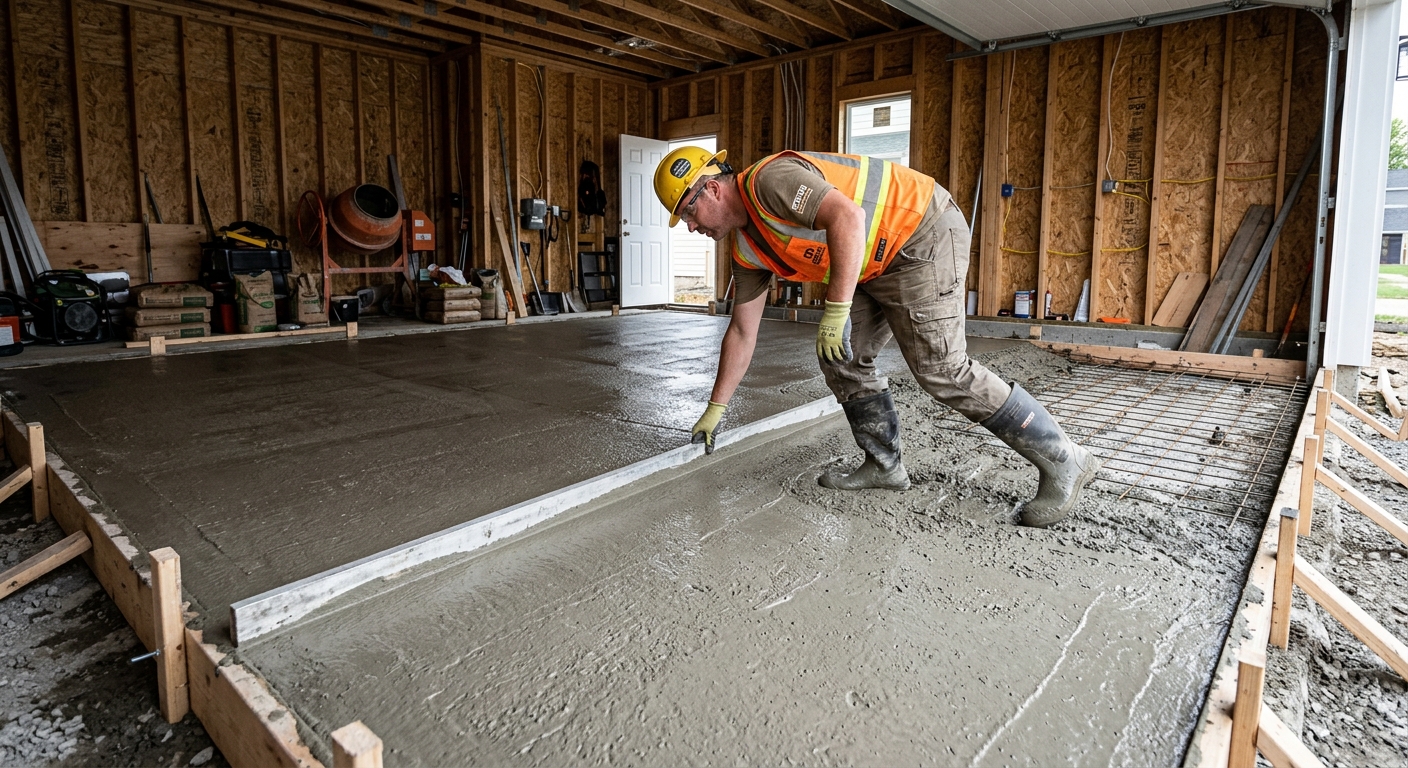
Concrete work options and costs in Glencoe
In Glencoe, Ontario, concrete is one of the fastest ways to upgrade curb appeal and usable outdoor space—especially for homeowners with driveways, patios, and walkways that see heavy seasonal moisture. Glencoe is a smaller community with a population of 2,126 (Statistics Canada, 2021 Census), and that typically means fewer big crews on rotation—when schedules open up, pricing can tighten. It also means a lot of work is concentrated around established residential streets where access is straightforward, which helps keep mobilization costs predictable. In the Toronto economic region, which includes Glencoe’s broader market for trades and materials, concrete pricing is heavily influenced by frost depth, freeze–thaw cycles, and how long crews can pour reliably before the weather forces cold-weather protections.
Driveways and exterior slabs need well-compacted granular base and drainage so water doesn’t expand and contract against the concrete every winter. For durability, contractors commonly specify air‑entrained mixes, adequate slab thickness, and control joints to manage cracking. Those choices—and the extra labour time to do base prep and proper curing—are why two “driveway replacements” can land far apart. In Glencoe’s local demand, areas around the downtown corridor and main service roads tend to be where exterior flatwork calls are frequent, because homeowners prioritize projects that improve winter traction and lower maintenance complaints.
Below is a realistic price range comparison for common concrete options so you can align quotes with what’s actually being installed.
| Application |
Typical Size |
Key Spec |
Finish Option |
Price Range |
| Concrete driveway (standard broom finish) |
12 ft x 24 ft (288 sq ft) |
4 in slab, granular base, proper grading |
Broom finish + control joints |
$18,000–$28,000 |
| Exposed aggregate driveway |
12 ft x 24 ft (288 sq ft) |
4 in slab, air‑entrained mix, base prep |
Exposed aggregate + joints |
$22,000–$32,000 |
| Stamped concrete driveway or patio |
10 ft x 20 ft (200 sq ft) |
4 in slab (exterior), air‑entrained mix |
Stamped pattern + release + sealer |
$4,800–$8,000 |
| Plain concrete patio or walkway |
8 ft x 16 ft (128 sq ft) |
4 in slab, compacted granular base |
Broom or smooth trowel |
$2,050–$3,325 |
| Garage floor (interior slab) |
20 ft x 22 ft (440 sq ft) |
4 in slab, vapour considerations |
Smooth trowel + saw cuts |
$7,900–$12,100 |
| Foundation footings (structural, below frost) |
Typical house: 40 linear ft |
Footings to 1.2 m (about 4 ft) below grade minimum |
Reinforced concrete footings |
$7,200–$12,000 |
Prices are estimates only and vary by project scope, site access and material selection.
What affects the price of concrete work in Glencoe
In the Toronto economic region, it’s common to see quotes for the “same” concrete job differ by 30–50% once you look past the surface price per square foot. That gap usually comes from differences in base preparation, reinforcement, mix design (especially air‑entrainment), and curing protections. Concrete is sensitive to how it’s built—not just what it looks like—so two contractors can offer the right finish but still use different specs that matter in Glencoe’s freeze–thaw weather.
Frost depth and freeze–thaw cycles dictate the entire build-up. For structural work, footings generally need to extend below the design frost depth—around 1.2 m (about 4 ft) minimum in Ontario—to prevent frost heave and differential movement. For exterior flatwork, contractors typically specify air‑entrained concrete mixes to help the slab survive repeated cycles. Costs also change with the pour schedule: in colder parts of Ontario, the reliable pour season is shorter and cold-weather curing precautions (insulating blankets, heating, extended protection) can add labour and rental expenses. Finally, de-icing salt accelerates surface spalling, which is why sealing and correct surface finishing often add to the bill—but can save money on repairs.
In Glencoe, a common cost swing happens between a basic broom-finish patio and a higher-spec option: for example, a standard patio often lands in the $16–$26 per square foot band, while stamped work usually runs higher—often in the $24–$40 per square foot band—because it includes formwork, stamping labour, and extra sealer and curing attention. If your home is older and the soil is already disturbed or poorly draining, excavation and drainage work can push the job toward the top end of the driveway/slab ranges by adding days of prep.
| Price Factor |
Why It Matters |
Cost Impact |
| Frost line depth — determines footing depth and form height |
Deeper footings reduce frost heave risk and stabilize the structure |
Can raise foundation/footings pricing by moving from shallow to full required depth |
| Site preparation — excavation, grading, compacted granular base |
Good base prevents settlement and keeps slab stress low in freeze–thaw |
Often adds 10–25% if soils are wet, soft, or need regrading |
| Reinforcement — rebar or wire mesh requirement |
Reduces cracking and improves load capacity for exterior flatwork and foundations |
Typical incremental material/labour increase; higher where specs call for more steel |
| Mix design — air-entrainment and compressive strength spec |
Air-entrained concrete resists freeze–thaw damage and scaling/spalling |
Small per-cubic-yard increase that can prevent costly failures; drives “premium” quote gaps |
| Finish type — broom vs. stamped vs. exposed aggregate |
Finish affects labour time, materials, and sealing requirements |
Stamped/exposed options usually push costs into the higher bands (e.g., $24–$40 for stamped) |
| Pour size and concrete truck access to site |
Long pours or difficult access increase labour time and pumping/handling |
Can add several thousand dollars if access requires pump or extended staging |
| Cold-weather curing precautions — heating and blankets |
Concrete needs protection so it reaches proper strength before it freezes |
Higher in shoulder-season pours; can increase labour/rental by 5–15% |
| Control joint pattern and sealing cost |
Joints control cracking; sealing helps reduce salt-driven surface deterioration |
Premium quotes include better joint layout and high-quality sealer system |
Permits & regulations in Ontario
In Ontario, structural concrete work requires the proper approvals before you start. That includes footings, foundation walls, grade beams, and any structural concrete element that supports a building’s loads. In most cases, you’ll need a building permit, and engineered drawings are often reviewed through the municipal process. By contrast, concrete flatwork—like patios, walkways, and driveways—typically does not require a permit unless the work affects lot grading, stormwater drainage, impervious surface limits, or the municipal right-of-way (for example, if you’re tying into or altering curb/drain areas). Even when a permit isn’t usually required for a driveway or patio, you still want the contractor to confirm whether your specific location triggers review.
Before breaking ground in Glencoe, verify insurance and compliance like you’re protecting your home’s build quality—not just the contractor. Step-by-step:
- Ask the contractor for a Certificate of Insurance (liability) showing coverage active for the project dates.
- Confirm WSIB (Workplace Safety and Insurance Board) clearance—your contractor should be in good standing or provide proof they’re registered/exempt.
- For licences, check the appropriate provincial registry/contractor licence information using the contractor’s business details (and match the company name on the insurance).
- Request references for similar-size jobs (for Glencoe’s freeze–thaw conditions, look for exterior work with control joints and sealed finishes).
- Confirm who pulls permits (if required), and whether protection/disposal is included in the scope.
If they can’t show paperwork quickly or the scope doesn’t clearly define what’s included, treat that as a scheduling and quality risk—especially for structural concrete.
Getting concrete right in Glencoe's freeze-thaw climate
Concrete fails in Glencoe most often when water gets into the slab or the base and then freezes, pushing and pulling the concrete during freeze–thaw cycles. The biggest preventable failure is spalling (surface scaling/flaking), which is strongly tied to air content, curing, and the way the base is built. To spec a job correctly for Glencoe and the Toronto market, start with a complete build-up plan: (1) base preparation with compacted granular sub-base sized and compacted for the local soil conditions and required slab support; (2) a mix designed for exterior exposure—commonly air‑entrained with target air content around 5–7% for typical exterior flatwork and minimum 32 MPa compressive strength; (3) control joints planned to guide cracking to predictable lines; (4) curing that protects the slab long enough to reach strength—minimum 7 days under proper conditions, with extra protection if temperatures drop; and (5) sealing after cure using a penetrating sealer to help repel de-icing salts.
Ask for these specs, because the “cheapest” option often misses air-entrainment or shortcuts base compaction. In exterior work, air-entrainment is usually not the biggest cost line—but it’s what keeps the slab serviceable through Ontario winters. If you compare options, the extra cost for a better finish can be worth it when it reduces long-term repairs: for example, a stamped driveway/patio often sits in the $24–$40 per square foot range due to stamping labour and sealing, while plain concrete patio/walkway typically lands around $16–$26 per square foot. If your priority is longevity and low maintenance, pay attention to the base and curing details first—then choose the aesthetic finish.
| Spec |
Why It Matters in Glencoe |
What to Ask For |
Impact if Skipped |
| Compacted granular base (depth?) |
Stable support reduces settlement and pumping during freeze–thaw |
Specify granular base thickness and compaction method; confirm drainage/grading |
More cracking, uneven settling, and early surface failure |
| Air-entrained concrete mix (target air %?) |
Resists freeze–thaw scaling and spalling from water expansion |
Ask for target air content, typically 5–7% for exterior flatwork |
Higher likelihood of spalling and flaking in Ontario winters |
| Compressive strength (MPa rating) |
Ensures the slab reaches durability strength before exposure |
Minimum 32 MPa (or as engineered/spec’d for your project) |
Weaker surface, abrasion damage, and faster deterioration |
| Control joints (spacing per ACI guidelines) |
Controls where cracking happens so it doesn’t become random |
Ask for joint layout/spacing plan based on slab size and thickness |
Wider random cracks and more water ingress at damage points |
| Minimum 7-day curing period |
Concrete needs time to gain strength before freeze conditions return |
Confirm curing protection plan; extend protection if cold weather arrives |
Surface softening, increased scaling risk, and reduced service life |
| Penetrating sealer (when applied after cure) |
Repels moisture and helps limit de-icing salt damage |
Apply penetrating sealer after cure, typically around 28 days post-pour |
Faster surface wear, staining, and salt-related spalling |
How to choose a concrete work contractor in Glencoe
Choosing the right concrete contractor in Glencoe is mostly about verifying documentation and matching the quote to the technical specs that matter in Ontario’s freeze–thaw climate. Start with Ontario compliance checks. Ask for a liability insurance Certificate of Insurance naming the worksite/address and showing active coverage. Then confirm WSIB clearance (or WSIB registration/exemption where applicable) so you’re not stuck with the risk if something goes wrong on site. For licensing details, ask the contractor for their business information and use Ontario resources/registries to confirm the company is legitimate and consistent with the paperwork they provide.
Next, get 2–3 itemised written quotes, not one lump sum. You want a breakdown that clearly separates labour, concrete supply, base prep/compaction, reinforcement, formwork, saw cutting/control joints, disposal, and sealing (if included). Make sure the scope states whether permits are pulled (if required) and whether demolition and haul-away/disposal are included. For warranty, ask for both workmanship warranty length and product/manufacturer warranty terms; also ask if it’s transferable to future homeowners.
Payment schedule matters: never pay more than 10–15% upfront. Hold back a portion until the final inspection is complete and the finished work meets spec (especially joints sealed/cleaned properly). Finally, require a written timeline with a start date window and completion estimate. In Ontario’s cooler seasons, a clear schedule is a quality indicator because curing protection needs planning.
- Verify liability insurance and confirm project-date coverage
- Confirm WSIB clearance status (request proof)
- Use itemised quotes: base prep, reinforcement, saw cuts, sealing, disposal
- Ask for slab thickness and granular base thickness in writing
- Confirm air‑entrained mix and target spec for exterior work
- Require a joint layout plan (spacing and where joints land)
- Ask what happens if temperatures drop during curing (blankets/heating)
- Check whether sealing is included and when it’s applied (post-cure)
- Look for a clear start/completion schedule tied to weather protection
- Confirm who pulls permits (structural concrete) and who is responsible for compliance
- Agree on inspection steps before final payment
- Avoid contractors who won’t provide references for similar exterior freeze–thaw jobs
Concrete red flags in Glencoe include: no written air‑entrainment or mix strength spec for exterior slabs, refusal to show WSIB/liability documentation, quotes that ignore base depth/compaction, “seal later” promises with no date or scope, and a vague schedule that doesn’t address curing protection in cold snaps.
Frequently asked questions — concrete work in Glencoe
What is air-entrained concrete and why does it matter here?
Air‑entrained concrete is a mix designed with microscopic air bubbles that give freezing water room to expand without breaking the paste. In Ontario—including Glencoe—freeze–thaw cycles and moisture from rain and melting snow are hard on exterior flatwork. Without proper air content, you’re more likely to see spalling and scaling at the surface after a few winters, especially where de-icing salts get used.
When comparing quotes in Glencoe, don’t accept “we use exterior mix” as a vague answer. Ask the contractor to state the air‑entrainment approach and target air content for your application. For budgeting, know that exterior flatwork commonly falls within bands like $16–$26 for patios/walkways and $18–$28 for driveways in this market—premium specs like air entrainment are usually part of what pushes a quote toward the higher end.
How do I prepare the base for a concrete slab?
For any slab in Glencoe, base prep is where performance is won or lost. The contractor should excavate to the required depth, remove unsuitable material, and install a compacted granular sub-base that’s graded to drain water away from the slab. Proper compaction is critical because a weak or uneven base causes settlement, which then translates into cracking and premature surface damage under freeze–thaw stresses.
In Ontario practice, base prep is also tied to frost considerations, because water movement under slabs increases with winter cycling. Ask your contractor to specify granular base depth and how they’ll compact (equipment type and passes). Also ask how they’ll handle wet soils or drainage issues on your property—if they don’t plan for drainage, you can get failure even if the concrete finish looks good on day one.
Good base prep is typically a major reason quotes vary across the region, sometimes by 30–50% when one quote includes proper excavation/compaction and the other doesn’t.
How do I compare concrete quotes?
To compare concrete quotes in Glencoe, focus on scope and specs, not just the total. Start by asking each contractor for an itemised breakdown: demolition and haul-away/disposal, excavation, base material and compaction, reinforcement (if required), concrete supply, finishing, saw cutting/control joints, curing protection, and sealing (if included). If any quote is “lump sum” with unclear inclusions, it’s not truly comparable.
Then check whether the quote matches your real application and finish. For example, plain patio or walkway work commonly aligns with $16–$26 per square foot, while stamped concrete is often higher—commonly within $24–$40 per square foot—because of labour, stamping materials, and additional sealing attention. Make sure thickness, air‑entrainment, and joint spacing are written into the scope, especially for exterior flatwork exposed to winter freeze–thaw.
Finally, confirm what happens in cold snaps: curing blankets/heating and protection can make the difference between a durable slab and a costly call-back.
Can concrete be poured in cold weather in Glencoe?
Yes, concrete can be poured in cold weather in Glencoe, but it should be done with protection planning—not “pour and hope.” Ontario contractors commonly adjust for temperatures near and below about 10 °C by using curing blankets, heating, and insulation strategies to help the concrete reach required strength before freezing. If a contractor ignores cold-weather curing precautions, it increases risk of weak surfaces, higher scaling, and early cracking.
Ask how they’ll manage the pour date, how long they’ll protect the slab, and what materials/equipment they’ll use for curing. Also ask whether they have a process for monitoring conditions and adjusting protection if the weather drops.
Cold-weather precautions add cost and can push a job toward the higher end of the typical price bands, especially for exterior slabs. It’s a legitimate expense—because failing concrete in a freeze–thaw climate can cost far more than the premium for proper curing.
How do I maintain concrete in Glencoe's freeze-thaw climate?
Maintenance in Glencoe is mainly about keeping water and salts from attacking the surface and joints. Start with sealing: for exterior flatwork, a penetrating sealer applied after proper cure (often around 28 days post‑pour) helps repel moisture and reduces the damage de-icing salts can cause over time. Reapply sealing as recommended by the sealer manufacturer and based on traffic and exposure.
Keep the surface clean and remove debris that holds moisture. Use de-icing products carefully; while salts are common, excessive use and repeated exposure can accelerate scaling if the slab is unsealed or joints are leaking. Also, don’t fill random cracks with incompatible materials—use joint-appropriate crack repair where needed.
Finally, watch the edges and joint lines. If you see settlement, standing water, or joints that are opening, address the drainage/base issue early. Preventing water infiltration is how you protect a slab through Ontario winters.
What causes concrete to spall in Glencoe winters?
Spalling in Glencoe winters is usually a freeze–thaw problem made worse by moisture and poor slab durability. The most common causes include inadequate air‑entrainment (so the concrete can’t tolerate freezing expansion), insufficient curing protection (so the surface is weaker), and inadequate base drainage (so water sits under/around the slab and cycles each winter).
De-icing salt can accelerate surface breakdown by increasing moisture movement at the surface, especially on flatwork that’s left unsealed. Thin slabs or slab designs without properly planned control joints can also worsen cracking, which then opens pathways for water to enter and freeze.
When you’re reviewing quotes, ask directly about air-entrained mix and target air content for exterior work, thickness, base compaction, curing plan, and whether penetrating sealer is included. It’s often the difference between staying closer to mid-range pricing like $18–$28 for a driveway and avoiding repeat repairs that quickly exceed that cost.