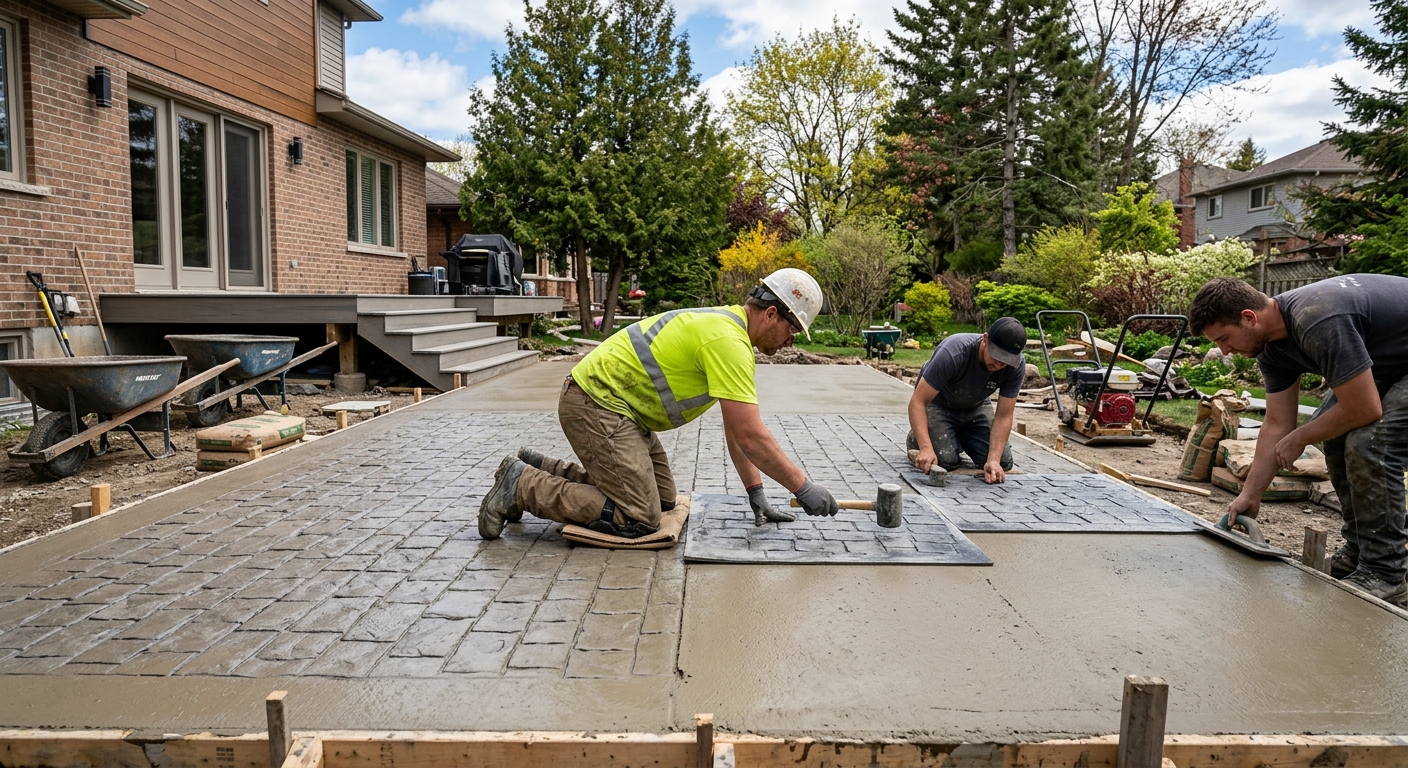
Concrete work options and costs in Quinte West
Concrete work is a big part of home life in Quinte West—whether you’re replacing a worn driveway, adding a patio by the back door, or building new steps for year-round access. The demand is strong because most homes in Quinte West are traditional single-detached houses (76.1% of dwellings), and many homeowners are actively planning exterior updates. With homeowner households making up 74.6% of households, most concrete projects start as “live-with-it” upgrades rather than purely new builds. You also see a lot of older housing stock (61.5% of homes built before 1981), which often means existing concrete is already showing issues like scaling, uneven settlement, and failed edges around the garage and walkways.
In the Kingston–Pembroke concrete market, pricing is shaped less by the slab style and more by site conditions and weather windows. Frost line depth and freeze-thaw cycles drive footing depth, base prep, and drainage details, while the shorter pour season in Ontario can tighten scheduling and increase labour costs. Around Lake Ontario and the Bay of Quinte, Quinte West jobs often face damp ground and slower curing discipline—contractors must protect the pour and control finishing timing to avoid early surface damage. That’s why some neighbourhood pockets—like the newer growth areas near Westward Ho / Trenton-adjacent zones and parts of the west end—see steady demand for driveways and walkways, especially in spring and early fall.
Below is a practical comparison of common concrete options and typical cost bands for Quinte West, so you can line up scope before you compare quotes.
| Application |
Typical Size |
Key Spec |
Finish Option |
Price Range |
| Concrete driveway (standard broom finish) |
400 sq. ft. (e.g., 20' x 20') |
Air-entrained mix; compacted granular base; control joints |
Broom finish |
$120,– $180 |
| Exposed aggregate driveway |
400 sq. ft. (e.g., 20' x 20') |
Air-entrained mix; proper curing; border/edge detailing |
Exposed aggregate (surface retarder wash) |
$140,– $220 |
| Stamped concrete driveway or patio |
300 sq. ft. (e.g., 15' x 20') |
Air-entrained mix; colour hardener; release agent; sealing |
Stamped pattern + sealer |
$160,– $280 |
| Plain concrete patio or walkway |
200 sq. ft. (e.g., 10' x 20') |
Air-entrained mix; compacted base; edge forms |
Smooth/steel trowel or broom finish |
$90,– $150 |
| Garage floor (interior slab) |
480 sq. ft. (e.g., 24' x 20') |
Vapour barrier (where appropriate); thickened edges; finish |
Steel-trowel or broom + densifier (optional) |
$140,– $200 |
| Foundation footings (structural, below frost) |
~2,000 lin. ft. varies by foundation plan |
Engineered layout; pour below design frost depth |
Structural concrete (reinforced) |
$180,– $320 |
Prices are estimates only and vary by project scope, site access and material selection.
What affects the price of concrete work in Quinte West
Even when homeowners think they’re comparing the “same job,” concrete quotes across Kingston–Pembroke and the broader Ontario market can swing by about 30–50%. The reason is that the biggest costs often sit outside the finished concrete: excavation, granular base prep, reinforcement, formwork complexity, delivery distance, and—especially in Ontario—weather protection during cool shoulder-season conditions. A stamped driveway that looks similar on two websites can involve very different labour time, colour/seasonal curing risk, and sealing requirements.
In Quinte West, frost line depth and repeated freeze-thaw cycles dictate specifications. Footings must be set below the design frost depth to prevent frost heave, and exterior slabs need air-entrained concrete mixes to survive freeze-thaw stresses. In colder zones, the pour season is shorter and cold-weather curing precautions (insulating blankets, heaters, controlled protection) can add meaningful cost. De-icing salt also accelerates surface spalling, so sealing discipline matters for exterior flatwork. That’s why a plain patio might land closer to the $90–$150 per sq. ft. band, while a stamped option that includes colour hardener, stamping labour, and sealing often trends toward $160–$280 per sq. ft.
Concrete examples from local Quinte West sites: (1) if your driveway is on heavy clay or near a low spot, contractors typically spend more on excavation and drainage—raising cost even with the same square footage; (2) if your garage approach has tight access for the truck, additional labour may be needed to stage materials and complete forms cleanly; (3) older properties with cracked edges often require sawcut removal and re-build of base, not just a “top-up,” which can add hundreds to thousands depending on depth and rebar tie-in. With many homes built before 1981, it’s common to see settlement at steps and driveway aprons that forces correct base reconstruction, not patchwork.
| Price Factor |
Why It Matters |
Cost Impact |
| Frost line depth — determines footing depth and form height |
Controls how deep structural concrete must go to resist frost heave |
Higher excavation and formwork; significant cost variance by site and design |
| Site preparation — excavation, grading, compacted granular base |
Good drainage and compaction reduce settlement and cracking |
Can add large costs if soil is unsuitable or base must be rebuilt |
| Reinforcement — rebar or wire mesh requirement |
Needed where design and load conditions require it |
Material and placement labour increases; varies by foundation vs slab |
| Mix design — air-entrainment and compressive strength spec |
Air entrainment improves freeze-thaw durability for exterior flatwork |
Often modest material premium, but critical to longevity and repair risk |
| Finish type — broom vs. stamped vs. exposed aggregate |
More complex finishes require extra labour and timing control |
Decorative options typically cost materially more than broom finish |
| Pour size and concrete truck access to site |
Impacts logistics, staging, and the ability to finish properly |
Restricted access can increase labour and equipment time |
| Cold-weather curing precautions — heating and blankets |
Ensures strength gain and protects surface during cool periods |
Can add noticeable cost during shoulder-season jobs |
| Control joint pattern and sealing cost |
Controls cracking location and protects against salt-driven damage |
More joints and proper sealing adds scope; reduces future spalling repairs |
Permits & regulations in Ontario
In Ontario, concrete can be simple flatwork—but once it becomes part of the structure, permits and engineered review often enter the picture. Structural concrete work like footings, foundation walls, grade beams, and other load-bearing elements typically requires a building permit, and many projects use engineered drawings that the municipality reviews as part of permit approval. For concrete flatwork such as patios, walkways, driveways, and typical garage approach slabs, a permit usually isn’t required unless the work affects lot grading, drainage, impervious surface coverage limits, or the municipal right-of-way (for example, work near a sidewalk or driveway apron rules). Because requirements can vary by situation and lot details, confirm with the Quinte West building department before breaking ground.
Homeowners should also verify that the contractor is properly insured and set up to do the work safely. Ask for a Certificate of Insurance showing general liability coverage and request proof of WSIB/WCB coverage (coverage types can vary, so have the contractor clarify what applies to the specific crew working on your site). Step-by-step, here’s how to verify:
- Confirm the contractor’s business details and legal name from their quote/contract.
- Request their WSIB clearance letter (or provide the applicable documentation they use).
- Review the Certificate of Insurance for limits, effective dates, and that your address is covered if applicable.
- Ask for references on similar Quinte West projects (driveways, patios, or foundation work) and follow up.
- Check online licensing/registry listings where applicable to the contractor’s trades and responsibilities.
Getting these items right at the start prevents delays, workmanship disputes, and insurance issues later—especially important in a freeze-thaw climate where foundation and exterior durability must be correct from day one.
Getting concrete right in Quinte West's freeze-thaw climate
Concrete fails in Quinte West most often when specs don’t match local climate behaviour. The big culprits are inadequate base preparation, poor drainage, insufficient air entrainment, weak curing discipline, and control joint design that allows random cracking. Freeze-thaw cycles expand water in the concrete and around the edges; if salts from de-icing get into microcracks, surface scaling and spalling can follow. If your neighbourhood sits damp or has older drainage patterns—common around many established parts of town—this risk increases because moisture stays near the slab longer.
To spec the job correctly, focus on five areas. (1) Base preparation: require a compacted granular sub-base to the correct depth for your soil and frost considerations, not “minimum fill.” (2) Mix design: for exterior flatwork, ask for air-entrained concrete with 5–7% air content and a minimum 32 MPa compressive strength. (3) Control joints: specify joint spacing that limits random cracking and ensure joints are cut promptly and cleanly. (4) Curing: require minimum 7 days of proper curing conditions; in cold or damp periods, contractors should use curing protection, because early traffic or exposure before strength gain can damage the surface. (5) Sealing: plan penetrating sealer applied after cure (commonly around 28 days) to help repel de-icing salts and reduce moisture movement.
A concrete example: a broom-finish driveway may land closer to the $120–$180 band, but paying for the correct air content, better base compaction, and proper sealing often costs less than the first major fix. If you “save” by skipping sealing, you may still get through the first winter, but you can see edge spalling and scaling sooner—turning a manageable maintenance issue into a costly repair and potential slab replacement.
Use these details in your questions so the crew builds for Quinte West’s Ontario winters from the beginning.
| Spec |
Why It Matters in Quinte West |
What to Ask For |
Impact if Skipped |
| Compacted granular base (depth?) |
Proper thickness and compaction control settlement and cracking under freeze-thaw |
Granular base depth and compaction requirements tied to your soil |
Uneven slab, pumping, early cracking and edge failures |
| Air-entrained concrete mix (target air %?) |
Air bubbles give room for freezing water expansion |
Air content stated (typically 5–7% for exterior flatwork) |
Higher risk of scaling and spalling in winter |
| Compressive strength (MPa rating) |
Strength gain supports durability and surface resistance |
Minimum 32 MPa compressive strength |
Surface deterioration, reduced long-term performance |
| Control joints (spacing per ACI guidelines) |
Joints give cracks a path and reduce random cracking |
Joint spacing plan and sawcut timing |
Random cracking, spall initiation at uncontrolled breaks |
| Minimum 7-day curing period |
Cold/damp conditions slow strength gain—curing protects the surface |
How curing will be maintained; protection in cool weather |
Weak surface, early wear under vehicles and salt exposure |
| Penetrating sealer (when applied after cure) |
Salt and moisture move differently in exterior slabs when sealer is used correctly |
Penetrating sealer applied after cure (commonly around 28 days) |
Faster salt-driven scaling; higher maintenance and replacement risk |
How to choose a concrete work contractor in Quinte West
Choosing a concrete contractor is mostly about verifying three things: capability to spec for freeze-thaw, proof they’re insured, and clarity in how they price your scope. In Ontario, confirm licensing and trade responsibility where applicable, then verify liability insurance and WSIB/WCB coverage. Practical steps: ask the contractor for their WSIB clearance letter (or applicable documentation), review their Certificate of Insurance for coverage limits and dates, and ensure the address is properly covered if your insurer requires it. If the quote is vague about curing or base prep, that’s a red flag—Quinte West concrete needs disciplined curing and air-entrained mixes for exterior durability.
Next, get 2–3 itemised written quotes. You want line items for excavation, granular base prep, reinforcement, forms, finishing, concrete supply/delivery, and any traffic control or disposal. A “single number” quote without the breakdown makes it hard to compare apples to apples. Also check exclusions: Is the permit pull included where required? Is disposal of excess soil included? Are ties into existing slabs included (sawcut, remove unsound concrete, and base rebuild) or only “patch and pour” assumed?
Ask about warranty. A good workmanship warranty is typically clearly defined in writing, and you should know whether it’s transferable if you sell the home. Finally, payment schedule should protect you: never pay more than 10–15% upfront, and hold back a portion until the job is complete and deficiencies are corrected. Get the timeline in writing with a start date estimate and finish/curing milestones, because Ontario’s weather windows and shoulder-season conditions can affect scheduling.
- Ask for the exact concrete mix spec: air entrainment, strength, and whether it’s suitable for exterior exposure.
- Confirm base prep scope: excavation depth, granular type, and compaction method.
- Request reinforcement details: where rebar/wire mesh is used and at what spacing.
- Check finishing plan: broom grade for driveways and slip resistance expectations.
- Confirm control joint spacing and how/when joints are cut.
- Discuss curing protection: blankets/heaters for cool nights and how long they’ll be used.
- Ask whether sealing is included and when it will be applied (after cure, commonly around 28 days).
- Require an itemised quote with labour + materials, not just a lump sum.
- Verify disposal of excess material and whether hauling is included.
- Check site protection: protection of landscaping, door thresholds, and existing drainage patterns.
- Ask for concrete delivery window planning and contingency if weather changes.
- Get a written warranty and what “service call” costs (if any) are covered.
Concrete red flags I’ve seen across Quinte West include: promises of “no need for air-entrainment” to save money, skipping curing protection in cool weather, refusing to specify base depth/compaction, quotes that don’t mention control joints, and contractors who won’t provide proof of WSIB/WCB coverage or updated insurance paperwork before starting.
Frequently asked questions — concrete work in Quinte West
How do I maintain concrete in Quinte West's freeze-thaw climate?
In Quinte West, maintenance is about managing moisture and protecting the surface from salt and freeze-thaw stress. Start with cleaning: remove debris and sand/rocks that can abrade the surface, especially after winter. Use de-icing products carefully—avoid over-salting and try to switch to calcium chloride blends where appropriate, since excessive chloride can accelerate surface damage. If your contractor applied a penetrating sealer, plan on inspections after winter and consider re-sealing based on how the surface repels water. For exterior slabs, keep drainage functioning around edges so meltwater doesn’t sit against the concrete. If you’re choosing upgrades, remember a broom-finish driveway is commonly priced around the $120–$180 band, but sealing discipline and correct mix design are what keep that price from turning into early repairs.
What causes concrete to spall in Quinte West winters?
Spalling in Ontario winters is usually a freeze-thaw and salt story. Water enters the concrete through microcracks and porous areas, freezes, and expands—damaging the surface layer. If the concrete wasn’t properly air-entrained (the key protection against freeze-thaw), the surface is far more likely to scale and then spall. Ontario de-icing salt worsens things by increasing chloride intrusion, which speeds up deterioration at the surface. Site conditions matter too: poor base drainage, thin or weak base, or weak edge detail lets moisture collect and increases freeze damage cycles. Older homes built before 1981 in Quinte West often have drainage issues or settled edges that concentrate water. If you’re comparing quotes, ask directly about air content, curing protection, and sealing—those are the specs that reduce spalling risk.
What is rebar and when is it required in Ontario?
Rebar (reinforcing steel) is used to strengthen concrete where loads, flexing, or structural requirements demand it. In Ontario, whether rebar is required depends on engineering design, structural drawings, and the type of concrete element—driveway slabs, patios, foundations, and footings are treated differently. For structural work like foundation footings and foundation walls, rebar requirements are typically determined by engineered plans and load assumptions, and they’re part of the structural permit scope. For exterior slabs, reinforcement may be specified based on slab thickness, soil conditions, and expected loads such as vehicles. In Quinte West’s freeze-thaw climate, proper base prep and drainage are just as important as reinforcement; rebar can’t fix poor compaction. When you get a quote, ask: where is rebar used, what size/spacing, and is it tied into existing foundations or slabs where required?
How long does a concrete project take in Quinte West?
For many residential concrete projects in Quinte West, “install time” is often one to three days, but total project time depends on curing and scheduling. A typical driveway pour day may include prep, forming, and finishing the slab within one working day, while curing means you should not treat the slab as fully serviceable immediately. Many contractors plan traffic limitations for at least 24–48 hours depending on weather conditions, with full-strength expectations growing over time. If you’re pouring in cooler periods of the Ontario season, curing protection (blankets or heaters) may extend the window for safe use and final finishing details. Stamped work usually adds time due to colouring, stamping, and finishing tolerances. If you’re comparing options, remember stamped concrete often sits in the $160–$280 range and takes more labour and careful timing than a broom-finish driveway closer to $120–$180. Always ask for a written start date and completion/cure milestones.
What is a concrete overlay and is it suited to Quinte West?
A concrete overlay is a new cementitious layer placed over an existing concrete surface—sometimes to improve appearance or add a uniform finish, without full removal. In Quinte West, overlays can be suited when the existing slab is stable and well-bonded, with no major structural failure, deep delamination, or widespread settlement. If the base has moved or water has repeatedly penetrated and caused spalling, an overlay may fail early because it can’t correct underlying drainage and base issues. Overlay performance also depends on surface preparation—proper grinding, cleaning, and sometimes bonding systems. Decorative overlays exist too, but they still require freeze-thaw durability and correct curing practices. If you’re considering overlay versus removal and replacement, the best comparison is to look at cracks, heaving, and edge deterioration around your driveway or walkway. For projects with significant spalling or poor drainage, removal and proper base reconstruction are usually the long-term best value.
How do I seal concrete to protect it in Quinte West?
Sealing helps protect exterior concrete by reducing moisture and salt penetration, which is important in Quinte West’s freeze-thaw climate. The key is timing: sealing too early can trap moisture and reduce performance. A common approach is penetrating sealer after full curing—often around 28 days post-pour—assuming weather conditions are suitable and the surface is clean/dry. Before sealing, the slab should be thoroughly cleaned to remove dirt, oils, and any contaminants that prevent penetration. Contractors should test for readiness (for example, surface dryness and absorption behaviour) rather than sealing on a guess. Sealer is especially valuable on driveways and walkways where de-icing salts are used. If you’re choosing between finishes, remember decorative work like stamped concrete often costs more (often in the $160–$280 range), but sealing is part of protecting that investment. Ask your contractor what sealer type they use (penetrating vs film-forming), application conditions, and whether it’s included in your quote.