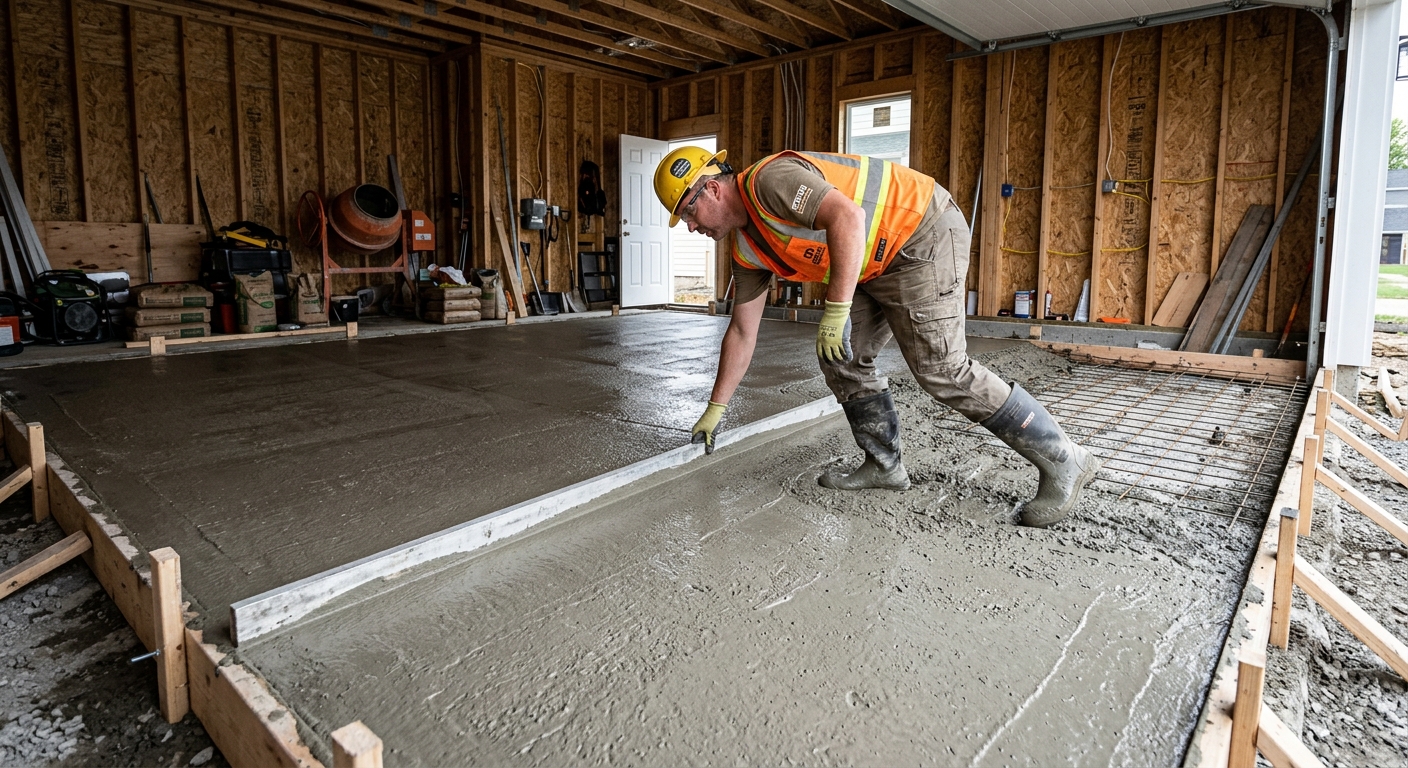
Concrete work options and costs in West Hill
In West Hill, Ontario, most homeowners start their concrete plan with flatwork—driveways, patios, and walkways—because it’s the quickest way to modernize curb appeal. With West Hill’s population sitting at 27,392 people (Statistics Canada, 2021 Census), and a steady mix of established neighbourhoods, demand for durable exterior concrete stays consistent year to year. The area’s housing stock is also very practical: single-detached and townhouse properties are common, and that typically means frequent driveway and patio upgrades where homeowners want a long service life, not just “something that looks fine for a season.”
Toronto-area concrete pricing is shaped by freeze–thaw cycles and the frost depth spec that drives how deep contractors must go with structural footings. For exterior pours, crews generally focus their schedule in the warmer months to protect curing quality as temperatures hover closer to the low-teens and dip toward 10 °C. That’s why even “routine” slabs can cost more than you’d expect if your site needs extra base prep, deeper reinforcement, air-entrained mix design, or additional cold-weather protection during shoulder-season work. Availability also varies: late spring and early fall can be busier than mid-summer, but curing performance becomes more sensitive to overnight temperatures, so the better contractors build their schedules around those conditions.
You’ll often see especially high demand along Kingston Road and the Guildwood area, where homeowners commonly renovate sidewalks and replace older drive surfaces. Below is a practical cost comparison to help you budget before you request an itemized quote.
| Application |
Typical Size |
Key Spec |
Finish Option |
Price Range |
| Concrete driveway (standard broom finish) |
10 m x 3 m (approx. 30 m²) |
Air-entrained exterior mix, compacted granular base |
Broom finish + control joints |
$18,000–$28,000 |
| Exposed aggregate driveway |
10 m x 3 m (approx. 30 m²) |
Air-entrained mix, proper curing and washing timing |
Exposed aggregate finish |
$22,000–$34,000 |
| Stamped concrete driveway or patio |
25 m² (typical patio-sized section) |
Air-entrained mix, release agent and color hardener |
Stamped pattern + integral color |
$24,000–$40,000 |
| Plain concrete patio or walkway |
6 m x 4 m (approx. 24 m²) |
Air-entrained mix, granular base + edge forms |
Broom finish |
$16,000–$26,000 |
| Garage floor (interior slab) |
6 m x 6 m (approx. 36 m²) |
Vapour barrier, proper sub-base, recommended reinforcement |
Trowel finish or broom finish |
$20,000–$32,000 |
| Foundation footings (structural, below frost) |
Typical small addition/repair (allowance by linear metres) |
Engineered sizing, below-grade excavation and rebar cage |
Structural concrete |
$180–$300 |
Prices are estimates only and vary by project scope, site access and material selection.
What affects the price of concrete work in West Hill
In the Toronto economic region, it’s common to see quotes for the “same-looking” concrete work vary by 30–50% once you compare the actual specs—especially base depth, reinforcement, mix design, and cure protection. Two contractors can both price a driveway, but if one includes proper granular excavation and the right air-entrained exterior mix while the other assumes simpler site conditions, the difference shows up in both crack control and long-term durability. Because West Hill is within Toronto’s freeze–thaw zone, contractors must treat the job like an engineered exterior system, not just a pour.
Frost depth and freeze–thaw cycles dictate every key choice. Structural footings need to extend below the local design frost depth (Ontario typically calls for at least 1.2 m, and designs often fall into the 1.5–2.4 m range) to prevent frost heave and differential movement. Exterior slabs also require air-entrained concrete to survive repeating cycles; that’s why exterior driveway and patio pricing is anchored to the local band (for example, concrete driveways typically land around $18,000–$28,000 in this city tier). In colder periods, crews also may add cold-weather curing precautions—insulating blankets or temporary heating—to maintain proper strength gain. De-icing salt accelerates surface spalling if the surface is not sealed and the mix and curing aren’t done correctly.
In West Hill, the most cost-sensitive variables often are site access and soil moisture. If your driveway ties into a sloped lot and requires thicker base and more grading, you may see pricing closer to the top end of the $18,000–$28,000 driveway band. Conversely, a flat lot with good drainage and straightforward truck access can keep you nearer the low-to-mid range. For stamped or decorative work, $24,000–$40,000 is commonly justified when the added labour for stamping, integral colouring, and careful curing protects appearance through Ontario’s wet fall and freeze–thaw winter.
| Price Factor |
Why It Matters |
Cost Impact |
| Frost line depth |
Determines footing depth and form height below grade |
Can add significant excavation and rebar labour; impacts foundation work most |
| Site preparation |
Excavation, grading, and well-compacted granular base prevent settlement |
Higher if soils are wet/soft, access is tight, or disposal is needed |
| Reinforcement |
Rebar or wire mesh reduces cracking and improves load performance |
Increases material and setup time; essential for exterior slabs |
| Mix design |
Air-entrainment and compressive strength specs protect through freeze–thaw |
Costs more than basic mixes, but lowers failure risk and patching |
| Finish type |
Broom vs. stamped vs. exposed aggregate changes labour and materials |
Stamped/exposed finishes typically increase cost and require more skilled crews |
| Pour size and concrete truck access to site |
Large pours or limited access may require extra equipment and time |
Can increase labour hours and pump/placement logistics |
| Cold-weather curing precautions |
Heating/insulating blankets protect strength gain when temperatures drop |
Adds daily labour and materials; prevents weak surface performance |
| Control joint pattern and sealing cost |
Proper jointing limits random cracking; sealing helps resist salt damage |
Small line items that meaningfully reduce maintenance and spalling |
Permits & regulations in Ontario
In Ontario, structural concrete work—anything that supports a building’s structure—typically requires a building permit and, in many cases, engineered drawings reviewed by the municipality. That usually includes footings, foundation walls, grade beams, and other structural elements that are part of the load-bearing system. For homeowners in West Hill, that means any plan that changes foundation structure or adds an engineered support system should be treated as “permit-required” until proven otherwise.
Concrete flatwork (driveways, patios, walkways, and sidewalks on your private property) usually does not require a permit, provided it doesn’t materially alter lot grading, create drainage issues, or run into municipal rules around impervious surface coverage and any ties to municipal right-of-way. If you’re cutting near a city sidewalk, working in an easement, or changing how water drains off the property, you should confirm requirements with the local authority before breaking ground.
Before you sign, verify three basics: contractor licensing/registration where applicable, liability insurance, and WSIB/WCB coverage. Step-by-step, ask for: (1) a current certificate of insurance naming you as additional insured where offered; (2) WSIB/WCB clearance or account proof for the firm and relevant workers; and (3) references on similar-scale Ontario exterior projects. To check credibility, use the online public business/contractor registry resources for your trade category (when available), then cross-check that the company name on the quote matches the insurance certificate. A reputable contractor should also explain what they handle—permit pull (if needed), inspections, and documentation—so there are no gaps when inspections are required.
Getting concrete right in West Hill's freeze-thaw climate
Concrete failure in West Hill is usually a freeze–thaw story: water gets in, the surface or base expands, and the slab or edges crack or spall—especially under de-icing salt. The fix isn’t just “more thickness.” It’s a system: base preparation, the right air-entrained mix, sensible control joints, proper curing, and sealing at the right time. In the Toronto market, the best crews build specs around the reality of wet fall, cold nights, and winter temperature swings.
First, base preparation matters most. Ensure a properly excavated, compacted granular sub-base to the correct depth for your soil conditions so there’s no pumpy base that moves in the spring thaw. Second, mix design should be air-entrained for exterior flatwork, targeting about 5–7% air content, with a minimum 32 MPa compressive strength to meet durability expectations. Third, control joints must be planned and cut to limit random cracking; without them, you’ll often see stress cracks where you least want them. Fourth, curing should be at least 7 days under appropriate conditions—when pours happen near the colder shoulder-season, contractors may add protection because strength gain slows as temperatures drop. Fifth, sealing is critical: a penetrating sealer applied around 28 days after the pour helps repel salt and moisture at the surface.
To avoid spalling, you should ask direct questions about air-entrainment and curing protection. A practical example: if a standard broom-finish patio comes in around the mid-range of the local band ($16,000–$26,000), you may spend a bit more on correct base and an air-entrained exterior mix—often worth it versus paying later for lift-and-replace. Stamped finishes may cost more (often near $24,000–$40,000 depending on scope), but good curing and sealing protect appearance through Ontario winters.
| Spec |
Why It Matters in West Hill |
What to Ask For |
Impact if Skipped |
| Compacted granular base (depth?) |
Prevents settlement and reduces water movement that freezes under slabs |
Base thickness by soil type + compaction test/method |
Uneven cracking, rocking slabs, and premature repairs |
| Air-entrained concrete mix (target air %?) |
Protects paste from freeze–thaw scaling in Toronto’s winter cycles |
Confirm target 5–7% air content for exterior flatwork |
Higher risk of spalling and surface deterioration |
| Compressive strength (MPa rating) |
Improves durability and strength gain in a variable curing season |
Minimum 32 MPa specified and how curing is maintained |
Weaker surface performance and faster weathering |
| Control joints (spacing per ACI guidelines) |
Controls where cracks form during shrinkage and temperature movement |
Joint spacing plan and cutting schedule |
Random cracking patterns and wider repairs |
| Minimum 7-day curing period |
Ensures strength development before the freeze–thaw season peaks |
How they protect during cold nights (blankets/heating if needed) |
Reduced strength and increased early-life damage |
| Penetrating sealer (when applied after cure) |
Repels moisture and helps reduce salt-related surface damage |
Penetrating sealer around 28 days post-pour (or as specified) |
More staining, increased freeze–thaw scaling, and higher maintenance cost |
How to choose a concrete work contractor in West Hill
Choosing a concrete contractor in West Hill comes down to proof—not promises. Start by verifying Ontario coverage details. Ask for: (1) liability insurance (current certificate and project-specific coverage); (2) WSIB/WCB clearance or proof of coverage for the firm and workers; and (3) if the contractor participates in any trade registration relevant to their scope, confirm their registration status matches the company name on the quote. Then check the paperwork: the certificate of insurance should show expiry dates, and WSIB/WCB clearance should correspond to the legal entity doing the work. If they can’t provide documents quickly, that’s a red flag.
Next, don’t accept vague lump sums. Get 2–3 itemised written quotes that break out labour, concrete supply, base prep, reinforcement, saw-cut joints, disposal/haul-away, and finishing/sealing. Ask what’s excluded: for example, is permit work included if structural elements require it, is grading/drainage correction included, and is any municipal sidewalk or hydro/easement work handled or avoided? A good quote also spells out timelines—start date, pour date window, and completion estimate—because in Toronto-area weather, schedule protection is a concrete quality issue.
Warranty matters too. Confirm workmanship warranty length and whether it covers labour for removal and replacement, not just cosmetic touch-ups. Understand the product/manufacturer warranty if applicable, and whether it’s transferable. For payment, keep it controlled: typically no more than 10–15% upfront, then hold back until key milestones are complete and cured. Concrete is unforgiving—proper cure time and joints are where workmanship shows.
- Ask for a clear written scope: base depth, reinforcement type, and air-entrained mix confirmation.
- Verify liability insurance and request WSIB/WCB clearance/proof before work starts.
- Confirm disposal/haul-away is included (or priced separately).
- Request an itemised breakdown (labour vs materials vs saw cutting vs sealing).
- Check who supplies and schedules concrete truck/pump, and how they manage pour sequencing.
- Require a control joint plan (spacing and cutting timing), not “we’ll cut when we can.”
- Ask what cold-weather curing precautions apply if temps drop.
- Clarify curing protection responsibilities and how long the contractor will keep the surface protected.
- Ensure sealing is specified: penetrating sealer and approximate timing after cure.
- Get the start date and completion estimate in writing, including contingencies for weather.
- Confirm warranty: workmanship duration, what triggers coverage, and whether replacement is covered.
- Use a payment schedule that leaves a holdback until finish quality and cure milestones are met.
Concrete red flags in West Hill include: quotes that omit base thickness and air-entrained mix details, “too-fast” schedules that ignore minimum curing and protection, refusal to provide insurance/WSIB/WCB proof, no written joint plan (leading to random cracking), and vague warranty terms that don’t cover removal/replacement for structural failure.
Frequently asked questions — concrete work in West Hill
When is the best time to pour concrete in West Hill?
In West Hill and the wider Toronto region, the best window is late spring through early fall—when daytime temperatures are consistently warm and nights don’t frequently drop low enough to slow strength gain. Contractors often plan exterior flatwork around the conditions needed for good curing, because freeze–thaw cycles can quickly expose weak early-age concrete. If you’re scheduling a driveway or patio, aim to pour when temperatures stay reliably above about 10 °C for curing progress, or confirm the contractor will use insulating blankets/heating if temperatures fall. If you do work in shoulder season, you should expect extra curing protection costs reflected in the quote. A well-timed pour helps you avoid early cracking and surface scaling that show up after winter starts.
How long does concrete take to cure?
Concrete curing has two timelines: initial set/finishing and strength gain. For most exterior flatwork in Ontario, you’ll typically need at least 7 days of proper curing under suitable conditions before you can treat the slab as fully supported for normal use. Full strength development continues beyond that—often into the 28-day mark—when you’ll see maximum performance. This matters in West Hill because moisture and salt get trapped near the surface during winter. For sealing, many contractors wait until about 28 days after the pour (once the concrete is cured and dry enough) to apply a penetrating sealer. If a contractor rushes curing or removes protection too early, you can get a weak surface that spalls faster than expected.
Do I need a permit for concrete work in Ontario?
In Ontario, structural concrete work (like footings, foundation walls, and grade beams) generally requires a building permit and may involve engineered drawings that are reviewed through the municipal process. Concrete flatwork such as driveways, patios, and walkways often does not require a permit by default, but it can if the work affects lot grading, impervious surface rules, drainage, or any impacts near municipal right-of-way. For West Hill homeowners, the safe approach is to confirm with the local authority before the excavation starts—especially if you’re changing drainage patterns or working close to sidewalks. Also ask your contractor what they include in the scope: permit pull (if required), protection of adjacent surfaces, and disposal. A credible contractor will tell you clearly what needs permitting and who handles it.
Concrete vs pavers for a patio in West Hill?
Concrete and pavers both work well for patios in West Hill, but the climate and maintenance picture differs. Concrete patio pricing often falls in the local band of $16,000–$26,000 depending on size, thickness, and finish. Concrete is usually easier to maintain as a monolithic surface, and a well-specified air-entrained mix with control joints plus sealing performs reliably through freeze–thaw. Pavers can be more flexible if you anticipate future landscaping changes; however, they rely on excellent base preparation too, or shifting can occur when water freezes and thaws. If you prefer the look of stamped or decorative finishes, stamped concrete can add visual impact with costs commonly near $24,000–$40,000. The best choice usually comes down to your desired look, drainage plan, and how long you want to go before any re-lifting or re-grading work.
How long does a concrete driveway last?
A concrete driveway’s lifespan in West Hill depends heavily on base prep, mix design, jointing, and how it’s protected. With good air-entrained exterior concrete, proper granular base compaction, correctly spaced control joints, and sealing at the right time, many driveways can last decades. In the Toronto area, failures often show up early when air-entrainment is inadequate, curing is rushed, or joints aren’t cut and sealed—leading to freeze–thaw spalling and random cracking. If your driveway is exposed to lots of de-icing salt, sealing becomes more important because it helps repel moisture at the surface. If you’re getting a new driveway priced in the typical West Hill tier of $18,000–$28,000, ask the contractor to specify the air-entrained mix, base depth, reinforcement plan, and whether they will recommend sealing after cure.
What is air-entrained concrete and why does it matter here?
Air-entrained concrete is mixed with microscopic air bubbles that give freezing water places to expand without damaging the paste. In West Hill and the Toronto economic region, freeze–thaw cycles are one of the biggest reasons exterior concrete deteriorates—especially under de-icing salt exposure. That’s why most exterior slabs and driveways should use an air-entrained exterior mix, typically targeting about 5–7% air content for durable performance. If air-entrainment is missing or incorrect, the concrete can scale and spall sooner, even if it initially looks fine. When you’re comparing quotes for exterior flatwork around $16,000–$26,000 or driveways around $18,000–$28,000, look for the spec language: air-entrained mix, minimum compressive strength, curing protection, and jointing. Those details are what protect your investment through Ontario winters.