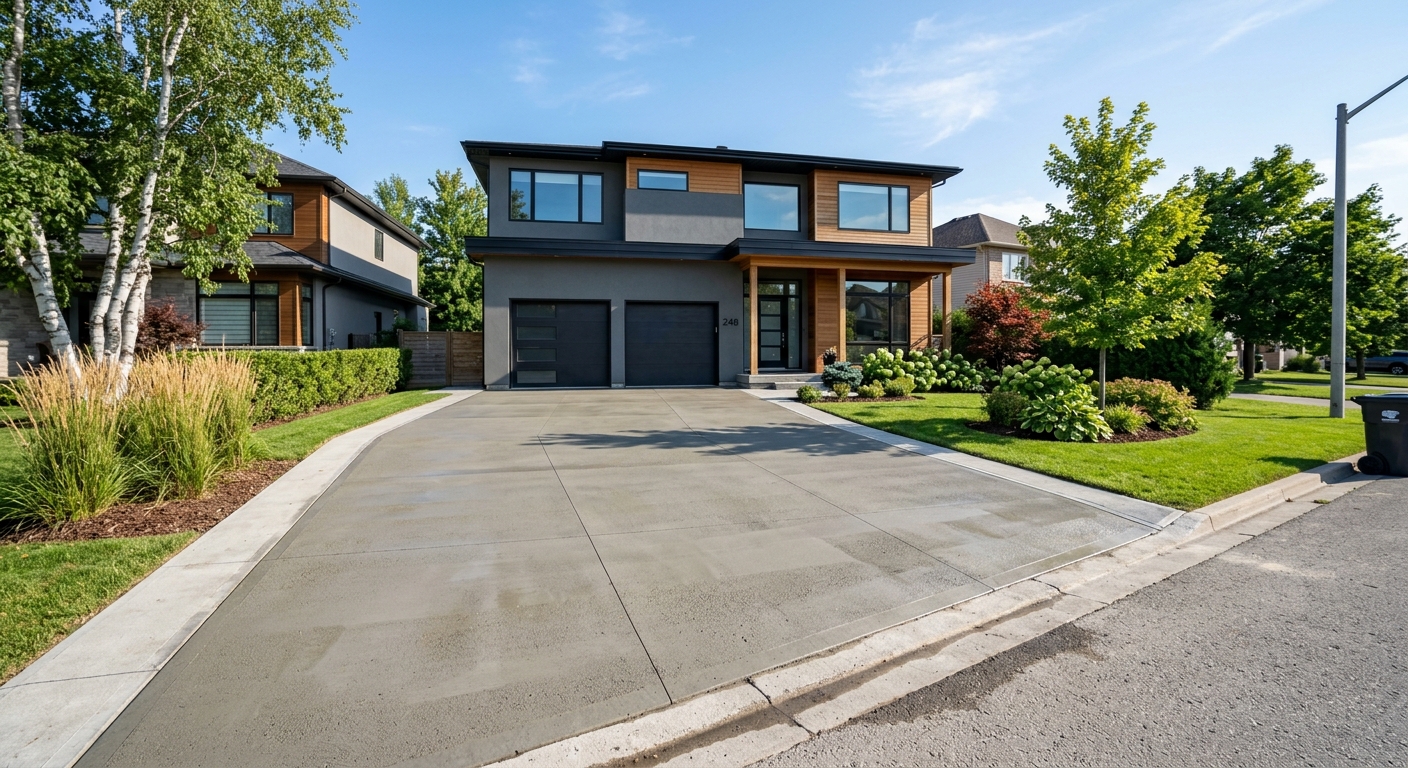
Concrete work options and costs in County Park
Concrete work in County Park is shaped by a familiar mix: steady demand from homeowners upgrading older lots and new infill builds, plus Toronto-area freeze–thaw stress that pushes crews to be more careful with base prep, drainage, and mix design. With County Park’s population sitting at 3,367 (Statistics Canada, 2021 Census), there’s a steady but practical level of contractor availability—enough tradespeople to compete, but not endless flexibility when crews are booked during peak pour season.
Most concrete flatwork is tied to detached and family-style housing, and that’s where driveways, walkways, and patios get replaced most often. In this area, the climate is a cost driver: Ontario’s structural footings generally need to extend below the design frost depth (commonly around 1.2 m or more below grade) to reduce frost heave risk, while exterior slabs rely on properly air-entrained concrete and well-planned joints. The Toronto economic region also sees humid, often wet fall and spring conditions, so contractors need to manage curing protection when temperatures trend toward 10 °C or below. That can change labour time and the amount of cover materials used (insulating blankets, curing blankets), and it’s one reason identical jobs can land in different price bands.
In County Park, I see the strongest demand for driveways and front-stoop upgrades in the older residential pockets off the main arterials—where curb runoff and soil saturation are common. If you’re comparing options, the table below breaks down realistic “what you get” specifications and price ranges, so you can match your quote to your intent.
| Application |
Typical Size |
Key Spec |
Finish Option |
Price Range |
| Concrete driveway (standard broom finish) |
400 sq. ft. |
Air-entrained exterior mix, compacted granular base |
Broom finish + control joints |
$7,200 – $11,200 |
| Exposed aggregate driveway |
400 sq. ft. |
Air-entrained mix + proper retard/cleaning plan |
Exposed aggregate finish |
$8,600 – $12,400 |
| Stamped concrete driveway or patio |
320 sq. ft. |
Air-entrained mix, integral colour, joint layout |
Stamp + texture release |
$8,000 – $12,800 |
| Plain concrete patio or walkway |
200 sq. ft. |
Air-entrained mix, compacted base, drainage grade |
Broom finish or light trowel |
$3,200 – $5,200 |
| Garage floor (interior slab) |
500 sq. ft. |
Fibre or mesh reinforcement, vapour barrier as needed |
Float finish |
$9,000 – $15,000 |
| Foundation footings (structural, below frost) |
per linear foot allowance |
Excavation, engineered rebar, concrete placement below grade |
Structural concrete finish (as formed) |
$180 – $300 |
Prices are estimates only and vary by project scope, site access and material selection.
What affects the price of concrete work in County Park
In the Toronto economic region, it’s common to see quotes for the “same” concrete job vary by 30–50%. The reason usually isn’t price gouging—it’s that frost depth, freeze–thaw cycles, and scheduling realities force different specs and different site prep. Ontario Building Code practices typically push most structural footings to extend at least about 1.2 m below grade so you don’t get frost heave and differential movement. For exterior flatwork, contractors also rely on air-entrained mixes and proper thickness so the slab survives repeated winter expansion and contraction. When teams have to pour close to cooler nights or damp spells, they may need cold-weather protection and longer curing control, which adds both labour time and materials. Surface damage from de-icing salts is another Ontario-specific reason sealing is often recommended for driveways and walkways.
Concrete costs can rise or fall quickly in County Park based on a few local realities. For example, a driveway replacement on a lot with saturated subsoil often needs extra excavation and a thicker, well-compacted granular base—shifting the job toward the higher end of the $18,000 – $28,000 driveway band. Conversely, a straightforward patio with good drainage and easy forms typically lands closer to the lower range of $16,000 – $26,000 for patios/walkways. Another cost lever is reinforcement: if your subgrade is poor or the slab is larger, wire mesh or rebar requirements can add cost but reduce long-term settlement cracking.
Even within the same neighbourhood, older housing stock can mean drainage patterns were never ideal—so you may pay more to rebuild grading and slope the slab away from the house. In practice, those details matter as much as the pour date.
| Price Factor |
Why It Matters |
Cost Impact |
| Frost line depth — determines footing depth and form height |
Footings must extend below design frost depth to reduce frost heave risk |
Can add significant excavation + concrete volume; often shifts structural work toward upper band |
| Site preparation — excavation, grading, compacted granular base |
Unsuitable soils or poor compaction cause settlement and early cracking |
Heavy haul-away and rebuild base can raise cost by 10–25% |
| Reinforcement — rebar or wire mesh requirement |
Controls cracking from loads and subgrade movement |
Mesh/rebar can add labour and material; typically 5–15% depending on slab type |
| Mix design — air-entrainment and compressive strength spec |
Air-entrained concrete helps resist freeze–thaw damage; strength affects durability |
Higher-spec mixes and placement testing can move pricing toward the high end |
| Finish type — broom vs. stamped vs. exposed aggregate |
Complex finishes require more steps, labour time, and curing control |
Stamped/exposed typically add 20–45% over standard broom finish |
| Pour size and concrete truck access to site |
Limited access increases labour for placement, wheelbarrowing, and planning |
Long placement distances can add 5–20% |
| Cold-weather curing precautions — heating and blankets |
Protects fresh concrete when temperatures drop toward 10 °C or below |
May add materials and labour; can raise cost notably for late-season pours |
| Control joint pattern and sealing cost |
Joints manage cracking; sealing helps repel moisture and de-icing salt impact |
Often small per square foot, but meaningful value for exterior durability |
Permits & regulations in Ontario
In Ontario, concrete is split into two practical categories: structural concrete and non-structural flatwork. Structural items—like footings, foundation walls, and grade beams—typically require a building permit, and many projects also need engineered drawings reviewed as part of the permit process by the municipality. The permit requirement is mainly about ensuring the design meets strength, drainage, and frost-related performance requirements.
Concrete flatwork (patios, walkways, driveways) usually does not require a permit by default, but it can if it affects grading, changes lot drainage, or impacts municipal requirements such as impervious surface limits or work near the right-of-way. Also, if your driveway ties into a permit-driven change (like grading that affects a foundation drain or eavestrough routing), expect questions from the municipality.
For County Park homeowners, the verification process should be simple and documented:
- Confirm the contractor’s Ontario business information and credentials (ask for their business details and insurance certificates before any start).
- Request a Certificate of Insurance (liability) naming you as an additional insured if possible.
- Ask for WSIB/WCB coverage clearance—get the document or clearance confirmation in writing.
- Check references on similar-size exterior flatwork and any structural work they claim to perform.
- If structural concrete is involved, insist they coordinate the permit and engineer requirements before excavation.
When in doubt, confirm with the local authority before breaking ground—one missed detail can delay pours and add cost fast.
Getting concrete right in County Park's freeze-thaw climate
Concrete fails in County Park most often when the slab or foundation is “built for average weather” instead of Toronto-area freeze–thaw reality. The biggest drivers are inadequate base preparation, insufficient thickness, and the absence (or wrong dosage) of air-entrained concrete on exterior work. If water gets under or into the slab and then freezes, it can expand, lift edges, and create spalling—especially when de-icing salts are used year after year.
To spec the job correctly, focus on five things. First is base preparation: a compacted granular sub-base, placed to the right depth for the soil conditions and frost performance needs. Second is mix design: for exterior flatwork, ask for air-entrainment in the range of 5–7% air content and a minimum 32 MPa compressive strength. Third is control joints: they should be laid out to limit random cracking; don’t let joints be “wherever the crew can fit them.” Fourth is curing: aim for a minimum 7-day curing period under proper conditions. In cooler stretches, curing protection matters. Finally, sealing: for driveways and walkways, use a penetrating sealer applied 28 days after pour to help repel moisture and de-icing salt impact.
How does this show up in cost? If a standard broom-finish patio comes in at the lower end of the $16,000 – $26,000 band, it’s often because the base is straightforward and the joints/sealing plan is already included. If you’re choosing stamped concrete in the $8,000 – $12,800 range for a typical patio/driveway area, you’re paying for extra steps and tighter scheduling—not for “stronger concrete.” The best value is when the contractor also nails the base, joints, and air content; otherwise, even decorative work can crack early.
| Spec |
Why It Matters in County Park |
What to Ask For |
Impact if Skipped |
| Compacted granular base (depth?) |
Prevents frost-related movement by keeping the slab supported and draining |
State granular type, thickness, and compaction method (and whether subgrade is stabilized) |
Settlement cracking, rocking slabs, and faster deterioration |
| Air-entrained concrete mix (target air %?) |
Helps concrete resist freeze–thaw damage and reduce spalling risk |
Confirm air content target of 5–7% for exterior flatwork |
Higher risk of surface scaling/spalling within a few winters |
| Compressive strength (MPa rating) |
Strength supports durability under traffic and seasonal moisture cycling |
Confirm minimum 32 MPa rating for exterior pours |
Early wear, cracking, and reduced lifespan |
| Control joints (spacing per ACI guidelines) |
Controls where cracks occur during curing shrinkage and seasonal movement |
Ask for a joint spacing plan and exact joint details |
Random cracking in visible areas and more difficult repairs |
| Minimum 7-day curing period |
Proper curing builds strength and reduces surface defects in variable Ontario temperatures |
Ask how curing will be protected if night temperatures fall |
Weaker surface, dusting, and increased permeability |
| Penetrating sealer (when applied after cure) |
Repels water and helps protect against de-icing salt and spring melt exposure |
Plan for penetrating sealer at about 28 days post-pour |
Faster salt-induced deterioration and staining |
How to choose a concrete work contractor in County Park
Choosing the right concrete contractor in County Park comes down to proof and process, not just a low number. In Ontario, verify licensing/credentialing where applicable to their scope, but more importantly for homeowners: confirm they carry liability insurance and WSIB/WCB coverage. You can check this by asking for (1) a current Certificate of Insurance from their insurer, (2) WSIB/WCB clearance or confirmation, and (3) the contractor’s business information and contact details that match the quote. Never rely on verbal confirmation—get documents before the first concrete truck arrives.
Next, get 2–3 itemised written quotes. The best quotes break down labour and materials (excavation, base material, rebar/mesh, formwork, concrete supply, finishing labour, curing protection, sealing if included, and disposal). Avoid lump-sum-only estimates that don’t say what’s included. Read the scope carefully: what is excluded (tree removal, hauling away topsoil, old concrete demo disposal, permits, traffic control)? Is permit coordination included if structural work is required? Are site protections and protection of landscaping part of the price?
Warranty matters too. Ask for a workmanship warranty length in writing, and clarify whether it covers control-joint performance, cracking repairs, and workmanship-related defects. Then confirm manufacturer/product warranty details. For payment, never pay more than about 10–15% upfront; hold back enough to ensure completion. Finally, request a start date and a completion estimate in writing—concrete crews plan around truck routes and curing windows.
- Verify liability insurance certificate is current and adequate for the job scope.
- Confirm WSIB/WCB coverage (clearance in writing).
- Ask for references on driveways/patios built in similar freeze–thaw conditions.
- Request an itemised quote with excavation, base, reinforcement, concrete supply, finishing, curing protection, and sealing (if offered).
- Confirm joint layout, saw-cut timing (if applicable), and sealing plan for exterior work.
- Ask what air-entrained mix specification they will use for exterior slabs.
- Confirm thickness and base depth (not just a “concrete thickness” number—include granular depth).
- Check whether disposal/dump fees for demo are included.
- Ensure delivery access is discussed (truck placement plan and any required ramp/haul method).
- Get curing protection details for cooler nights and damp weather.
- Review the warranty terms in plain language and what qualifies as a workmanship issue.
- Use a payment schedule with a meaningful holdback until final cleanup and sign-off.
Concrete red flags in County Park: missing air-entrainment details for exterior slabs, a quote that doesn’t specify base depth/compaction, no written curing plan for late-season pours, unclear joint spacing/timing, and contractors who want a large deposit before any paperwork, insurance confirmation, or scope review.
Frequently asked questions — concrete work in County Park
Concrete vs pavers for a patio in County Park?
In Ontario’s Toronto-region freeze–thaw climate, both concrete and pavers can perform well, but the failure modes differ. Concrete patios rely heavily on air-entrained mix and control joints to handle moisture movement; pavers rely on a properly built base and correct edge restraint to prevent shifting. If your lot has drainage issues or saturated soil, concrete with a compacted granular base and a good joint/sealing plan is often more predictable. Pavers can be great for easier spot repairs, but only if the contractor does the base right and maintains clean drainage away from the patio. For budgeting, a plain concrete patio typically sits in the $16,000 – $26,000 band for common residential sizes, while pavers often trend higher when excavation and base rebuilds are extensive.
How long does a concrete driveway last?
A concrete driveway in County Park can last 20–30 years or more when it’s built for Ontario winters: correct base preparation, air-entrained exterior concrete, adequate thickness, and well-managed joints. The biggest threats are water under the slab, de-icing salt exposure without sealer, and freeze–thaw damage if the mix wasn’t air-entrained to the right target. If the slab is installed low on a poorly compacted base, you’ll often see edge lifting or cracking in freeze-heavy seasons. A properly sealed driveway (sealer typically after full cure, about 28 days) and routine maintenance can slow surface scaling and keep the surface from becoming porous. If you’re planning a replacement, ask your contractor what they include for base prep and sealing—those details heavily influence lifespan in Ontario.
What is air-entrained concrete and why does it matter here?
Air-entrained concrete is designed with tiny, evenly distributed air bubbles that give expanding water a place to go as it freezes. That reduces internal pressure and helps prevent spalling and scaling—problems that are common in Ontario’s freeze–thaw cycles. In County Park, exterior flatwork is exposed to repeated wetting and thawing during spring melt and winter storms, and it’s also subjected to de-icing salts. That’s why GTA contractors often specify air-entrained mixes for driveways, patios, and walkways and plan control joints to manage cracking. When you compare quotes, look for an explicit air target (commonly 5–7% for exterior flatwork) and minimum strength requirements (often 32 MPa). A cheaper quote that omits air-entrainment may look attractive up front, but it can cost more later.
How do I prepare the base for a concrete slab?
Base prep is where you win (or lose) long-term performance. For a concrete slab in County Park, your contractor should excavate unstable topsoil, set the final grade correctly for drainage away from the house, and install a compacted granular sub-base to the specified depth. The key is compaction: the granular layer should be compacted in lifts to reach the required density for supporting the slab through frost and thaw cycles. If the soil is saturated or soft, they may need to remove more material or use stabilization before placing the granular base. A good quote should name the base depth, the granular type, and the compaction approach—not just “we’ll prep the base.” This is also where costs vary: heavier excavation and rebuild work can push driveway and patio projects toward the upper end of the typical bands (for example, driveway work in the $18,000 – $28,000 range).
How do I compare concrete quotes?
Compare quotes by scope, not just totals. For County Park projects, ask every bidder the same questions: slab thickness, granular base depth and compaction, reinforcement (mesh or rebar), concrete mix spec (including air-entrainment for exterior), joint layout, curing protection, and whether sealing is included for driveways/walkways. Confirm what’s included for demo removal, disposal fees, and restoration of edges/landscaping. Ask for an itemised breakdown separating labour and materials, so you can see what’s driving differences. It’s normal for Toronto-area quotes to differ by 30–50% when base prep, reinforcement, and finish complexity vary. If one quote includes sealing and a full curing plan and another doesn’t, the cheaper number often means higher risk later. As a reference point, standard exterior concrete is often priced within common bands (driveways roughly $18,000 – $28,000; patios/walkways $16,000 – $26,000).
Can concrete be poured in cold weather in County Park?
Concrete can be poured in cold weather in Ontario, but it requires correct procedures. In the Toronto area, crews typically concentrate exterior pours in warmer months for a reason: curing must progress properly to reach strength. When temperatures drop toward 10 °C or below, contractors need cold-weather curing precautions such as insulating blankets, heating the work area if necessary, and protecting the slab from freezing during the early set period. The exact methods should be described in your quote and schedule. If a contractor offers to pour late-season without a curing and protection plan, that’s a major risk—especially for exterior slabs that face freeze–thaw soon after. For County Park homeowners, the best approach is to schedule pours with adequate weather windows and insist on written curing protection details, air-entrainment, and minimum cure timing.