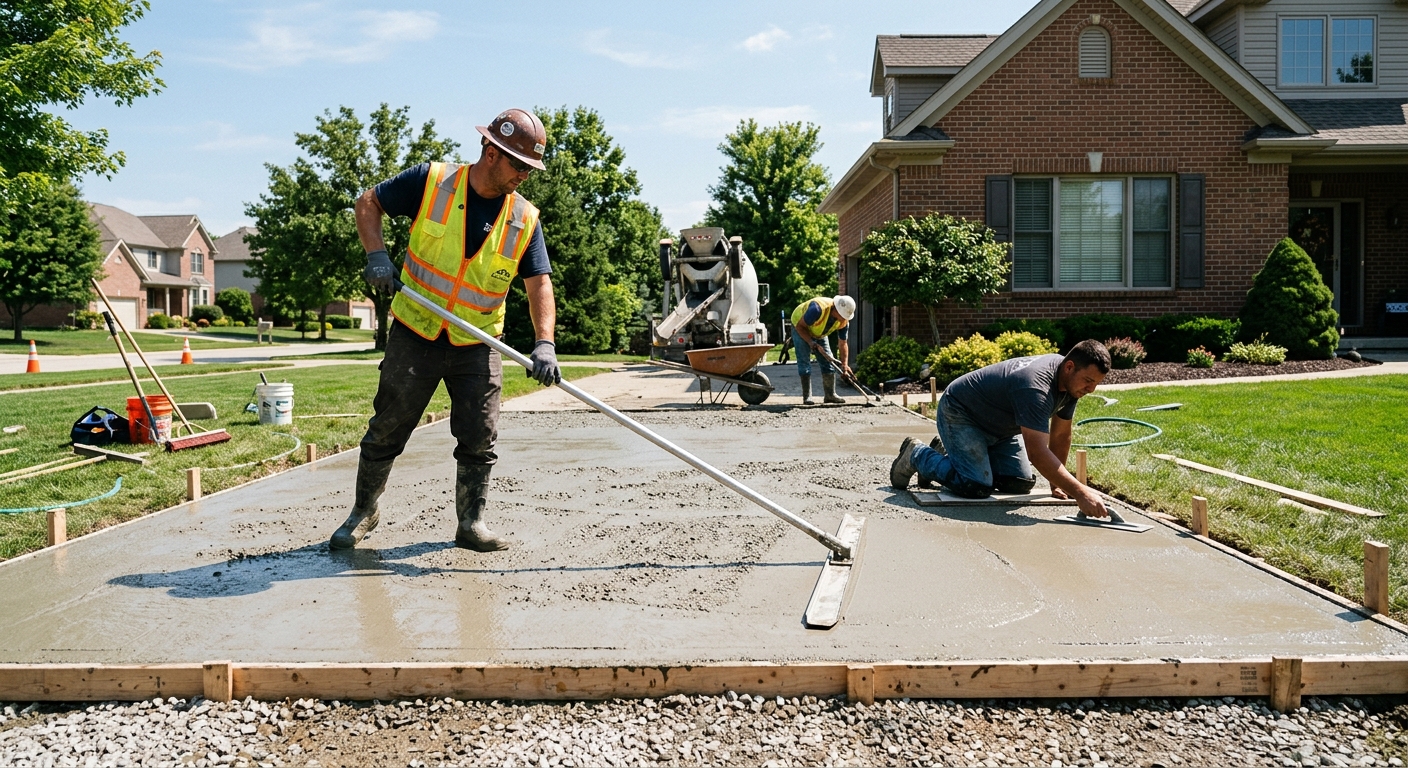
Concrete work options and costs in Orangeville
Concrete work in Orangeville is common because the area has a strong base of homeowners and a housing stock that’s maintained or upgraded in cycles. In Orangeville, single-detached homes make up about 59.7% of dwellings, and homeowner households represent 75.7% of households (Statistics Canada, 2021 Census). That mix is a big reason driveways, patios, and walkways are consistently in demand—especially in established neighbourhoods where properties are older and lots are often renovated for better parking, curb appeal, and accessible backyard routes.
In the Kitchener–Waterloo–Barrie region, costs tend to run higher than milder parts of Ontario because the freeze-thaw cycle is relentless and frost depth is commonly in the 1.0–1.2 m range. For driveways and patios, the contractor’s planning matters as much as the concrete itself: footings and any thickened edges must be built around the local frost strategy to reduce heave and random cracking. Exterior slabs also require air-entrained concrete, proper drainage, and well-spaced control joints—otherwise, you can see surface scaling and spalling during winter cycles. Labour and equipment time often increase because excavation and base prep take longer when the site is wet or the ground is firm.
Contractor availability can also shift through the year: the effective pour season is shorter, and cold-weather precautions (insulation blankets, curing protection) can add line items. If you’re pricing options, it helps to remember the market spread: a standard driveway is often budgeted around $15,000–$25,000, while decorative systems like stamped work can land in a higher range. Compare the options below for typical, homeowner-scale projects in Orangeville (for example, areas like the downtown Core and nearby family residential pockets often see driveway refreshes and patio additions after landscaping upgrades).
| Application |
Typical Size |
Key Spec |
Finish Option |
Price Range |
| Concrete driveway (standard broom finish) |
400–600 sq. ft. |
Air-entrained mix, compacted granular base, control joints |
Broom finish + saw-cut joints |
$15,000–$25,000 |
| Exposed aggregate driveway |
400–600 sq. ft. |
Air-entrained mix, proper finishing timing, sealed surface |
Exposed aggregate with protective sealer |
$18,000–$30,000 |
| Stamped concrete driveway or patio |
300–500 sq. ft. |
Air-entrained mix, colour hardener, reinforced base |
Stamped pattern + release + sealer |
$22,000–$35,000 |
| Plain concrete patio or walkway |
150–350 sq. ft. |
Air-entrained mix, compacted base, edge forms |
Float/smooth + light broom finish |
$14,000–$22,000 |
| Garage floor (interior slab) |
240–500 sq. ft. |
Vapour barrier (where required), typically 4 in. slab |
Plain finish, optional light broom/steel trowel |
$10,000–$18,000 |
| Foundation footings (structural, below frost) |
Varies by home; typical per linear ft. |
Engineered sizing, rebar, excavation below frost line |
Structural concrete with formwork |
$120,000–$220,000 |
Prices are estimates only and vary by project scope, site access and material selection.
What affects the price of concrete work in Orangeville
In Orangeville and the broader Kitchener–Waterloo–Barrie region, it’s not unusual to see quotes for the “same” concrete job come in 30–50% apart. A big driver is that contractors may be pricing different build-ups—especially excavation depth, granular base thickness, reinforcement, and curing protection—rather than just the volume of concrete. Labour availability also changes through the year, and cold snaps can force the contractor to add thermal blankets, curing control, and schedule adjustments to stay on-spec.
Frost depth and freeze-thaw cycling dictate nearly every structural spec and most exterior slab details. In Ontario, footings must extend below the design frost depth to prevent frost heave, and all exterior slabs are typically built with air-entrained concrete to survive freeze-thaw stress. The Kitchener–Waterloo–Barrie climate also means a shorter pour season, so the contractor may plan fewer “weather-permitted” days—pushing up labour and equipment costs when the schedule compresses. De-icing salt and winter traction can accelerate surface damage if the slab isn’t properly cured and sealed; in practice, this is why sealing (often a recommended step after cure) shows up as a meaningful cost line item.
Here are a few local examples that shift the final number in Orangeville: an older property built before 1981 is more likely to have compacted fill or unknown drainage conditions, which can add excavation and sub-base rebuild time (41.7% of homes were built before 1981, Statistics Canada, 2021 Census). A driveway with limited access—like tight side yards near the downtown Core—can increase hauling and formwork time. Conversely, a straightforward backyard patio on a flat lot with good existing drainage can keep pricing closer to the practical lower band—often around $14,000–$22,000 for a basic patio/walkway—while decorative stamped work can land near the $22,000–$35,000 range when colour, stamps, and labour-heavy finishing are included.
| Price Factor |
Why It Matters |
Cost Impact |
| Frost line depth |
Determines footing depth and required formwork/excavation |
Can swing major structural budgets; deeper excavation increases equipment hours |
| Site preparation |
Grading and compacted granular base control settlement and cracking |
More removal and re-compaction typically adds labour and materials |
| Reinforcement |
Rebar or mesh helps control cracking and supports slab performance |
Adds steel + tying time; also affects minimum build-up thickness |
| Mix design |
Air-entrainment and strength targets improve freeze-thaw durability |
Air-entrained and higher-spec mixes cost more but reduce early failure risk |
| Finish type |
Broom vs stamped vs exposed aggregate changes labour intensity |
Stamped/exposed usually costs more due to timing, colour and extra steps |
| Pour size and concrete truck access to site |
More volume or difficult access changes manpower and placement method |
Narrow access can mean smaller batches or additional equipment time |
| Cold-weather curing precautions |
Blankets/membranes and controlled curing protect strength gain |
Extra materials and labour can add to the quote during shoulder season |
| Control joint pattern and sealing cost |
Joints control shrinkage cracking; sealing helps manage salt exposure |
Skip or poor detailing can shorten lifespan; proper sealing adds a predictable line item |
Permits & regulations in Ontario
In Ontario, the rule of thumb is: structural concrete usually triggers permit requirements, while typical flatwork often does not. For Orangeville homeowners, you should plan on a building permit (and often engineered drawings submitted for review) when the concrete forms part of the structure—such as foundation walls, grade beams, structural footings, underpinning, and other load-bearing elements. For concrete flatwork like driveways, patios, sidewalks, and walkways, a permit is often not required on its own. That said, permits may be needed if the project changes lot drainage, affects grading, increases impervious surface beyond municipal thresholds, or encroaches near the municipal right-of-way. Always confirm with the municipality before breaking ground, especially if you’re altering swales, adding catch basins, or changing elevations.
To verify a contractor is set up correctly in Ontario, ask for three items before you sign: (1) a clear certificate of insurance (liability), (2) WSIB/WCB coverage proof, and (3) evidence the contractor is eligible/licensed to do the work where applicable (many concrete contractors are not “licensed” the same way as trades like electrical, but you still should confirm the company’s legal business status and any trade authorizations required for the scope). Step-by-step: start by asking the contractor for their certificate of insurance and WSIB/WCB clearance details; then confirm the certificate lists the correct business entity and project address. Finally, ask for references from similar Orangeville-scale pours—especially exterior flatwork built for freeze-thaw durability.
Getting concrete right in Orangeville's freeze-thaw climate
Concrete failures in Orangeville typically come from one of five issues: weak or uncompacted base, incorrect mix, poor air-entrainment, inadequate jointing, or curing shortcuts. In a cold, high freeze-thaw environment like Kitchener–Waterloo–Barrie, water expands when it freezes; if the concrete isn’t built to accommodate that expansion, you can see scaling, spalling, and random cracking. The way to prevent this is to spec the job for the local weather and frost strategy, not just for appearance.
First, base preparation: excavate to the proper depth for your soil conditions and frost strategy, then install a compacted granular sub-base. Second, mix design: exterior flatwork should be air-entrained (commonly in the 5–7% air range for durable exposure) with a minimum 32 MPa compressive strength. Third, control joints: plan saw cuts and spacing to limit uncontrolled shrinkage cracking, and keep them aligned with expected stress points (like at corners and transitions). Fourth, curing: protect the slab for at least 7 days so strength gain isn’t compromised—cold weather is where contractors need to use proper curing blankets or membranes. Fifth, sealing: apply a penetrating sealer after cure (commonly at 28 days) to help repel moisture and reduce salt-related surface damage.
If you want an example that matches real homeowner decision-making, many people consider “plain” broom-finished concrete because it fits the practical pricing band, while stamped options may add labour and materials. If a broom-finished patio lands near $14,000–$22,000, a stamped driveway may approach $22,000–$35,000. That difference is justified when the contractor also proves the structure is right—base, air-entrainment, joints, curing—because a beautiful stamp won’t last if the slab was rushed or under-built.
| Spec |
Why It Matters in Orangeville |
What to Ask For |
Impact if Skipped |
| Compacted granular base (depth?) |
Reduces settlement and controls frost-related movement in freeze-thaw cycles |
Base thickness by site soil + proof of compaction |
More cracking, edge spalling and uneven surfaces over winters |
| Air-entrained concrete mix (target air %?) |
Helps concrete resist freeze-thaw damage and salt exposure |
Confirm air content typically 5–7% for exterior exposure |
Higher risk of scaling/spalling in Orangeville winters |
| Compressive strength (MPa rating) |
Strength gain impacts durability and resistance to surface wear |
Minimum 32 MPa specified for exterior flatwork |
Surface breakdown and premature deterioration |
| Control joints (spacing per ACI guidelines) |
Controls where cracks appear so they don’t become random fractures |
Planned joint layout, saw-cut timing and spacing rationale |
Uncontrolled cracking and moisture pathways into the base |
| Minimum 7-day curing period |
Strength must develop safely despite cold, damp periods |
Describe curing method; mention protection during cold snaps |
Lower early strength and increased risk of cracking and scaling |
| Penetrating sealer (when applied after cure) |
Reduces moisture and salt penetration through the surface |
Apply penetrating sealer after cure (commonly around 28 days) |
Faster surface weathering and salt-related deterioration |
How to choose a concrete work contractor in Orangeville
Start with verification—because the quality differences show up in base prep, mix selection, and curing, not just the final broom marks. In Ontario, you want proof of liability insurance (certificate of insurance naming the correct business entity) and WSIB/WCB coverage for workers on site. Step-by-step: request the certificate of insurance and WSIB/WCB clearance before scheduling; check that the coverage is active and that dates align with your project window. If the contractor can’t provide documentation promptly, it’s a major warning sign.
Next, get 2–3 itemised written quotes with labour and materials breakdowns, not a single lump sum that hides assumptions. Ask whether permit pulling is included (for structural work it usually matters), and whether disposal of removed concrete and excess soil is covered. Read exclusions: for example, is removing existing slabs part of the price, or is it “extra if required”? Also check the warranty: workmanship warranty length, product/manufacturer warranty terms, and whether coverage is transferable to future owners if you sell.
For payment, use a safe schedule—never pay more than about 10–15% upfront. Hold back the remaining amount until the work is complete, joints are finished, edges are cleaned, and you’ve confirmed curing/protection steps were followed. Finally, insist on a written timeline with a start date and a realistic completion estimate; in Orangeville’s freeze-thaw climate, weather can affect pours and curing.
- Ask for air-entrained concrete confirmation for all exterior flatwork.
- Confirm the planned base thickness and compaction method (not just “granular base”).
- Request the joint layout and saw-cut timing for control joints.
- Get curing plan details for cold or wet shoulder-season weather.
- Require an itemised quote: excavation, base, rebar/mesh, concrete, finishing, sealing, disposal.
- Verify liability insurance certificate and WSIB/WCB proof before signing.
- Ask for at least 2 references from similar Orangeville projects (driveways/patios in particular).
- Confirm whether forms and thicknesses are included (especially at edges and transitions).
- Clarify concrete truck access limits and how they’ll handle placement if the yard is tight.
- Check warranty terms in writing: workmanship duration and what it covers.
- Set payment milestones tied to inspection and cure/protection milestones.
- Ensure cleanup and debris removal are explicitly included.
Concrete contractor red flags in Orangeville include: refusing to show air-entrained mix details, promising “no joints needed” or skipping saw cuts, starting pours without a curing plan for cold weather, vague quotes that don’t list base thickness or reinforcement, and asking for large upfront payments without a written scope and schedule.
Frequently asked questions — concrete work in Orangeville
How long does a concrete driveway last?
In Orangeville, a well-built concrete driveway commonly lasts 25+ years, but lifespan depends heavily on how the contractor handled freeze-thaw stress. Proper base prep, air-entrained concrete for exterior exposure, correct joint spacing, and curing quality are what usually separate a long-lasting driveway from one that scales or chips early. Homes in the area often have older drainage patterns and driveways experience salt and plough abrasion, which makes sealing and maintenance more important than in milder climates. If you’re comparing quotes, don’t just look at the sticker price—ask whether they’re specifying air-entrainment and a control joint plan that matches the slab size. For reference, a standard driveway often falls around $15,000–$25,000 depending on size, access, and build-up.
What is air-entrained concrete and why does it matter here?
Air-entrained concrete is mixed with microscopic air bubbles that give freezing water a place to expand. In Orangeville and the Kitchener–Waterloo–Barrie region, the repeated freeze-thaw cycle is the reason air-entrainment is critical for exterior slabs—especially driveways, patios, and walkway surfaces that see moisture and de-icing salt. Without enough air, water expansion stresses the concrete paste and can lead to scaling or spalling, often starting at the surface and corners. This is one of the most common “why is my slab failing?” causes after winter weather. When you request a quote, ask the contractor to confirm the concrete is air-entrained for exterior exposure and to explain how they’ll protect curing in cold or damp conditions.
How do I prepare the base for a concrete slab?
Base preparation is where the durability story starts in Orangeville. A good base means excavating to the correct depth for your site conditions, placing granular sub-base in lifts, and compacting it to an appropriate density before any concrete is poured. The correct thickness depends on soil, drainage, and the slab’s purpose (driveway vs walkway). In freeze-thaw regions, poor base prep leads to movement, which then creates cracks and exposes concrete to moisture cycles. Ask the contractor for the planned build-up thickness, how they’ll handle drainage (slopes, sub-drain considerations if needed), and evidence of compaction. For driveways and patios, a reputable company will also discuss control joints and edge detailing—because even the best base can’t compensate for missing joints.
How do I compare concrete quotes?
To compare quotes fairly in Orangeville, you need like-for-like scopes. Ask for itemised quotes showing excavation, base material and thickness, reinforcement (rebar or wire mesh where specified), concrete quantity, formwork, finishing, and disposal. Confirm whether the price assumes good access for the concrete truck and whether any handwork is included for tight areas near side yards. Also clarify what’s excluded: sealing, curbing/edges, removal of existing slabs, and protection during curing. Compare finish quality too—broom-finish and stamped work can look similar when first poured but differ in labour intensity and materials. If one quote lands near $15,000–$25,000 for a standard driveway and another is closer to $22,000–$35,000, the difference should be explained by build-up, reinforcement, and the finish system—not by shortcuts.
Can concrete be poured in cold weather in Orangeville?
Yes, concrete can often be poured in cold weather in Orangeville, but it must be managed correctly. The key issues are whether temperatures are cold enough to slow strength gain and whether the contractor can protect the concrete while it cures. Good contractors use cold-weather curing precautions such as insulation blankets or curing membranes and may adjust the concrete mix temperature and placement timing. You should also ask how they’ll handle freeze risk overnight and what their minimum curing protection period is. Don’t rely on “we’ve done it before” without a written curing plan. In shoulder seasons, the best projects still depend on proper scheduling to meet the minimum curing time—typically at least 7 days under protected conditions for exterior slabs.
How do I maintain concrete in Orangeville's freeze-thaw climate?
Maintenance in Orangeville is mostly about keeping water and salt from attacking the surface. Start with cleanliness: sweep off debris and avoid leaving standing water at low spots. After the slab has cured, many homeowners benefit from a penetrating sealer—often applied around 28 days post-pour—because it helps repel moisture and reduces salt penetration during winter. Reapply sealer according to the product schedule and inspect annually for hairline cracks, spalling, or joint seal failure. Keep snow clearing equipment careful at edges; repeated impacts can chip surfaces, especially on broom-finished driveways. If your driveway or patio has control joints, keep them clean and repair them promptly so water doesn’t migrate into the base during freeze-thaw cycles.