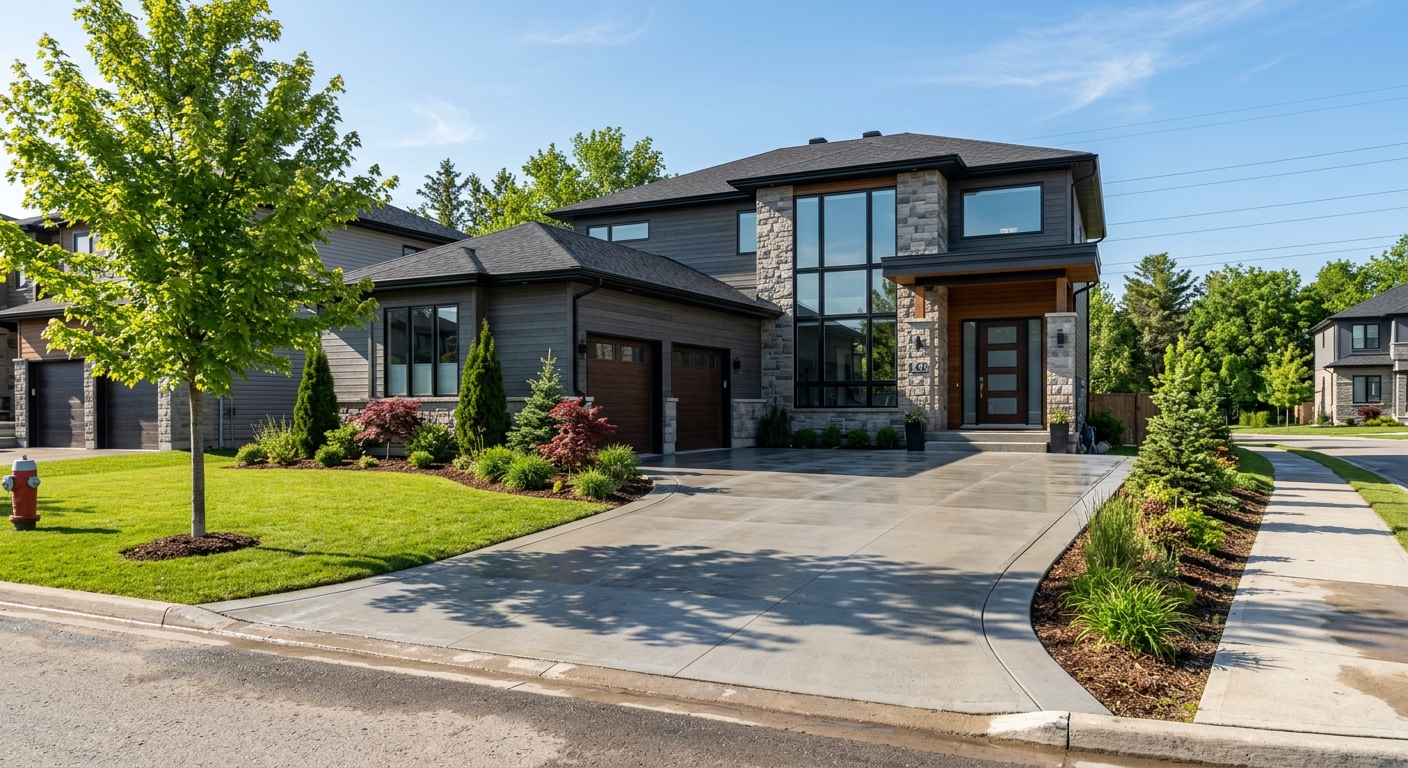
Concrete work options and costs in Clarence-Rockland
Concrete work in Clarence-Rockland is a smart upgrade for homeowners because most neighbourhoods here need exterior flatwork that can handle long winters and repeated freeze–thaw cycles. With 74.5% of local dwellings being single-detached homes, demand is steady for driveways, patios, walkways, and even interior garage slabs. The market also skews older in parts of town—29.1% of homes were built before 1981—so many jobs involve replacement and matching existing grades, not just new pours.
Ottawa-area pricing stays higher than in milder regions because the frost line drives deeper excavation and more insulation/isolated detailing, especially at slab edges and walkout points. Strong labour demand in the building season can tighten schedules, too, and cold-weather limitations shorten finishing windows—meaning contractors often plan around curing conditions with blankets or heaters when temperatures drop. If you’re near popular residential pockets like the Rockland core (around Main Street and nearby streets), concrete flatwork is especially in demand during spring replacements and fall crack-sealing touch-ups as homeowners prepare for another winter.
Below are realistic cost ranges homeowners in Clarence-Rockland typically see for common projects. Use them to sanity-check quotes, then compare the specifications line-by-line—base depth, air-entrainment, reinforcement, and joints are usually where “cheap” bids turn expensive later.
| Application |
Typical Size |
Key Spec |
Finish Option |
Price Range |
| Concrete driveway (standard broom finish) |
400–600 sq. ft. |
Well-compacted granular base; air-entrained mix for exterior exposure; control joints |
Broom finish, 4–6 in thickness typical |
$16,000–$25,000 |
| Exposed aggregate driveway |
400–600 sq. ft. |
Air-entrained mix; careful wash process; reinforced edges as required |
Exposed aggregate (sand or small stone), slip-resistant texture |
$18,000–$29,000 |
| Stamped concrete driveway or patio |
300–500 sq. ft. |
Air-entrained mix; thicker/stronger spec often used; sealed finish |
Stamped pattern with release and optional colour hardener |
$22,000–$35,000 |
| Plain concrete patio or walkway |
150–300 sq. ft. |
Granular base + air-entrainment; appropriate slope to drain |
Smooth or broom finish; lightweight edging |
$14,000–$22,000 |
| Garage floor (interior slab) |
300–500 sq. ft. |
Vapour barrier as needed; reinforcing as specified; proper flatness |
Trowel finish; optional hardener |
$12,000–$20,000 |
| Foundation footings (structural, below frost) |
Per project/engineered layout |
Engineered footing dimensions; below frost level; rebar per design |
Structural concrete (no decorative finish) |
$120–$200 |
Prices are estimates only and vary by project scope, site access and material selection.
What affects the price of concrete work in Clarence-Rockland
In Clarence-Rockland and the wider Ottawa area, it’s not unusual to see bids for the same concrete scope land 30–50% apart. The difference is rarely the “concrete” itself—it’s the build-up underneath and the weather-proofing details: how deep they excavate, how they compact the granular base, whether the mix is air-entrained to survive freeze–thaw cycles, and how they manage curing when temperatures fall. Contractors who plan for Ottawa’s short exterior pour season often charge more for time and equipment (blankets/heaters), but it typically prevents early cracking and surface deterioration.
Frost protection is a primary driver. In Ontario, footing depth must be designed to extend below local frost requirements to prevent heaving; in practice, that means deeper excavation and more formwork for foundations and also careful edge detailing for slabs. Exterior flatwork also needs air-entrained concrete mixes to withstand freeze–thaw stress, and de-icing salts accelerate surface wear—so sealing becomes part of a durable system rather than an add-on.
Concrete examples of how local conditions move cost up or down: (1) driveways on clayey or poorly drained subgrades require extra base thickness and better drainage, which can push the job toward the upper end of the $16,000–$25,000 driveway band; (2) a straightforward patio with good access and stable soil may land closer to $14,000–$22,000 because excavation and compacted base work are simpler; and (3) replacing older pre-1981 slabs can involve more demo, hauling, and re-grading than a new build.
Season matters, too—when you pour in cold snaps, crews may need insulated curing blankets and tighter temperature control, increasing labour and equipment time. For many homeowners, that’s money well spent: a properly cured, air-entrained mix costs less than repeat patching after the first winter.
| Price Factor |
Why It Matters |
Cost Impact |
| Frost line depth — determines footing depth and form height |
Below-frost placement prevents heaving and structural movement. |
Can add major excavation/formwork labour; often shifts foundation pricing significantly. |
| Site preparation — excavation, grading, compacted granular base |
Compaction and drainage reduce settlement and cracking at edges. |
Often the #1 variable; can swing the total by thousands on challenging soils. |
| Reinforcement — rebar or wire mesh requirement |
Controls cracking and improves performance for driveways and load areas. |
Material + placement labour; increases cost but improves longevity. |
| Mix design — air-entrainment and compressive strength spec |
Air-entrainment is critical for freeze–thaw durability in Ontario. |
Small per-cubic-yard change, but it’s essential; “cheaper” mixes often fail early. |
| Finish type — broom vs. stamped vs. exposed aggregate |
Finish complexity affects labour time and material usage (stamping/release/sealer). |
Stamped/exposed typically push pricing into higher bands. |
| Pour size and concrete truck access to site |
Longer placement distances increase labour and may require pumps. |
Access issues can add truck, pump, and extra labour costs. |
| Cold-weather curing precautions — heating and blankets |
Proper curing protects strength gain and reduces early surface damage. |
Adds equipment and labour; more common for early spring/late fall pours. |
| Control joint pattern and sealing cost |
Joints manage shrinkage/thermal movement; sealing protects against salts. |
Minor per-item material cost, but it reduces future repairs. |
Permits & regulations in Ontario
In Ontario, structural concrete work such as foundation footings, foundation walls, and grade beams typically requires a building permit, and many projects rely on engineered drawings that the municipality reviews as part of the permit process. In Clarence-Rockland, concrete flatwork like patios, walkways, and driveways often does not require a permit by default, but it can become part of a permit conversation if the work affects lot grading, changes drainage patterns, or increases impervious surface coverage beyond what the municipality requires. If you’re changing slopes near the foundation or altering how water leaves the property, always confirm first.
Before work starts, homeowners should also verify the contractor is properly insured and able to work legally on your site. Ask for proof of liability insurance (certificate of insurance showing your address or that they can add you as additional insured if required), and confirm WSIB coverage in Ontario. For hiring confidence, request references for similar jobs (driveway replacements or foundation concrete work at a comparable scale), and compare what’s included—demo, hauling, base preparation, and disposal—because exclusions are a common cause of disputes.
Step-by-step: (1) request the contractor’s certificate of insurance and the WSIB clearance/confirmation documents; (2) check the Ontario contractor licensing information through the appropriate online registry provided for licensing in your municipality/province context (your contractor should point you to their exact registration details); (3) call or email references; (4) keep copies of everything you receive in a folder for your records.
Getting concrete right in Clarence-Rockland's freeze-thaw climate
Concrete failures in Clarence-Rockland are usually traceable to a few preventable issues: inadequate base preparation, wrong mix design for freeze–thaw exposure, poor joint layout, and rushed curing. The region’s freeze–thaw cycles put the most stress on slab edges, walkways, and driveways—especially where water can sit or where de-icing salts repeatedly wet the surface. To spec the job correctly, start from the ground up.
(1) Base preparation: specify a compacted granular sub-base at the right depth for the soil and frost considerations, with good grading so water drains away from the house. (2) Mix design: require air-entrained concrete for exterior work. A common target is 5–7% air, and many contractors aim for a durability-oriented spec that includes a minimum 32 MPa compressive strength for exterior flatwork. (3) Control joints: spacing should limit random cracking and keep cracks where they can be managed. (4) Curing: insist on a minimum 7-day curing period under proper conditions. In cold spells, crews should use insulated blankets or heating strategies so green concrete doesn’t get damaged before it gains strength. (5) Sealing: plan for a penetrating sealer applied about 28 days post-pour to repel de-icing salts and reduce surface deterioration.
Ask pointed questions like: “What’s the air content target for my driveway?” and “What’s the joint spacing plan?” These details prevent spalling linked to inadequate air-entrainment. For a real-world budget check: if a stamped patio quote is near $22,000–$35,000 but the broom-finish option is closer to $14,000–$22,000, it can be justified—if (and only if) both quotes include the same base depth, air-entrained mix, and joint/sealer plan. Otherwise, you’re paying extra for looks while risking durability.
| Spec |
Why It Matters in Clarence-Rockland |
What to Ask For |
Impact if Skipped |
| Compacted granular base (depth?) |
Helps prevent settlement and reduces frost-related movement at edges. |
Documented excavation depth, granular type, and compaction method; correct slope for drainage. |
Uneven slabs, cracking at edges, and early “pumping” or voids. |
| Air-entrained concrete mix (target air %?) |
Air voids protect against freeze–thaw stress and spalling. |
State air target in the mix submittal (commonly 5–7% for exterior flatwork). |
Surface scaling/spalling during the first few winters, especially on salted areas. |
| Compressive strength (MPa rating) |
Strength gain supports long-term durability and load resistance. |
Specify minimum 32 MPa for exterior work (or as engineered for the application). |
Reduced long-term performance; increased susceptibility to cracking. |
| Control joints (spacing per ACI guidelines) |
Controls shrinkage and thermal movement to reduce random cracking. |
Written joint layout plan (spacing and sealing approach). |
Wider random cracks and higher repair costs after freeze–thaw cycling. |
| Minimum 7-day curing period |
Strength development depends on time and temperature stability. |
Confirm curing method; require cold-weather protection if needed. |
Premature surface weakness and curling/damage before the winter season. |
| Penetrating sealer (when applied after cure) |
Sealers reduce salt/saltwater penetration during freeze–thaw cycles. |
Apply around 28 days after pour (confirm product type and recoat schedule). |
Faster surface wear and scaling in salted drive/sidewalk zones. |
How to choose a concrete work contractor in Clarence-Rockland
Start by verifying Ontario compliance before signing. Ask for (1) proof of liability insurance—your certificate of insurance should show the contractor’s coverage limits and the period of coverage; (2) proof of WSIB/WCB coverage for Ontario work; and (3) their contractor licensing/registration details so you can confirm they’re eligible to do the type of work you’re hiring for. If they can’t provide documents quickly, that’s a red flag.
Then get 2–3 itemised written quotes that break costs into labour and materials, not just one lump sum. The best quotes list what’s included in the price: excavation, disposal/hauling, granular base type and thickness, whether reinforcement is included and how it’s placed, concrete mix spec (air-entrainment and strength), formwork, finishing, joint cutting, sealing, and what happens if weather changes the schedule. Make sure permit pulls are clearly stated: structural foundation work usually involves permits and engineered details; simple flatwork may not, unless drainage/grading triggers requirements.
Warranty matters. Ask for (a) workmanship warranty length and what it covers (cracks due to shrinkage vs. structural failure), (b) whether there is any product/manufacturer warranty on sealer, admixtures, or decorative components, and (c) whether warranty is transferable if you sell. For payments, never agree to more than 10–15% upfront; hold back the remainder until final finishing and cleanup are complete. Get your timeline in writing with a start date window and estimated completion date, and plan for the shorter exterior pour season.
- Confirm liability insurance (certificate of insurance) matches your project dates.
- Confirm WSIB coverage status for Ontario work and keep a copy in your file.
- Use itemised quotes with base depth, reinforcement, and concrete mix specs listed.
- Ask for a written joint layout plan and sealing plan for exterior slabs.
- Verify disposal/hauling is included (or priced separately).
- Check whether permits are included where required for structural concrete.
- Review the proposed drainage/slope away from the house.
- Confirm whether cold-weather curing measures are included if temperatures drop.
- Ask how they protect newly poured concrete from wind/washdown and traffic.
- Require a start date window and completion estimate in writing.
- Clarify the payment schedule and keep a holdback until final acceptance.
- Request at least two references for similar concrete projects in the Ottawa-area climate.
Concrete contractor red flags in Clarence-Rockland: quoting without base depth details, refusing to discuss air-entrainment and joint spacing, using “lowest price” mix without durability specs, skipping sealer for salted exterior slabs, and asking for large upfront payments before any forms or base preparation are complete.
Frequently asked questions — concrete work in Clarence-Rockland
How do I compare concrete quotes?
In Clarence-Rockland, compare quotes like-for-like: ask each contractor to write the same specifications into the estimate—base thickness and compaction method, concrete air-entrainment, minimum compressive strength (often 32 MPa for exterior flatwork), reinforcement placement, and the control joint layout. Also check whether sealing is included (penetrating sealer is usually applied about 28 days after pour for driveways and walkways exposed to salt). Even when your driveway size is the same, 30–50% differences are common if one bid cuts corners on excavation or curing. Use the local price bands as a sanity check: standard broom-finish driveways often land around $16,000–$25,000, while stamped concrete usually comes higher (often $22,000–$35,000) when durability specs match.
Can concrete be poured in cold weather in Clarence-Rockland?
Yes, concrete can be poured in cold weather in Ontario, but it’s not just about “pouring”—it’s about curing and temperature control. Clarence-Rockland’s winter conditions can slow strength gain and damage green concrete if the surface freezes too early. Reputable contractors plan with cold-weather measures: heated enclosures or heaters, insulated blankets, and controlling the placement temperature so the mix can reach the required early strength safely. Your contract should specify curing protection and the plan if temperatures dip overnight. If a quote doesn’t mention heating/blanketing or curing protection during cold snaps, be cautious—this is where early cracking and surface scaling can start, especially on exterior slabs exposed to freeze–thaw cycles.
How do I maintain concrete in Clarence-Rockland's freeze-thaw climate?
Maintenance is about keeping water and salts from damaging the surface. First, seal exterior concrete (typically a penetrating sealer about 28 days after the pour) so de-icing salts don’t penetrate as easily. In Clarence-Rockland, that matters because freeze–thaw cycles drive moisture expansion and accelerate wear at slab edges. Sweep regularly to remove grit that can scratch the surface, and avoid overusing harsh de-icers; if you can, use calcium chloride or products recommended for concrete (and apply sparingly). Inspect seasonal: look for small chips, hairline cracks, or joint failure—repairing early costs less than waiting for water to get under the slab. For stamped or exposed aggregate, stick to manufacturer-recommended cleaners to preserve texture and colour.
What causes concrete to spall in Clarence-Rockland winters?
Spalling is usually the result of freeze–thaw damage combined with moisture and the wrong mix or insufficient durability precautions. In Clarence-Rockland’s climate, the most common cause is inadequate air-entrainment, which means there aren’t enough microscopic air voids to relieve freezing pressure. When water in the surface layer freezes and thaws repeatedly, the paste can scale and eventually flake off (spall). Another frequent contributor is poor drainage or insufficient base prep, where water sits near slab edges and joints. Salting can intensify the problem by increasing moisture movement and chemical exposure. The fix is prevention: require an air-entrained exterior mix, proper base prep, correct joint spacing, and a penetrating sealer after cure—these are the “must-spec” items in Ottawa-area jobs.
What is rebar and when is it required in Ontario?
Rebar is steel reinforcement embedded in concrete to control cracking and improve structural performance. Whether it’s required depends on the engineering/design for the application (and the slab thickness, loading, and soil conditions). In Ontario, foundation footings and other structural concrete elements typically require reinforcement per engineered drawings and municipal review as applicable. For exterior flatwork like driveways, reinforcement is commonly used when design calls for it—often due to thickness, span/soil support, and the freeze–thaw movement that can stress slabs. Ask your Clarence-Rockland contractor to specify whether they’re using rebar (or wire mesh) and how it’s positioned (on chairs/spacers so it’s in the correct concrete zone). A quote that doesn’t address reinforcement placement isn’t complete.
How long does a concrete project take in Clarence-Rockland?
Timelines depend on whether you’re doing demo and base regrade, the pour size, and weather/curing requirements. In Clarence-Rockland, exterior flatwork often takes a few working days end-to-end for a straightforward job: prep and forming/edging, the pour and finishing, then joint cutting shortly after finishing, followed by curing time before heavy use. Even if the pour happens quickly, the concrete needs time to reach strength; a minimum 7-day cure is a practical baseline, and many contractors manage curing more strictly in cold weather with blankets/heating. Sealing is typically scheduled around 28 days post-pour for best results on driveways and patios. For a homeowners’ schedule, ask each contractor for a start-date window and a written completion estimate.