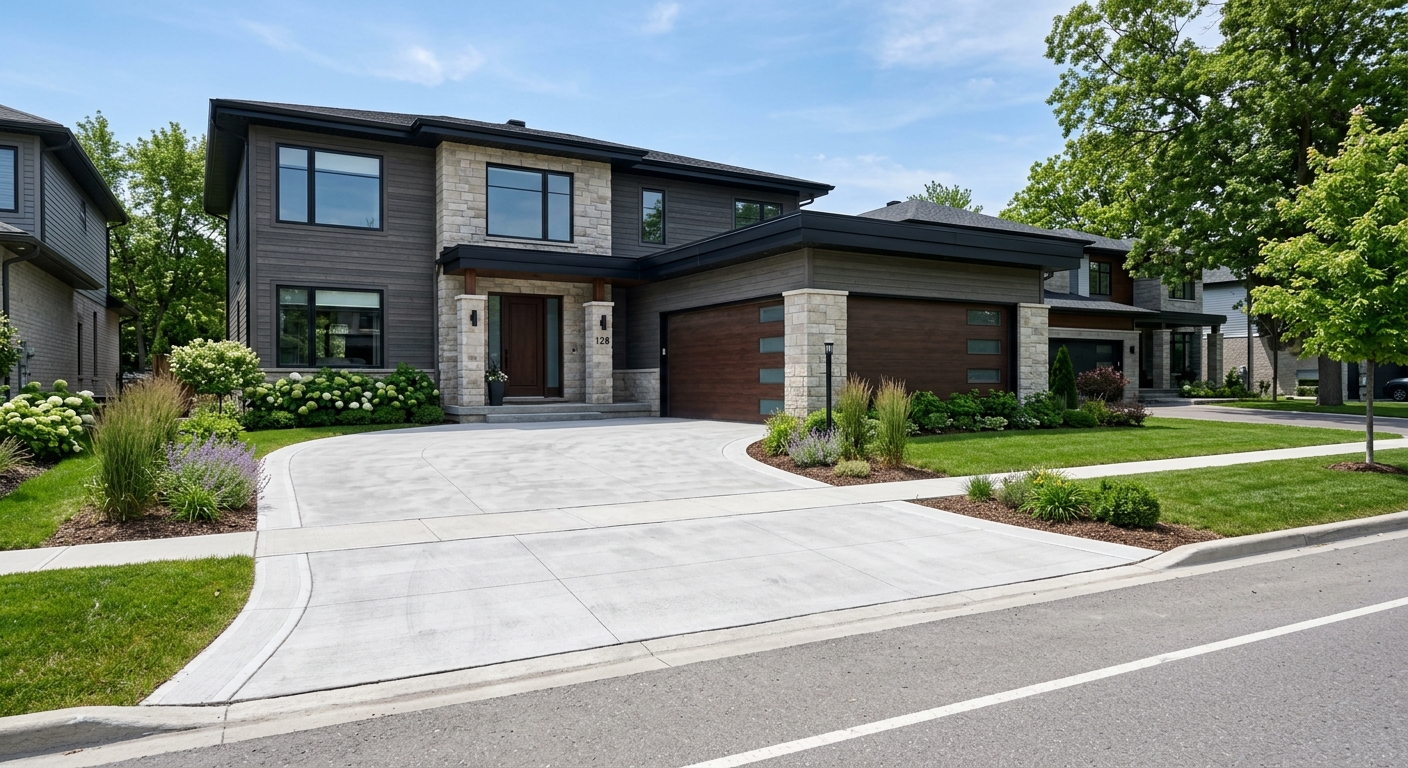
Concrete work options and costs in Eastwood
In Eastwood, Ontario, most homeowners are looking at concrete because it’s dependable, low-maintenance, and suited to the way the Toronto area actually freezes and thaws through winter. With a local population of 1,768 (Statistics Canada, 2021 Census), the market is smaller than Toronto itself, so crews often prioritize neighbourhoods where access and schedules line up—particularly in busier pockets like the Eastwood-area streets near local schools and commercial nodes where driveway and walkway replacements are common. Concrete flatwork demand also tends to track the housing stock: Eastwood’s neighbourhood pattern is dominated by single-detached and townhouse-style properties, which means driveways, walkways, and patios are frequent upgrades.
In the Toronto economic region, concrete costs are shaped by frost depth and repeated freeze–thaw cycles. Structural footings typically need to extend at least 1.2 m (about 4 ft) below grade in Ontario to reduce frost heave and differential movement. For exterior flatwork, contractors commonly use air-entrained mixes and properly detailed control joints because cold, wet shoulder seasons and de-icing salts can accelerate surface wear and cracking. The weather also affects the calendar: exterior pours are usually concentrated in warmer months so curing is controlled, and that can tighten availability and scheduling.
Below is a practical comparison of typical Eastwood options so you can understand what changes when you go from a standard broom finish to exposed aggregate or stamped concrete, and when foundation work moves from “simple” to engineered, below-frost construction. Use the table to anchor your quote discussions.
| Application |
Typical Size |
Key Spec |
Finish Option |
Price Range |
| Concrete driveway (standard broom finish) |
400–600 sq. ft. |
Air-entrained exterior mix, compacted base, control joints |
Broomed surface |
$7,200 – $14,800 |
| Exposed aggregate driveway |
400–600 sq. ft. |
Air-entrained mix with retarder/exposure process, strengthened edges |
Exposed aggregate |
$10,500 – $18,000 |
| Stamped concrete driveway or patio |
300–500 sq. ft. |
Air-entrained mix, colour hardeners, release agents, proper joints |
Stamped + coloured |
$9,000 – $20,000 |
| Plain concrete patio or walkway |
200–400 sq. ft. |
Compacted base, drainage slope, control joints |
Float/trowel then light broom |
$3,200 – $10,400 |
| Garage floor (interior slab) |
300–500 sq. ft. |
Vapour barrier (if required), proper thickness, wire mesh or rebar |
Standard smooth finish or broom light texture |
$5,400 – $14,000 |
| Foundation footings (structural, below frost) |
Per linear foot / small footing system |
Engineered design, rebar steel, below-grade excavation and backfill |
Formed/structural concrete |
$180 – $300 |
Prices are estimates only and vary by project scope, site access and material selection.
What affects the price of concrete work in Eastwood
In Eastwood and across the broader Toronto region, it’s common to see quotes for the “same” concrete work differ by 30–50%. The difference usually isn’t the concrete itself—it’s the details: how deep the excavation goes, whether the base is built with the right granular layers and compaction, how much steel is required, and how the contractor manages freeze–thaw durability. When crews price risk correctly (and include proper curing and jointing), your price tends to be higher—but the slab often lasts longer with fewer repairs.
Here’s the Ontario reality that drives pricing: frost depth and freeze–thaw cycles dictate footing depth and slab prep. Structural footings generally need to extend at least 1.2 m (about 4 ft) below grade to help prevent frost heave and differential movement. Exterior slabs also commonly use air-entrained concrete mixes so the freeze–thaw cycle doesn’t scale the surface. GTA contractors typically focus pours during the warmer part of the year to keep curing conditions consistent; when temperatures drift toward about 10 °C or below, contractors may need cold-weather precautions like insulated blankets or supplemental heating. That added protection affects the schedule and labour time.
Even within Eastwood, costs swing based on site conditions. For example, replacing a broom-finished driveway on flat access can land near the lower end of the Toronto range (often aligning with the $18–$28 per sq. ft. concrete pricing band), while a driveway that requires deeper excavation, thicker base, and more reinforcement for poor-draining soil can move toward the higher end. Likewise, stamped concrete usually sits above plain concrete—if you’re comparing $24–$40 per sq. ft. stamped pricing, you’re paying for colour hardeners, stamps, and labour-intensive finishing, which is justified when you want a specific look and longer-lasting surface treatment.
In older Eastwood homes where landscaping has shifted over decades, saturated soils and settlement can mean more demo, more hauling, and more base rebuild—often translating to a noticeable jump, sometimes hundreds to thousands of dollars depending on the area size and how far down repairs must go.
| Price Factor |
Why It Matters |
Cost Impact |
| Frost line depth |
Determines footing depth and form height to prevent frost heave |
Can add major excavation and concrete volume; shifts jobs higher when access is tight |
| Site preparation |
Excavation, grading, and well-compacted granular base control settlement |
More hauling and base material increases labour and material costs |
| Reinforcement |
Rebar or wire mesh affects crack control and slab strength |
Steel and placement labour can noticeably increase total price |
| Mix design |
Air-entrainment and compressive strength specs are critical for freeze–thaw survival |
Better mix design often increases material cost but reduces early spalling |
| Finish type |
Broom vs. stamped vs. exposed aggregate changes labour time and materials |
Stamped/exposed typically add the most labour and finishing products |
| Pour size and concrete truck access to site |
Distance, slopes, and access affect how fast and efficiently the crew can place concrete |
Pump/extra equipment or longer labour time can raise costs |
| Cold-weather curing precautions |
Heating and insulating blankets protect strength gain when temps drop |
Added materials and labour; can extend schedule and increase admin time |
| Control joint pattern and sealing cost |
Joints manage cracking and sealer helps repel de-icing salts |
More attention to joint layout and sealing adds cost but reduces maintenance |
Permits & regulations in Ontario
In Ontario, structural concrete work typically requires more oversight than exterior flatwork. Concrete foundation walls, footings, grade beams, and any structural slabs tied into the building structure generally fall under permit requirements and often require engineered drawings reviewed by the municipality. Concrete flatwork like patios, walkways, and driveways usually does not require a building permit by default—however, it can require approval if it affects lot grading, drainage, or impervious surface coverage limits, or if work encroaches into municipal right-of-way areas (for example, adjustments near boulevard/driveway apron locations). The safest approach is to confirm with the local authority before breaking ground.
For every Eastwood project, also verify the contractor is properly insured and accountable. You should require proof of liability insurance and WSIB/WCB coverage where applicable, and ask for references on similar-scale work (same type of slab, similar soil conditions, and similar exterior exposure). For concrete, the details matter—especially for freeze–thaw durability—so you want a contractor who can explain thickness, base prep, air-entrainment, and jointing.
How to verify (step-by-step):
- Ask the contractor for their Ontario licence details and confirm they match the company name on the quote.
- Request a certificate of insurance (liability) showing your address (or project) is covered.
- Ask for WSIB/WCB clearance or coverage proof—then check the validity date on the documents.
- Look for job photos and references from similar exterior pours in GTA conditions.
- Confirm who pulls permits (if required) and what they’re including in the scope.
Getting concrete right in Eastwood's freeze-thaw climate
Concrete failures in Eastwood usually come down to one theme: water plus freeze–thaw exposure, compounded by shortcuts in base prep or mix design. When saturated soil sits under a slab, it can expand in winter and reduce support, leading to cracking and uneven settlement. On the surface, freeze–thaw can cause spalling, especially if the concrete doesn’t have the right amount of air entrainment. That’s why in the Toronto market you’ll frequently hear contractors talk about air-entrained mixes, adequate thickness, and control joints—those are not “nice-to-haves,” they’re essential.
To spec your job correctly, start with base preparation: use a properly compacted granular sub-base to the depth needed for your soil and local frost conditions, then build the slab with consistent thickness and proper drainage slopes. For the mix design, many GTA exterior flatwork projects target 5–7% air content for freeze–thaw durability and use minimum 32 MPa compressive strength so the concrete reaches adequate strength during curing. Control joints should be planned to limit random cracking—spacing depends on slab thickness and layout, but the key is that joints are cut or formed while the slab can still benefit from predictable crack control. Curing matters too: plan for a minimum 7-day cure under appropriate conditions. When pours happen near colder temperatures, contractors may need to protect the surface and maintain curing conditions. Finally, sealing: a penetrating sealer is typically applied after the concrete has fully cured (commonly after 28 days) to help repel de-icing salts.
Example: if you’re choosing between plain broom-finished concrete and stamped concrete, you might see plain flatwork near $16–$26 per sq. ft. while stamped items move into the $24–$40 per sq. ft. band. That price difference is often justified when the contractor uses proper joint detailing, colour system products, and a finish plan that still respects freeze–thaw durability—otherwise you’re just paying more for the look while leaving durability at risk.
| Spec |
Why It Matters in Eastwood |
What to Ask For |
Impact if Skipped |
| Compacted granular base (depth?) |
Provides stable support and reduces frost-related movement |
Ask for base depth, material type, compaction method, and slope/drainage plan |
Settlement, cracking, and uneven surface after freeze–thaw cycles |
| Air-entrained concrete mix (target air %?) |
Helps resist scaling/spalling during repeated freezing and thawing |
Ask for target air content (commonly 5–7% for exterior flatwork) and mix approval |
Surface scaling, spalling, and early deterioration |
| Compressive strength (MPa rating) |
Ensures adequate strength gain for wear resistance and durability |
Ask for minimum 32 MPa rating and curing plan |
Reduced durability and higher risk of damage from de-icing and traffic |
| Control joints (spacing per ACI guidelines) |
Limits random cracking by creating planned crack locations |
Ask for joint spacing based on slab thickness and layout, plus sealing timing |
Random cracking patterns and water infiltration into joints |
| Minimum 7-day curing period |
Strength development protects the slab before it’s exposed to winter conditions |
Ask how curing will be protected (especially if temps drop) and when you can use the area |
Lower early strength and higher chance of surface damage |
| Penetrating sealer (when applied after cure) |
Improves resistance to de-icing salts in wet Eastwood winters |
Ask about sealer type and timing (commonly after full cure, around 28 days) |
Faster salt-related deterioration and increased maintenance costs |
How to choose a concrete work contractor in Eastwood
Choosing the right concrete contractor in Eastwood is mostly about verifying accountability and then comparing apples-to-apples scopes. In Ontario, start by confirming licensing (where applicable), then require proof of liability insurance and WSIB/WCB coverage. How to check: (1) request current certificate documents and confirm they match the contracting company name on the quote; (2) look for coverage dates that are valid through the project; (3) ask for clearance proof or documentation that shows coverage status—don’t rely on verbal confirmation.
Next, get 2–3 itemised written quotes that separate labour and materials. Look for details like excavation depth assumptions, granular base build-up, reinforcement type (wire mesh vs rebar), concrete thickness, air-entrainment and compressive strength, and finishing method. A quote that only states a lump-sum number without describing these items often leads to change orders. Confirm what’s excluded: disposal/hauling, saw-cutting and joint sealing, permit pulling (if required), edge drains, saw cuts, and protection/curing materials. For warranty, ask for workmanship warranty length and what it covers (cracks within a reasonable timeframe, scaling, spalling), plus product/manufacturer warranty terms if a system like a sealer is specified. Also ask if the warranty is transferable if you sell the home.
Finally, payment and timeline matter. As a homeowner, never pay more than about 10–15% upfront; keep a holdback until the job is complete and surfaces are cured/accepted. Get a written start date and completion estimate. In GTA concrete work, the weather can impact schedule—good contractors plan for that and communicate protection steps when temperatures drop.
- Ask for proof of liability insurance and WSIB/WCB coverage before signing.
- Confirm the quote includes concrete specs: air entrainment and minimum compressive strength.
- Require a granular base description (materials, depth, compaction expectations).
- Check reinforcement scope: mesh/rebar placement and cover depth.
- Look for joint layout details (where joints go, spacing, and sealing timing).
- Verify curing and protection plan (especially in shoulder months).
- Confirm finishing method: broom finish vs stamped vs exposed aggregate process.
- Ask whether disposal/hauling is included, including concrete demo and forms removal.
- Confirm access assumptions (truck access vs pump needs) are included in the quote.
- Get the permit responsibility in writing if structural permits are required.
- Request warranty terms in writing and how claims are handled.
- Use an itemised quote format and avoid “allowances” without ranges.
Concrete contractor red flags I see in the Eastwood area: vague concrete mix details (“standard mix” only), no mention of air-entrainment for exterior flatwork, skipping base compaction discussion, pushing full upfront payment beyond 15%, and refusing to provide itemised scope or a curing/protection plan for cold or wet weeks.
Frequently asked questions — concrete work in Eastwood
How long does a concrete driveway last?
In Eastwood, a properly built concrete driveway often lasts 20 to 30 years, and sometimes longer, if the base is compacted correctly, the concrete is air-entrained for freeze–thaw, and control joints are planned and maintained. The big durability lever is water management: if the base becomes saturated and the slab loses support, cracking and unevenness show up sooner. Surface wear is also influenced by de-icing salt; that’s why sealing after cure (commonly after about 28 days) is a smart step. Cost-wise, many homeowners compare plain broom-finished driveway work that aligns with the $18–$28 per sq. ft. range in the Toronto market versus upgrades like exposed aggregate or stamped finishes, which cost more but can improve aesthetics and surface character—if the durability specs stay solid.
What is air-entrained concrete and why does it matter here?
Air-entrained concrete is made with a controlled amount of tiny air bubbles that give freezing water a place to expand. In Ontario’s Toronto region climate, freeze–thaw cycles can pull moisture through the slab and into the paste. Without adequate air entrainment, repeated freezing can damage the surface, leading to scaling and spalling—especially on exterior flatwork exposed to snowmelt and de-icing salts. For Eastwood patios, walkways, and driveways, contractors typically target about 5–7% air content and specify a minimum compressive strength (commonly 32 MPa) with proper curing. When you’re comparing quotes, ask the contractor to state the air-entrainment target and whether it’s included for exterior slabs—this is one of the easiest ways to separate a durable bid from a cheaper one.
How do I prepare the base for a concrete slab?
Base preparation is the step that most affects long-term performance in Eastwood, and it should be clear in your quote. The contractor should remove topsoil/unsuitable material, then grade the subgrade and place a compacted granular base to the required depth for your soil and slab type. Proper compaction is essential so the slab doesn’t settle unevenly. The driveway or walkway should also have the right slope so water drains away rather than pooling under the slab. If drainage is ignored, you can get freeze–thaw pumping: saturated soil expands and contracts through winter. Before work starts, ask your contractor what granular material they’re using, what compaction method they’ll follow, and what thickness they’re planning. Those details protect your concrete whether it’s a plain patio in the $16–$26 band or a stamped project in the higher range.
How do I compare concrete quotes?
To compare quotes fairly in Eastwood, you need more than a total price—compare the scope line by line. Ask each contractor to break out labour and materials and to specify concrete thickness, reinforcement type (mesh vs rebar), air-entrainment target for exterior work, and minimum compressive strength. Verify base prep details too: excavation depth assumptions, granular base type, and compaction expectations. For finishing, confirm whether the price includes broom finish only, or stamped/exposed aggregate processes and colour systems. Also check exclusions: concrete disposal/hauling, permit pulling (if required for structural work), joint sealing, and curing/protection measures in cooler weather. A cheaper quote that skips air entrainment, offers vague jointing, or assumes minimal base work may look attractive now but can cost you later in repairs or resurfacing—especially under Toronto’s freeze–thaw conditions.
Can concrete be poured in cold weather in Eastwood?
Yes, concrete can be poured in cold weather in Eastwood, but it must be protected so it can achieve early strength safely. Contractors need to manage curing conditions when temperatures drop toward around 10 °C or below, because cold slows hydration. Proper cold-weather curing precautions can include insulating blankets, temporary heating, and stricter scheduling so the slab isn’t exposed too early. If protection isn’t planned, you can end up with weaker concrete and increased risk of surface damage once the freeze–thaw cycle starts. In the Toronto market, many exterior pours are concentrated in warmer months to reduce these variables and maintain predictable curing. When comparing bids, ask how they’ll handle temperature, how long they’ll protect the pour, and what the curing plan is. That’s where the real cost difference shows up between a basic pour and a durable one.
How do I maintain concrete in Eastwood's freeze-thaw climate?
Maintenance in Eastwood is mostly about keeping water and salts from attacking the surface and joints. Start with sealing after the concrete has fully cured (commonly around 28 days) using a penetrating sealer designed for exterior exposure and de-icing salts. Then, re-check joints: keep them clean and ensure sealing is maintained where needed so water doesn’t infiltrate and expand under freeze–thaw. When snow ploughs and shovels are used, avoid aggressive scraping that chips edges or the surface. If you notice small scaling or minor spalling early, address it promptly—repairs are cheaper when damage is still superficial. Cost-wise, sealing and joint attention are far less than redoing a driveway in the $18–$28 per sq. ft. band, or a larger stamped project higher in the $24–$40 per sq. ft. range. Consistent upkeep can meaningfully extend service life.