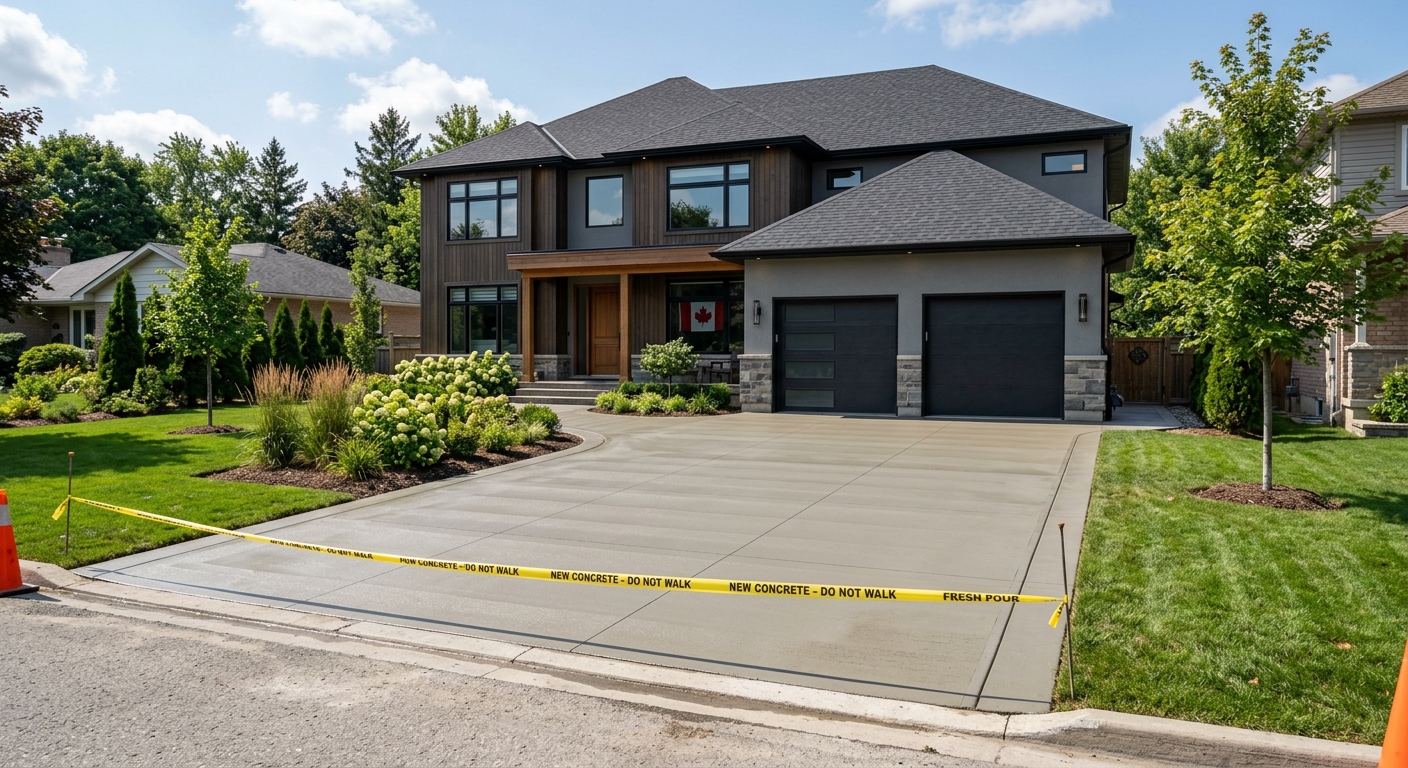
Concrete work options and costs in Patrick Fogarty Catholic Secondary School
Concrete work around Patrick Fogarty Catholic Secondary School in Ontario is typically driven by how homeowners want their outdoor and foundation spaces to perform through Toronto’s freeze–thaw seasons. In the area, single-family homes remain a common market segment (Statistics Canada, 2021 Census), and that demand lines up directly with concrete flatwork like driveways, patios, and walkways. The local profile also shows a smaller surrounding population base (Statistics Canada, 2021 Census), which can influence availability and scheduling when crews are booked for peak spring and summer pours.
In the Toronto economic region, costs are strongly shaped by frost depth and winter performance requirements. Most structural footings are designed to extend about 1.2 m (roughly 4 ft) below grade to help prevent frost heave and differential movement. Exterior slabs and flatwork also need air-entrained concrete mixes, adequate thickness, and well-planned control joints to manage cracking. GTA contractors usually concentrate driveway and patio work in warmer months so curing is reliable; when temperatures dip toward 10 °C or below, concrete needs added protection and longer cure management to reach the strength you want.
That’s why even “the same size” project can come in at noticeably different totals depending on excavation depth, base prep quality, reinforcement, and finish style. Use the table below as a practical starting point for comparing concrete options at Patrick Fogarty Catholic Secondary School, then we can narrow pricing with site measurements and a proper scope.
| Application |
Typical Size |
Key Spec |
Finish Option |
Price Range |
| Concrete driveway (standard broom finish) |
16 ft x 20 ft (320 sq ft) |
4 in slab, compacted granular base, air-entrained mix |
Broom finish, control joints |
$5,760 – $8,960 |
| Exposed aggregate driveway |
16 ft x 20 ft (320 sq ft) |
4–5 in slab, proper curing, surface retarder |
Exposed aggregate, slip-resistant texture |
$7,200 – $12,800 |
| Stamped concrete driveway or patio |
16 ft x 20 ft (320 sq ft) |
4 in slab, integral colour, air-entrained mix |
Stamp + release + sealer-ready finish |
$9,600 – $12,800 |
| Plain concrete patio or walkway |
12 ft x 16 ft (192 sq ft) |
4 in slab, granular base, drainage slope |
Light broom or trowel-float + broom texture |
$3,072 – $4,992 |
| Garage floor (interior slab) |
20 ft x 22 ft (440 sq ft) |
4 in slab, vapour barrier, typical reinforcement |
Broom finish, optional densifier |
$6,600 – $12,100 |
| Foundation footings (structural, below frost) |
Approx. 40 linear ft |
Below-frost depth, formwork, rebar, inspection-ready |
Engineered footings (varies by design) |
$7,200 – $12,000 |
Prices are estimates only and vary by project scope, site access and material selection.
What affects the price of concrete work in Patrick Fogarty Catholic Secondary School
If you ask three contractors for the same concrete scope near Patrick Fogarty Catholic Secondary School, Ontario, it’s not unusual to see 30–50% swings. In the Toronto economic region, those differences usually come from what’s included in the base preparation, how deep and how well the site is excavated, the reinforcement strategy, and whether the mix and finishing process is built for freeze–thaw durability—not just “getting it poured.” A contractor who price-shaves by reducing granular base depth or skipping proper air-entrainment will often appear cheaper short-term, but they’re cutting corners that come back as scaling, spalling, or early cracking.
Frost line depth and freeze–thaw cycles dictate many specs. Footings for structural work must extend below design frost depth (commonly about 1.2 m in Ontario) to prevent frost heave and differential movement. Exterior slabs should use air-entrained concrete to survive repeated cycles; in cold conditions, cold-weather precautions like insulating blankets and temperature management may be required when overnight temperatures drop toward 10 °C or below. That added labour and material time is part of why many driveways and patios trend toward the higher end—especially when decorative work like stamping is involved (Toronto-region typical concrete patio/walkway: $16–$26).
Concrete choices in this area can also raise or lower cost. For example, converting a plain patio (often closer to $16–$26/sq ft) into stamped concrete is usually justified when homeowners want curb appeal and a more controlled crack pattern; it’s a meaningful premium because of integral colour, stamp tooling, and extra labour. On the other hand, a broom finish driveway may stay near the $18–$28/sq ft band if excavation is straightforward and truck access is easy. In older neighbourhoods with mature trees, we frequently see higher costs from stump removal and tighter excavation, while newer infill lots can reduce those logistics.
| Price Factor |
Why It Matters |
Cost Impact |
| Frost line depth — determines footing depth and form height |
Controls heave risk and required excavation volume |
Higher depth increases labour, excavation, and disposal |
| Site preparation — excavation, grading, compacted granular base |
Proper base prevents settling and premature cracking |
Can shift totals by thousands if soils are poor or deeper removal is needed |
| Reinforcement — rebar or wire mesh requirement |
Improves performance under loads and helps crack control |
Adds material and labour; typically increases cost on driveways/garages |
| Mix design — air-entrainment and compressive strength spec |
Air voids help resist freeze–thaw damage; strength supports service life |
Premium mix is usually money well spent to reduce spalling risk |
| Finish type — broom vs. stamped vs. exposed aggregate |
Finishes require different labour, curing steps, and sometimes integral colour |
Stamped/exposed aggregate commonly moves you toward the upper price bands |
| Pour size and concrete truck access to site |
Access affects placement efficiency and labour hours |
Tight access or multiple pours can add time and equipment costs |
| Cold-weather curing precautions — heating and blankets |
Protects strength gain when temperatures drop |
May add materials and crew time during shoulder-season pours |
| Control joint pattern and sealing cost |
Joints limit random cracking; sealing helps resist salt scaling |
More joints and sealing add line items but reduce long-term surface damage |
Permits & regulations in Ontario
In Ontario, structural concrete work—such as footings, foundation walls, and grade beams—typically requires a building permit, and engineered drawings are often required or reviewed by the municipality before work starts. If you’re doing anything that changes the structure (new foundation, underpinning, significant foundation repair, or new structural beams), plan for permit review and inspections. For concrete flatwork (driveways, patios, and walkways), permits usually are not required when the work stays within your existing footprint and doesn’t alter lot grading or violate impervious surface and drainage constraints. However, if your project changes slopes toward neighbouring property, affects municipal right-of-way, or triggers stormwater/drainage issues, you may need approval.
For homeowners at Patrick Fogarty Catholic Secondary School, the safest approach is to confirm in advance with the local authority that the intended concrete scope is permit-exempt. Also verify your contractor is properly set up: ask for proof of liability insurance and WSIB coverage (and any applicable clearance letter/certificates). For licensing, check the contractor’s registration and any required trade authorization through Ontario’s public contractor/consumer resources, then request a current certificate of insurance showing the policy active dates and jobsite coverage. Before signing, confirm references on similar structural or exterior freeze–thaw projects, because inspection-ready documentation and curing practices are often what separate a pass from a redo.
If your plan is borderline—like regrading for a new driveway ramp—get written clarification before breaking ground.
Getting concrete right in Patrick Fogarty Catholic Secondary School's freeze-thaw climate
The biggest concrete failures around Patrick Fogarty Catholic Secondary School aren’t usually the driveway “looking cracked”—it’s what you can’t see: frost-driven movement and freeze–thaw damage that leads to scaling and spalling. In the Toronto market, we spec for durability because exterior concrete has to survive wet winters, repeated freezing cycles, and de-icing salt. The right way to avoid trouble is to control five things: base preparation, mix design, control joints, curing, and sealing.
First, base prep: excavate to the right sub-base depth for the local soil, then place compacted granular material to the required thickness so saturated soils can’t pump and move. Second, mix design: exterior flatwork should use air-entrainment—commonly targeting about 5–7% air content for durability—plus a minimum 32 MPa compressive strength. Third, control joints: spacing should limit random cracking; we design joint patterns so shrinkage cracks happen where you can manage them. Fourth, curing: plan for minimum 7-day curing under conditions that allow strength gain; cold weather means extra protection (insulating blankets) if temperatures drop. Fifth, sealing: apply a penetrating sealer after the concrete has cured—typically at 28 days post-pour—to help repel salt and water.
If you’re choosing between options, the price difference can be justified. For example, a plain patio/walkway often lands in the $16–$26 band, but stamped concrete moves up (often around $24–$40) because it adds colour work, stamping labour, and extra finish steps. If the goal is longevity, the real “premium” isn’t the look—it’s the correct air-entrained mix, proper base, and joint layout that prevent spalling from inadequate air-entrainment.
Ask contractors directly: “What air content are you targeting, what’s the base depth, what joint spacing are you using, and how will you cure if temperatures fall?” Those answers usually predict performance after the first winter.
| Spec |
Why It Matters in Patrick Fogarty Catholic Secondary School |
What to Ask For |
Impact if Skipped |
| Compacted granular base (depth?) |
Reduces frost-related movement and settlement during wet winters |
Exact granular thickness, compaction method, and drainage slope |
Settling, uneven cracking, and water pooling that accelerates freeze–thaw damage |
| Air-entrained concrete mix (target air %?) |
Protects against freeze–thaw scaling and spalling from de-icing salts |
Target 5–7% air for exterior flatwork and documentation of mix |
Spalling and surface scaling within a few winters |
| Compressive strength (MPa rating) |
Ensures strength gain for long service life and loading resistance |
Minimum 32 MPa and cure timeline aligned with weather conditions |
Surface weakness, raveling, and faster wear under foot traffic or vehicles |
| Control joints (spacing per ACI guidelines) |
Governs shrinkage cracks and prevents uncontrolled fracture |
Planned joint spacing, layout, and whether they’ll be saw-cut |
Random cracking that can widen and let water in |
| Minimum 7-day curing period |
Allows strength development despite humid and cooler shoulder-season conditions |
How curing will be protected if temperatures drop |
Underdeveloped strength leading to surface damage and poor durability |
| Penetrating sealer (when applied after cure) |
Helps repel water and de-icing salt intrusion during winter cycles |
Apply penetrating sealer about 28 days after the pour (or as specified) |
Faster salt scaling and higher maintenance needs |
How to choose a concrete work contractor in Patrick Fogarty Catholic Secondary School
Choosing the right contractor for concrete near Patrick Fogarty Catholic Secondary School in Ontario is mostly about verifying responsibility and documentation—then matching the quote to the real technical scope your site needs. Start by asking for proof of liability insurance and WSIB clearance/coverage. You can verify insurance by checking the certificate of insurance documents the contractor provides (active policy dates, correct business name, and jobsite coverage). For WSIB/WCB, request current clearance letters or confirmation of coverage. For licensing, confirm the contractor’s trade authorization through Ontario’s public-facing contractor information resources and ensure their business registration matches the company name on the quote.
Next, get 2–3 itemised written quotes rather than “one lump number.” A good quote breaks down labour and materials clearly: excavation, granular base, reinforcement, formwork, concrete supply, finish materials, and any sealing. Pay close attention to what’s excluded: permit pull (if required), disposal/hauling, backfilling, and restoration of grass/landscaping. Also clarify whether drainage adjustments are included, because flatwork without proper slope often fails early.
Warranty matters in concrete because workmanship problems are usually detectable only after freeze–thaw exposure. Ask for a workmanship warranty term, whether it covers labour only or materials too, and whether it’s transferable if you sell the home. On payment schedule, never pay more than 10–15% upfront; hold back until the job is fully completed and any required curing/sealing steps are done. Finally, get the start date and estimated completion in writing, including weather contingencies for pouring and curing during shoulder-season swings.
- Confirm liability insurance certificate is current and matches the legal business name on the quote.
- Confirm WSIB coverage or clearance letter for the contractor and any subcontractors.
- Request at least 3 recent references for exterior flatwork in Ontario freeze–thaw conditions.
- Ask for an itemised breakdown (excavation, base, reinforcement, concrete supply, finishing, curing protection).
- Clarify whether permit/inspection coordination is included for structural work.
- Confirm disposal/hauling is included if excavation exceeds topsoil removal.
- Ask what granular base depth and compaction method they use for your soil type.
- Require air-entrainment and documentation of mix targets for exterior slabs.
- Ask for thickness and reinforcement details (mesh/rebar, spacing, and cover).
- Get the control joint plan: timing for saw cutting and joint spacing logic.
- Confirm cure plan (including blankets/heating if night temps fall).
- Schedule sealing: penetrating sealer timing after cure, and who applies it.
In Patrick Fogarty Catholic Secondary School’s local market, four common red flags are: quotes that don’t mention air-entrained mix for exterior work, missing base-depth details, “lump sum only” pricing with unclear inclusions (disposal, reinforcement, sealing), and contractors who ask for large upfront payments beyond 10–15% without a written schedule.
Frequently asked questions — concrete work in Patrick Fogarty Catholic Secondary School
When is the best time to pour concrete in Patrick Fogarty Catholic Secondary School?
For most driveway, patio, and walkway pours near Patrick Fogarty Catholic Secondary School, Ontario, the best results come from late spring through summer—when daytime temperatures stay reliably warm and nights aren’t consistently cold. In the Toronto area, contractors time pours to avoid temperature drops toward about 10 °C or below, because curing slows and increases the need for protection (insulating blankets or other cold-weather methods). That’s also why scheduling is often busiest in warmer months: crews are protecting strength gain and reducing the risk of early surface scaling. If you’re planning a decorative finish like stamped concrete, the weather window matters even more due to colour and finishing steps, so confirm your pour date and curing plan well in advance.
How long does concrete take to cure?
Concrete curing is a two-part story: strength gain and surface readiness. Typically, you should plan on a minimum 7-day curing period before expecting normal exterior exposure, because that’s when much of the early strength develops. However, full durability and performance improvements continue beyond that, and for sealing and maximum long-term protection, many specifications use 28 days as a practical benchmark for applying a penetrating sealer. In Ontario’s freeze–thaw climate, curing conditions matter: if temperatures fall and the slab isn’t protected, early strength development can lag, which raises the odds of scaling in winter. Your contractor should clearly describe curing steps—especially if the pour happens late in the season.
Do I need a permit for concrete work in Ontario?
In Ontario, structural concrete such as footings, foundation walls, and grade beams usually requires a building permit and often engineered drawings reviewed as part of the municipal process. For concrete flatwork—patios, walkways, and driveways—permits are frequently not required when the work doesn’t alter lot grading, stormwater handling, or impervious surface limits. That said, if your concrete changes slopes, affects drainage, or encroaches into municipal right-of-way, approvals may be needed. For projects around Patrick Fogarty Catholic Secondary School, the right approach is to confirm with the local authority before work starts and make sure the quote indicates whether permit/inspection coordination is included. A reputable contractor should also provide proof of insurance and the documentation you’ll need if inspections are required.
Concrete vs pavers for a patio in Patrick Fogarty Catholic Secondary School?
Both concrete and pavers can work well in Ontario freeze–thaw conditions, but they fail differently. Concrete patios are typically more seamless and—when done with proper base prep, air-entrained mix, control joints, and good curing—tend to provide long, low-maintenance service. Pavers can be easier to repair locally if a section settles, but they require consistent base compaction and proper edging/drainage to avoid shifting over time. In this area, plain concrete patios/walkways often price around the $16–$26 band, while decorative options like stamped concrete land higher (often $24–$40 depending on complexity). If you want a smooth, continuous look with fewer visible seams, concrete usually offers better value. If you anticipate frequent landscaping changes, pavers may be more flexible.
How long does a concrete driveway last?
A well-built concrete driveway in Ontario commonly lasts 25–35 years, sometimes longer, but that timeline depends heavily on base preparation, air-entrained mix for freeze–thaw durability, and joint/sealing practices. Near Patrick Fogarty Catholic Secondary School, the biggest drivers of driveway longevity are frost-related movement and salt exposure. A driveway poured on a properly compacted granular base, with the right mix and control joint plan, typically performs much better through repeated winters. Sealing after the concrete has cured (often at about 28 days) helps repel salt and reduces scaling risk. If you’re comparing quotes, be wary of low bids that don’t clearly cover base depth, reinforcement, air-entrainment, and curing protection. That’s where “cheap” driveways often start costing more later.
What is air-entrained concrete and why does it matter here?
Air-entrained concrete is mixed with microscopic air bubbles (typically targeting around 5–7% air for exterior flatwork) that give freezing water room to expand without destroying the paste. In Ontario’s Toronto region, freeze–thaw cycles plus de-icing salts are a common recipe for spalling and scaling when concrete isn’t properly air-entrained. For homeowners around Patrick Fogarty Catholic Secondary School, this matters because exterior slabs are exposed to moisture every winter, and surface damage often shows up after a couple of seasons if the mix isn’t right. When you request a quote, ask specifically for the air-entrainment target and confirmation that the mix meets minimum compressive strength (often 32 MPa for exterior durability). That single detail can make a noticeable difference in service life.