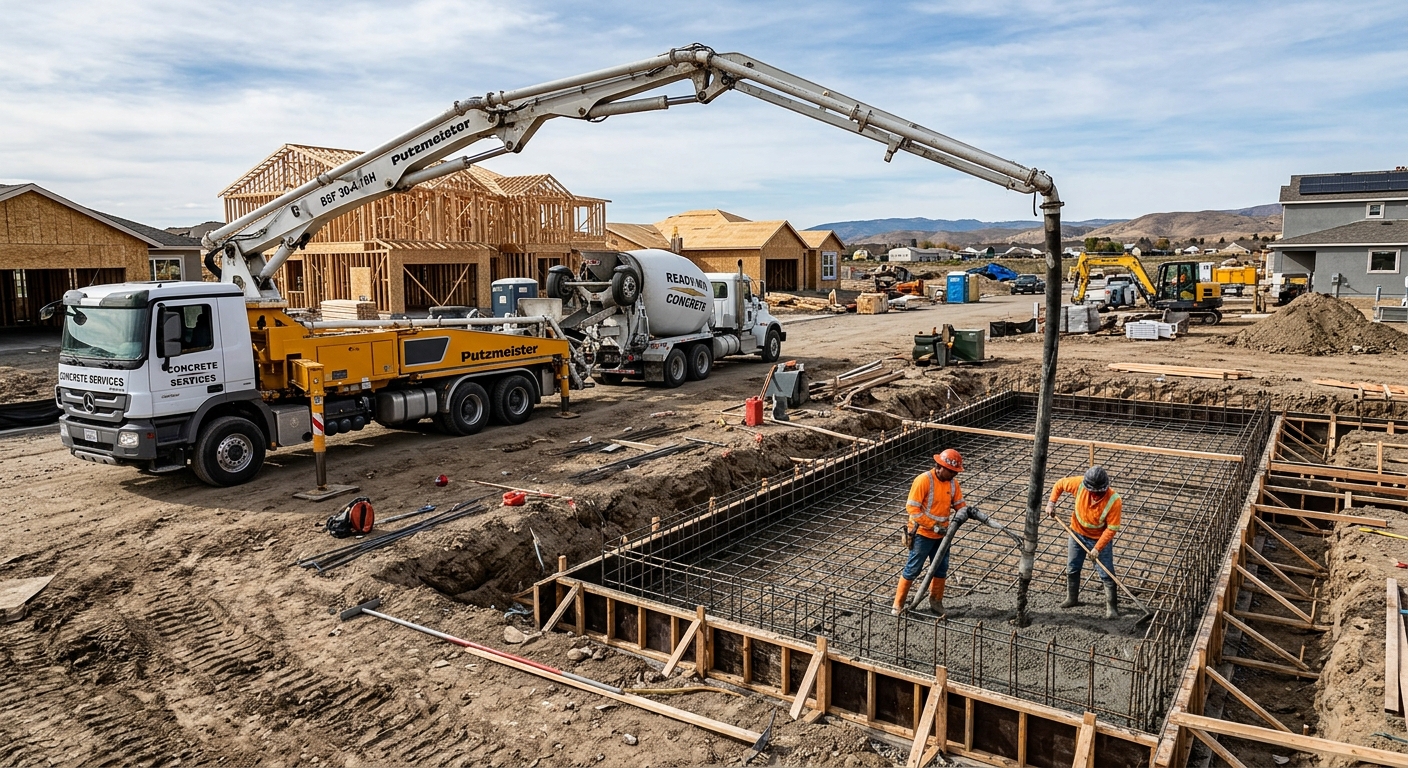
Concrete work options and costs in Watford
Concrete is a common upgrade in Watford, Ontario—whether you’re replacing a tired driveway, widening a patio, or giving walkways a clean, level surface. Watford’s smaller population (1,536 residents as of the 2021 Census (Statistics Canada, 2021 Census)) means fewer crews are always available on short notice, so scheduling matters when frost and rainy shoulder-season weather affects site access. In this area, most concrete flatwork is built to serve homes and lots where exterior surfaces see daily freeze–thaw stress; Toronto’s broader housing market is heavily driven by single-detached homes, which is where driveways, front steps, patios, and walkways are most often updated (Statistics Canada, 2021 Census).
In the Toronto economic region, concrete pricing is strongly shaped by frost depth, freeze–thaw cycles, and the Ontario Building Code’s expectations for exterior stability. For structural work, footings generally need to sit below the local design frost depth (commonly at least 1.2 m, about 4 ft) to prevent frost heave and differential movement. For exterior flatwork, contractors typically specify air-entrained concrete mixes, adequate thickness, and properly spaced control joints to manage cracking. Curing also becomes a cost factor: exterior pours are best concentrated in warmer months, and when temperatures dip toward 10 °C or below, protection and longer curing times are often required.
In Watford, trade demand is especially consistent around the residential pockets close to the main service routes, where homeowners want durable driveways and low-maintenance walkways that can handle wet falls, icy winters, and salt use. Below is a practical cost comparison to help you budget before you request quotes.
| Application |
Typical Size |
Key Spec |
Finish Option |
Price Range |
| Concrete driveway (standard broom finish) |
16 m x 6 m (96 sq. ft.) |
Air-entrained mix, compacted granular base, control joints |
Broom finish |
$1,800 – $2,700 |
| Exposed aggregate driveway |
16 m x 6 m (96 sq. ft.) |
Air-entrained mix, proper curing and surface wash control |
Exposed aggregate (standard stone) |
$2,400 – $3,500 |
| Stamped concrete driveway or patio |
20 m x 10 m (200 sq. ft.) |
Air-entrained mix, integral color, joint layout planned for cracking |
Stamped pattern + seal |
$4,000 – $8,000 |
| Plain concrete patio or walkway |
12 m x 4 m (48 sq. ft.) |
Compacted base, drainage plan, control joints |
Float + light broom |
$800 – $1,300 |
| Garage floor (interior slab) |
8 m x 18 m (144 sq. ft.) |
Vapour barrier (where appropriate), steel reinforcement, smooth finish |
Steel trowel / broom (per use) |
$2,600 – $4,000 |
| Foundation footings (structural, below frost) |
Per linear foot (typ. 40–80 ft overall) |
Below frost depth, engineered requirements, rebar as specified |
Structural concrete |
$180 – $300 |
Prices are estimates only and vary by project scope, site access and material selection.
What affects the price of concrete work in Watford
In Watford, you can see quotes for what looks like the “same” concrete job vary by 30–50% across the Toronto region and Ontario, mainly because the details change: excavation depth, base preparation, reinforcement requirements, and the concrete mix spec for freeze–thaw durability. A low price often comes from cutting corners on base thickness, using a less appropriate mix, or skipping time-consuming protection/cure management when the weather turns.
Every spec ties back to frost depth and freeze–thaw cycles. Ontario expectations are that footings extend below design frost depth—commonly at least 1.2 m (about 4 ft) below grade—to reduce frost heave and movement. For exterior slabs, air-entrained concrete is a must because it helps the paste tolerate freeze–thaw without spalling. When concrete is poured and temperatures fall toward 10 °C or below, crews typically need cold-weather curing precautions (insulating blankets, wind protection, and careful timing), which adds labour and material cost. In addition, de-icing salt accelerates surface scaling; sealing is often the difference between a driveway that “looks fine” for a few years versus one that deteriorates faster.
Two local examples: (1) A driveway replaced on saturated or poorly drained soil usually costs more because it requires extra granular removal and regrading; (2) a stamped patio can be priced higher (often in the $24–$40 per sq. ft.-type band for decorative work) because stamping mats, integral colour, and finishing time are labour-intensive, but it’s not always “worth it” if the sub-base is weak—fixing base prep often gives better long-term value than upgrading the surface.
| Price Factor |
Why It Matters |
Cost Impact |
| Frost line depth — determines footing depth and form height |
Deeper footings reduce frost heave risk and keep structure stable |
Higher excavation and concrete volume; can shift structural pricing substantially |
| Site preparation — excavation, grading, compacted granular base |
Durable exterior concrete needs a stable, drained base |
Unsuitable soils and poor drainage increase labour and materials |
| Reinforcement — rebar or wire mesh requirement |
Helps control cracking and supports loads |
Costs more upfront, but reduces premature failure on drives and garage floors |
| Mix design — air-entrainment and compressive strength spec |
Air content and strength help resist freeze–thaw and scaling from salt |
Moderate materials cost; often essential for exterior longevity |
| Finish type — broom vs. stamped vs. exposed aggregate |
Finishes change curing technique and labour time |
Stamped and exposed aggregate typically cost more than standard broom |
| Pour size and concrete truck access to site |
Smaller access or long wheelbarrow distance increases labour and time |
Traffic control, line pumps, and extra handling can add significant cost |
| Cold-weather curing precautions — heating and blankets |
Protects strength gain and reduces surface damage when temps drop |
Extra labour/materials during cooler pours |
| Control joint pattern and sealing cost |
Joints manage cracking; sealing helps repel salt and moisture |
Small line item cost that can prevent costly early repairs |
Permits & regulations in Ontario
In Ontario, structural concrete work generally requires more oversight than decorative flatwork. In most cases, footings, foundation walls, grade beams, and other structural foundation elements require a building permit and are commonly based on engineered drawings reviewed by the municipality. Concrete flatwork like patios, sidewalks, driveways, and walkways usually does not need a permit—unless it affects lot grading, triggers municipal impervious surface/lot coverage limits, or involves work near a municipal right-of-way (for example, modifications that alter drainage patterns or access points).
Before breaking ground in Watford, confirm the contractor carries liability insurance and has proper WSIB/WCB coverage (as applicable to their workforce). Ask for references on similar-scale projects—especially exterior flatwork done with air-entrained mixes and a proper base.
Step-by-step: how homeowners verify coverage and credentials in Ontario:
- Confirm business licensing status: check the contractor’s online presence and any posted registration details, and request their licensing/permit participation information in writing.
- Request a Certificate of Insurance (COI): ask for the most recent COI showing liability coverage and the project address if possible.
- Verify WSIB/WCB clearance: request a clearance letter or proof of coverage showing they’re in good standing for workers.
- Match scope to credentials: ensure the insured trade is performing the structural vs flatwork components you’re hiring for.
- Get it in writing: store a copy of COI and WSIB/WCB proof with your contract documents.
Getting concrete right in Watford's freeze-thaw climate
Watford concrete tends to fail in predictable ways when the base, mix, or cure plan doesn’t match the region’s freeze–thaw rhythm. The most common exterior problem we see is spalling—surface scaling and flaking—usually linked to inadequate air-entrainment, poor consolidation, or early exposure before strength gain. To spec a job correctly for Ontario’s winter exposure, focus on five levers: base preparation, mix design, control joints, curing, and sealing.
1) Base prep: excavate and install a compacted granular sub-base to the right depth for the soil and drainage conditions. If the base holds water or isn’t compacted, the slab can move and crack regardless of how good the finish looks. 2) Mix design: use air-entrained concrete for exterior flatwork—typically 5–7% air content—and target at least 32 MPa compressive strength for durability. 3) Control joints: joint spacing should limit random cracking to predictable lines. 4) Curing: plan for a minimum 7-day curing period under proper conditions; when cold weather arrives, additional protection is often required to keep strength gain on track. 5) Sealing: apply a penetrating sealer after the concrete has fully cured—commonly 28 days post-pour—to help repel moisture and de-icing salt.
Here’s where dollars make sense: a standard broom driveway is often in the $18–$28 per sq. ft. kind of range, while decorative options like stamped finishes can push up into the $24–$40 band. If a quote makes stamped look “cheap” but doesn’t address base thickness and air-entrainment, it’s usually not a real bargain. In Watford winters, the durability specs protect your investment—finish upgrades only shine on top of solid prep.
| Spec |
Why It Matters in Watford |
What to Ask For |
Impact if Skipped |
| Compacted granular base (depth?) |
Prevents settlement and limits water movement under slabs |
Granular type and target compacted depth based on soil and frost considerations |
Cracking, rocking slab, premature edge failure |
| Air-entrained concrete mix (target air %?) |
Reduces freeze–thaw damage and spalling from salt exposure |
Documented air content typically 5–7% for exterior flatwork |
Surface scaling/spalling within a few winters |
| Compressive strength (MPa rating) |
Supports strength gain and long-term abrasion resistance |
Minimum 32 MPa (or higher if design calls for it) |
Lower durability under loads and freeze–thaw stresses |
| Control joints (spacing per ACI guidelines) |
Controls where cracks form so they’re less visible and more stable |
Planned joint layout and spacing schedule |
Random cracking across the field and difficult-to-repair damage |
| Minimum 7-day curing period |
Ensures proper strength development in Ontario weather swings |
Cooling/wind protection plan; confirm curing method for cold snaps |
Weak surface, increased risk of scaling and early failure |
| Penetrating sealer (when applied after cure) |
Helps repel moisture and de-icing salts |
Sealer type and timing—commonly 28 days post-pour |
Faster surface deterioration and salt-driven spalling |
How to choose a concrete work contractor in Watford
Choosing the right concrete contractor in Watford is less about the lowest number on the quote and more about whether they build to the freeze–thaw specs Ontario expects. Start by verifying Ontario coverage: ask for a current Certificate of Insurance (liability) and proof they have the correct WSIB/WCB coverage for their workers. In practice, you should request a WSIB/WCB clearance letter (or equivalent proof of standing) and confirm the COI matches the job address and scope.
Next, insist on 2–3 written, itemised quotes rather than a single lump sum. A good quote separates excavation and formwork, granular base and compaction, reinforcement (if required), concrete supply and mix, finishing, joints, sealing, and disposal. Also look for what’s excluded: removal of old concrete, grading adjustments, downspout redirection, permit pulling (if applicable), and whether concrete truck access is included.
For warranties, ask what’s covered and for how long: workmanship warranty length, product/manufacturer warranty terms, and whether coverage is transferable if you sell the home. Payment schedule matters too—never pay more than 10–15% upfront. Hold back remaining funds until the site is cleaned and the final measurements/finishes are verified. Finally, get a written start date and completion estimate that accounts for weather downtime during shoulder season.
- Provide COI for liability insurance and confirm project-specific details.
- Provide WSIB/WCB clearance proof before signing.
- Quote is itemised (base, concrete mix, reinforcement, finishing, joints, disposal).
- Spec confirms air-entrained concrete for exterior flatwork.
- Includes control joint layout and sealing plan (timing matters).
- Explains base depth, compacted granular type, and drainage approach.
- Lists reinforcement method (wire mesh vs rebar) based on intended use.
- Shows whether cold-weather curing precautions are included when temperatures drop.
- Clarifies removal and disposal of old slab (if replacement) and haul-away fees.
- Includes protection for landscaping and site cleanup in writing.
- Warranty is in the contract with duration and exclusions.
- Payment schedule holds back enough funds until final acceptance.
Concrete contractor red flags in Watford: quoting “air” is optional on exterior work, refusing to provide itemised pricing, skipping documentation of mix strength/air-entrainment, scheduling pours without a plan for cold-weather curing, and asking for most payment upfront without a clear completion timeline.
Frequently asked questions — concrete work in Watford
What causes concrete to spall in Watford winters?
In Watford, spalling is most often tied to freeze–thaw plus salt. When water gets into the concrete pores or around edges and then freezes, expansion can lift off the surface paste, especially if the mix wasn’t properly air-entrained. Poor base prep can also create tiny voids under slabs where water collects, speeding up freeze–thaw damage. The timing of finishing and curing matters too: if concrete is exposed before it reaches sufficient strength, the surface becomes more vulnerable in later winters. If you’re comparing quotes for a driveway, be cautious of very low pricing in the $18–$28 style range that doesn’t clearly state air-entrainment and curing/protection steps for Ontario weather swings.
What is rebar and when is it required in Ontario?
Rebar (reinforcing steel bars) is added to concrete to help carry tensile forces and control cracking. In Ontario, whether rebar is required depends on the structural design and the application: foundation and footing work typically follows engineered plans, and reinforcement is commonly specified for grade beams, walls, and footings. For exterior flatwork like driveways and garage slabs, reinforcement may be required based on thickness, expected loads (vehicle weight), and slab design. A contractor should explain how their reinforcement strategy matches the intended use and the concrete thickness they’re pouring. Don’t assume “mesh is the same as rebar,” and don’t assume reinforcement is optional—your quote should state exactly what they’re placing and why.
How long does a concrete project take in Watford?
The actual pour is usually fast, but real timelines in Watford depend on site conditions and weather. A standard driveway or walkway may take a few days overall: excavation and base prep, forms (if needed), the pour day, and finishing/jointing. Drying/curing is where calendar time really matters—concrete needs proper curing conditions, and minimum cure periods are typically at least 7 days before you treat the surface as ready for light use. Full strength development is longer, and many contractors plan sealing around 28 days post-pour. If temperatures drop toward 10 °C or below, cold-weather curing precautions can extend the schedule. In a small community, scheduling delays can also happen because fewer crews are available—so build buffer time into your plan.
What is a concrete overlay and is it suited to Watford?
A concrete overlay is a new concrete layer placed over an existing slab after preparation (usually grinding/scarifying, repairing spalls, and bonding with the right product). Overlays can be suitable in Ontario when the existing base is structurally sound and the damage is mostly surface-level or cosmetic. However, overlays aren’t a cure-all if the underlying concrete is moving due to poor base compaction or drainage—freeze–thaw can keep working the problem from below. In Watford’s winter conditions, the biggest question is whether the old slab is stable and properly drained. If the existing concrete is badly heaved, severely cracked through, or draining poorly, replacement may cost more initially but prevent repeat failures.
How do I seal concrete to protect it in Watford?
Sealing helps protect against moisture and de-icing salt intrusion, which is important in Watford’s freeze–thaw winters. The key is timing: most sealers are applied only after the concrete has properly cured—commonly at around 28 days post-pour. Your contractor should use a penetrating sealer designed for exterior concrete and confirm the surface is clean, dry, and ready to accept treatment. If you seal too early, you can trap moisture and reduce performance. Also, sealing doesn’t replace proper air-entrainment, base preparation, and control joints—it’s the last layer of defense against salt-driven scaling. When budgeting, ask whether sealing is included in your quote and what product and application method will be used.
What is the difference between concrete and cement?
Concrete is the finished construction material you see—cement plus water, plus aggregates (sand and stone), and often admixtures like air-entraining agents. Cement is only one component within concrete. In other words, cement is the binder that reacts with water, while concrete includes the aggregate skeleton that provides bulk and strength. For Watford exteriors, the practical difference is that your mix design is about the whole concrete system: air-entrainment for freeze–thaw resistance and the required compressive strength (commonly at least 32 MPa for durability on exterior work). When you get quotes in the $16–$26 driveway/patio style bands, ask what the actual concrete mix includes—not just “cement” in general—so you know you’re getting the freeze–thaw performance Ontario needs.