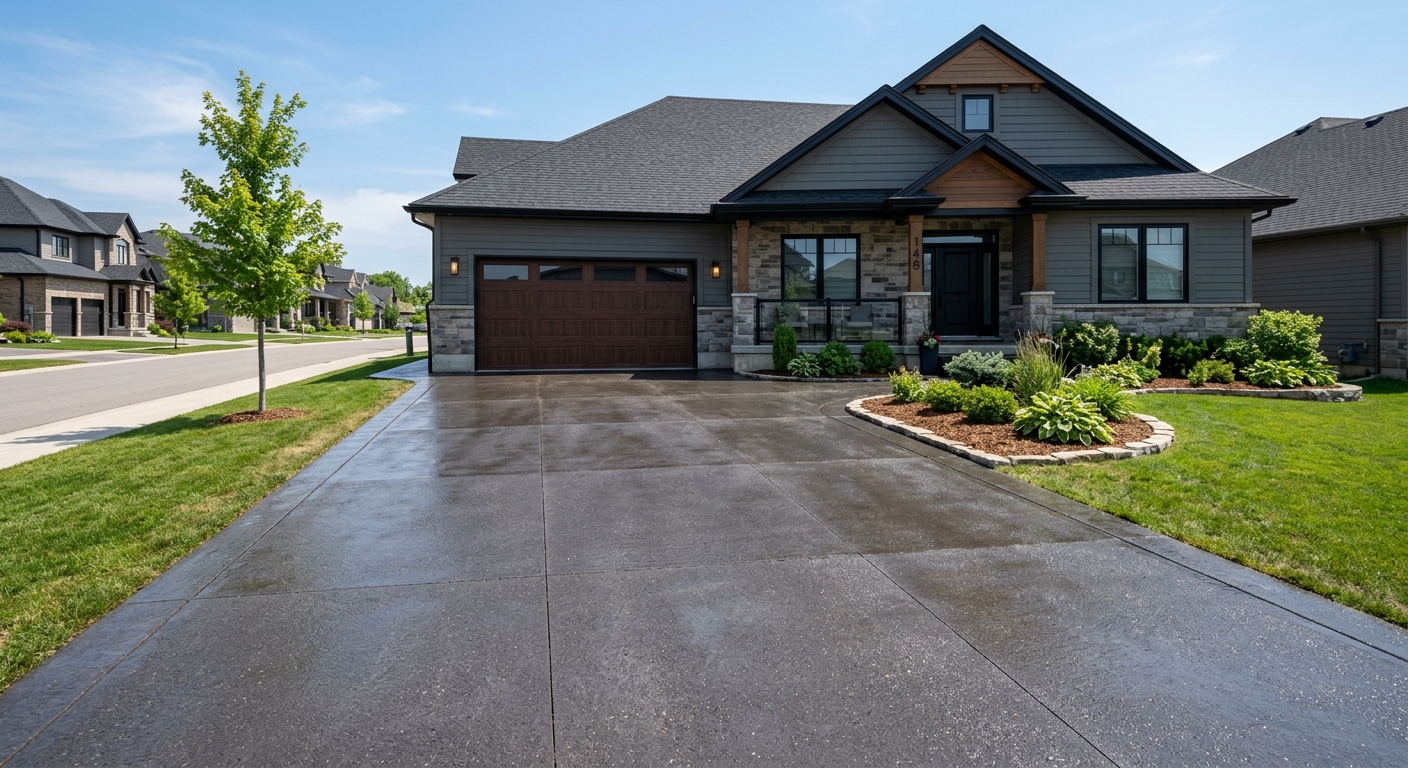
Concrete work options and costs in Willowridge-Martingrove-Richview
In Willowridge-Martingrove-Richview, concrete work is a year-round home-service need, but the best-value projects still happen when conditions are right for curing. With a population of 22,156 people (Statistics Canada, 2021 Census), this neighbourhood sees steady demand from homeowners maintaining driveways, patios, and walkways—especially in established pockets near the Islington–Rexdale corridor where many properties have mature landscaping and older flatwork that’s reached the end of its service life. Concrete prices and scheduling are also shaped by Toronto’s freeze–thaw cycle: repeated winter wetting and thawing puts stress on exterior slabs, so contractors plan for drainage, air-entrained mixes, and control joints rather than “just pouring and moving on.”
Costs can swing because Toronto-area soil and grading conditions vary block to block. A driveway rebuild with deepened base and proper compaction may cost more than a straightforward resurfacing, but it typically performs far better through winter. The Ontario Building Code drives structural footings to extend below the design frost depth (commonly around 1.2 m, or about 4 ft) to reduce frost heave and differential movement. Meanwhile, exterior flatwork is often concentrated in the warmer months to keep curing reliable; when temperatures drop toward about 10 °C or below, protection and longer cure management raise costs.
Below is a practical comparison of common concrete options you’ll see around Willowridge-Martingrove-Richview, along with typical size ranges and the specs that usually separate a “good” job from a long-lasting one. Use this table to translate your priorities into a realistic budget before you collect quotes.
| Application |
Typical Size |
Key Spec |
Finish Option |
Price Range |
| Concrete driveway (standard broom finish) |
10’ x 20’ to 12’ x 22’ (200–280 sq. ft.) |
Air-entrained exterior mix, compacted granular base |
Broom finish, standard edging |
$18,000–$28,000 |
| Exposed aggregate driveway |
10’ x 20’ to 12’ x 22’ (200–280 sq. ft.) |
Air-entrained exterior mix, deeper finishing control |
Exposed aggregate with sealer-ready surface |
$22,000–$34,000 |
| Stamped concrete driveway or patio |
8’ x 20’ to 12’ x 20’ (160–240 sq. ft.) |
Air-entrained exterior mix, colour and release system |
Stamped pattern + sealer |
$24,000–$40,000 |
| Plain concrete patio or walkway |
6’ x 12’ to 10’ x 20’ (120–200 sq. ft.) |
Proper base and drainage slope |
Float and broom/brush texture |
$16,000–$26,000 |
| Garage floor (interior slab) |
18’ x 20’ (360 sq. ft.) |
Vapour barrier, fibres or mesh as required |
Broom finish, trowel finish option |
$18,000–$30,000 |
| Foundation footings (structural, below frost) |
Per footing wall/section (project-dependent) |
Below frost depth, reinforcing per engineered plans |
Structural concrete only |
$180,000–$300,000 |
Prices are estimates only and vary by project scope, site access and material selection.
What affects the price of concrete work in Willowridge-Martingrove-Richview
In Toronto and across Ontario, you can see the same “driveway size” quote vary by 30–50% because concrete pricing isn’t just about the slab thickness—it’s the full system: excavation, base design, reinforcement, mix design, finishing labour, and winter durability precautions. Contractors also price around risk. If your site requires hauling, constrained access for a concrete truck, or extra base depth to control water movement, the job becomes more labour-intensive even when the visible concrete area looks similar.
Frost depth and freeze–thaw cycles dictate every spec in this region. Structural footings must extend below the design frost depth (commonly around 1.2 m in Ontario) to prevent frost heave and differential movement. Exterior slabs and walkways need air-entrained concrete mixes to survive repeated freeze–thaw. When temperatures drop toward 10 °C or below, contractors either schedule pours earlier or add cold-weather curing precautions (insulating blankets, additional protection and planning), which can add cost. Finally, de-icing salt accelerates surface spalling when concrete isn’t properly made and protected—this is why sealing is often part of a durability-focused plan.
In Willowridge-Martingrove-Richview, two common cost drivers are sub-base condition and drainage. For example, if an older driveway base is pumping fines or the lot grading traps water, the contractor may need extra granular depth and drainage work before pouring—this can move your driveway budget closer to the higher end of the driveway bands (for instance, standard broom often lands in the $18,000–$28,000 range, while decorative options trend higher). On the other hand, a straightforward patio with good existing drainage might come in closer to $16,000–$26,000 because the base prep and excavation are simpler. Age of housing stock matters too: many homes in the area have older, less reliable drainage patterns, and fixing that can shift costs by hundreds to thousands of dollars.
| Price Factor |
Why It Matters |
Cost Impact |
| Frost line depth — determines footing depth and form height |
Deeper footings reduce frost heave and movement |
Can add major excavation and concrete volume on structural work |
| Site preparation — excavation, grading, compacted granular base |
Controls settlement and prevents water from undermining slab |
Often the biggest swing factor on driveways and patios |
| Reinforcement — rebar or wire mesh requirement |
Improves crack control and structural capacity |
Materials + labour increase with rebar placement complexity |
| Mix design — air-entrainment and compressive strength spec |
Air entrainment is critical for freeze–thaw durability |
Higher-spec mixes cost more but reduce winter failure risk |
| Finish type — broom vs. stamped vs. exposed aggregate |
Finishing complexity and colour/release systems |
Stamped and exposed aggregate add labour and materials |
| Pour size and concrete truck access to site |
Access affects staging time and batching logistics |
Limited access can add labour hours and equipment |
| Cold-weather curing precautions — heating and blankets |
Protects strength gain when temperatures fall |
Can increase labour and material for insulation/protection |
| Control joint pattern and sealing cost |
Joints guide cracking; sealing helps resist de-icing salt damage |
Sealing and correct joint layout add line-item cost but extend life |
Permits & regulations in Ontario
In Ontario, the rule of thumb is that structural concrete work needs more oversight than decorative or surface-only flatwork. For example, structural concrete such as footings, foundation walls, and grade beams typically requires a building permit, and engineered drawings are often reviewed by the municipality as part of the approval process. If you’re changing the structure, supporting loads, or altering foundation elements, assume permits apply.
Concrete flatwork—like patios, walkways, and driveways—typically does not require a permit on its own, unless it affects lot grading, touches impervious surface coverage limits, or involves work near a municipal right-of-way. Even when permits aren’t required for the slab, contractors still need to ensure drainage and elevation meet local requirements so runoff doesn’t create problems.
To verify a contractor in Willowridge-Martingrove-Richview, follow this homeowner checklist: (1) confirm the company’s business credentials and any applicable provincial registration, (2) request a certificate of insurance showing general liability, (3) ask for WSIB/WCB clearance or coverage proof for their workers, and (4) confirm they can provide references on similar-scale concrete work. Step-by-step, you’ll look for the insurance certificate that matches the contracting entity name, and you’ll obtain WSIB/WCB confirmation directly from the proof letter or clearance documentation before any excavation starts.
Getting concrete right in Willowridge-Martingrove-Richview's freeze-thaw climate
Concrete failure in Willowridge-Martingrove-Richview is usually less about “bad concrete” and more about a missing piece of the system under our freeze–thaw cycles. The two most common problems I see are spalling (surface scaling from winter salt and freezing) and cracking from movement (insufficient base, missing or mis-spaced joints, or poor drainage). To spec the job correctly, start with base prep: use a compacted granular sub-base to the right depth for local soils and frost protection, and build in proper slopes so water drains away rather than saturating the underside.
Next, require a mix design that can survive winter. For exterior flatwork, that means air-entrainment (typically a target air content in the 5–7% range for many exterior mixes) and a minimum compressive strength such as 32 MPa where specified for flatwork. Then plan for control: joints aren’t optional—spacing governs where shrinkage and thermal cracking happens. Curing is critical too: protect and cure for at least 7 days under proper conditions, and if you’re pouring when evenings get cold, additional insulation or heating plans may be needed to keep strength gain on track. Finally, apply a penetrating sealer after cure—commonly around 28 days—to help repel de-icing salts and reduce surface deterioration.
Here’s where the dollars make sense: a properly prepped base and correct air-entrained mix might cost more upfront, but it avoids the cycle of patching and premature replacement. For instance, moving from a basic driveway build toward a higher-spec exterior plan can still fall within the typical driveway band $18,000–$28,000, while repeated “cheap patch” repairs often cost far more over 3–5 winters. Ask the contractor to show how they’ll meet air-entrainment and joint spacing so you’re not betting on the weather.
| Spec |
Why It Matters in Willowridge-Martingrove-Richview |
What to Ask For |
Impact if Skipped |
| Compacted granular base (depth?) |
Prevents pumping, settlement and water trapping through winters |
Granular base depth and compaction method (e.g., proof rolling) |
Cracks, uneven slab, and drainage failures |
| Air-entrained concrete mix (target air %?) |
Reduces freeze–thaw scaling and spalling risk |
Declared target air content (commonly 5–7% for exterior flatwork) |
Spalling and surface deterioration after de-icing salt exposure |
| Compressive strength (MPa rating) |
Supports strength gain and long-term durability |
Minimum MPa spec (commonly at least 32 MPa where required) |
Premature wear, raveling and reduced structural capacity |
| Control joints (spacing per ACI guidelines) |
Controls shrinkage and thermal cracking locations |
Planned joint layout and spacing for your slab dimensions |
Random cracking and difficult-to-repair spall zones |
| Minimum 7-day curing period |
Ensures strength development through temperature swings |
Curing plan and protection for cold nights |
Weak surface, dusting, and early deterioration |
| Penetrating sealer (when applied after cure) |
Helps block salt and water penetration at the surface |
Sealer type and timing (often after 28 days of cure) |
Faster scaling and shortened service life |
How to choose a concrete work contractor in Willowridge-Martingrove-Richview
Choosing the right contractor in Willowridge-Martingrove-Richview is mostly about verification and clarity. Start with Ontario requirements and basic risk checks: ask for their general liability insurance certificate (so you’re not left holding the bag for damage or injury), and confirm they have WSIB/WCB coverage for their workers. For Ontario licensing, don’t rely on verbal claims—ask for the business details they’re registered under and the specific documentation they can provide (and then match it to the insurance certificate’s legal name).
Next, get 2–3 itemised written quotes, not lump-sum guesses. A good quote separates labour and materials (excavation, forms, base, reinforcement, concrete supply, finishing, and sealing). It should also state what’s excluded: permit fees (if applicable), disposal/hauling of existing material, geotextile or drainage features, and protection for curing in cooler weather. Read the scope like a contract—if you can’t find the curing or base prep details, you’re likely buying “minimum compliance.”
Warranty is also important in concrete because Ontario winters expose defects fast. Ask for a workmanship warranty length, whether any product/manufacturer warranty is included, and whether the warranty is transferable if you sell your home. For payment, avoid large deposits—keep upfront payments around 10–15% and hold back money until the job is complete and cleaned up. Finally, request a written start date and a completion estimate that accounts for curing and weather protection—this is where Toronto-area scheduling differs from milder regions.
- Ask for an itemised quote (labour, materials, disposal) rather than one total number.
- Confirm air-entrained mix is included for exterior work.
- Require base prep details: granular depth, compaction expectations, and drainage slope.
- Verify insurance certificate is current and matches the contractor’s legal name.
- Get WSIB/WCB clearance or coverage proof before work starts.
- Request references for similar driveways/patios in Toronto-area freeze–thaw conditions.
- Ask how they handle curing when temperatures approach 10 °C or below.
- Confirm reinforcement and mesh/rebar placement strategy (not just “we use it”).
- Ask about control joint pattern, timing, and saw-cut versus formed joints.
- Clarify sealing: product type, when it’s applied (after cure), and coverage.
- Understand site access and how they’ll place concrete without damaging landscaping.
- Set a payment schedule: keep upfront to 10–15% and use holdback until final acceptance.
Concrete contractor red flags in Willowridge-Martingrove-Richview include: promising “no need” for air-entrainment on exterior slabs, skipping granular base depth or drainage slope details, offering only a single lump-sum without specs, refusing to provide proof of WSIB/WCB and liability insurance, or rushing curing and removing protection too soon.
Frequently asked questions — concrete work in Willowridge-Martingrove-Richview
How long does a concrete project take in Willowridge-Martingrove-Richview?
Timelines in Willowridge-Martingrove-Richview depend on the size of the slab, excavation/disposal needs, and—most importantly—curing conditions in Toronto’s freeze–thaw climate. A small patio or walkway can often be completed faster because the base prep and formwork are straightforward, but drying and cure protection still matter. For typical residential exterior flatwork, you should plan for several days on-site (demo/excavation/base prep, pour and finishing day, then curing/protection). Even after the concrete is poured, follow-up work like sealing is often scheduled after cure (commonly around 28 days). In colder weeks when temperatures approach 10 °C or below, contractors may extend the schedule with insulation blankets or heating plans to ensure strength gain.
What is a concrete overlay and is it suited to Willowridge-Martingrove-Richview?
A concrete overlay is a new layer of concrete placed on top of an existing slab, usually after patching spalls and properly preparing the surface (often including grinding, cleaning, and applying a suitable bonding system). In Willowridge-Martingrove-Richview, overlays can work when the original slab is largely stable, well-drained, and not experiencing major structural movement. If the base is failing, water is undermining the slab, or the existing concrete is heaving with freeze–thaw, an overlay can crack and spall again—sometimes faster than a full rebuild. Cost-wise, overlays can be a middle ground, but they don’t fix the underlying moisture or base issues. If you’re seeing widespread cracking or repeating patches, you may be better budgeting for a full driveway or patio rebuild in the typical range such as $18,000–$28,000 for many standard driveway projects.
How do I seal concrete to protect it in Willowridge-Martingrove-Richview?
Sealing helps protect exterior concrete surfaces from water and de-icing salt—both are big drivers of winter scaling in Ontario. The key is timing: allow adequate curing first. A common approach is applying a penetrating sealer after the concrete has cured—often about 28 days—so moisture levels are reasonable and the sealer can penetrate rather than trap water. Before sealing, the surface should be clean and dry; contractors typically power wash and allow full drying. Ask for the sealer product type (penetrating versus film-forming) and ensure it’s compatible with air-entrained exterior concrete. Keep in mind that sealing isn’t a cure-all for poor base prep or missing air-entrainment. It supports durability, but a correctly built slab with proper drainage is still what prevents repeated freeze–thaw damage.
What is the difference between concrete and cement?
People often use “cement” and “concrete” interchangeably, but there’s a real difference. Cement is one component inside concrete—it’s the binding material that reacts with water to create strength. Concrete is the full mixture: cement plus water plus aggregate (sand and stone), and for most exterior work in Ontario, an air-entrainment system is included to manage freeze–thaw performance. When a contractor quotes concrete flatwork, you should ask about the mix design: air content targets for exterior slabs and the minimum compressive strength (commonly 32 MPa in many specs for residential durability). In Willowridge-Martingrove-Richview, the freeze–thaw cycle makes air-entrainment and curing practices particularly important, because surface scaling can accelerate if the cement/aggregate system isn’t properly designed.
How much does concrete work cost in Willowridge-Martingrove-Richview?
Concrete pricing in Willowridge-Martingrove-Richview usually falls into the same broad GTA bands because the major variables—base prep, air-entrained mix requirements, reinforcement, and curing protection—are common across the Toronto economic region. For example, many residential concrete patios and walkways often land around $16,000–$26,000, while standard broom-finished driveways are commonly in the $18,000–$28,000 range depending on size and access. Decorative options move higher: stamped concrete driveway or patio typically trends around $24,000–$40,000 because finishing is labour-intensive and colour systems add materials. Structural work like footings is quoted quite differently and depends heavily on engineered drawings and excavation scope. Always compare quotes on what’s included—disposal, base depth, reinforcement, curing protection, and sealing.
How deep must footings be for Willowridge-Martingrove-Richview's frost line?
For Willowridge-Martingrove-Richview in Ontario, structural footings generally need to extend below the design frost depth to help prevent frost heave and differential movement. In the Toronto region, local building practice commonly targets around 1.2 m (about 4 ft) below grade for many foundation footing applications, though the exact depth should follow the applicable design requirements for your specific soil conditions and engineering plan. This is one reason foundation work can’t be estimated reliably from square footage alone—engineered drawings and site conditions control excavation depth and rebar placement. If you’re building or underpinning, ask your contractor to confirm the specified footing depth and reference the engineered plan (not a rule-of-thumb). This structural requirement is different from exterior flatwork depth, which is controlled by base design and drainage rather than frost-protected foundation elements.