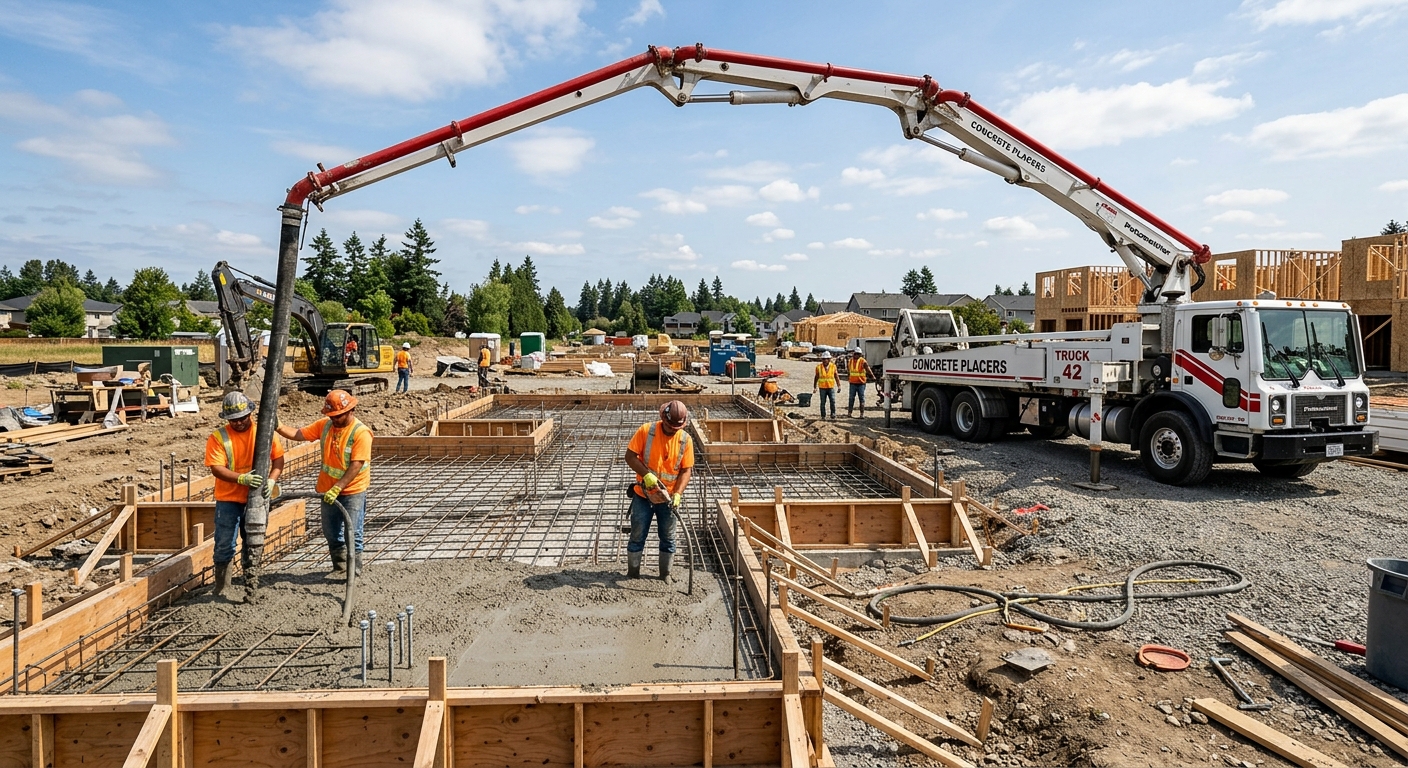
Concrete work options and costs in Owen Sound
Owen Sound is a great place for concrete flatwork, but it’s also a place where the weather calls the shots. With a population of 21,612 (Statistics Canada, 2021 Census) and a housing stock where single-detached homes make up 51.1% of dwellings, most driveway, patio and walkway projects are driven by homeowners who want a durable, low-maintenance surface for year-round use. In the Stratford–Bruce Peninsula economic region, concrete pricing tends to run higher than in milder parts of Ontario because cold winters bring deep frost, frequent freeze–thaw cycles, and a shorter pour season. That means deeper excavation, more granular base preparation and drainage attention, and more careful curing steps—especially for exterior slabs near Lake Huron and Georgian Bay where moisture and salt exposure can be worse.
You’ll also see scheduling pressure because crews often concentrate pours from late spring into early fall. On top of that, cold-weather requirements (insulation blankets, heaters, and tighter control of water/cement ratios) add labour and materials. In neighbourhoods like West Hill and the West Side, concrete flatwork demand is consistent because many properties have older driveways and mature landscaping that make access planning and removal/disposal part of the real cost.
Below is a practical comparison of common options and what typically drives the range before we talk about spec and scope.
| Application |
Typical Size |
Key Spec |
Finish Option |
Price Range |
| Concrete driveway (standard broom finish) |
16 ft x 30 ft (480 sq ft) |
Air-entrained exterior mix; reinforced where needed |
Broomed surface |
$16,000–$22,000 |
| Exposed aggregate driveway |
16 ft x 30 ft (480 sq ft) |
Air-entrained exterior mix; proper base and curing |
Exposed aggregate finish |
$19,000–$27,000 |
| Stamped concrete driveway or patio |
12 ft x 24 ft (288 sq ft) |
Air-entrained mix; integral colour/texture system |
Stamped pattern with release agent |
$10,000–$15,000 |
| Plain concrete patio or walkway |
10 ft x 20 ft (200 sq ft) |
Exterior mix; control joints |
Float and broom or smooth trowel edges |
$2,800–$4,000 |
| Garage floor (interior slab) |
20 ft x 22 ft (440 sq ft) |
Reinforcement and vapour considerations |
Steel trowel/finish with light broom edges |
$8,500–$14,000 |
| Foundation footings (structural, below frost) |
Typical single house spread footings |
Excavation below frost; engineered rebar/placement |
Formed and concrete placed |
$20,000–$35,000 |
Prices are estimates only and vary by project scope, site access and material selection.
What affects the price of concrete work in Owen Sound
In Owen Sound and across the Stratford–Bruce Peninsula region, two quotes for the “same size” concrete job can differ by 30–50% because the spec changes—especially where frost, drainage, and finishing complexity are concerned. The big swing comes from what has to happen before any concrete touches the ground: excavation depth, disposal, granular base thickness, compaction, reinforcement, and whether the contractor must plan around a tight pour schedule. And because much of the local housing stock is older—72.4% of homes were built before 1981 (Statistics Canada, 2021 Census)—many projects include retrofit issues like replacing failed sub-base, reworking settlement cracks, or dealing with challenging access and existing drainage.
Locally, frost line depth and freeze–thaw cycles dictate every spec: exterior footings must extend below the regional design frost depth to prevent frost heave and cracking, which drives more excavation and more forming than milder areas. Exterior flatwork also needs air-entrained concrete mixes to resist surface scaling and spalling over repeated cold cycles. The short pour season means colder days can trigger cold-weather curing precautions—insulation blankets and heaters—raising costs. Finally, de-icing salt accelerates surface damage, so sealing is often recommended, and that’s another line item.
Concrete options also shift the labour profile. A basic broom driveway may land closer to the $16–$22 per square foot band, while stamped work commonly pushes into the $22–$32 per square foot range because of colour hardeners, release agents, pattern tooling, and extra labour control. A homeowner sometimes expects a “slab is a slab,” but if the job needs heavier base prep or reinforcement due to soil conditions, the real cost can move quickly toward the high end.
| Price Factor |
Why It Matters |
Cost Impact |
| Frost line depth |
Determines footing depth and form height |
More excavation can add thousands in labour and equipment time |
| Site preparation |
Excavation, grading, compacted granular base |
Stronger base work typically increases cost, but reduces future settlement |
| Reinforcement |
Rebar or wire mesh requirement |
Adds material and placement labour; may be required for exterior durability |
| Mix design |
Air-entrainment and compressive strength spec |
Exterior air-entrained mix costs more, but it’s essential here for freeze–thaw resistance |
| Finish type |
Broom vs. stamped vs. exposed aggregate |
Stamped/exposed finishes add labour and specialty materials |
| Pour size and concrete truck access to site |
Access affects pumping, labour, and turnaround time |
Poor access can increase truck waiting and equipment charges |
| Cold-weather curing precautions |
Heating and blankets |
Can add direct costs in materials plus extra on-site labour hours |
| Control joint pattern and sealing cost |
Cracking control and moisture/salt protection |
Sealing and proper jointing improve longevity; skipping them often leads to early repairs |
Permits & regulations in Ontario
In Ontario, structural concrete work—footings, foundation walls, and grade beams—generally requires a building permit, and you’ll often see engineered drawings reviewed as part of the municipal process. For concrete flatwork (driveways, patios, and walkways), permits are usually not required when the work stays within typical scope, but it can change if the project affects lot grading, drainage, or impervious surface/coverage limitations. If you’re tying into a foundation, changing stormwater flow, or working near municipal right-of-way areas, it’s smart to confirm with the local authority before the first shovel goes in.
For homeowners in Owen Sound, the practical process is: (1) decide whether your work is “structural” or “flatwork,” (2) confirm whether a permit is required for your specific location and scope, and (3) ensure your contractor is compliant. A reputable contractor should carry liability insurance and WSIB/WCB coverage (as applicable), provide references for similar projects, and give clear written documentation that matches your scope.
Step-by-step verification is straightforward. Check the Ontario contractor’s licence/registration online through the appropriate Ontario registry for the trade (if they’re performing work that falls under licensing requirements), ask for a current certificate of insurance, and request proof of WSIB clearance/coverage relevant to the workers on site. If they can’t provide documentation quickly, that’s a red flag.
Getting concrete right in Owen Sound's freeze-thaw climate
Concrete fails in Owen Sound most often for two reasons: water (from poor drainage or weak base) and freeze–thaw damage (from inadequate air-entrainment and curing). The cure matters because cold, damp conditions slow hydration, which can leave the surface weaker and more vulnerable to early scaling. Start with base preparation: use a properly compacted granular sub-base to the right depth for the soil and frost exposure, with drainage that prevents water from sitting under the slab. Next, specify an air-entrained exterior concrete mix—commonly 5–7% air content for exterior flatwork—because it creates tiny air voids that help the paste survive expansion during freeze–thaw cycles. For strength, request a minimum 32 MPa compressive strength for exterior work, and confirm the mix design is appropriate for freeze resistance and workability.
Control joints are not an afterthought. They should be spaced to limit random cracking, and they should be cut early enough to manage shrinkage stresses rather than letting cracks find their own path. Then curing: plan for at least 7 days of proper curing under suitable conditions. Finally, sealing is a smart defensive step for this area’s de-icing salt exposure—use a penetrating sealer applied 28 days after the pour once the slab has cured.
When you ask questions, tie them directly to outcomes. For example, don’t just say “broom finish”—ask whether the mix includes air entrainment to survive winter cycles. If a contractor proposes to reduce cost by skipping air-entrainment or shortcuts base prep, you’re borrowing trouble for the next freeze season. A stamped driveway might cost roughly $22–$32 per square foot (regionally), but the extra cost is usually justified when it’s paired with correct base, joints, and curing. If those fundamentals aren’t right, even the most beautiful finish won’t last.
| Spec |
Why It Matters in Owen Sound |
What to Ask For |
Impact if Skipped |
| Compacted granular base (depth?) |
Reduces water movement and supports frost resistance |
Base thickness and compaction test method; show excavation depth plan |
Settlement, pumping, and premature cracking or heaving |
| Air-entrained concrete mix (target air %?) |
Protects against freeze–thaw scaling and spalling |
5–7% air content for exterior flatwork; confirm it on the mix ticket |
Surface damage, scaling, and flaking during winter cycles |
| Compressive strength (MPa rating) |
Ensures adequate durability under traffic and thermal stress |
Minimum 32 MPa compressive strength; confirm test/quality process |
Weaker concrete, higher risk of surface wear and cracking |
| Control joints (spacing per ACI guidelines) |
Controls shrinkage cracking in a predictable pattern |
Planned joint layout and timing of saw-cut or form-cut joints |
Random cracks that are harder to repair neatly |
| Minimum 7-day curing period |
Cold weather slows hydration and can reduce early strength |
How they protect the slab if temperatures drop; curing plan |
Lower early strength and increased risk of early deterioration |
| Penetrating sealer (when applied after cure) |
Repels moisture and helps resist salt-driven surface breakdown |
Penetrating sealer applied after cure (commonly 28 days post-pour) |
Higher risk of staining, moisture ingress, and accelerated surface scaling |
How to choose a concrete work contractor in Owen Sound
Choosing the right contractor in Owen Sound comes down to proof: proof they can legally work in Ontario, proof they’re insured, and proof their crews build to spec. Start by verifying the contractor’s Ontario licence/registration where applicable for the scope, then request a certificate of liability insurance showing active coverage. Ask for WSIB/WCB coverage confirmation for the workers who will be on your site. In practice, you can also request a clearance letter or coverage status document directly from the contractor—if they can’t provide it, don’t “assume it’s fine.”
Next, get 2–3 quotes that are itemised—labour and materials, plus removal/disposal and site prep—rather than one vague lump sum. Concrete pricing in this region swings when excavation depth, granular base prep, reinforcement, and access/pumping are handled differently. Read the scope line-by-line: what’s excluded (beyond minor adjustments), is the permit included if needed, and is disposal of existing concrete or topsoil hauled away included? Also ask about warranties: workmanship warranty length, whether there’s a product/manufacturer warranty for specialty items, and whether it transfers to future owners if you sell the house.
Payment schedule matters. Avoid paying more than about 10–15% upfront. Use a holdback until the job is complete and any final grading, joint finishing, and cleanup are done. And insist on a timeline in writing: a start date and a completion estimate, because spring scheduling and cold nights can change curing requirements.
- Confirm Ontario licensing/registration for the scope before signing.
- Request a current certificate of liability insurance (and verify dates).
- Ask for WSIB/WCB coverage proof/clearance letter for workers.
- Get itemised quotes (labour, materials, base prep, reinforcement, disposal).
- Make sure air-entrained exterior mix is stated on the quote for exterior work.
- Ask for a written curing plan for cold snaps (blankets/heaters if needed).
- Confirm reinforcement details (wire mesh vs rebar and where it goes).
- Verify joint layout—spacing and whether joints are cut early.
- Clarify sub-base thickness and compaction approach.
- Ask about drainage: slope/grade, edge details, and runoff management.
- Ensure permit responsibility is clear (who pulls it, if needed).
- Use a realistic payment schedule: small deposit, holdback until final.
In Owen Sound, concrete contractor red flags include vague wording like “proper base” with no depth or compaction plan, refusing to provide insurance/WSIB/WCB documentation, proposing exterior work without explicitly stating air-entrainment, cutting corners on joints/curing (especially when temperatures drop), and giving only a lump-sum number without disposal/removal details.
Frequently asked questions — concrete work in Owen Sound
When is the best time to pour concrete in Owen Sound?
In Owen Sound, the best window is late spring through early fall when temperatures stay workable and curing is reliable. Even within that season, we watch night-time temperatures closely because cold nights slow hydration and can leave the slab vulnerable. Contractors who schedule properly will include cold-weather precautions in the plan if a cool spell hits—insulation blankets and heaters—because that’s where many “cheap” pours go wrong. Since 72.4% of homes in the region were built before 1981 (Statistics Canada, 2021 Census), many driveways and walkways are retrofit work that can compress timelines. For pricing, exterior slabs priced around the $16–$22 band for standard driveways are typically easier to schedule in warm-enough weeks, while cold-weather adjustments can push costs higher in the shoulder months.
How long does concrete take to cure?
Concrete curing is often misunderstood. A slab usually reaches workable strength early, but durability depends on proper curing time and conditions. In practical homeowner terms, plan for at least 7 days of curing under appropriate conditions for many exterior flatwork specs. Full strength development continues beyond that—so avoid heavy impacts or locking in salt exposure too soon. If weather is cold or damp, the contractor should extend protection and curing methods so hydration isn’t interrupted. This matters locally because Owen Sound’s freeze–thaw cycles can punish weak early concrete. After the slab has fully cured, penetrating sealing is commonly done around 28 days post-pour to help repel moisture and de-icing salt effects. Ask your contractor what curing method they’ll use if temperatures dip overnight.
Do I need a permit for concrete work in Ontario?
Sometimes, but not always. In Ontario, structural concrete like footings, foundation walls, and grade beams generally requires a building permit and may involve engineered drawings reviewed by the municipality. Concrete flatwork—driveways, patios, and walkways—often does not require a permit when it’s staying within standard grading and coverage expectations. However, if your project changes lot grading, impacts drainage, or involves municipal right-of-way or impervious surface limits, you should confirm with the local authority before starting. For a homeowner in Owen Sound, the easiest step is to tell the contractor exactly what you’re doing and ask, in writing, whether a permit is required and who handles the process if needed. A compliant contractor will align their documentation with your municipal requirements.
Concrete vs pavers for a patio in Owen Sound?
Concrete patios and pavers can both work well in Owen Sound, but the tradeoffs are real. Concrete is usually less expensive up front; plain concrete patios and walkways commonly fall in the $14–$20 per square foot band, while stamped styles can move higher (roughly $22–$32 per square foot) because of the decorative process. Pavers can be attractive because individual units can be replaced if damage happens. With concrete, longevity depends heavily on base preparation, air-entrainment for freeze–thaw resistance, correct jointing, and proper curing. In our climate, concrete that’s poured without the right granular base depth or without air-entrained mix is more likely to scale or crack. If you want a tight, modern look with straightforward maintenance, concrete is often the best fit—if it’s built correctly for frost and drainage.
How long does a concrete driveway last?
A well-built concrete driveway in Owen Sound can last many years—often decades—when it’s designed for local freeze–thaw exposure with proper sub-base, drainage, air-entrained concrete, and correctly spaced control joints. The most common driveway failures here aren’t “random”—they’re usually the result of water under the slab, insufficient base preparation, missing or poorly timed joints, or inadequate air-entrainment leading to surface scaling. That’s why two driveway quotes in the same size range can diverge by 30–50%. If you’re comparing options, look at the stated spec, not just the price per square foot. Standard broom-finish driveway pricing is commonly in the $16–$22 per square foot band, while decorative work costs more. Longevity is tied to fundamentals more than finish alone.
What is air-entrained concrete and why does it matter here?
Air-entrained concrete contains tiny, intentionally created air bubbles that give freeze–thaw expansion somewhere safe to go. In Owen Sound and the broader Stratford–Bruce Peninsula area, winter brings deep frost and frequent freeze–thaw cycles, so exterior slabs are repeatedly stressed. Without air-entrainment, water in the concrete can expand as it freezes, damaging the surface paste and leading to scaling and spalling. For exterior flatwork, contractors typically target about 5–7% air content and use proper curing so the concrete gains strength before harsh cold hits. This is a place where “saving money” can be expensive: the premium for air-entrained mix is generally far less than the cost of early repairs. If your quote doesn’t clearly mention air-entrained mix for exterior work, ask for the mix specification and how they’ll verify it.