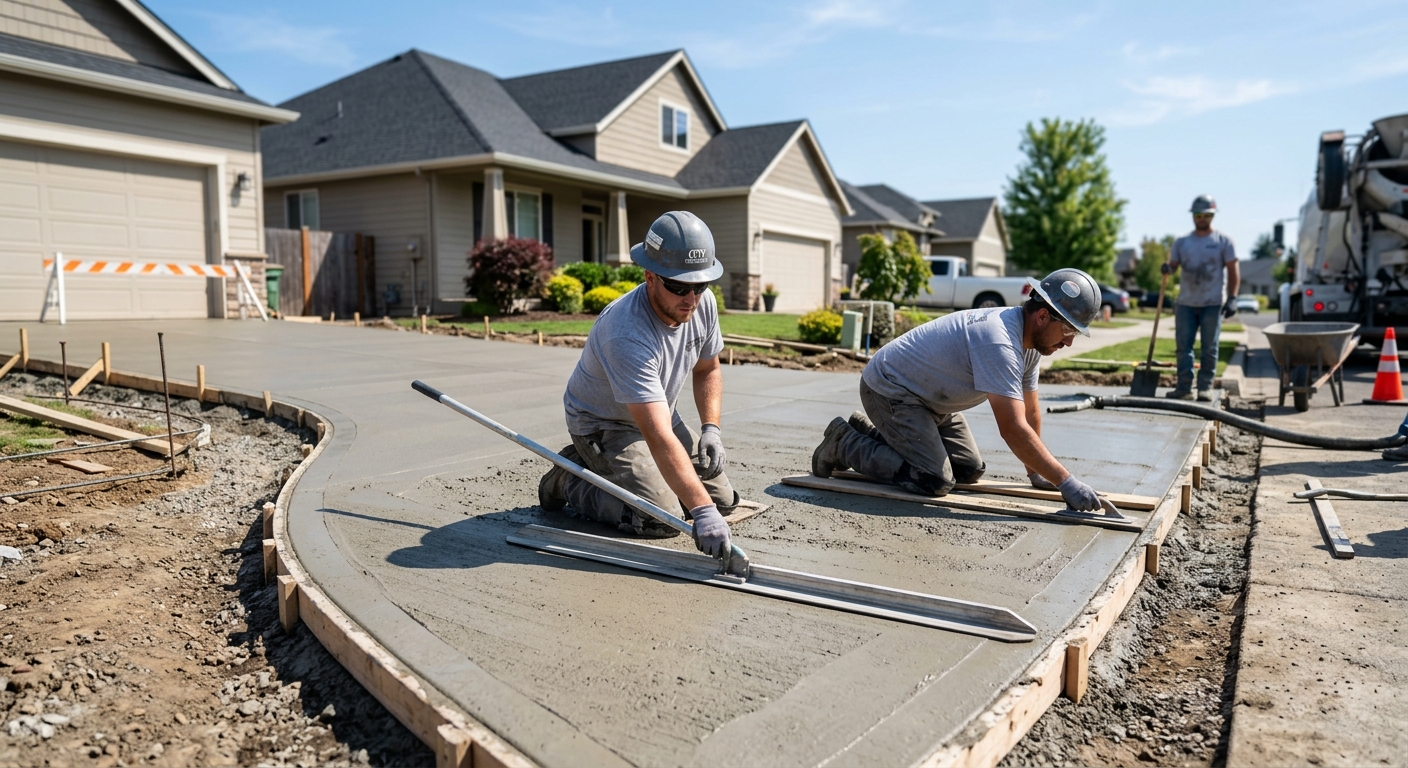
Concrete work options and costs in Kanata
Kanata homeowners usually start with a driveway, patio, or walkway—small projects that add real curb appeal in a fast-growing community that reached about 90,000 residents in 2021 (Statistics Canada, 2021 Census). In many neighbourhoods, concrete flatwork is in high demand because single-detached homes dominate day-to-day renovation needs, and driveways and entrances see heavy seasonal use. Areas like Bridlewood and Kanata Lakes are especially active for exterior concrete work, where upgrades often happen alongside landscaping, drainage improvements, and winter-proofing.
Ottawa-area pricing trends higher than milder parts of Ontario because of the deep frost line and strong freeze–thaw cycles. Those climate conditions push contractors to excavate deeper, build a well-compacted granular base, and place air-entrained mixes with tighter control joints—especially at slab edges, driveways, and walkways where freeze–thaw stress concentrates. The pour season is also shorter, so winter risk affects scheduling and adds cost for planning, heating/blanketing on marginal days, and careful curing. Even when your “design” looks basic, the underlying specs aren’t.
Below is a practical price comparison for common concrete options in Kanata. Use it to benchmark quotes you receive, then confirm the proposed thickness, base depth, reinforcement, and finishing details—those items drive long-term performance in Ottawa’s winters.
| Application |
Typical Size |
Key Spec |
Finish Option |
Price Range |
| Concrete driveway (standard broom finish) |
400–600 sq. ft. |
Air-entrained mix, compacted granular base, control joints |
Broom finish, standard edges |
$16,000 – $25,000 |
| Exposed aggregate driveway |
400–600 sq. ft. |
Air-entrained mix, consistent stone exposure, proper curing |
Exposed aggregate (surface retarder or wash method) |
$20,000 – $30,000 |
| Stamped concrete driveway or patio |
300–500 sq. ft. |
Air-entrained mix, base prep, release agent + curing attention |
Stamp pattern + optional colour hardener/sealer |
$22,000 – $35,000 |
| Plain concrete patio or walkway |
150–350 sq. ft. |
Air-entrained mix, slope to drainage, control joints |
Float/smooth then light broom or brush texture |
$14,000 – $22,000 |
| Garage floor (interior slab) |
400–600 sq. ft. |
Vapour barrier (where required), reinforcement option, proper curing |
Steel-trowel or broom finish (per plan) |
$18,000 – $28,000 |
| Foundation footings (structural, below frost) |
Per building design |
Excavation to design frost depth, concrete class per engineer, rebar per plan |
Formed/structural finish only (no cosmetic finish) |
$12,000 – $20,000 |
Prices are estimates only and vary by project scope, site access and material selection.
What affects the price of concrete work in Kanata
It’s common to see “the same” concrete job come back 30–50% apart across Ottawa and other Ontario regions. In Kanata, the difference usually isn’t the sticker price of cement—it’s the spec needed to survive freeze–thaw, plus how much labour and equipment time it takes to build a durable base under a deep frost line. A basic-looking driveway still needs the right footing/subgrade prep, air-entrained concrete, and a joint and curing plan that matches Ottawa’s shorter working season.
Contractors price differently because frost protection drives the whole build-up. For exterior concrete in Ontario, footings typically need to extend below the design frost depth, which means more excavation and a higher volume of granular base. Also, freeze–thaw cycles demand air-entrained mixes so the concrete can tolerate repeated expansion and contraction. Cold-weather curing precautions—heating/blankets, scheduling to protect green concrete, and ensuring proper strength gain—add cost, especially when daytime temperatures fluctuate. Then there’s de-icing salt: it accelerates surface wear and spalling if the mix and finishing aren’t designed and sealed correctly. That’s why sealing is often recommended once the slab has cured (commonly after 28 days) to improve performance against salt exposure.
Two examples from Kanata: (1) if your driveway crosses a low spot where drainage is poor, contractors will often include extra sub-drainage and regrading—raising the cost, but reducing future settlement cracking. (2) If you choose stamped concrete, the material and finishing time jumps—often landing in the $22–$35 band—while plain patios and walkways may fit closer to the $14–$22 band, assuming similar thickness and base prep. In older Kanata neighbourhoods with more mature soils, excavation and disposal can also add $2,000–$6,000 depending on how much unstable material is removed and how access affects haul time.
| Price Factor |
Why It Matters |
Cost Impact |
| Frost line depth — determines footing depth and form height |
Deeper frost protection prevents heaving and cracking at edges and supports |
Higher excavation + forms can add several thousand dollars on structural work |
| Site preparation — excavation, grading, compacted granular base |
Proper base reduces settlement, pumping, and joint-related failures in freeze–thaw |
Often the biggest driver after design: increases labour/equipment time |
| Reinforcement — rebar or wire mesh requirement |
Controls cracking and improves load capacity, especially for driveways and garage slabs |
Rebar placement and chairs add labour even if concrete volume stays similar |
| Mix design — air-entrainment and compressive strength spec |
Air-entrainment is critical to resist freeze–thaw scaling and spalling |
Small material increase, but it protects the rest of the build |
| Finish type — broom vs. stamped vs. exposed aggregate |
Finish complexity changes labour time and crew skill needs |
Stamped/exposed typically cost more than plain broom finish |
| Pour size and concrete truck access to site |
Narrow access and multiple loads increase setup time and labour |
Access issues can raise costs via extra equipment and additional trucking |
| Cold-weather curing precautions — heating and blankets |
Maintains early-age strength gain through Ottawa temperature swings |
Can add meaningful daily costs during shoulder-season pours |
| Control joint pattern and sealing cost |
Controls shrinkage cracking and helps manage salt/ice exposure |
Sealant + labour is usually modest compared with repair avoidance |
Permits & regulations in Ontario
In Ontario, structural concrete work typically requires a building permit and, in many cases, engineered drawings reviewed by the municipality. That includes foundation footings, foundation walls, grade beams, and any structural slab elements that relate to the stability of the home. For Kanata homeowners, that means if your project involves below-grade concrete, changes to structural supports, or new foundation elements, expect the permit and paperwork to be part of the process.
Concrete flatwork like patios, walkways, and driveways usually does not require a permit by itself. However, permits can become relevant if the work affects lot grading, stormwater flow, or impervious surface coverage limits—or if it ties into municipal right-of-way matters (for example, curb/sidewalk interfaces). When in doubt, confirm with the local authority before breaking ground.
Also verify your contractor is properly covered. Ontario structural work should be supported by liability insurance, and you should confirm WSIB coverage for workers where applicable. Practical step-by-step: (1) ask the contractor for a current certificate of insurance (liability) and any WSIB clearance documentation; (2) confirm the contractor’s credentials through available public registries/verification portals for Ontario businesses; (3) request references from similar projects in the Ottawa area—ideally with photos of finished flatwork and joints/edges; and (4) ensure the permit responsibilities (who pulls it, and who pays) are written clearly in the contract.
Getting concrete right in Kanata's freeze-thaw climate
Concrete fails in Kanata most often when the build-up isn’t engineered for freeze–thaw. The biggest culprit is surface and edge damage from inadequate air-entrainment and poor base preparation. When water gets under or into the slab system, Ottawa’s winter cycles drive expansion and contraction that widen cracks, loosen paste, and eventually cause spalling—especially at slab edges, driveway transitions, and areas exposed to de-icing salt.
To spec the job correctly in Kanata, focus on five areas. First, base preparation: contractors should excavate to a design-appropriate depth and place a well-compacted granular sub-base. The exact depth depends on soil condition, frost protection requirements, and slab thickness, but the key is compaction and uniform grade. Second, mix design: for exterior flatwork, specify air-entrained concrete with target air content commonly around 5–7% and a minimum 32 MPa compressive strength (or higher if specified by your engineer). Third, control joints: plan joint locations early to limit random cracking from shrinkage and thermal movement—then seal after cure for salt resistance. Fourth, curing: in a cold-weather-prone region like Ottawa, plan for minimum 7 days of curing under proper conditions; if pouring during shoulder season, ask about heating/blanketing so the slab can gain strength without damage to the surface. Fifth, sealing: use a penetrating sealer after the slab has cured (commonly at 28 days) to help repel de-icing salts.
If you’re comparing prices, the most common “cheap quote” pitfall is skipping base depth/compaction or using a mix that isn’t truly air-entrained for exterior exposure. For example, a plain broom-finish walkway might land in the $14–$22 range, but if the contractor under-specifies the base and air entrainment, you may be funding premature repairs—turning a moderate budget job into a much bigger cost later. Spend to get the specs right now, then choose finish aesthetics (like stamped work in the $22–$35 range) without compromising the structural durability items.
| Spec |
Why It Matters in Kanata |
What to Ask For |
Impact if Skipped |
| Compacted granular base (depth?) |
Reduces settlement and water movement that fuels freeze–thaw damage |
Base depth to match frost protection + soil condition; compaction method |
Uneven settlement, cracked edges, premature joint failure |
| Air-entrained concrete mix (target air %?) |
Improves freeze–thaw durability and limits scaling/spalling in winter |
Target air content (commonly 5–7% for exterior flatwork) and mix documentation |
Higher risk of spalling after first or second harsh winter |
| Compressive strength (MPa rating) |
Ensures the slab develops the strength needed for early-age and seasonal loads |
Minimum 32 MPa (or higher per engineer/structural requirement) |
Surface wear, reduced durability, slower strength gain in cold weather |
| Control joints (spacing per ACI guidelines) |
Controls shrinkage and thermal cracking patterns |
Joint layout plan before the pour; spacing and sawcut timing |
Random cracking, wider fractures, water infiltration and freeze expansion |
| Minimum 7-day curing period |
Early-age curing affects strength development and surface resistance |
Curing schedule, curing protection plan, and cold-weather measures |
Weak surface, increased scaling, reduced long-term performance |
| Penetrating sealer (when applied after cure) |
Helps reduce salt and moisture penetration on Ottawa driveways and walkways |
Application timing after cure (commonly at 28 days) and product type |
Faster spalling and surface deterioration from de-icing salts |
How to choose a concrete work contractor in Kanata
Start by verifying the basics that protect you if something goes wrong. In Ontario, confirm the contractor carries liability insurance (ask for a current certificate of insurance) and has appropriate WSIB/WCB coverage for workers. Next, check their Ontario business registration/standing through available public verification channels. Don’t rely only on a website—ask for proof documents directly and ensure the names and project address match. For concrete work, strong communication matters because Kanata’s freeze–thaw climate makes curing, base prep, and joint layout non-negotiable.
Then get 2–3 itemised written quotes. You want a breakdown that shows labour and materials, including excavation removal/disposal, granular base volume, concrete thickness, reinforcement (rebar vs. mesh), joint cutting method, and whether sealing is included. Avoid lump-sum quotes that don’t specify thickness and base depth; those are where “low” pricing usually hides. Ask whether permits are included where required (structural foundation work) and whether disposal, backfilling, and site restoration are part of the scope. A transparent warranty is also important: ask for a workmanship warranty term, and separate it from any product/manufacturer warranty. Confirm if the warranty is transferable if you sell your home.
Finally, payment schedule and timeline should be written. Never pay more than about 10–15% upfront. Hold back the final portion until the job is complete, cleaned, and curing/sealing steps are finished as promised. Get a start date and completion estimate in writing, especially because Ottawa shoulder-season weather can affect curing windows.
- Request insurance certificate (liability) and confirm coverage is active for your project period.
- Ask for WSIB/WCB clearance or proof of coverage for workers.
- Confirm contractor experience with Ottawa/Kanata freeze–thaw exterior slabs, not just interior work.
- Use an itemised quote that lists thickness, base depth, and concrete strength/air-entrainment specs.
- Clarify reinforcement: rebar vs. wire mesh, spacing, and placement chairs.
- Verify joint plan: location, spacing, sawcut timing, and whether joints will be sealed.
- Ask about cold-weather curing procedures (blanketing/heating) if pouring near freezing.
- Check whether disposal (topsoil/excavated material) and backfill are included.
- Confirm concrete access logistics: truck placement, pumping (if needed), and protection of landscaping.
- Get a written warranty: workmanship duration, what’s covered, and claim process.
- Ask who pulls permits when structural concrete is involved; don’t assume it’s automatic.
- Keep the holdback until final finishing, cleaning, and any required curing/sealer steps are completed.
Red flags in Kanata: quotes that don’t state concrete thickness or air-entrainment; “cheapest mix” language with no documentation; missing details on base depth/compaction; no written curing plan for cold nights; and vague payment terms that ask for large upfront deposits.
Frequently asked questions — concrete work in Kanata
How do I compare concrete quotes?
In Kanata (and across Ontario), comparing quotes is mostly about comparing specs, not just the total price. Ask each contractor to list concrete thickness, granular base depth, reinforcement (rebar or mesh), air-entrainment for exterior work, and the control joint plan. For finishes, confirm what’s included: broom finish versus stamped concrete labour/time, and whether sealing is part of the scope. As a quick reality check, exterior broom-finish driveways often land in the $16–$25 band, while stamped work is commonly higher, around $22–$35, mainly due to labour and finishing time. If one quote is dramatically lower, look for missing items like compacted base depth, weak mix documentation, or fewer joints.
Can concrete be poured in cold weather in Kanata?
Yes, concrete can be poured in Kanata during colder periods, but only with proper cold-weather procedures. Ottawa winters bring temperature swings that can slow strength gain and damage the surface if curing isn’t protected. A reputable contractor will discuss heating/insulating blankets, protection from wind and frost, and a curing schedule that maintains suitable temperature for the first 24–48 hours and beyond. This is why the pour season for exterior work is shorter locally—cold-weather curing precautions add cost but are essential for durability. If a contractor promises “no problem” without talking about curing protection, that’s a concern. Always ask how they manage the work temperature range and what they’ll do if temperatures drop overnight.
How do I maintain concrete in Kanata's freeze-thaw climate?
Maintenance in Kanata is about managing moisture and salt exposure. First, keep water from pooling by maintaining surface slopes and clearing debris from edges and joints. Second, use the right de-icing approach: avoid over-salting because de-icing salt can accelerate surface deterioration in freeze–thaw cycles. Third, seal when recommended—many contractors apply a penetrating sealer after the slab has cured, commonly at about 28 days—so water and salt repel better. Finally, don’t ignore joint issues: if a joint sealant fails, water can enter and widen cracks over multiple winters. Regular visual checks a few times per year help you catch minor problems before they become repair-level issues.
What causes concrete to spall in Kanata winters?
Spalling in Kanata is usually linked to freeze–thaw damage plus exposure conditions. Water gets into the concrete paste or along edges/joints; when it freezes, expansion can break apart the surface. The most common specification failure is inadequate air-entrainment for exterior exposure, which reduces the concrete’s ability to tolerate freezing. Base and drainage problems also play a role: if water can sit under or at the edges, the slab experiences more stress. De-icing salt intensifies the problem by increasing deterioration once freeze–thaw scaling begins. The fix is preventative: specify air-entrained concrete, ensure proper base prep and joint layout, cure correctly, and apply sealing where appropriate.
What is rebar and when is it required in Ontario?
Rebar (reinforcing steel) is used in concrete to help control cracking and increase strength for certain structural elements. In Ontario, whether rebar is required depends on the engineering design for your specific foundation or slab. For foundation footings, foundation walls, and grade beams, rebar placement is typically determined by engineered drawings and structural requirements, and those projects usually require a building permit. For exterior flatwork like patios or driveways, reinforcement (rebar or wire mesh) may be used based on thickness, subgrade support, and load expectations. In Kanata, it’s especially important for driveways and areas that see vehicle loads. The key is to ask your contractor for the structural spec (and thickness/base build-up) so you’re not guessing.
How long does a concrete project take in Kanata?
Timelines vary by scope, access, and weather, but a helpful rule is to separate “build time” from “cure time.” For many small exterior flatwork projects in Kanata, the actual placement day is typically one day, but prep (excavation, base compaction, forms) can take additional days depending on site conditions. After the pour, curing governs how soon you can use the area. Even if the surface looks ready, strength gain continues—so contractors usually plan for protection rather than full load immediately. Cold weather can extend the schedule due to heating/blanketing and extra protection. If you’re comparing quotes, ask for a start date, completion estimate, and curing plan—especially if the project falls near freezing temperatures.