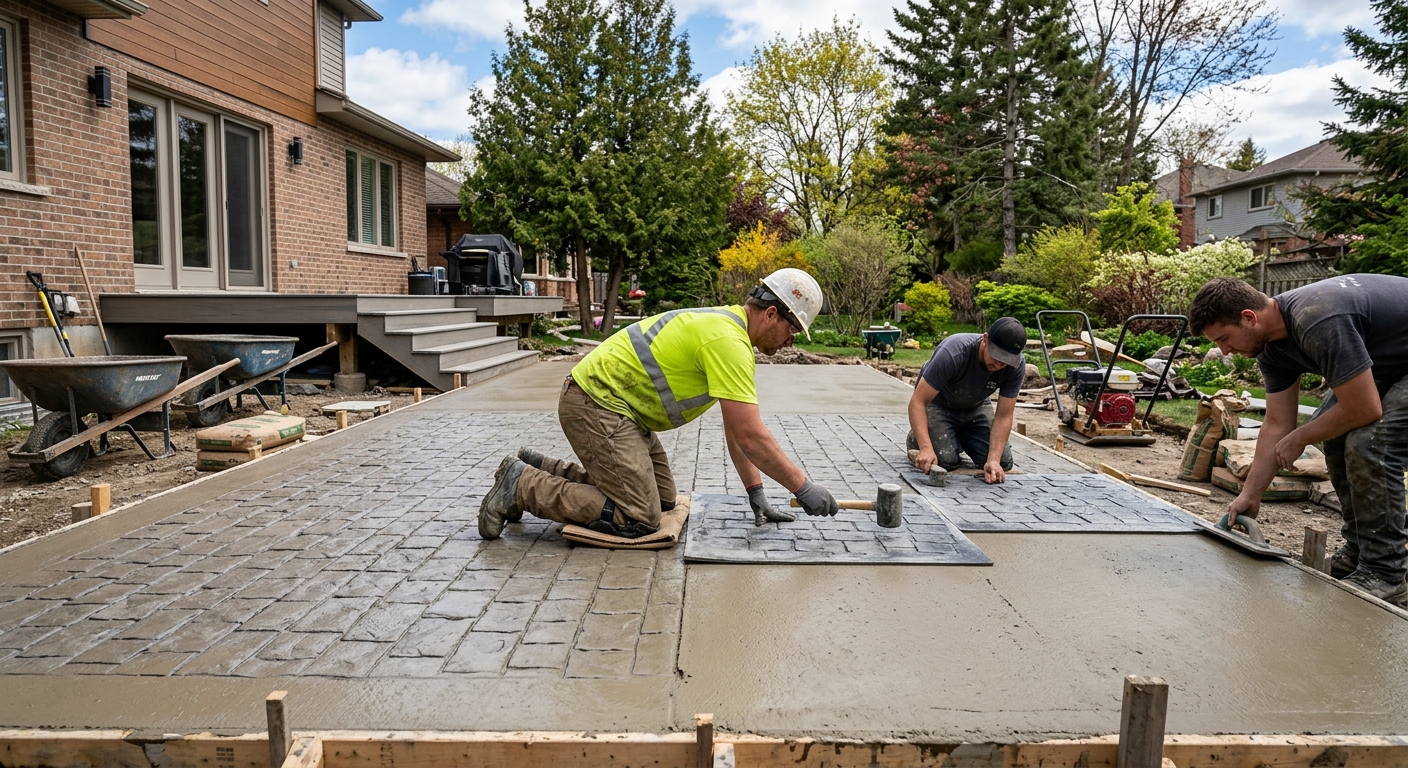
Concrete work options and costs in Fenelon Falls
Concrete work is a practical part of home maintenance in Fenelon Falls, whether you’re updating a driveway, adding a patio, or rebuilding foundation footings. With a population of 1,915 people (Statistics Canada, 2021 Census), the local market is smaller than the GTA, so scheduling can be tighter and crews may travel from nearby hubs for larger pours. That matters for timing and for how quickly a contractor can mobilize equipment like pumps, saws, and finishing crews.
In Fenelon Falls, most demand comes from owner-occupied housing stock and long-term residential neighbourhoods where upgrades are common—especially around areas with older home lots where flatwork and drainage are overdue. Toronto’s freeze–thaw climate drivers still apply here: repeated winter cycles push contractors toward air-entrained concrete, proper drainage, and control joints to manage cracking. Ontario municipalities and the Ontario Building Code also shape specs for structural work: footings typically must extend at least 1.2 m (about 4 ft) below grade to reduce frost heave and differential movement. Because the Toronto economic region experiences humid, often wet shoulder seasons, contractor availability and curing management (blankets, protection) can affect cost and timelines.
Below is a realistic comparison of common options for Fenelon Falls—then you can use the Key Spec and Finish Option lines to match a quote to the right technical approach.
| Application |
Typical Size |
Key Spec |
Finish Option |
Price Range |
| Concrete driveway (standard broom finish) |
16 ft × 24 ft (384 sq ft) |
4 in slab, compacted granular base, control joints |
Broom finish, light sealer |
$6,900–$10,700 |
| Exposed aggregate driveway |
16 ft × 24 ft (384 sq ft) |
4–5 in slab, air-entrained mix, stronger surface durability |
Exposed aggregate (wash/broadcast) |
$9,000–$13,900 |
| Stamped concrete driveway or patio |
12 ft × 20 ft (240 sq ft) |
4 in slab, air-entrained, integral colour + release |
Stamped pattern, anti-slip sealer |
$6,300–$9,600 |
| Plain concrete patio or walkway |
10 ft × 16 ft (160 sq ft) |
4 in slab, compacted base, edge forms, joints |
Float/score or broom finish |
$2,500–$4,200 |
| Garage floor (interior slab) |
20 ft × 22 ft (440 sq ft) |
4 in slab with vapour/underlay if specified, fibre or mesh |
Light broom/steel trowel finish |
$8,300–$12,000 |
| Foundation footings (structural, below frost) |
Typical small foundation (varies by design) |
Engineered footing layout, below-frost depth, rebar as required |
Structural concrete (no decorative finish) |
$180–$300 |
Prices are estimates only and vary by project scope, site access and material selection.
What affects the price of concrete work in Fenelon Falls
In Fenelon Falls, two quotes for what looks like the same concrete job can easily land 30–50% apart once you factor in Toronto-region freeze–thaw durability requirements, base preparation quality, and how carefully the contractor manages curing. In the Toronto economic region, contractors commonly standardize specs—air-entrained mixes, control joints, and more robust drainage—so the “cheap” version often cuts corners on sub-base depth, reinforcement, or surface protection. In addition, colder shoulder conditions can shorten the reliable pour window, which increases scheduling friction and can raise labour rates for manpower and equipment.
Here’s what drives the spec: frost depth and freeze–thaw cycles dictate every structural choice. Footings must extend below the design frost depth (Ontario typically 1.5–2.4 m depending on locality and design), and exterior slabs should use air-entrained concrete to survive repeated expansion and contraction. When temperatures trend toward 10 °C or below, contractors may need cold-weather curing precautions—insulating blankets, temporary heat, and longer protection—so the concrete reaches strength before exposure. De-icing salt can also accelerate surface spalling on untreated or poorly mixed concrete, which is why sealing and correct surface prep are often included.
Local examples in Fenelon Falls include wet or poorly drained approaches near ditches and culverts, where contractors must dig deeper, haul away unsuitable soil, and rebuild with well-compacted granular base—adding cost. Conversely, a straightforward, level access route to a small patio with good existing grades may fit closer to the plain patio band (often around $16–$26 per sq ft for typical scopes). Larger stamped work tends to move closer to the stamped/decorative band (often $24–$40 per sq ft) because stamping mats, integral colouring, and extra labour steps are non-negotiable.
Even home age can affect cost: older lots may have settlement-prone backfill and failing drainage, so contractors spend more time on grading corrections than on the concrete itself. For foundation work, the “below frost” requirement and reinforcement detailing are usually the cost anchor (often quoted in the $180–$300 per linear footing range depending on scope and engineering).
| Price Factor |
Why It Matters |
Cost Impact |
| Frost line depth — determines footing depth and form height |
Deeper excavation prevents frost heave and differential movement |
Higher excavation and forming can add material + labour |
| Site preparation — excavation, grading, compacted granular base |
Concrete fails early when the base is soft or poorly drained |
More trucking/compaction time increases costs |
| Reinforcement — rebar or wire mesh requirement |
Controls cracking and supports loads |
Steel increases material cost and labour for tying |
| Mix design — air-entrainment and compressive strength spec |
Air-entrainment helps resist freeze–thaw damage |
Specified mix can cost more but improves durability |
| Finish type — broom vs. stamped vs. exposed aggregate |
Complex finishes require more steps and materials |
Stamped/exposed typically raises unit pricing |
| Pour size and concrete truck access to site |
Short access can require smaller loads, pumps, or more labour |
Access issues can add hauling and equipment costs |
| Cold-weather curing precautions — heating and blankets |
Protects early-age strength development |
Blankets/heat time can increase labour and material expense |
| Control joint pattern and sealing cost |
Joints guide cracking; sealing helps manage salt exposure |
Proper jointing/sealer adds line-item cost but reduces failures |
Permits & regulations in Ontario
In Ontario, structural concrete work generally needs a permit—especially when it involves load-bearing elements. That typically includes footings, foundation walls, and grade beams, and it may require engineered drawings reviewed by the municipality. For concrete flatwork such as patios, walkways, and driveways, permits are often not required by default, but they can be required if the work changes lot grading, involves altering drainage patterns, or affects municipal limits on impervious surface coverage and access to the right-of-way. As a homeowner in Fenelon Falls, the safest approach is to confirm with the local authority before the first shovel hits the ground.
Also verify your contractor is properly insured. Ask for proof of liability insurance and WSIB/WCB coverage for the crew working on site. For any structural job, request references on similar-scale projects and confirm that rebar placement, footing elevations, and formwork details match the engineered plan.
To verify before you sign:
- Check the contractor’s licensing/registration using the appropriate Ontario online registry for the trade category they operate under (your contractor should provide their registration number).
- Request a current certificate of insurance (liability) showing your address as applicable and the policy’s active dates.
- Ask for WSIB/WCB clearance or account documentation showing coverage is in good standing.
- Confirm who pulls the permit (and whether it’s included) for structural work.
Having these items in place up front is what protects your project—especially on frost-depth-sensitive foundation scopes.
Getting concrete right in Fenelon Falls's freeze-thaw climate
Concrete commonly fails in Fenelon Falls due to freeze–thaw stress, poor drainage, and weak early-age protection. When water sits under or near a slab, it expands as temperatures drop; without the right base depth and air-entrained mix, surfaces can spall and slabs can heave or settle. The fix is to spec the job like it will be exposed every winter—because it will.
Start with base preparation: use a compacted granular sub-base to the correct depth for your soil conditions and frost protection strategy. Next, specify mix design. For exterior flatwork, contractors should use air-entrained concrete (commonly around 5–7% air content for freeze–thaw resistance) and a minimum 32 MPa compressive strength unless your engineer specifies otherwise. Add control joints at a spacing that limits random cracking, and make curing non-negotiable—aim for at least 7 days under proper conditions. In colder periods, protection (insulating blankets and careful temperature management) matters because you can’t “rush” strength gain safely.
Finally, sealing: apply a penetrating sealer after the concrete has cured (often around 28 days post-pour) to help repel de-icing salt and reduce moisture intrusion. This is one of the most cost-effective durability choices in Ontario’s humid, wet fall and spring conditions.
For a dollar reality check: a broom-finished driveway may land closer to the standard driveway band (for many projects around $18–$28 per sq ft), while stamped concrete is often higher because of integral colour, stamping, and extra finishing labour (commonly within $24–$40 per sq ft). The difference is justified if you want a specific look—but if your main goal is long-term performance, the biggest value comes from base prep, the correct air-entrainment, proper joints, and sealing rather than decoration alone.
| Spec |
Why It Matters in Fenelon Falls |
What to Ask For |
Impact if Skipped |
| Compacted granular base (depth?) |
Controls settlement and prevents water from pooling under slabs |
Granular base depth for your soil + compaction method (e.g., 95%+ Proctor) |
Uneven settlement, cracking, and premature slab failure |
| Air-entrained concrete mix (target air %?) |
Resists freeze–thaw damage in Ontario winters |
Air content target typically 5–7% for exterior flatwork |
Surface spalling and scaling in 1–5 winters |
| Compressive strength (MPa rating) |
Strength development impacts durability and load capacity |
Minimum 32 MPa (unless engineer/spec requires more) |
Weak surface, increased cracking and wear |
| Control joints (spacing per ACI guidelines) |
Directs cracking to predictable locations |
Joint spacing plan and saw-cut timing |
Random cracking and aesthetic + performance problems |
| Minimum 7-day curing period |
Ensures early-age strength before exposure to freeze cycles |
Curing protection plan, especially when temps drop |
Lower strength, cracking, and scaling risk increases |
| Penetrating sealer (when applied after cure) |
Helps repel moisture and de-icing salt |
Sealer type and application timing (often 28 days post-pour) |
Faster deterioration of the surface layer |
How to choose a concrete work contractor in Fenelon Falls
Choosing the right contractor matters as much as the concrete itself—because freeze–thaw durability is mostly a workmanship and detailing story. Start by verifying the contractor’s Ontario credentials, then confirm insurance and coverage for the crew.
How to check each item:
- Ontario licensing/registration: ask for their registration number and confirm it through the appropriate Ontario online lookup for their trade category.
- Liability insurance: request a current certificate of insurance showing active dates and your property/address where applicable.
- WSIB/WCB: ask for clearance or proof of coverage showing workers are insured for the duration of the job.
Next, get 2–3 itemized written quotes. You want labour + materials broken out (concrete supply, granular base, reinforcement, saw-cutting, sealing, disposal). A lump-sum quote is fine only if the scope is fully described. Read the exclusions carefully: what’s not included for excavation, hauling away unsuitable soil, permits, equipment access, or winter curing protection?
For payment, don’t move too fast. Never pay more than 10–15% upfront; use a holdback until the work is complete and verified (and ideally until curing/protection steps are done as agreed). Ask for start date and completion estimate in writing, especially in shoulder seasons when pours are harder to schedule.
Warranty should be clear: workmanship warranty length, what’s covered (cracking management vs. spalling vs. settlement), and whether any product/manufacturer warranty is included and transferable. In a small town market like Fenelon Falls, reputable contractors stand behind their finishing and jointing decisions.
- Ask what air-entrained mix they plan to use for exterior slabs.
- Confirm the base depth and compaction requirements in writing.
- Request the joint layout: locations, spacing, and saw-cut timing.
- Ask whether disposal of excavated material is included.
- Confirm sealing is included (and the sealer type) or quoted as an add-on.
- Verify whether permit pulling is included for structural work.
- Check who supplies reinforcement (rebar size, chairing/tie wire, or mesh).
- Confirm truck access plan (pump vs. wheelbarrow/chorable methods).
- Ask what cold-weather protection they use if temps drop.
- Require a written curing/protection plan and responsibility at handoff.
- Ensure the quote specifies finish (broom vs. stamp vs. exposed aggregate) and slip-resistance approach.
- Check warranty details in writing—duration and exclusions.
Concrete red flags in Fenelon Falls include: no discussion of air-entrainment for exterior work, skipping compacted granular base details, vague joint spacing plans, pressure to pay most of the cost upfront, and promises to “seal later” without stating timing (often around 28 days) and product type.
Frequently asked questions — concrete work in Fenelon Falls
What is a concrete overlay and is it suited to Fenelon Falls?
A concrete overlay is a new layer of concrete (or a thin resurfacing system) placed over existing concrete to restore appearance and smooth out minor damage without removing the entire slab. In Fenelon Falls and across Ontario, overlays can be a good option when the original slab is structurally sound—meaning it has no major settlement, deep spalling, or widespread movement. The risk is that overlays can “hide” problems while trapping moisture or failing over cracked, pumping, or heaving slabs. If your driveway or walkway has repeated freeze–thaw scaling, it’s crucial to inspect drainage and crack movement first. Pricing depends on prep and thickness; for example, a basic new patio/walkway often lands in the $16–$26 per sq ft range, while overlays may cost close to or more than removal-and-replacement once full surface prep is included.
How do I seal concrete to protect it in Fenelon Falls?
Sealing in Fenelon Falls is about moisture and salt management. After your concrete cures, use a penetrating sealer designed for exterior slabs; this helps repel water and de-icing salt so freeze–thaw doesn’t accelerate surface scaling. In Ontario, the timing matters: many contractors apply sealer around 28 days after the pour, once the concrete has properly cured and is dry. Before sealing, the surface needs cleaning (and sometimes light preparation) so the sealer can penetrate rather than sit on dirt or laitance. Ask your contractor what sealer product they use and whether they include surface cleaning in the quote. A well-done seal won’t make concrete indestructible, but it significantly slows deterioration—especially on driveways where salt and meltwater repeatedly contact the surface.
What is the difference between concrete and cement?
Concrete is the final construction material you see and work with; cement is one component inside concrete. Cement is the binder that reacts with water to create the hard matrix. Concrete typically combines cement, water, fine and coarse aggregates (sand and stone), and often admixtures such as air-entrainment for freeze–thaw durability. When contractors in Fenelon Falls talk about “air-entrained concrete,” they mean the overall concrete mix includes an air-void system to improve performance during winter cycles. That mix design choice affects durability far more than casual wording like “cement mix.” If you’re comparing quotes, ask for the specified concrete properties—such as air content and compressive strength (commonly 32 MPa for exterior flatwork unless otherwise required)—rather than focusing only on the word cement.
How much does concrete work cost in Fenelon Falls?
Concrete costs in Fenelon Falls generally follow Ontario’s regional pricing, adjusted for access, base prep, and finish complexity. As a practical starting point, many homeowners see typical unit pricing fall near the provided bands: concrete patios and walkways often come in around $16–$26 per sq ft, while standard driveway work is commonly higher (often around $18–$28 per sq ft depending on thickness, base work, and site conditions). Decorative options like stamped concrete are usually higher—often $24–$40 per sq ft—because they require more steps (integral colour, stamping, and extra finishing). Foundation footings are priced differently and commonly land in the $180–$300 per linear footing range depending on design and reinforcement. The fastest way to get a firm number is an itemized quote that includes excavation, granular base, reinforcement, joints, and sealing where appropriate.
How deep must footings be for Fenelon Falls's frost line?
Footing depth is set by the design frost depth and the building’s engineered foundation requirements. In Ontario, structural footings typically need to extend at least 1.2 m (about 4 ft) below grade as a practical minimum, and engineered designs often require deeper excavations depending on locality, soil conditions, and how the foundation is detailed. In the Toronto region, frost protection requirements are especially important because freeze–thaw cycles can create frost heave and differential movement if the footing is too shallow. The correct depth should come from your building permit documents or engineering drawings, not guesswork. If you’re having foundation work done in Fenelon Falls, ask the contractor to confirm footing elevations relative to the design plan and to explain how they’ll handle poor soils and groundwater during excavation—those details often drive both performance and cost.
Why does concrete crack in Fenelon Falls and how is it prevented?
Concrete cracks mainly because it shrinks as it cures and because temperatures and moisture change in winter. In Fenelon Falls, freeze–thaw cycles and the presence of water near the slab can turn small stresses into visible cracking or even spalling. Cracking can be reduced and controlled by proper base preparation (so the slab doesn’t move), air-entrained concrete for exterior work, and a correct control-joint plan. Joints aren’t optional in exterior flatwork—if you don’t create planned weak points, random cracks will choose their own locations. Prevention also includes correct curing and protection during cold periods so the slab reaches strength safely, and sealing to reduce moisture and de-icing salt contact. If your quote doesn’t mention air-entrainment, joint spacing, and curing/protection, it’s missing the key steps that help concrete survive Ontario winters.